

WASHINGTON — The sovereign debt pressures facing African governments have become one of the defining economic policy challenges of the mid-2020s, a crisis shaped by the intersection of pandemic-era borrowing, rising global interest rates, commodity price volatility and structural vulnerabilities in the continent’s public finances that predate any single triggering event. Several African governments have either defaulted on or restructured their external debt since 2020, others have sought emergency IMF support programs, and a number more are managing debt service burdens that consume a share of government revenue that leaves inadequate resources for the health, education and infrastructure investment their populations need. No single narrative captures the diversity of the continent’s debt situations — countries ranging from fiscally sound to acutely distressed share a continent, sometimes a regional trading bloc — but understanding the main cases provides essential context for any assessment of African economic prospects.
Zambia became in 2020 the first African country to default on its Eurobonds in the pandemic era, a default that had been years in the making as the country’s debt grew rapidly through a combination of Chinese infrastructure loans, Eurobond issuance and domestic borrowing to fund fiscal deficits that expanded alongside falling copper revenues in prior years. The subsequent debt restructuring process proved a painful test of the G20 Common Framework for debt treatment — a mechanism established to provide a coordinated approach to sovereign debt restructuring involving a broader range of official creditors, including China, than had been encompassed by previous Paris Club processes. Zambia’s eventual restructuring agreement, which took several years to finalize, was broadly viewed as a cautionary illustration of how the presence of new official creditors with different interests, disclosure preferences and institutional cultures from traditional Paris Club members can extend and complicate sovereign debt resolution processes in ways that impose real economic costs on the debtor country during the period of uncertainty.
Ghana’s debt crisis reflected a different combination of vulnerabilities. Years of fiscal expansion under successive governments — spending on public sector wages, energy sector subsidies and infrastructure, funded by a combination of Eurobonds issued at relatively high yield premiums and domestic borrowing at short maturities — left the country with a debt stock that became unsustainable when global financing conditions tightened sharply in 2022. Ghana sought an IMF program and subsequently undertook a domestic debt restructuring — the exchange of government bonds held by domestic investors including banks, pension funds and insurance companies for new bonds at lower interest rates and longer maturities — that imposed losses on domestic institutional investors in ways that had significant knock-on effects for the banks and pension funds that held large government bond portfolios. The episode illustrated the systemic risks embedded in African financial systems where commercial banks and institutional investors are heavily exposed to sovereign bonds, creating the potential for a sovereign debt crisis to transmit rapidly into a banking sector and financial system crisis.
Ethiopia’s situation has been shaped by the combination of long-standing debt sustainability challenges, the fiscal costs of the devastating civil conflict in the Tigray region that ended in 2022, and the structural difficulties of an economy attempting to modernize at scale under conditions of persistent hard currency scarcity. Ethiopia restructured its external debt under the G20 Common Framework, a process that again illustrated the challenges of coordinating among official creditors with different approaches to debt treatment, as well as the difficulties of reaching agreement on the treatment of private creditors alongside official creditors in frameworks that were designed primarily around official bilateral lending.
Mozambique’s debt experience has been shaped by a decade-long saga arising from hidden debt — government-guaranteed borrowings to state enterprises that were not disclosed to the IMF or other creditors at the time — that generated a donor freeze and economic crisis whose effects on the country’s development trajectory extended long beyond the initial revelation of the undisclosed liabilities. The episode has had enduring influence on discussions of transparency in African sovereign borrowing, contributing to stronger advocacy for public debt disclosure requirements and to closer scrutiny of state enterprise borrowing that may carry implicit or explicit sovereign guarantees.
Kenya has managed a more complex debt situation without formal default, though at significant cost in terms of the share of government revenue committed to debt service. The country’s Eurobond repayments attracted intense market scrutiny and spread widening at periods when investor confidence in Kenya’s capacity to refinance obligations weakened, with the government eventually managing its way through the most acute market pressure through a combination of new commercial borrowing and IMF program support. The episode nonetheless illustrated how sharply and quickly market access can become constrained for African sovereign borrowers when global risk appetite shifts, even for countries with reasonably well-regarded economic management by regional standards.
Egypt’s debt management challenge has been intertwined with a broader balance of payments crisis that saw the country negotiate successive IMF programs and undertake painful currency adjustments. The Egyptian government’s large external financing needs — reflecting a persistent current account deficit, substantial Eurobond and bilateral debt maturities and the fiscal costs of an extensive subsidy system — have required near-continuous engagement with the IMF and bilateral partners including Gulf states that have provided balance of payments support as strategic partners. Gulf financial support — deposits at the central bank, direct investments and bilateral loans — has been a critical stabilization factor for Egypt but has also raised questions about the conditionality attached to that support relative to the more transparent and publicly documented conditionality associated with IMF programs.
Nigeria’s federal government has managed a debt service burden made more acute by the combination of substantial borrowing accumulated over the past decade and a revenue base severely constrained by years of petrol subsidy expenditure that consumed a large share of oil revenue before the subsidy’s eventual removal. The naira’s depreciation has increased the local currency cost of external debt service significantly, a dynamic common across African sovereign borrowers whose external debt is predominantly denominated in dollars or euros while their revenue base is in local currency — a currency mismatch that amplifies the fiscal impact of exchange rate weakness.
Angola and several other oil-exporting sovereigns present a variant of the debt challenge specific to commodity exporters: high debt loads accumulated during periods of commodity price strength become difficult to service when prices fall and revenue contracts, while Chinese infrastructure lending — significant across multiple commodity-exporting African countries — presents unique restructuring challenges given China’s preference for bilateral rather than multilateral debt treatment processes.
The IMF has been an indispensable first responder in multiple African debt crises, providing balance of payments financing combined with policy conditionality aimed at restoring debt sustainability. IMF programs have been active across a significant number of African countries simultaneously in recent years, a scale of engagement that reflects the breadth of the continent’s debt challenges but also raises questions about the capacity of both the IMF and the borrowing countries to implement multiple overlapping reform programs effectively. Conditionality requirements — typically including fiscal consolidation, revenue mobilization, subsidy rationalization and structural reforms — are economically appropriate in many cases but have faced criticism from development advocates who argue they can compress public investment and social spending at precisely the moment when such spending is most needed, trading short-term fiscal stabilization for longer-term development setbacks.
Looking across the continent’s debt landscape as a whole, the structural reform needed most urgently is an improvement in the domestic revenue mobilization performance of African governments, most of whom collect a significantly lower share of GDP in tax than their economic development levels would suggest is feasible with appropriate institutional investment. Tax-to-GDP ratios across sub-Saharan Africa average well below those of comparable-income regions elsewhere, a gap that cannot be fully explained by structural economic differences and that reflects both under-taxation of high-income individuals and large corporations and under-investment in the revenue authority capacity needed to enforce existing tax law effectively. More robust domestic revenue bases would reduce the dependence on external borrowing that has driven the debt accumulation of recent years and would give African governments greater fiscal policy space during the external shocks that, given the continent’s exposure to commodity price cycles and climate-related disruptions, are a predictable feature of the economic landscape rather than exceptional events.

More from Finance

Who will own Africa’s next trillion-dollar businesses?
Africa’s next corporate giants may emerge from AI, energy, finance, mining, logistics and consumer markets rather than traditional industries.

MTN Rwanda’s profit surge shows how mobile money is reshaping Africa’s digital economy
Rwanda’s mobile-money boom is turning telecom networks into financial infrastructure, creating a new investment frontier across Africa.
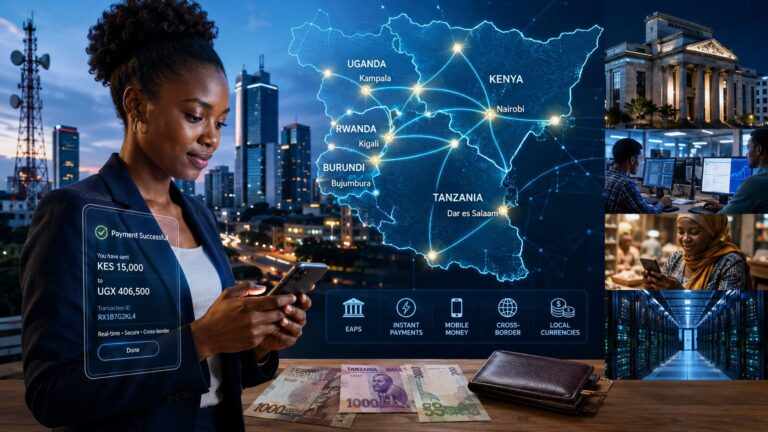
Who will control East Africa’s new digital payments network?
East Africa is building a faster, more connected payments ecosystem, opening a new contest among banks, fintechs, central banks and technology companies.