


A decade and a half after the launch of M-Pesa in Kenya, mobile money has moved from a novel way to send cash between cities to a core pillar of household finance across much of sub-Saharan Africa. Today, more than half of all registered mobile money accounts worldwide are held in the region, and for tens of millions of people the mobile wallet — not the bank branch — is the first and often only place they store money. Understanding how this shift has unfolded, and what it has and has not delivered for household savings behavior, is essential context for anyone seeking to understand the trajectory of African financial inclusion.
The shift was driven less by deliberate policy design than by necessity. Formal banking infrastructure in much of Africa remains thin outside major cities. Branch networks that serve urban centers thin out sharply once travel moves beyond regional capitals. Mobile money providers, by contrast, built networks of agents — small shopkeepers, kiosk owners and roadside vendors — who handle cash-in and cash-out transactions on behalf of telecom-linked financial platforms. That agent network now reaches villages that have never had a bank branch and, given the economics of rural banking, may never get one.
For households, the practical effect has been a fundamental change in how savings behavior works. Surveys conducted by financial inclusion researchers across Kenya, Tanzania, Uganda and Ghana have found that mobile money users are more likely to report having emergency funds set aside than non-users, even when controlling for income. Part of the explanation is structural: a mobile wallet allows for savings to be split into small, frequent deposits rather than a single lump sum, mirroring the irregular, often daily income patterns of informal traders, smallholder farmers and gig workers who make up the bulk of economic activity outside Africa’s major cities.
Mobile network operators have leaned into this behavior by layering interest-bearing savings products on top of basic wallets. M-Shwari in Kenya, a partnership between Safaricom and a commercial bank, popularized the model of a savings-and-loan product accessible entirely through a phone menu, with no paperwork and no branch visit required. Variants have since appeared in Tanzania, Uganda, Ghana and Côte d’Ivoire, often structured as partnerships between a telecom operator and a licensed bank that holds the underlying deposits. In Tanzania, M-Pawa and Tigo Nivushe pursued similar models, while in Ghana, MTN MoMo has developed several savings overlays catering to the country’s large informal trader population.
The growth has not been without friction. Regulators across the continent have wrestled with how to classify these products: are they banking services subject to prudential oversight, or telecom value-added services regulated more loosely? Kenya’s central bank brought mobile money squarely under its supervisory umbrella years ago, a model other regulators have followed, in part to guard against the risk that a telecom-run wallet could fail without the deposit protections that apply to licensed banks. Uganda’s central bank has pursued a similarly assertive stance, while some Francophone West African markets operate under regional BCEAO oversight, which has moved more cautiously in defining regulatory perimeters for mobile money providers.
Transaction costs remain a persistent complaint among users. While sending money domestically through a mobile wallet is typically far cheaper than using a traditional bank wire, fees on larger transfers and on withdrawals can still eat meaningfully into low-income users’ balances, prompting periodic regulatory intervention to cap charges. Several governments have also moved to tax mobile money transactions directly, arguing that the sector represents an undertaxed segment of the economy. Ghana introduced a mobile money levy in 2022 that drew significant public backlash before being revised; Tanzania has similarly adjusted mobile money tax structures amid complaints that charges disproportionately burden poor users who rely on mobile wallets out of necessity rather than preference.
Gender gaps in mobile money usage have proven especially stubborn. Across most markets where data is available, women remain less likely than men to own a registered mobile money account. Even where ownership rates are comparable, women tend to transact smaller amounts and save less per account. Researchers attribute the gap to a combination of factors: lower rates of independent phone ownership among women in some communities, lower digital literacy linked to historically lower school enrollment, and social norms that in some households route financial decision-making through a male head of household even when the registered account formally belongs to a woman. Several mobile money providers and development organizations have launched targeted agent-training and outreach programs aimed at female customers. Results have been mixed but generally positive in pilot regions, and organizations such as the Gates Foundation and GSMA have invested substantially in research aimed at identifying the specific interventions most effective at narrowing the gender gap in mobile account ownership and active usage.
Rural-urban disparities compound the access picture. While agent density in major cities now rivals that of ATM networks in more developed banking markets, rural coverage remains uneven, with some remote districts served by a single agent who may run out of cash float during peak periods such as harvest payouts or school-fee season. Providers have experimented with super-agent models, in which a larger, better-capitalized merchant supports several smaller sub-agents with liquidity, as one way of stabilizing service in thinly served areas without the capital cost of building bank-branch-equivalent infrastructure. The model has shown promise in parts of rural Kenya and Zambia but has not yet scaled consistently across the broader region.
The interplay between mobile money and informal savings culture is another area drawing sustained research attention. Long before formal microfinance arrived in much of the region, informal savings groups — known as chamas in Kenya, susus in Ghana, iqubs in Ethiopia and tontines across Francophone West Africa — provided community-based mechanisms for pooling and rotating savings among members who trusted each other but had limited access to formal financial products. Rather than displacing these groups, mobile money has in many cases digitized them, with group treasurers using mobile wallets to record contributions, disburse payouts and maintain transaction histories that members can verify independently, reducing the disputes that previously depended on paper ledgers or collective memory.
Linkages to pension and insurance products represent a newer frontier. Several markets have piloted mobile-linked micro-pension schemes aimed at informal workers who fall outside formal employer-sponsored retirement systems — a population that, in some countries, makes up more than 80% of the labor force. Early enrollment numbers have been modest relative to the scale of the informal economy, but providers argue that the infrastructure built for mobile money savings — agent networks, trusted brands, low per-transaction costs — gives these newer products a faster path to scale than would have been possible through traditional channels.
Cross-border interoperability has emerged as the longer-term infrastructure challenge. For years, mobile money ecosystems operated as walled gardens, with a wallet from one operator in one country largely unable to transact directly with a wallet from a different operator or country. Regional initiatives backed by the Pan-African Payment and Settlement System and the African Union’s broader digital integration agenda have sought to link these systems, with the explicit aim of cutting the cost of remittances both within the continent and from the diaspora abroad. Africa remains the most expensive region in the world to send money to, and mobile-to-mobile cross-border interoperability is viewed by development finance institutions as one of the more credible near-term paths to changing that.
Looking at the regulatory horizon, several central banks are examining how to extend deposit insurance schemes to cover mobile money balances held in pooled trust accounts at partner banks. Should a partner bank face financial distress, the treatment of mobile money balances under existing deposit insurance frameworks remains legally untested in most jurisdictions — a gap regulators have flagged as a priority given how much aggregate household savings the sector now holds. Clarity on this question is increasingly urgent as mobile money balances grow and as the sector’s systemic importance to household finances becomes harder to distinguish from that of conventional bank deposits.
Whether the layered model of mobile-first financial inclusion can be extended to close Africa’s remaining access gap — particularly among rural women and the poorest households — remains one of the defining questions for financial regulators and development institutions alike. The first generation of mobile money growth was remarkable by any measure. The second generation, focused on deeper and more equitable access and on building durable savings and investment habits rather than simply enabling transactions, will be the harder and more consequential chapter to write.

More from Finance

Who will own Africa’s next trillion-dollar businesses?
Africa’s next corporate giants may emerge from AI, energy, finance, mining, logistics and consumer markets rather than traditional industries.
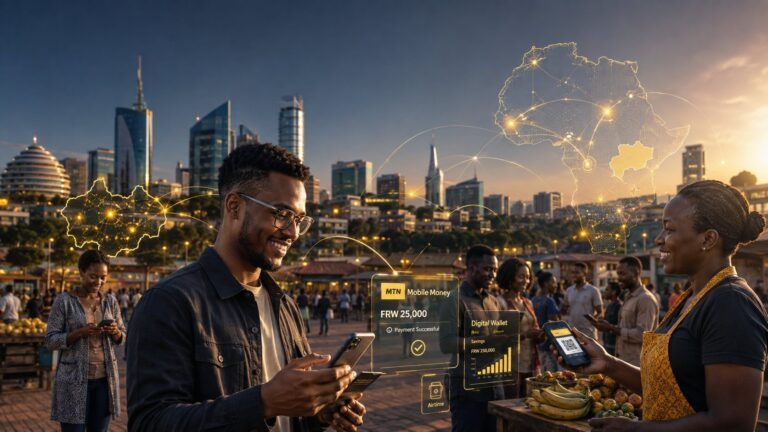
MTN Rwanda’s profit surge shows how mobile money is reshaping Africa’s digital economy
Rwanda’s mobile-money boom is turning telecom networks into financial infrastructure, creating a new investment frontier across Africa.
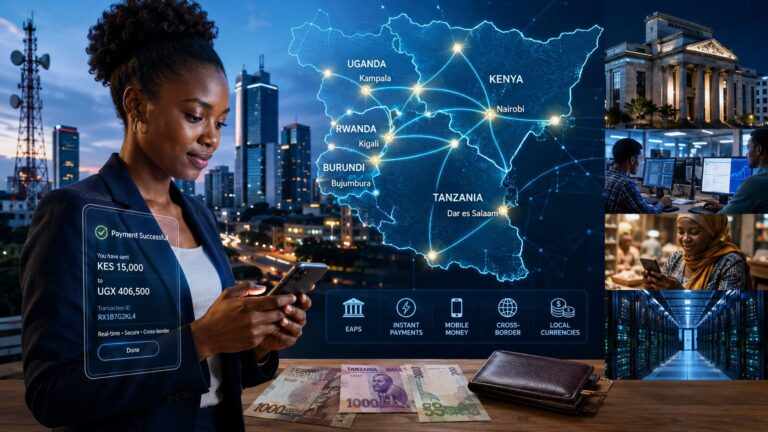
Who will control East Africa’s new digital payments network?
East Africa is building a faster, more connected payments ecosystem, opening a new contest among banks, fintechs, central banks and technology companies.