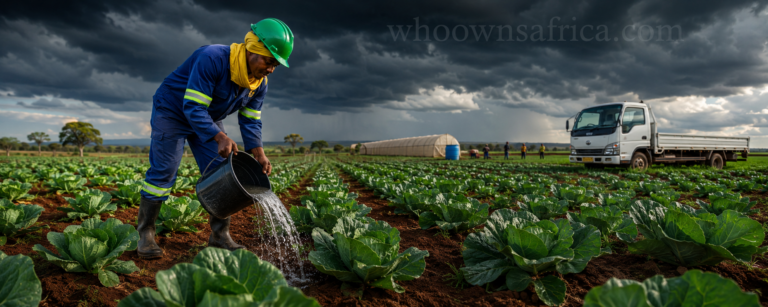

NAIROBI — Agriculture employs the majority of sub-Saharan Africa’s workforce and provides the primary source of income for hundreds of millions of rural households. It is also the sector most directly exposed to the weather and climate risks that are intensifying in frequency and severity as global warming progresses — droughts that are becoming longer and more severe, rainfall patterns that are becoming less predictable, flooding events that damage crops, infrastructure and livestock, and temperature extremes that reduce yields for heat-sensitive crops across the continent. Agricultural insurance ought in principle to be one of the most vital components of a risk management toolkit for an economy so dependent on weather-sensitive production. In practice, formal agricultural insurance coverage across sub-Saharan Africa remains one of the thinnest of any major economic region in the world, a gap that is simultaneously a financial inclusion failure, a climate resilience failure and an economic development failure.
The reasons agricultural insurance has been so difficult to develop at scale in Africa are rooted in the specific characteristics of the sector. Smallholder farming dominates African agriculture: the large majority of African farms are small, often less than two hectares, operated by household labor using minimal mechanized equipment, with output values in most seasons that are measured in hundreds rather than thousands of dollars. Insuring this population at the individual farm level, using conventional indemnity insurance that requires individual inspection, damage assessment and verified loss calculation, is arithmetically impossible — the administrative cost of individual claim assessment for millions of small farms would dwarf the premium income available from insuring them at any price that smallholders can afford.
Index-based agricultural insurance has been the primary technological response to this challenge, and it represents a genuinely important innovation in insurance design for low-income agricultural markets. Rather than insuring individual farm output, index insurance triggers payouts when an objective, externally observable index — typically rainfall measured at a weather station, or a satellite-derived vegetation index measuring crop health across a geographic area — falls below or above a defined threshold. The administrative cost advantage of index insurance is dramatic: since payouts are determined by a publicly observable measurement rather than individual farm assessment, there is no need for individual claim notification, inspection or verification. Every policyholder in a geographic area with the same index receives the same payout automatically when the trigger is reached, allowing the insurance to be administered at very low cost per policy even for large numbers of small policyholders.
The primary limitation of index insurance — basis risk, the risk that the index does not accurately reflect actual farm-level losses in a given area — is also well documented and has moderated some of the early enthusiasm about the approach. A farmer whose crops were damaged by flooding may receive no payout if the rainfall index at the nearest weather station shows an average rather than excessive reading; conversely, a farmer whose individual farm was not severely damaged may receive a payout because the area-level index triggered. The imperfect correlation between the index and individual farm experience is not merely a technical imperfection but can seriously undermine the insurance’s value to farmers who experience it — receiving no payout when losses are real and urgent is not meaningfully different from having no insurance at all, and the perception that the product did not perform as expected discourages continued participation.
Several approaches to improving index accuracy have been explored and partially implemented across African markets. Satellite imagery and remote sensing have progressively improved the spatial resolution and accuracy of vegetation index measurements, reducing the area over which a single index measurement is assumed to apply and therefore reducing the basis risk arising from geographic heterogeneity in weather outcomes. Weather station density remains a constraint in many African countries, where the number of weather observation points is far too low relative to the geographic area they are expected to represent, particularly in remote and sparsely populated agricultural regions — a data infrastructure gap that development programs aimed at improving agricultural climate monitoring have sought to address.
Ethiopia has been the site of the continent’s largest national agricultural index insurance program, implemented through a public-private partnership model that combines government premium subsidy for smallholder farmers with commercial insurance company risk-taking capacity backed by international reinsurance. The Ethiopia program has enrolled millions of farmers and has generated the largest volume of agricultural insurance premium in sub-Saharan Africa outside South Africa, demonstrating that scale is achievable with the right combination of government support, private sector participation and international backing. Evaluation of the program has found that enrolled farmers do make somewhat different agricultural investment decisions — investing more in improved seeds and inputs, for instance — when insured, suggesting that the insurance is performing its theoretical function of enabling risk-taking that improves productivity alongside its direct protection function. The program has also faced operational challenges including claim payment delays, basis risk complaints in specific years and distribution constraints in reaching the most remote farming communities, illustrating that even well-resourced programs at national scale continue to confront implementation difficulties.
Kenya’s agricultural insurance market has developed somewhat differently, with a stronger private sector component and a government crop and livestock insurance program that has sought to extend coverage to the large pastoralist populations in arid and semi-arid areas of the country — a population segment whose livelihoods depend on livestock rather than crops and who face specific weather risks including drought-induced livestock mortality. Livestock index insurance, in which payouts are triggered by satellite-measured vegetation indices that serve as proxies for pasture availability and therefore livestock mortality risk, has been piloted and progressively scaled in Kenya’s dryland areas, providing a form of financial protection to pastoralist households that have historically had essentially no access to any formal insurance product.
Ghana and Nigeria have each seen agricultural insurance programs develop with varying degrees of government involvement, with the National Agricultural Insurance Scheme in Nigeria offering premium subsidies for small farmers and the Ghana Agricultural Insurance Pool facilitating risk sharing among participating commercial insurers. In both cases, penetration has remained limited relative to the agricultural sector’s scale, reflecting the distributional challenges of reaching millions of smallholder farmers dispersed across large rural areas, the affordability constraints even with subsidy, and the limited trusted distribution channels capable of reaching farmers who are not participating in structured agribusiness supply chains through which insurance can be bundled with input supply relationships.
The climate change dimension of agricultural insurance risk is making the financial modeling of the sector significantly more complex. Historical loss data, which forms the actuarial basis for insurance pricing, reflects a historical climate that is no longer the best predictor of future loss experience as the frequency and severity of weather extremes increases. Insurers using historical data to price future risk may be systematically underpricing climate-affected agricultural risks, creating underreserving that could become apparent only after a major loss event. Incorporating forward-looking climate projections into agricultural insurance pricing is an actuarial challenge that the global insurance industry is actively working to address, with the African context particularly urgent given the continent’s high climate vulnerability and its disproportionate dependence on agricultural income.
The private sector’s long-term commercial interest in African agricultural insurance remains conditioned on the availability of government premium support or development finance backing sufficient to reduce the effective premium to levels that smallholder farmers can afford while providing insurers with adequate revenue to cover risk and operational costs. Without subsidy, the premium rates needed for an actuarially sound agricultural insurance product are simply not affordable for households operating at subsistence income levels, and commercial insurers operating without subsidy have generally focused on larger commercial farms where transaction economics and risk profiles are more manageable. Scaling agricultural insurance to the smallholder population that needs it most therefore requires a sustained public commitment to the supporting role that markets alone cannot efficiently provide, sustained across political cycles and fiscal pressures that have historically made that commitment inconsistent in most African countries where it has been attempted.
The aggregation risk embedded in agricultural index insurance — the risk that a widespread drought or flood triggers simultaneous payouts across millions of insured farmers in a large geographic area — requires reinsurance capacity from global markets to manage, since no African insurer has capital reserves adequate to fund catastrophic agricultural loss events at continental scale from its own balance sheet. Global reinsurers including MunichRe and SwissRe have been active participants in African agricultural reinsurance markets, providing capacity that allows local primary insurers and national insurance pools to offer coverage against systemic weather risks that would otherwise be uninsurable at the national level. The pricing of this reinsurance capacity reflects both the underlying weather risk and an additional loading for the limited and potentially unreliable quality of African loss data and index measurement infrastructure, providing an additional commercial incentive for investment in weather station networks, satellite infrastructure and actuarial data development that can reduce this loading over time as data quality improves.
Food security has become an increasingly explicit framing for African agricultural insurance, particularly in discussions with international development finance institutions and climate funds that are looking for mechanisms to build household resilience against food production shocks that have direct nutritional consequences. When agricultural insurance enables a farming household to maintain investment in the following season’s crop even after a loss year — paying for seeds, inputs and hired labor from the insurance payout rather than liquidating productive assets or taking on exploitative informal debt — the protection it provides extends from the financial to the food security dimension in ways that government agencies managing hunger and nutrition programs should find compelling. Building explicit connections between agricultural insurance programs and food security policy objectives, including integrating insurance with safety net programs and emergency food assistance frameworks, offers a pathway to more sustainable government support for agricultural insurance that goes beyond the narrow fiscal logic of premium subsidy and toward a broader assessment of the public value delivered by functional agricultural risk management systems.