

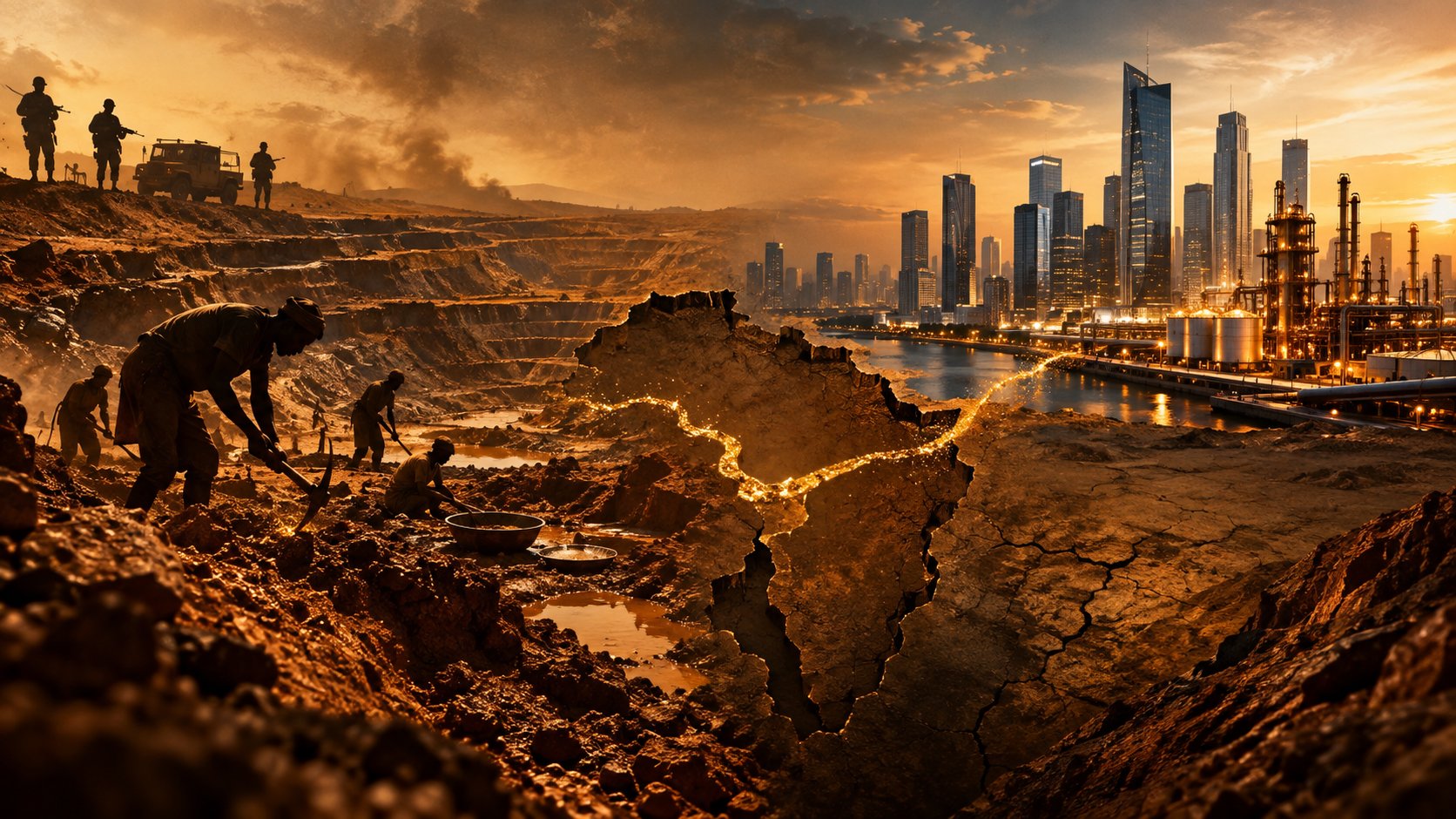
Gold is the one commodity in Sudan that never stops moving, even as everything else in the country grinds to a halt. Roads are mined, ports are blockaded, hospitals have gone dark, yet somehow, a steady river of bullion keeps flowing out of Darfur’s pits, across borders that barely function, and into refineries thousands of kilometres away.
This is not a footnote to Sudan’s civil war. It is arguably the war’s engine room, and understanding who profits from that gold may matter more to ending the conflict than any peace talk held so far.
A War That Runs on Bullion
Sudan’s war did not begin over gold. It began in April 2023 as a power struggle between the national army and the paramilitary Rapid Support Forces, two institutions that had once been allies against the country’s own people. But wars need money, and Sudan’s gold fields have become the closest thing either side has to a functioning treasury. Long before the guns went off, gold had already replaced oil as the backbone of the Sudanese economy, following the loss of most oil revenue when South Sudan seceded in 2011. That transition quietly reshaped the incentives of everyone with a stake in power.
What makes this war different from many resource conflicts is the sheer informality of the trade underpinning it. Sudan is estimated to produce far more gold than official statistics capture, most of it dug by hand in artisanal mining camps scattered across Darfur, Kordofan and the Nile Valley. Analysts who track the sector believe a majority of that output never touches an official ledger. It is bought in cash, moved in small planes and pickup trucks, and sold long before it reaches a formal exchange. That opacity is precisely what makes it so useful to armed actors who cannot access international banking but can always find a buyer for a bar of gold.
The Miners, the Militia, and the Missing Ledger
Visit any of Sudan’s artisanal mining belts and the pattern repeats itself. Local diggers, often desperately poor, extract ore using rudimentary tools and toxic chemicals like mercury and cyanide. Middlemen buy the raw gold at a fraction of world prices. Armed groups, whichever one happens to control that patch of territory, tax the operation, sometimes lightly, sometimes brutally. The value only becomes clear once the gold leaves Sudanese soil, at which point it has usually changed hands three or four times, erasing any trace of where it actually came from.
The Rapid Support Forces have built much of their war chest on this system. Having expanded aggressively into gold-rich areas of Darfur and Kordofan over the past decade, the RSF is widely described by researchers and diplomats as controlling a significant share of the country’s informal gold production. Estimates from regional monitors have put the value of gold moved out of RSF-held territory in the hundreds of millions of dollars annually, financing everything from fuel and salaries to drones and mercenaries. The Sudanese army, for its part, has hardly stayed out of the business either, continuing to export gold through official channels even as it accuses its rival of plundering the same resource illegally. Both sides need the money too badly to resist the temptation.
Dubai: Where Blood Gold Becomes Just Gold
If Sudan is where the gold is dug, the United Arab Emirates is where it disappears into the legitimate economy. Dubai has for years functioned as the world’s most convenient laundromat for conflict gold, not because every transaction there is illicit, but because its refining infrastructure is vast enough, and its due diligence loose enough, to absorb enormous volumes of undocumented metal without asking too many questions. Sudan’s own central bank data show the UAE has imported the overwhelming majority of the country’s official gold exports in recent years. What is harder to measure, and far more damning, is how much additional smuggled gold enters alongside it.
Investigations by watchdog groups including Swissaid and The Sentry have traced networks of Dubai-registered trading companies allegedly linked to RSF financiers, some of them named in leaked internal spreadsheets describing the militia’s own commercial operations abroad. Once gold from Darfur reaches a Dubai refinery and is melted down, it becomes indistinguishable from any other bar on the market. Its origin, its blood, its role in financing a genocide-scale conflict, simply vanishes. That transformation, more than any single transaction, is the real function of the network: turning war gold into world gold.
The UAE has consistently rejected accusations that it knowingly finances the RSF, and points to reforms made after being placed on international financial monitoring lists. Yet the volume of trade, and the persistence of the allegations from independent researchers, diplomats and even Sudan’s own government, suggest a system that is, at minimum, structurally indifferent to where its raw material originates.
Brussels Draws a Line, Quietly
For a long time, the international response to all this consisted mostly of sanctioning individuals: generals, militia commanders, a handful of companies. It rarely touched the commodity itself. That changed in the middle of 2026, when the Council of the European Union moved to ban the purchase, import or transfer of gold originating in Sudan altogether, alongside a ban on exporting mercury and cyanide, the chemicals that make artisanal gold extraction possible in the first place. Officials described the move as an attempt to choke off one of the principal sources of financing sustaining the war, rather than simply punishing the individuals who benefit from it.
It was a notable escalation in tone. Rather than chasing down every intermediary company or crooked broker, European regulators effectively said that the entire supply chain, from pit to port, is tainted enough to warrant a blanket restriction. That is a rare admission that traditional targeted sanctions, the kind aimed at named individuals and specific firms, had simply failed to keep pace with a trade this fluid and this well hidden.
The Sanctions Nobody Wanted to Write
What is more revealing than the sanctions themselves is what they left out. European foreign ministers stopped short of designating the Rapid Support Forces as a terrorist organisation, despite pressure from members of the European Parliament and despite the group facing allegations of genocide from the United States and United Nations bodies. Nor did the measures directly target the UAE, the country most consistently named by investigators as the destination for smuggled Sudanese gold and, according to Sudanese officials and independent researchers, a source of weapons and support for the RSF.
That omission is not an accident. It reflects the same tension that has haunted Sudan diplomacy since the war began: Gulf states, and the UAE in particular, are simply too economically and diplomatically significant for Western governments to confront directly. Sanctioning a mining cooperative in Darfur costs nothing politically. Sanctioning a trading hub that processes tens of billions of dollars in gold annually, much of it entirely legitimate, is another matter altogether. The result is a sanctions regime that attacks the product but tiptoes around the marketplace that gives it value.
Kenya, Chad, and the Quiet Complicity of Neighbors
Sudan’s gold rarely travels in a straight line from mine to Gulf refinery. Along the way it typically passes through a rotating cast of neighboring states, chosen less for geographic convenience than for how easily their borders and customs systems can be worked around. Chad has emerged as a significant transit route for gold from western Darfur, particularly since Sudanese army airstrikes disrupted processing facilities closer to the mines. Libya, South Sudan, Uganda and Kenya have all been named at various points as waypoints in the smuggling chain, sometimes for onward air shipment, sometimes simply as places where the gold’s paperwork can be cleaned up before it moves on.
None of these countries has been sanctioned over the trade, and most would object strongly to being cast as complicit. But the persistence of these routes, year after year, despite growing international attention, says something uncomfortable about regional enforcement. Customs officials, airport staff, and local traders across the region all have incentives to look the other way, and few have the resources or political will to do otherwise. A conflict gold network this durable does not survive on the actions of a few bad actors alone. It survives because an entire regional ecosystem, wittingly or not, keeps it functioning.
Who Actually Owns Sudan’s Gold?
The uncomfortable answer is that nobody does, in the sense that matters. Legally, Sudan’s mineral wealth belongs to the Sudanese state and, by extension, its people. In practice, ownership has fractured along the same lines as the war itself. The army controls what gold moves through official channels and the revenue that comes with it. The RSF controls a parallel economy built on militia taxation and informal extraction. Foreign buyers, brokers and refiners in the Gulf absorb both streams with little regard for which side profited. And the artisanal miners who do the actual digging, often in dangerous, mercury-soaked conditions, capture the smallest share of the value chain despite bearing nearly all of its physical risk.
This is the deeper story that a simple sanctions announcement cannot capture. Gold has become a proxy battlefield in Sudan’s war precisely because control over it confers the ability to keep fighting. Whoever holds a mining district can tax it, arm themselves with the proceeds, and use that leverage to hold more territory, which in turn produces more gold. It is a self-reinforcing cycle that has little to do with governance and everything to do with survival, on both sides of the conflict.
The Bigger Question: Can a Metal Be Made to Behave?
Sanctions on Sudanese gold are a meaningful signal, but signals alone rarely stop a war economy this entrenched. Gold, unlike oil or diamonds, requires no pipeline, no cutting facility, no elaborate certification scheme to move across a border undetected. A kilogram can be carried in a backpack and be worth more than most people in the region will earn in a lifetime. That physical portability is precisely why decades of similar restrictions on conflict minerals elsewhere in Africa have achieved partial results at best: the trade adapts, reroutes, and finds new intermediaries faster than regulators can track them.
If there is a lesson buried in Sudan’s gold war, it is that commodity sanctions only work when they are paired with pressure on the marketplaces that absorb the product, not just the territory that produces it. Until refining hubs like Dubai face the same scrutiny as the mines of Darfur, and until neighboring transit states are held to the same standard as the belligerents themselves, gold will keep finding a way out of Sudan. The war may eventually end through negotiation, exhaustion or outside intervention. But as long as there is a buyer willing to ask no questions, someone in Sudan will keep digging, and someone else will keep profiting from a conflict that shows no sign of running out of fuel.
The real story of Sudan’s war economy, then, is not simply who controls the gold today. It is who continues to make it profitable to fight for control of it at all.
Why This Story Matters Beyond Sudan
It would be a mistake to treat Sudan’s gold economy as an isolated tragedy, confined to one country’s civil war and one region’s mining belts. The mechanics on display here, informal extraction feeding into opaque trading networks that terminate in a handful of poorly regulated refining hubs, are not unique to Sudan. Versions of the same system have quietly financed conflicts in the Democratic Republic of Congo, the Central African Republic and parts of the Sahel for years. What Sudan offers is a particularly stark, well-documented case study of how a single commodity can sustain a war almost indefinitely, long after the political grievances that started it have become secondary to simple survival and profit.
For investors, refiners and jewellers further down the supply chain, that should be an uncomfortable thought. Gold’s fungibility, the very quality that makes it valuable as a store of wealth, is also what allows conflict gold to slip so easily into legitimate portfolios, wedding rings and central bank vaults around the world. Due diligence standards exist on paper across much of the industry, yet Sudan’s experience suggests they remain far easier to circumvent than to enforce, particularly when the volumes involved are lucrative enough and the political will to police them is weak.
There is also a harder truth for policymakers to sit with. Sanctions regimes built around named individuals and specific front companies will always struggle against a commodity this liquid and this easily disguised. Sudan’s case suggests that meaningful disruption requires treating gold refining hubs themselves as accountable nodes in the conflict financing chain, not merely as passive marketplaces reacting to whatever arrives at their door. That is a far more politically costly proposition than sanctioning a Darfur mining cooperative, which may explain why it has taken this long, and why even now, the toughest measures still stop short of the trade’s true center of gravity.
Until that changes, Sudan’s war will likely keep being funded the same way it has been for the past three years: quietly, profitably, and almost entirely out of public view, one shipment of unmarked bullion at a time.
