

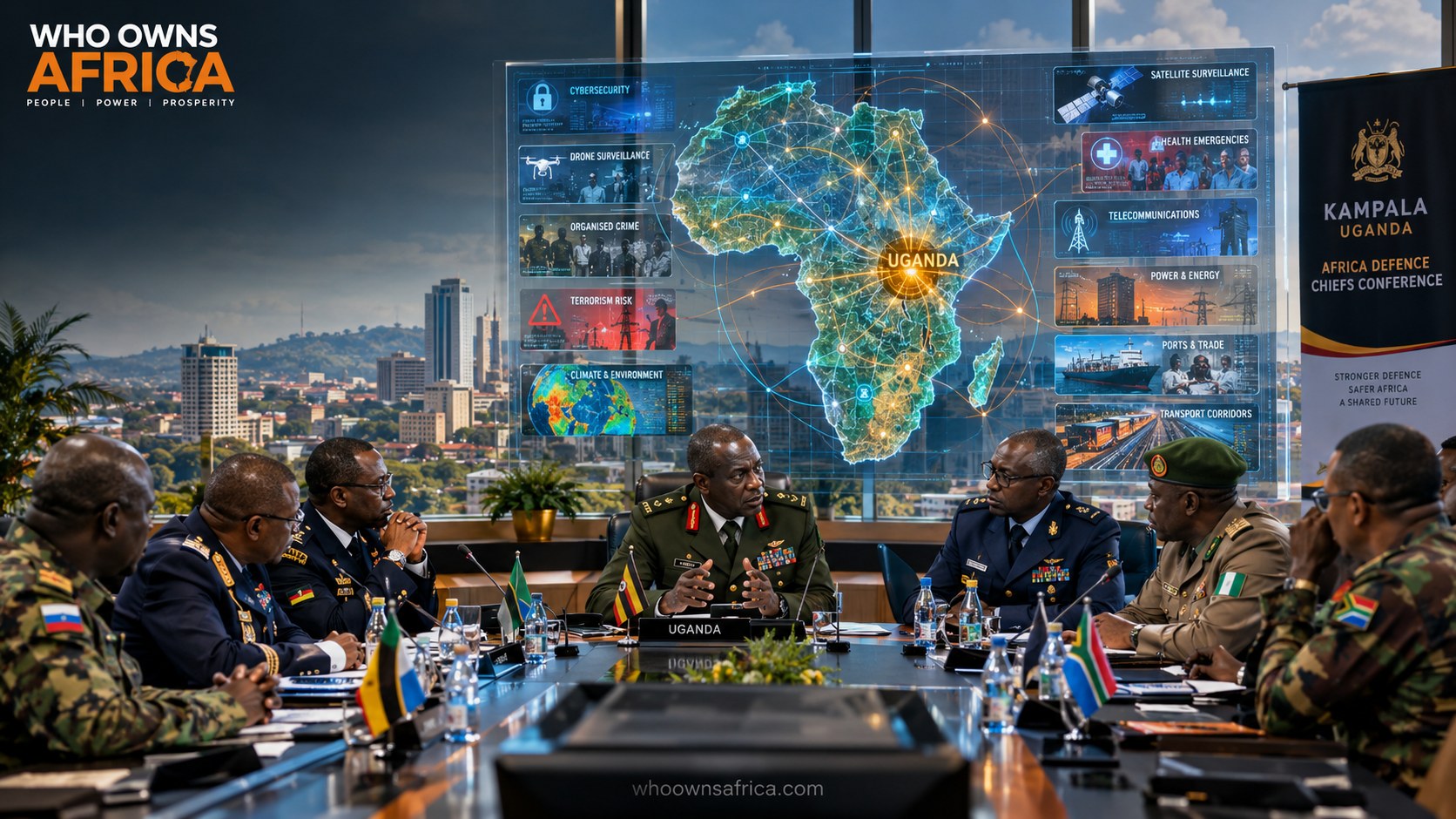
Africa is entering a security era in which the greatest threats may no longer arrive as invading armies, but through networks, algorithms, disease, organised crime, climate shocks and fragile institutions. That reality gives Uganda’s first African Chiefs of Defence Forces Conference on Military Operations Other Than War significance far beyond the meeting rooms of Kampala.
The conference, running from October 5 to 8, has brought together defence and security representatives from more than 18 countries, African Union structures and commanders involved in African and United Nations peace support missions. Its agenda covers terrorism, organised crime, cyber warfare, artificial intelligence, unmanned systems, pandemics, climate-related emergencies, border security and critical infrastructure.
On the surface, this is a military conference. At a deeper level, it is an admission that the definition of security itself is changing.
Africa’s old security model
For decades, African military planning has largely been shaped around conventional conflict, insurgencies, coups, border disputes and peacekeeping.
Those challenges remain.
But they increasingly overlap with threats that cannot be defeated by military force alone.
A cyberattack can paralyse a financial system without a single soldier crossing a border. A pandemic can weaken an economy and overwhelm public institutions. Climate shocks can intensify competition over water, land and food. Organised criminal networks can operate simultaneously across several countries. Drones can transform the battlefield while artificial intelligence changes how intelligence is collected and interpreted.
This creates a difficult question for African governments: what does national defence mean when the threat itself is not necessarily military?
Uganda’s conference is attempting to place that question at the centre of continental security thinking.
The real test is coordination
The most important issue may not be whether African militaries understand these threats. Increasingly, they do.
The harder problem is whether they can act together.
Africa already possesses multiple security mechanisms, including the African Union’s Peace and Security Architecture, regional standby arrangements and organisations such as the East African Community, IGAD and ECOWAS. The Kampala conference brings several of these institutions into the same conversation.
That matters because Africa’s security problem is often less about the absence of institutions than the distance between them.
Intelligence may remain national. Borders may limit operations. Different militaries use different technologies and procedures. Political interests can diverge sharply. Funding remains a persistent constraint.
A terrorist organisation, cybercriminal network or trafficking operation does not necessarily face those limitations.
The threat can move faster than the institutions created to stop it.
Uganda’s strategic message
Uganda is not a neutral observer in this discussion.
The country has accumulated extensive experience in regional peace operations, counterterrorism, counterinsurgency, border security and civil-military operations. Kampala has also remained deeply involved in regional security efforts, including operations linked to Somalia.
That experience gives Uganda credibility in convening the discussion, but it also creates an important responsibility.
If Kampala wants the conference to become more than another diplomatic gathering, the outcome must be measurable.
African defence chiefs need more than declarations about cooperation. They need mechanisms for intelligence sharing, joint training, interoperable communications, coordinated responses to disasters and clearer procedures for dealing with emerging technologies.
Uganda’s own defence establishment has framed the conference around an African-led, preventive and cooperative approach to security.
That is an ambitious idea.
The technology question
Perhaps the most consequential part of the discussion is the growing role of technology.
Cybersecurity, artificial intelligence and unmanned aerial systems are now central to modern conflict. African states cannot afford to treat them as specialist subjects for a handful of technologically advanced countries.
The continent is becoming increasingly connected through mobile networks, digital payments, cloud infrastructure, satellites and online government services. That connectivity creates enormous economic opportunities, but it also creates new vulnerabilities.
The same technology that helps a government deliver services can become a target.
The same drone that assists agriculture can potentially be adapted for surveillance or warfare.
The same artificial intelligence system that improves intelligence analysis can create new risks if poorly governed.
Africa therefore faces a strategic choice: become primarily a consumer of security technology developed elsewhere, or develop stronger indigenous capabilities and regulatory frameworks.
The Kampala discussions should push that question much further.
Security is also economic
There is another reason this conference matters to anyone interested in Africa’s economic future.
Investors do not separate security from economics.
Ports, mines, energy facilities, telecommunications networks, financial centres and transport corridors all depend on stability. A country can possess enormous mineral wealth and still struggle to attract long-term investment if infrastructure is vulnerable or conflict risks remain high.
This is particularly important as global competition for Africa’s critical minerals intensifies.
Cobalt, copper, lithium, graphite, rare earths and other strategic resources are increasingly connected to global industries ranging from electric vehicles to defence technology.
The security of these supply chains will therefore become an increasingly important part of Africa’s geopolitical position.
Who controls the infrastructure, information and security systems surrounding these resources may matter almost as much as who owns the mines.
The African Union question
The bigger institutional question is whether Africa can turn security cooperation into something genuinely continental.
The African Union has long promoted the principle of African solutions to African problems. Yet implementation remains complicated by financing gaps, political disagreements and dependence on external partners.
The Kampala conference provides an opportunity to examine whether African countries can gradually build a security architecture that is more coordinated, technologically capable and less reactive.
That does not mean excluding international partners.
It means ensuring that African states have greater ownership of the decisions affecting their security.
The distinction is important.
Partnership is valuable when African institutions have the capacity to define their priorities. Dependency becomes dangerous when external actors effectively determine the priorities.
The uncomfortable questions
The conference also raises questions that should not be avoided.
Who decides when a military should intervene in a public emergency?
How should governments balance national security with civil liberties?
Who regulates military use of artificial intelligence?
How should African countries respond when external powers compete for strategic influence?
And perhaps most importantly, how can stronger security institutions be built without weakening democratic accountability?
The conference agenda itself includes legal and ethical accountability, suggesting that these questions are already entering the discussion.
That is encouraging.
Military effectiveness without accountability can create a different form of insecurity.
What comes after Kampala
The real measure of Uganda’s conference will not be the speeches delivered in Kampala.
It will be what happens after the delegates leave.
Will African militaries share more intelligence?
Will regional organisations conduct more joint exercises?
Will countries establish common approaches to drones and artificial intelligence?
Will African institutions become better prepared for pandemics and climate emergencies?
Will governments protect critical infrastructure as seriously as they protect territorial borders?
Those are the questions that will determine whether Kampala represents the beginning of something important or simply another entry in Africa’s long list of security conferences.
For Who Owns Africa, the deeper story is therefore not simply that Uganda has gathered defence chiefs.
It is that Africa is beginning to confront a fundamental reality: power in the 21st century will increasingly depend on who can protect information, infrastructure, resources, populations and institutions as effectively as territory.
Africa’s security architecture was largely designed for yesterday’s wars.
The continent now has to decide whether it is prepared for tomorrow’s threats.
And that, ultimately, is the real significance of Kampala.
