
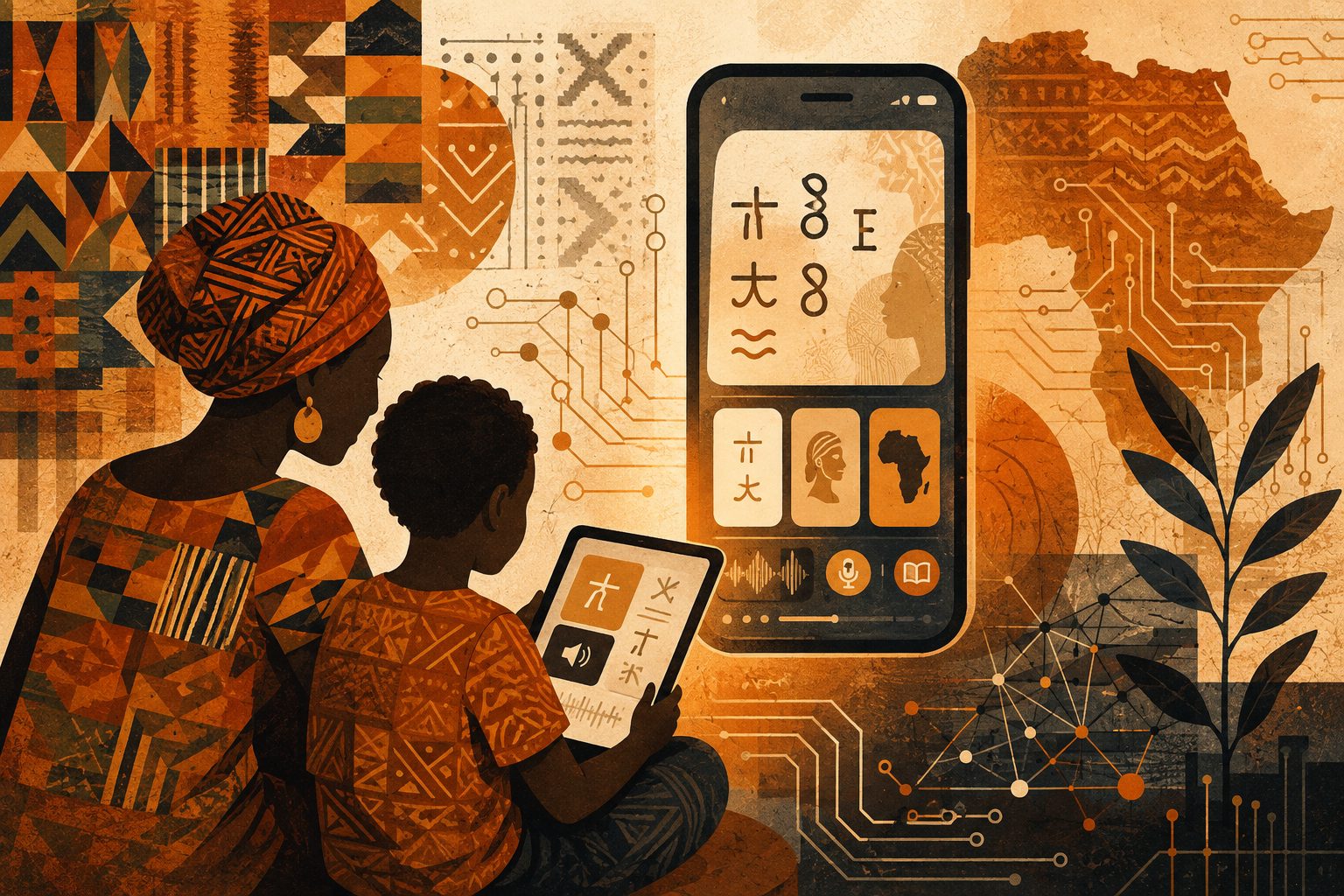
A generation of African parents raised abroad is spending real money to make sure their children can say more than a few borrowed words in Yoruba, Swahili, Igbo or Shona, and that quiet family decision is turning into a fast-growing digital industry.
Language apps, online tutors, streaming lesson platforms and now artificial intelligence tools built around African languages are multiplying, chasing a diaspora estimated at well over 150 million people. The bigger question emerging behind the growth is not whether African languages will go digital. It is who ends up owning the infrastructure, the data and the intellectual property once they do.
A market hiding in plain sight
For decades, African languages were treated by big technology platforms as a niche too fragmented and too commercially uncertain to prioritise. That calculation is changing. Millions of second and third-generation Africans abroad, in cities from London to Houston to Toronto, are actively searching for ways to reconnect with languages their parents or grandparents spoke fluently. That demand has not gone unnoticed by venture-backed startups, nonprofit research groups and large technology companies alike, all circling the same opportunity from different angles.
Language learning platform Duolingo added Swahili to its course catalogue in 2017 after Peace Corps volunteers in Tanzania pushed for it, and later expanded into Zulu and Xhosa in partnership with the Trevor Noah Foundation. But Duolingo still has no Yoruba, Igbo, Twi or Hausa course, a gap that smaller, African-founded platforms are now racing to fill.
The startups betting on mother tongues
A wave of African-built apps has stepped into that space in the past few years. Nigeria’s Izesan! now teaches 15 languages including Yoruba, Hausa, Igbo and Nigerian Pidgin, and pairs flashcard-style lessons with paid one-on-one tutoring sessions. NKENNE says it has attracted more than 250,000 learners across 15 African languages, while newer entrants such as Atarrodo and Dialogue Africa are positioning themselves squarely as the “Duolingo that Duolingo forgot to build.” Each is chasing a similar customer: a diaspora professional, often a parent, willing to pay a modest monthly subscription for something no mainstream app offers.
What separates the winners from the rest so far is less about lesson quality and more about ownership of content, community and, increasingly, data. A platform that has recorded thousands of hours of native speaker audio in Twi or Wolof is sitting on an asset that stretches well beyond a subscription app, and that is where the story starts to intersect with artificial intelligence.
Where artificial intelligence enters the picture
Large language models are trained overwhelmingly on English, French, Mandarin and a handful of other high-resource languages. Most of Africa’s more than 2,000 languages are barely represented in the datasets that power modern AI systems, according to the research collective Masakhane, a grassroots network working to change that. The organisation argues that when a language has no meaningful digital footprint, its speakers are effectively locked out of AI-driven tools for healthcare, education and financial services.
That gap is now attracting serious institutional money. In May, the Masakhane African Languages Hub joined Microsoft’s AI for Good Lab, the Bill and Melinda Gates Foundation and Google.org to launch LINGUA Africa, an open call offering grants of up to $250,000 in cash and as much as $400,000 in cloud computing credits for projects that build African-language datasets, models and real-world applications. The programme drew more than 800 applications from 64 countries, and organisers selected 26 winning projects in August, spanning categories from raw data creation to deployed sectoral tools. Masakhane has said the broader ambition is to put locally relevant AI tools in front of a billion Africans by 2029.
Whoever builds and controls those foundational datasets, whether that is a well-funded nonprofit consortium, a national government, or a private technology company, will effectively hold the keys to how African languages function inside search engines, voice assistants and chatbots for years to come. That is a different kind of ownership question from who owns a language app, and arguably a more consequential one.
Diaspora parents as the first investors
Long before institutional grants entered the picture, diaspora households were already functioning as the earliest funders of this economy, one subscription and one weekend class at a time. Interviews and public commentary from language-app founders describe a consistent pattern: parents living outside Africa searching for structured ways to pass on a mother tongue their own children are not absorbing at home. Some enrol children in weekend heritage-language schools run out of community centres. Others turn to paid tutoring marketplaces such as italki, where tutors for Swahili, Amharic and other African languages connect with learners abroad through live video sessions.
That willingness to pay, even modest amounts, has validated a market that mainstream education technology companies had largely ignored. It has also created an unusual dynamic in which the people generating the most valuable proof of demand, and in some cases the richest linguistic data through their children’s learning patterns, are not the ones who end up owning the platforms or the resulting intellectual property.
Who actually owns this economy
Ownership in this emerging sector is scattered across at least four groups, and none of them fully controls it yet. African-founded startups own the consumer-facing apps and their user relationships, but most remain thinly capitalised compared with the venture-backed language giants of Silicon Valley. Large philanthropic and technology partnerships, through initiatives like LINGUA Africa, are shaping who gets to build the underlying AI infrastructure and on what terms, with grant recipients typically required to release datasets under open licenses such as CC-BY. Universities and heritage organisations hold decades of linguistic scholarship that has rarely been digitised or monetised. And diaspora communities themselves, the paying customers and unpaid data contributors, currently have the least formal claim over any of it.
That fragmentation mirrors a pattern whoownsafrica.com has tracked across other sectors of the continent’s digital economy, where early-mover advantage and access to capital, rather than cultural authenticity, tend to determine who ultimately profits.
Can this become a billion-dollar industry
The raw numbers suggest the ceiling is high. Africa’s diaspora population abroad numbers well over 150 million people, alongside a continental population approaching a billion and a half, and global language-learning spending already runs into the billions of dollars annually across established markets. If even a modest share of that spending shifts toward African languages as heritage learning becomes more socially valued, the addressable market for apps, tutoring, publishing and AI tools built around Yoruba, Swahili, Igbo, Shona and dozens of other languages could plausibly reach into the billions within a decade.
Whether African founders, researchers and communities capture that value, or whether it consolidates around a handful of well-funded outside platforms once the commercial case is proven, remains genuinely unresolved. What is increasingly clear is that African languages are no longer a cultural afterthought in the digital economy. They are becoming an asset class, and the race to own them, quietly, has already begun.

More from Diaspora
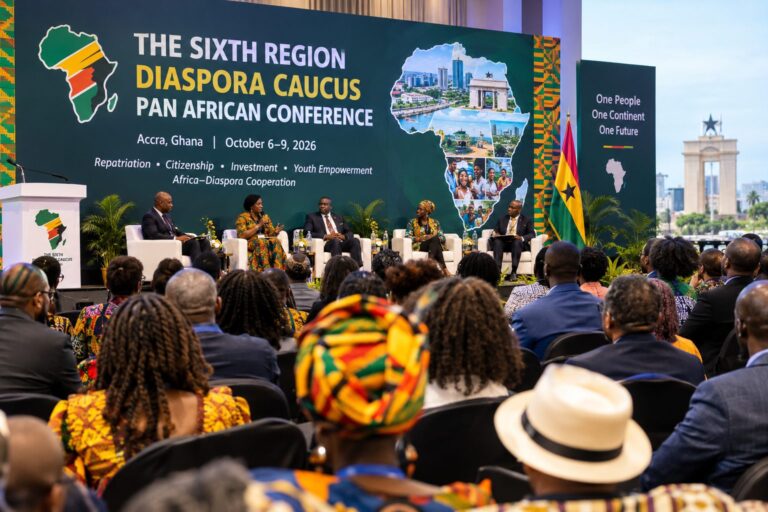
Africa’s sixth region meets in Accra: Diaspora leaders push for a stronger role in Africa’s future
In Accra, Africa’s diaspora is confronting an old Pan-African question: how can belonging become political power, economic partnership and shared responsibility?