

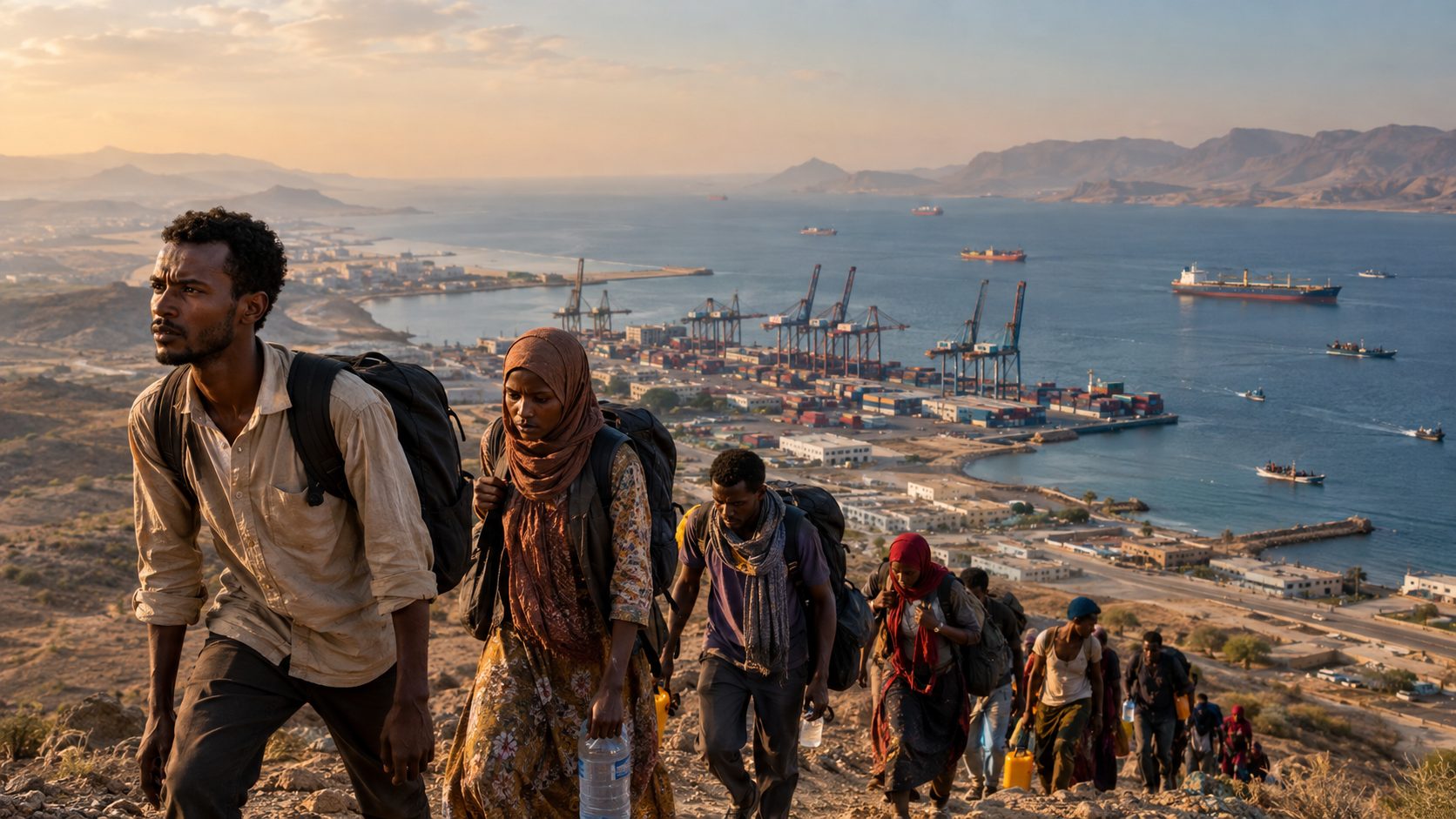
More than 20,000 migrant movements from Ethiopia into Djibouti since September 10 should not be read simply as another migration statistic. It is a signal that the Horn of Africa is undergoing a deeper economic transformation, one in which people themselves have become part of a vast cross-border system connecting rural Ethiopia, Djibouti’s coastline, Yemen and the labour markets of the Gulf.
The number is large, but the more important question is what sits behind it.
Why does a person leave home knowing the journey may involve hunger, dehydration, exploitation, detention, drowning or being stranded in a country that was never the intended destination?
The answer is not contained in a single crisis. It lies somewhere between the scarcity of decent work, household financial pressure, climate shocks, insecurity, expectations of life abroad and the powerful economic pull of the Arabian Peninsula.
This is why the Ethiopia-Djibouti corridor deserves to be understood as more than a migration route.
It is an economic corridor.
A route built on aspiration
The eastern migration route has existed for years. IOM describes it as one of the busiest and riskiest migration corridors in the world, linking the Horn of Africa with Yemen and, ultimately, Saudi Arabia and other Gulf countries.
The route is often discussed through the language of irregular migration. That description is legally relevant, but economically incomplete.
Most people do not begin such journeys because they have an abstract desire to migrate. They are making a calculation about the future.
For some, the calculation is brutally simple. Staying offers limited income, unemployment or uncertain livelihoods. Leaving offers the possibility, however remote, of earning money that can support relatives at home.
That distinction matters.
If migration is treated only as a border-control problem, governments will focus on stopping movement. If it is understood as an economic decision, the question becomes much harder: what conditions would make staying economically viable?
Djibouti is more than a transit point
Djibouti occupies a remarkable position on the African map.
It is small in territory but strategically located beside the Bab el-Mandeb, one of the world’s most important maritime passages. Its ports connect African markets to the Red Sea and the wider global trading system.
The same geography has made the country an important point on the eastern migration route.
People arriving from Ethiopia may continue towards the coast, particularly around Obock, before attempting the maritime crossing to Yemen. Others move in the opposite direction, returning from Yemen towards Ethiopia.
That means Djibouti is simultaneously a gateway, a bottleneck, a destination and a place of return.
The recent numbers expose the pressure created by that position. IOM said more than 3,000 migrants were observed stranded along migration routes in Djibouti between September 20 and 30, facing shortages of food and water, exhaustion and dehydration.
The uncomfortable reality is that geography can create wealth and vulnerability at the same time.
Djibouti’s position gives it strategic importance to governments, militaries, shipping companies and international investors. For migrants, the same geography can become a dangerous obstacle between the life they left behind and the future they hope to reach.
The hidden economy of movement
Every major migration corridor develops an economy around movement.
Vehicles carry people across borders. Boats carry them across seas. Brokers arrange connections. Smugglers provide routes when legal pathways are unavailable. Communities along the route provide food, shelter and information. Authorities attempt to monitor movement. Humanitarian organisations respond when people become stranded.
This creates a complicated ecosystem in which migration itself generates economic activity.
The danger is that the people at the centre of that economy often have the least power.
IOM’s reporting has repeatedly identified migrants’ dependence on smugglers as a major protection concern. As authorities increase controls, routes can become more remote and difficult to monitor. That can make journeys more expensive and more dangerous without necessarily eliminating demand.
This creates a familiar cycle.
More restrictions can push migrants towards less visible routes. Less visible routes make rescue and assistance harder. Greater risk can increase dependence on smugglers. And greater dependence can increase vulnerability to exploitation.
The route therefore cannot be understood only through the question of who crosses a border.
The more revealing question is who controls movement.
The Gulf is part of the story
There is another side to this migration system that receives less attention.
The journey continues because there is an imagined economic destination at the other end.
For many Ethiopians, the Gulf represents employment, wages and the possibility of supporting families back home. Saudi Arabia in particular has become a central destination within the eastern migration system.
That creates an important contradiction.
Africa is losing labour from communities that need economic opportunities, while Gulf economies continue to attract workers from countries where formal employment opportunities are often limited.
Migration therefore becomes a form of economic redistribution.
Young Africans move towards labour markets where their work is perceived to have greater value. Money can flow back to families and communities. But the costs of reaching those labour markets are frequently carried by the migrants themselves.
This raises a question that African migration policy rarely answers adequately: why should dangerous irregular migration remain the most accessible route to an economic opportunity?
The price of returning
The story also has to include those who do not reach their destination.
IOM recorded more than 95,000 forced returns from Saudi Arabia to Ethiopia in 2025, bringing cumulative returns since 2017 to roughly 750,400.
Return is often presented as the end of migration.
For many families, it may instead be another stage of the cycle.
A person leaves in search of work, reaches another country, faces detention or deportation, returns home and may eventually attempt the journey again.
This is important because it challenges the idea that migration can be managed simply by making the journey more difficult.
People respond to incentives.
If the economic conditions that encouraged departure remain unchanged, the desire to migrate can survive deportation, border controls and even the memory of a dangerous journey.
Climate is becoming an economic force
The Horn’s migration story is also inseparable from climate pressure.
Drought, water scarcity and declining livelihood security do not always produce migration directly. But they can weaken household economies until migration becomes one of the few available strategies.
That makes climate change an economic issue as much as an environmental one.
A farmer who loses productive capacity may seek wage work. A young person unable to find employment locally may look abroad. A household carrying debt may decide that migration offers a chance to increase income.
The result is a gradual transformation in which environmental stress becomes mobility.
This matters because migration policy designed without climate policy will always be responding to symptoms.
Who owns the corridor?
This is where the story becomes particularly relevant to Who Owns Africa.
The eastern migration route is not owned by one government or one company. It is shaped by a network of states, ports, transport systems, smugglers, employers, recruitment markets, humanitarian organisations and security actors.
Each controls part of the journey.
Yet the migrant often controls very little.
That imbalance is the real story.
Africa’s migration debate frequently asks how countries can stop people from leaving. A more useful question is how African economies can create enough productive opportunity that leaving becomes a choice rather than a necessity.
That requires more than slogans about youth employment.
It means asking where investment is going, who benefits from infrastructure, how agricultural communities withstand climate shocks, whether young people can access credit and whether legal labour-migration channels can connect African workers with international demand safely.
The corridor tells us something bigger
The movement of more than 20,000 people into Djibouti in a matter of weeks is not proof that every Ethiopian wants to leave Africa.
It is evidence of something more complicated.
People are responding to the geography of opportunity.
When opportunity is concentrated elsewhere, people move towards it. When legal pathways are limited, informal systems fill the gap. When borders become harder to cross, routes change. When livelihoods deteriorate, the willingness to accept risk can increase.
That is why the Horn’s migration corridor should not be viewed only as a humanitarian emergency.
It is also a mirror of Africa’s economic architecture.
The desert, the port, the sea crossing and the border checkpoint are merely physical expressions of a larger imbalance between where people live and where they believe economic opportunity exists.
The question facing Ethiopia, Djibouti, Yemen, Saudi Arabia and the wider African region is therefore not simply how to stop the next boat from leaving.
It is whether the region can build an economic system in which young Africans do not have to gamble their lives to participate in the global labour market.
Until that changes, the road from Ethiopia to Djibouti will remain more than a migration route.
It will remain a map of Africa’s unfinished economic transformation.
