

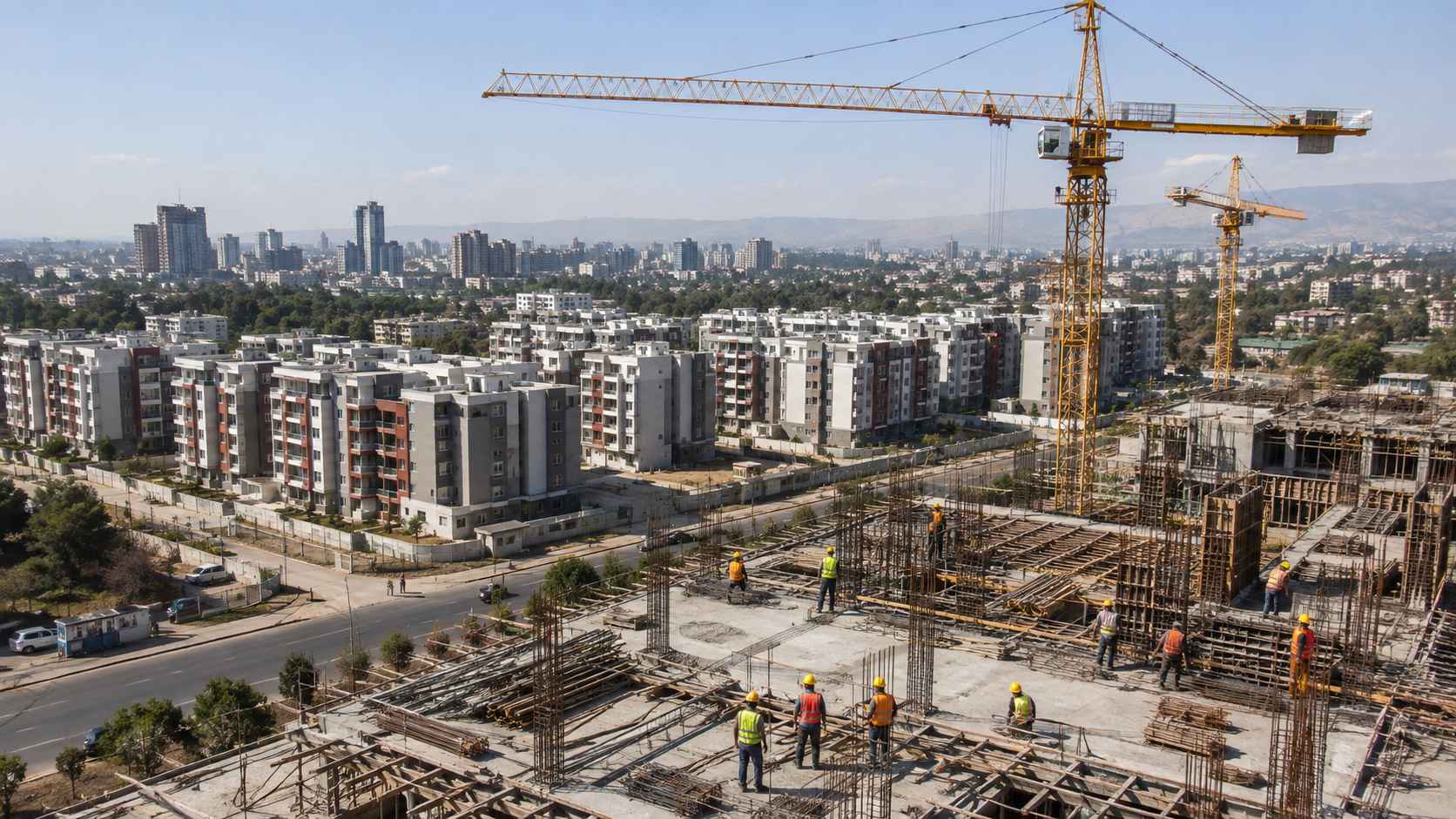
Ethiopia is putting a major new piece of financial infrastructure behind its housing ambitions, with the government and the International Finance Corporation agreeing to establish the country’s first dedicated mortgage refinance company, capitalized at 100 billion birr and backed by at least $200 million from the IFC.
The move could become one of the most consequential developments in Ethiopia’s housing and financial sectors, not simply because of the amount of money involved, but because it could determine which banks, investors, developers and households gain access to long-term capital as the country seeks to build 1.5 million affordable homes.
The money behind the housing push
The framework agreement was signed on September 3 between the National Bank of Ethiopia and the IFC, the private-sector arm of the World Bank Group, under a plan intended to address a persistent problem in Ethiopia’s financial system: banks have struggled to provide long-term mortgage loans while relying heavily on shorter-term sources of funding. The proposed institution is designed as a wholesale financial intermediary rather than a lender that will directly hand mortgages to individual homebuyers. That distinction matters because the real economic power of the institution will sit in the financial plumbing behind the housing market.
The government says the company will be capitalized at 100 billion Ethiopian birr, while the IFC will contribute at least $200 million. The exact final ownership structure, including the share that will be held by the Ethiopian state, the IFC and any other participating investors, has not been publicly detailed in the announcement. That leaves an important question for investors and citizens: who will ultimately control the institution that could become a central funding channel for Ethiopia’s next housing cycle?
The answer could have implications well beyond the mortgage industry. A refinancing institution can influence which banks receive long-term liquidity, how mortgage products are priced and how quickly lenders can expand their housing portfolios. If the model succeeds, the institution could also help attract institutional investors and other sources of long-term capital into the housing market.
Why refinancing matters
A mortgage refinance company operates one level behind the consumer. Instead of competing directly with commercial banks for homebuyers, it can provide longer-term funding to lenders, allowing banks to originate mortgages without carrying the entire burden of funding loans that may remain outstanding for decades.
That model is particularly relevant in Ethiopia, where the mortgage market remains relatively small compared with the country’s housing needs. The Centre for Affordable Housing Finance Africa says Ethiopia’s mortgage market is underdeveloped and has historically faced regulatory and funding constraints. Its latest available figures put outstanding mortgage lending at 24.1 billion birr, with the Commercial Bank of Ethiopia accounting for the largest share.
The proposed institution therefore represents a potentially dramatic increase in the financial capacity available behind housing. Its 100 billion birr capitalization is several times the latest outstanding mortgage figure cited by CAHF, although capitalization should not be confused with the amount that will immediately become mortgage lending. The institution will need an operating structure, participating lenders, risk-management systems and access to sustainable sources of funding before the headline capital figure translates into mortgages for households.
IFC’s experience elsewhere in Africa provides some indication of the intended direction. The institution says mortgage refinancing companies can give primary mortgage lenders access to long-term funding, allowing them to lengthen loan maturities and potentially improve affordability. IFC has supported such structures as part of its broader housing-finance strategy.
The 1.5 million-home ambition
The mortgage initiative is closely linked to Prime Minister Abiy Ahmed’s target of delivering 1.5 million affordable homes over five years. The government has said the housing programme will require more than public spending, with private-sector investment and public-private partnerships expected to play a larger role.
The scale of the ambition is significant. In July, the prime minister said Ethiopia had built 1.2 million homes during the previous five years and was now targeting at least 1.5 million additional housing units. He also said the government was working on modern construction technologies and long-term housing finance mechanisms to make homeownership more attainable.
That means the refinance company is not an isolated banking reform. It is potentially one of the financial engines for a broader housing programme involving land, construction companies, cement producers, developers, banks, insurers, pension and institutional capital and, ultimately, millions of households.
The key question for WhoOwnsAfrica.com is therefore not simply how many houses Ethiopia can build. It is who controls the capital required to build them, who owns the companies supplying the construction materials, who develops the land, who finances the buyers and who eventually owns the completed properties.
Banks could be early winners
Commercial banks are likely to be among the first institutions affected by the new model. If the refinancing company provides reliable long-term funding, banks could potentially expand mortgage lending without having to rely entirely on deposits that may mature much sooner than the loans they finance.
For banks, that could create a larger pool of mortgage customers and a new source of relatively long-duration lending. It could also encourage competition in a market historically dominated by a small number of major lenders.
The Commercial Bank of Ethiopia is particularly significant because of its existing position in mortgage lending. CAHF says CBE held about 69% of outstanding mortgages in its latest available data.
But greater liquidity will not automatically produce affordable mortgages. Interest rates, household incomes, land costs, construction expenses, inflation, foreign-exchange conditions and credit risk will all influence what households can actually afford. A refinance institution can improve the supply of mortgage funding, but it cannot by itself solve every affordability problem in the housing market.
Developers are another piece
The other major group to watch is property developers.
Ethiopia’s housing shortage creates a large potential market, but the economics of development remain challenging. CAHF says annual housing demand has historically exceeded supply by a wide margin, while formal real estate development has been limited and has tended to focus on middle and higher-income buyers.
A larger mortgage market could change that equation by giving developers a deeper pool of potential buyers. If households can obtain longer-term mortgages, developers may have greater confidence that completed homes can be sold to a broader segment of the population.
That could increase the value of development rights, construction companies and property portfolios. It could also increase demand for cement, steel, engineering services, transport, building technology and financial services.
The ownership question becomes important here. If public policy creates the conditions for a large housing boom, the resulting economic gains will not be distributed evenly. Companies with access to land, finance, construction capacity and government-backed projects could capture a substantial share of the value created.
Who will own the new homes?
For households, the government’s stated objective is straightforward: make affordable homeownership more accessible.
The financial structure, however, introduces another layer. A mortgage means that a household may occupy and ultimately own a property while a bank holds the mortgage claim until the loan is repaid. Behind the bank, refinancing institutions and investors can become part of the funding chain.
This creates a more complex ownership ecosystem than simply asking who owns the building.
The new housing market could eventually involve households as property owners, banks as mortgage lenders, the refinance company as a funding intermediary, investors as providers of long-term capital and developers as owners of land or construction projects. The distribution of returns between those participants will depend heavily on how the new institution is structured.
At this stage, the government and IFC have announced the framework and broad capitalization, but not enough detail to establish the final shareholder structure or governance arrangements. Those details will be crucial for understanding who ultimately has influence over the institution.
The capital-market opportunity
There is another potential consequence that could be even more important over time: the development of Ethiopia’s domestic capital markets.
IFC’s housing-finance model includes the use of mortgage refinancing companies as vehicles for capital-markets refinancing. In principle, a successful institution can create a bridge between mortgage lenders and investors looking for longer-term assets.
That could gradually move Ethiopia’s housing finance system away from a model primarily dependent on bank deposits and toward one involving a broader pool of institutional capital.
For investors, that creates an opportunity but also raises questions about credit quality, currency risk, interest rates, regulation and the ability of households to service long-term loans. Ethiopia’s broader financial-sector reforms will therefore matter as much as the initial capital injection.
The International Monetary Fund has noted that Ethiopia is continuing to develop its domestic debt markets while seeking to reduce financial repression and create more reliable sources of financing.
The ownership trail to watch
For WhoOwnsAfrica.com, the most important developments may come after the headline announcement.
The first issue to watch is the final shareholder structure of the mortgage refinance company. The second is governance: who appoints directors, who controls strategic decisions and how independent the institution will be from government and participating banks. The third is funding: whether the initial capital attracts additional domestic and international investors.
The fourth is the distribution of mortgage finance. Which banks qualify for refinancing? Will smaller lenders gain meaningful access, or will the largest banks capture most of the liquidity? The fifth is the developer pipeline. Which construction companies win contracts for the homes supported by the programme, and who owns those companies?
Finally, there is the question of land and completed housing assets. As financing becomes easier, land values and development opportunities could rise in areas targeted for large-scale housing. Tracking ownership at that level will reveal who captures the greatest economic value from Ethiopia’s housing expansion.
A new financial layer
Ethiopia’s 100 billion birr mortgage refinance plan is therefore more than a housing-finance announcement. It is an attempt to build a new financial layer underneath one of the country’s biggest development programmes.
If implemented effectively, it could give banks access to longer-term funding, broaden mortgage lending and help private developers build for a much larger market. It could also deepen Ethiopia’s financial system by connecting housing loans with institutional and capital-market funding.
But the biggest story may ultimately be about ownership.
The government’s 1.5 million-home target will create demand for capital on a scale that could reshape banking, construction and real estate. The institutions that control that capital, the companies that receive it and the investors who ultimately finance it will have a significant influence over who benefits from Ethiopia’s next property cycle.
