
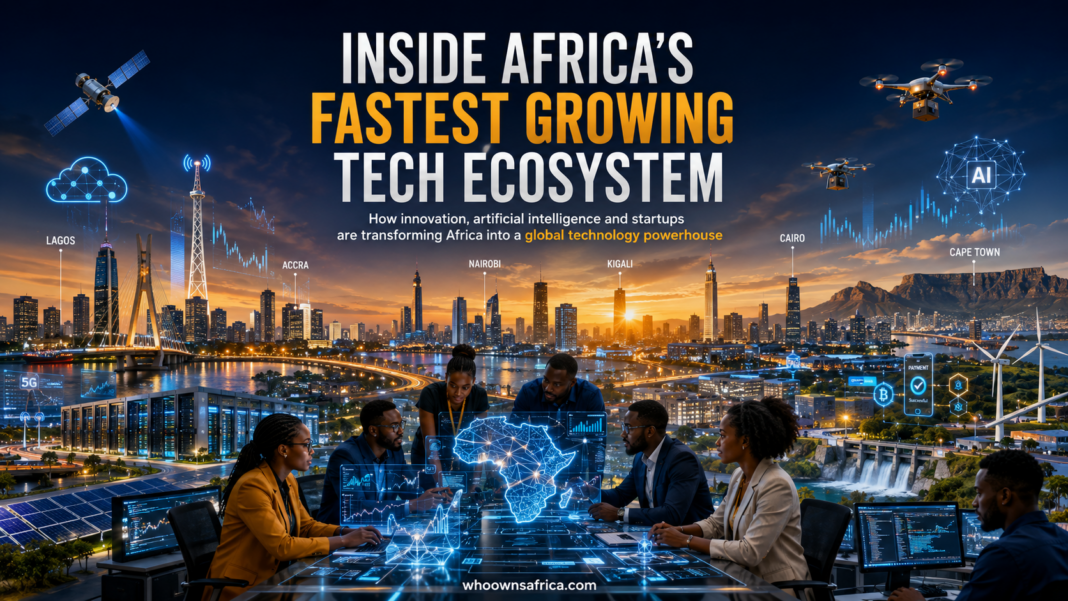

Africa’s technology industry is undergoing one of the fastest transformations in its history, driven by a combination of youthful talent, expanding internet access, mobile money innovation, artificial intelligence, growing venture capital interest and government backed digital reforms. From Nairobi and Lagos to Cape Town, Cairo, Kigali and Accra, technology ecosystems are becoming powerful engines of economic growth, attracting investors seeking opportunities beyond traditional sectors such as mining, oil and agriculture. Although funding slowed globally after the post pandemic investment boom, African technology companies continue to solve uniquely local challenges while building products that increasingly compete on an international stage.
For decades, Africa was largely viewed as a consumer of imported technology. Today that narrative is changing rapidly. Entrepreneurs across the continent are creating digital payment systems, healthcare platforms, agricultural technologies, logistics software and artificial intelligence applications designed specifically for African markets.
International investors, development finance institutions and global technology companies are also paying closer attention to Africa’s growing digital economy. Although funding volumes fluctuate from year to year, the long term trajectory remains positive as internet penetration increases and governments invest more heavily in digital infrastructure.
Africa’s technology landscape is no longer defined by a single city or country. Instead, it consists of interconnected ecosystems, each with distinct strengths and competitive advantages.
Nairobi leads East Africa
Kenya has earned its reputation as one of Africa’s leading innovation centres through decades of investment in digital finance and entrepreneurship.
The success of mobile money fundamentally changed the country’s technology landscape. It demonstrated that African innovations could scale nationally before expanding internationally. That experience created an ecosystem where entrepreneurs became more willing to tackle financial inclusion, healthcare delivery, education and logistics using technology.
Nairobi now hosts hundreds of startups supported by accelerators, venture capital firms, universities and multinational technology companies.
Global firms including Microsoft, Google, Amazon Web Services and IBM have expanded their presence in Kenya through research initiatives, cloud services, engineering teams and innovation programmes.
Artificial intelligence has emerged as a new growth area. Kenyan startups are applying AI to agriculture, medical diagnostics, financial services, cybersecurity and customer support, helping businesses improve efficiency while addressing local challenges.
Government investment in digital public services has also contributed to the ecosystem’s expansion by increasing demand for software development, cybersecurity and cloud infrastructure.
Nigeria remains Africa’s startup capital
If Nairobi is East Africa’s innovation hub, Lagos continues to dominate West Africa’s technology sector.
Nigeria’s enormous population provides startups with one of the continent’s largest domestic markets. Entrepreneurs often test products locally before expanding into neighbouring countries.
Financial technology remains Nigeria’s strongest technology segment. Digital payment companies have transformed how millions of consumers transfer money, pay bills and conduct business.
The country’s startup ecosystem has also produced several billion dollar companies, helping demonstrate that African technology firms can achieve global scale.
Despite economic pressures, currency volatility and inflation, Nigeria continues to attract international venture capital because investors view its market size as difficult to ignore.
Beyond fintech, Nigerian entrepreneurs are increasingly building businesses in logistics, digital commerce, healthcare technology, artificial intelligence, education technology and enterprise software.
Young software developers have also gained international recognition, with many working remotely for global companies while simultaneously launching startups serving African markets.
South Africa combines maturity with scale
South Africa possesses one of the continent’s most mature technology ecosystems.
Cape Town has become a centre for software development, venture capital and technology entrepreneurship, while Johannesburg remains a major financial hub supporting fintech innovation.
Unlike some younger ecosystems, South Africa benefits from relatively advanced infrastructure, stronger research institutions and deeper pools of experienced technology professionals.
The country has become particularly attractive for enterprise software companies, cybersecurity firms and business technology providers serving corporate clients across Africa.
International cloud providers have invested heavily in South African data centres, strengthening the country’s position as a gateway for digital services across the continent.
Local universities continue producing skilled engineers, while experienced entrepreneurs increasingly mentor younger founders, creating a stronger innovation pipeline.
Egypt bridges Africa and the Middle East
Egypt occupies a unique position within Africa’s technology economy.
Its geographic location connects African, Middle Eastern and European markets, allowing startups to expand across multiple regions.
Cairo has emerged as one of Africa’s fastest growing startup cities, supported by government reforms, investment funds and expanding digital infrastructure.
Fintech, electronic commerce, logistics and education technology have become major areas of innovation.
Egypt’s large population provides startups with substantial opportunities to scale before entering international markets.
Government initiatives encouraging digital transformation have further increased demand for technology services, software development and cloud computing.
Rwanda builds innovation through policy
Although considerably smaller than Nigeria or Kenya, Rwanda has gained international attention for its technology friendly policies.
The government has consistently promoted digital transformation as part of its broader economic development strategy.
Kigali has become a preferred destination for technology conferences, startup accelerators and innovation programmes.
Public services increasingly operate through digital platforms, while investments in broadband infrastructure continue expanding internet access.
Rwanda has also attracted companies developing drone technology, digital healthcare solutions and financial services platforms.
Its relatively efficient regulatory environment has made the country an attractive testing ground for innovative business models before regional expansion.
Ghana and emerging ecosystems
Ghana has steadily strengthened its position as one of West Africa’s emerging technology centres.
Accra hosts growing numbers of software companies, fintech startups and innovation hubs supported by universities and international development partners.
Government programmes promoting digital identification systems and electronic payments have helped stimulate entrepreneurship.
Elsewhere, Morocco is expanding its technology manufacturing capabilities alongside software development.
Senegal continues building digital infrastructure that supports entrepreneurship in Francophone Africa.
Ethiopia, following economic reforms, is gradually opening new opportunities for private sector technology investment.
Uganda, Tanzania, Côte d’Ivoire and Zambia are also witnessing increasing startup activity, particularly in agriculture, financial services and digital commerce.
Collectively, these emerging ecosystems demonstrate that Africa’s technology growth is becoming broader rather than concentrated in only a handful of cities.
Venture capital enters a new phase
African startups experienced record investment during the global technology boom that followed the pandemic.
Although funding later declined alongside international venture capital markets, investors increasingly shifted their attention towards companies with sustainable business models and clear paths to profitability.
Rather than pursuing rapid expansion at any cost, founders are placing greater emphasis on revenue generation, operational efficiency and long term resilience.
This shift is helping create healthier businesses capable of surviving changing economic conditions.
International investors continue viewing Africa as one of the world’s last major untapped digital markets because of its rapidly growing population, expanding middle class and rising smartphone adoption.
Artificial intelligence moves into the mainstream
Artificial intelligence is becoming one of the defining technologies shaping Africa’s next phase of digital growth. What was once limited to academic research and experimental projects is now being adopted by startups, banks, hospitals, manufacturers and government agencies seeking to improve efficiency and reduce costs.
Across the continent, software developers are building AI tools that address uniquely African challenges. Farmers are using machine learning to monitor crop health, predict weather patterns and identify plant diseases before they spread. Healthcare providers are deploying AI assisted diagnostic systems that help clinicians detect illnesses more quickly, particularly in areas where specialist doctors remain scarce.
Banks and financial technology companies are using artificial intelligence to identify fraud, assess creditworthiness and automate customer support. Retailers are relying on predictive analytics to manage inventory, while logistics firms are using intelligent routing systems to reduce fuel consumption and improve delivery times.
African entrepreneurs are also creating large language models and voice recognition systems capable of understanding local languages and dialects, making digital services accessible to millions of people who have traditionally been excluded from online platforms.
Major global technology companies have expanded AI research partnerships with African universities, investing in training programmes designed to develop the next generation of engineers and data scientists. These collaborations are helping strengthen local expertise while encouraging more innovation to remain within Africa rather than moving abroad.
Industry analysts say the next decade will likely see artificial intelligence become a standard feature across nearly every sector of the African economy rather than remaining a specialised technology.
Fintech continues to drive innovation
Financial technology remains the backbone of Africa’s digital economy.
Millions of Africans continue to rely on digital wallets, mobile banking applications and electronic payment systems for everyday transactions. For many consumers, smartphones have effectively replaced traditional bank branches.
Startups are expanding beyond simple money transfers into lending, insurance, investment management and cross border payments. Small businesses are increasingly accepting digital payments, improving transparency while expanding access to formal financial services.
Cross border commerce represents another major opportunity.
Africa’s growing regional trade ambitions have increased demand for payment platforms capable of handling transactions across multiple currencies and financial systems. Technology companies are responding by building infrastructure that simplifies international payments for businesses operating throughout the continent.
Financial inclusion also remains a major objective.
Despite significant progress over the past decade, hundreds of millions of Africans remain underserved by conventional banking institutions. Technology companies continue developing products that allow consumers to save, borrow and invest using only a mobile phone.
This growing digital financial ecosystem is expected to play an increasingly important role as African economies become more integrated through regional trade agreements.
Data centres and cloud infrastructure expand
Behind every digital service lies a growing network of data centres and cloud computing infrastructure.
International technology companies have accelerated investment across Africa, recognising that local data storage improves service reliability while reducing latency for businesses and consumers.
New facilities are being constructed in several countries as demand rises for cloud computing, cybersecurity services and artificial intelligence applications.
Businesses that once relied on expensive in house servers are increasingly migrating to cloud platforms, allowing them to scale operations more efficiently.
Governments are also adopting cloud technologies to modernise public services, digitise records and improve service delivery.
The expansion of cloud infrastructure has created opportunities for software developers, cybersecurity specialists, network engineers and data analysts, contributing to employment growth within the technology sector.
However, experts note that continued investment in electricity generation and fibre optic connectivity will be essential to support future expansion.
Digital infrastructure underpins growth
Africa’s technology boom depends on far more than startup funding.
The rapid expansion of fibre optic networks, submarine internet cables, mobile broadband and affordable smartphones has dramatically improved internet access across much of the continent.
Telecommunications companies continue investing billions of dollars in network upgrades as demand for digital services grows.
Fifth generation mobile technology is gradually expanding in several African markets, creating new possibilities for smart manufacturing, connected healthcare, autonomous logistics and advanced digital services.
Meanwhile, satellite internet providers are beginning to improve connectivity in remote regions where traditional infrastructure remains difficult or expensive to deploy.
Improved connectivity is encouraging entrepreneurship beyond major cities.
Developers can now launch technology companies from smaller towns while serving customers nationally or internationally through cloud based platforms.
Talent becomes Africa’s greatest advantage
Perhaps Africa’s most valuable technology asset is its people.
The continent has one of the world’s youngest populations, with millions of students entering universities and technical training programmes every year.
Software engineering boot camps, coding academies and online education platforms have expanded rapidly, helping young professionals acquire skills demanded by employers worldwide.
Many African developers now work remotely for international companies while contributing to local startup ecosystems through mentorship, investment and entrepreneurship.
The growing availability of remote work has increased incomes for many technology professionals while allowing them to remain within their home countries.
Universities are also strengthening partnerships with industry, introducing courses focused on artificial intelligence, cybersecurity, cloud computing and software engineering.
This combination of education, entrepreneurship and international experience is gradually building a larger pool of highly skilled professionals capable of supporting sustained innovation.
Women reshape the technology landscape
Women entrepreneurs are playing an increasingly important role within Africa’s startup ecosystem.
Across fintech, health technology, agriculture and education, female founders are building businesses that address pressing social and economic challenges.
Investment in women led startups remains lower than investment received by male founders, but several venture capital firms and development organisations have introduced programmes designed to narrow this gap.
Female technology leaders are also becoming more visible as executives, investors and mentors, encouraging greater diversity across the industry.
Analysts say increasing women’s participation in technology will be critical to unlocking Africa’s full innovation potential.
Challenges remain significant
Despite impressive progress, Africa’s technology sector continues to face substantial obstacles.
Access to early stage financing remains uneven, particularly outside major innovation hubs.
Many startups struggle to secure follow on investment needed to expand operations beyond their domestic markets.
Infrastructure challenges also persist.
Reliable electricity remains inconsistent in several countries, increasing operating costs for technology businesses that depend on backup power systems.
Internet access has improved considerably but remains expensive in some regions, limiting digital adoption among lower income households.
Regulatory uncertainty presents another concern.
Differences in taxation, licensing requirements and data protection laws across African countries can complicate regional expansion.
Founders often face complex compliance requirements when attempting to operate across multiple jurisdictions.
Currency volatility also creates financial uncertainty for businesses generating revenue in local currencies while paying for cloud services or international software subscriptions in foreign currencies.
Although these challenges are significant, many entrepreneurs have demonstrated remarkable resilience by adapting business models to local conditions.
Competition intensifies
Africa’s technology market has become increasingly competitive.
Local startups now compete not only with domestic rivals but also with multinational technology companies expanding their presence across the continent.
Global firms bring significant financial resources, established brands and advanced technology platforms.
At the same time, African startups possess an important competitive advantage through their understanding of local markets, consumer behaviour and regulatory environments.
Many successful companies combine international technology standards with products specifically designed for African customers.
Industry observers believe partnerships between multinational companies and local innovators will become increasingly common as both seek to accelerate digital transformation.
Governments play a larger role
Public policy is becoming an increasingly important factor in determining which technology ecosystems thrive. Across Africa, governments are introducing national digital strategies aimed at expanding internet access, improving digital literacy and encouraging private investment.
Several countries have simplified business registration processes, introduced technology parks and created innovation funds to support entrepreneurs. Others are investing in digital identity systems, electronic government services and online tax platforms that reduce bureaucracy while creating demand for local software developers.
Education has also become a priority. Universities are expanding computer science programmes, while partnerships with private companies are providing students with practical skills in software engineering, artificial intelligence, cybersecurity and data analytics.
Even so, entrepreneurs say policy consistency remains essential. Investors typically favour markets where regulations are predictable and where governments engage regularly with the private sector. Stable legal frameworks can encourage long term investment and help startups expand with greater confidence.
Regional integration opens new markets
One of the biggest opportunities for African technology companies lies beyond their home countries.
The implementation of the African Continental Free Trade Area is expected to improve cross border trade by reducing barriers between markets. Although the agreement extends well beyond technology, it has significant implications for digital businesses.
A startup that succeeds in one country increasingly has the potential to serve customers across multiple markets. Software products, digital payments, online education and cloud based services can often scale more quickly than traditional industries because they require fewer physical assets.
This regional approach is already shaping the strategies of many founders. Rather than building companies designed for a single national market, entrepreneurs are increasingly developing products with multilingual capabilities, flexible payment systems and compliance strategies that support expansion across Africa.
Investors view this shift positively because larger addressable markets improve the potential for long term growth.
International partnerships gather pace
Africa’s technology sector is attracting growing interest from international investors, development institutions and multinational corporations.
Global technology companies continue to establish engineering centres, cloud regions and research partnerships across the continent. Venture capital firms are increasing their focus on early stage startups, while development finance institutions are supporting projects that strengthen digital infrastructure and innovation.
These partnerships provide more than funding. They also create opportunities for knowledge transfer, technical training and access to international markets.
Many African startups now collaborate with companies in Europe, North America, Asia and the Middle East, allowing them to refine products while expanding beyond the continent.
Industry leaders say international partnerships are most effective when they complement rather than replace local innovation. The strongest ecosystems tend to combine global expertise with African leadership and locally developed solutions.
Sustainability enters the technology agenda
As digital infrastructure expands, sustainability is becoming a more prominent consideration.
Data centres require substantial electricity, prompting operators to invest in energy efficient technologies and renewable power sources where possible.
Technology companies are also contributing to climate resilience by developing tools that help governments, businesses and farmers monitor environmental conditions.
Digital platforms are supporting smarter water management, renewable energy distribution and precision agriculture. Satellite imagery and artificial intelligence are enabling faster responses to droughts, floods and changing weather patterns.
Investors increasingly consider environmental, social and governance standards when evaluating technology companies, encouraging startups to incorporate sustainability into their long term strategies.
The next generation of African unicorns
Africa has already produced several startup companies valued at more than one billion dollars, demonstrating that globally competitive businesses can emerge from the continent.
Analysts believe the next generation of high growth companies is likely to come from sectors extending beyond fintech.
Artificial intelligence, climate technology, biotechnology, digital health, cybersecurity, enterprise software and advanced manufacturing are all expected to attract increasing investment over the coming decade.
Companies operating in these industries may benefit from rising demand both within Africa and internationally.
Rather than copying business models developed elsewhere, many founders are building products specifically designed for African conditions before adapting them for global markets.
This reverse innovation model has attracted growing attention from international investors seeking solutions that are affordable, scalable and resilient.
Competition for talent intensifies
As Africa’s technology industry expands, demand for skilled professionals is increasing.
Software engineers, cybersecurity experts, cloud architects and artificial intelligence specialists are among the most sought after professionals across the continent.
Companies are responding by offering flexible working arrangements, professional development opportunities and competitive compensation packages.
At the same time, universities and technical institutions continue expanding programmes designed to meet industry demand.
Several countries are also encouraging members of the African diaspora to contribute expertise through investment, mentorship and entrepreneurship.
This exchange of knowledge is helping strengthen local ecosystems while connecting African innovation with global technology networks.
Looking ahead
Africa’s technology sector remains at a pivotal moment.
The continent faces undeniable challenges, including infrastructure gaps, uneven access to capital, regulatory complexity and macroeconomic uncertainty. Yet these obstacles coexist with powerful long term drivers that continue to reshape the digital economy.
Africa has the world’s youngest population, rapidly expanding internet connectivity, growing smartphone adoption and increasing demand for digital services. These structural trends provide a strong foundation for continued innovation.
The next phase of growth is likely to depend less on headline funding rounds and more on building sustainable businesses capable of generating consistent revenue and solving practical problems.
Investors are increasingly rewarding companies with disciplined management, clear paths to profitability and products that address genuine market needs.
Governments, meanwhile, have an opportunity to accelerate progress through policies that encourage entrepreneurship, strengthen education, improve infrastructure and support regional integration.
If these conditions continue to improve, Africa’s technology industry could become one of the continent’s most significant economic engines over the coming decades.
Conclusion
Africa’s fastest growing technology ecosystem is no longer confined to a single city or country. It is a continent wide network of entrepreneurs, engineers, investors, researchers and policymakers working to redefine how innovation emerges from Africa.
Nairobi continues to lead in digital finance and artificial intelligence. Lagos remains a powerhouse for fintech and entrepreneurial ambition. Cape Town and Johannesburg offer mature investment environments and strong enterprise technology sectors. Cairo connects African innovation with markets across the Middle East and Europe. Kigali demonstrates how policy can accelerate digital transformation, while Accra, Casablanca, Dakar, Addis Ababa and several other cities continue to build momentum.
Together, these ecosystems reflect a broader shift in Africa’s economic story. Technology is moving from the margins to the centre of development, creating new industries, modernising traditional sectors and opening opportunities for millions of people.
The continent’s future will not be defined solely by natural resources or commodity exports. Increasingly, it will be shaped by software developers writing code, entrepreneurs solving local problems, researchers advancing artificial intelligence and investors backing the next generation of innovators.
For global investors, Africa is evolving from an emerging opportunity into a strategic technology market. For African entrepreneurs, the challenge is no longer proving that innovation can thrive on the continent. It is demonstrating how African solutions can compete, scale and influence the global digital economy.
If current trends continue, the coming decade may be remembered not simply as the period when Africa adopted technology, but as the era when it became one of the world’s most dynamic centres of digital innovation.

