
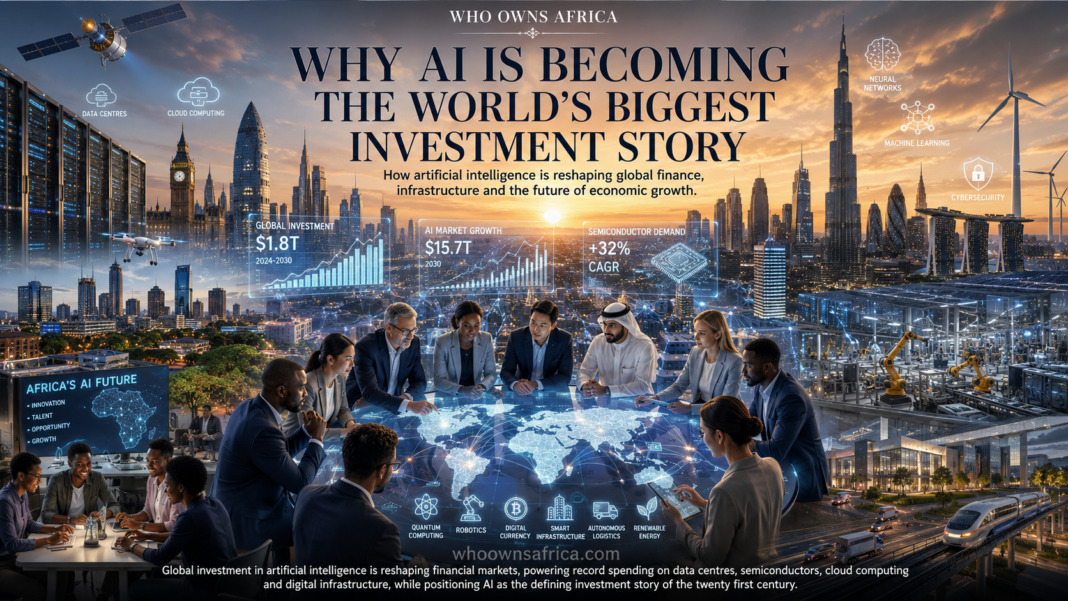

Artificial intelligence has rapidly evolved from a niche technology into one of the world’s most significant investment themes, attracting unprecedented levels of capital from governments, technology companies, venture capital firms, and financial markets. Investors who once viewed AI as a long term research project are now treating it as a defining force that could reshape every major sector of the global economy, from healthcare and finance to manufacturing, agriculture, education, and national security.
The pace of investment has accelerated sharply over the past three years as breakthroughs in generative artificial intelligence demonstrated capabilities that few industry experts expected to emerge so quickly. The release of advanced AI systems capable of generating human like text, images, software code, scientific research, and business analysis sparked intense competition among the world’s largest technology companies.
What followed was one of the biggest waves of corporate investment in recent history.
Technology giants committed hundreds of billions of dollars to expanding cloud infrastructure, building larger data centres, acquiring powerful graphics processors, and recruiting top AI researchers. Venture capital firms redirected funding towards AI startups at levels not seen since the early days of the internet.
The result has been a transformation of global capital markets, with artificial intelligence emerging as one of the primary drivers of stock market performance and corporate investment.
A New Industrial Revolution
Economists increasingly compare artificial intelligence to previous technological revolutions that fundamentally changed the global economy.
The steam engine powered industrial manufacturing.
Electricity transformed factories and households.
The internet reshaped communications, commerce, and information sharing.
Today, artificial intelligence is increasingly viewed as the next foundational technology capable of boosting productivity across nearly every industry.
Unlike earlier software systems that relied heavily on human input, modern AI systems can analyse vast datasets, recognise patterns, generate original content, automate repetitive tasks, and assist decision making at remarkable speed.
Businesses are adopting AI to improve customer service, optimise supply chains, detect fraud, accelerate medical research, develop new products, and enhance workplace productivity.
Consulting firms estimate that AI could contribute trillions of dollars to global economic output over the coming decade as adoption spreads across developed and emerging markets.
That potential has encouraged investors to view AI not simply as another technology trend but as a structural shift that could reshape global economic growth for decades.
Investors Follow the Money
Capital has flowed rapidly into every layer of the AI ecosystem.
Semiconductor manufacturers are expanding production to meet soaring demand for advanced processors.
Cloud computing companies are investing heavily in new data centres capable of supporting increasingly complex AI workloads.
Software developers are integrating AI features into existing products while startups seek to commercialise specialised applications across healthcare, legal services, education, agriculture, logistics, and finance.
Private equity firms are also increasing exposure to AI enabled businesses, while institutional investors continue allocating larger portions of their portfolios to companies positioned to benefit from the technology.
Public market investors have rewarded many AI focused firms with soaring valuations, reflecting expectations that demand for AI infrastructure and services will remain strong for years.
The scale of spending has become one of the defining characteristics of the AI boom.
Rather than reducing investment during periods of economic uncertainty, many technology companies have accelerated spending on AI infrastructure, arguing that failing to invest now could leave them at a competitive disadvantage in the future.
The Race to Build AI Infrastructure
Behind every advanced AI application lies an enormous physical infrastructure that is often invisible to consumers.
Modern AI models require massive computing power, supported by specialised processors, sophisticated networking equipment, high speed storage systems, and vast quantities of electricity.
Building this infrastructure has become one of the largest investment opportunities in the global economy.
Construction firms are developing new hyperscale data centres across North America, Europe, Asia, and the Middle East.
Energy companies are exploring new ways to supply electricity to AI facilities whose power requirements continue to rise.
Telecommunications providers are expanding fibre networks to handle increasing volumes of data generated by AI applications.
Property developers are also benefiting as demand grows for land suitable for large scale data centre construction.
This interconnected investment cycle has extended the economic impact of AI far beyond the technology sector itself.
Governments Join the Competition
Governments have increasingly recognised artificial intelligence as a strategic national priority.
Many countries now regard AI leadership as essential to economic competitiveness, technological independence, and national security.
Public investment programmes have expanded significantly as policymakers seek to strengthen domestic AI capabilities.
National strategies increasingly focus on supporting semiconductor manufacturing, scientific research, workforce development, cybersecurity, and advanced computing infrastructure.
Governments are also introducing incentives to attract technology companies to build AI facilities within their borders, creating new competition to host the next generation of digital infrastructure.
For policymakers, the stakes extend beyond economic growth.
Artificial intelligence is expected to influence military capability, healthcare systems, education, financial services, and public administration, making investment in AI a strategic decision as well as an economic one.
Beyond Silicon Valley
Although much of the early AI boom has centred on the United States, investment is rapidly becoming more global.
European countries are increasing funding for AI research and digital innovation.
Asian economies continue investing heavily in semiconductor manufacturing, robotics, and advanced computing.
Middle Eastern sovereign wealth funds are allocating billions of dollars to AI companies, infrastructure projects, and technology partnerships as they seek to diversify their economies beyond oil revenues.
Emerging markets are also beginning to position themselves within the global AI value chain.
Countries with growing digital economies, expanding internet access, and youthful technology talent are attracting increased attention from international investors looking for future growth opportunities.
Africa is among the regions seeking to leverage artificial intelligence to improve financial inclusion, agriculture, healthcare, education, and public services while building local innovation ecosystems capable of attracting global investment.
A Market Defined by Expectations
The excitement surrounding artificial intelligence reflects both present day commercial opportunities and expectations about the future.
Investors believe AI has the potential to create entirely new industries while transforming existing ones.
That optimism has supported significant increases in market valuations for companies supplying critical AI infrastructure, software, and services.
At the same time, analysts caution that sustained investment will depend on companies demonstrating measurable financial returns from increasingly large capital expenditures.
The coming years will test whether today’s spending produces productivity gains substantial enough to justify the enormous sums being committed.
For now, however, the scale of global investment suggests artificial intelligence has moved beyond being a technological breakthrough.
It has become one of the defining economic stories of the decade, influencing financial markets, government policy, corporate strategy, and international competition in ways that few technologies have achieved before.
Why AI Is Becoming the World’s Biggest Investment Story
Subtitle: Global spending on artificial intelligence is reshaping financial markets, corporate strategy, and economic growth as governments and investors race to secure a stake in the technology powering the next industrial revolution.
Part 2
Big Tech Opens the Spending Floodgates
The rapid rise of artificial intelligence has triggered one of the largest waves of corporate investment in modern business history. Companies that once competed primarily in cloud computing, online advertising and software are now investing unprecedented sums to secure leadership in AI.
For the world’s biggest technology firms, artificial intelligence is no longer an experimental business. It has become the centrepiece of long term growth strategies.
Executives increasingly describe AI as a technology that will influence every product, service and customer interaction over the next decade. That expectation is driving record levels of capital expenditure as companies build the infrastructure needed to train and deploy increasingly sophisticated AI systems.
Industry analysts estimate that global spending on AI related infrastructure will continue rising sharply as demand for computing power outpaces available capacity.
Microsoft Bets on the AI Economy
Microsoft has emerged as one of the most influential companies in the AI investment boom.
The company made an early strategic decision to integrate advanced AI capabilities throughout its business, from productivity software and cloud services to software development tools and enterprise applications.
Its cloud platform has become one of the primary destinations for businesses deploying AI applications, while AI assistants have been embedded into products used daily by millions of workers around the world.
To support growing demand, Microsoft has committed tens of billions of dollars to expanding data centre capacity across multiple continents.
Those facilities require advanced processors, high speed networking equipment, storage systems and reliable energy supplies, creating opportunities for suppliers across numerous industries.
Investors increasingly view Microsoft’s AI strategy as a long term revenue driver rather than a short lived technology trend.
NVIDIA Becomes the Backbone of AI
No company better illustrates the financial impact of artificial intelligence than NVIDIA.
Originally known for producing graphics chips for video games, the company has become one of the world’s most valuable businesses because its processors are widely regarded as essential for training and operating advanced AI models.
Demand has risen so rapidly that technology companies have competed aggressively to secure supplies of NVIDIA’s most advanced chips.
The company’s financial performance has reflected that demand, with revenue and profits growing at extraordinary rates as customers continue expanding AI infrastructure.
For investors, NVIDIA has become a symbol of how AI is reshaping financial markets.
Its success has also highlighted an important reality of the AI economy. The companies supplying critical infrastructure often benefit just as much as those developing consumer facing applications.
Alphabet Expands the AI Race
Google parent Alphabet has accelerated investment across its AI business after recognising the competitive threat posed by generative AI.
The company has integrated AI into internet search, advertising, cloud computing, smartphones and productivity software while continuing to invest heavily in research.
Alphabet also operates some of the world’s largest data centres and continues expanding computing capacity to meet growing demand from enterprise customers.
Executives argue that artificial intelligence will improve search quality, strengthen advertising performance and create new revenue opportunities across its ecosystem.
The company’s investment strategy reflects a broader industry belief that AI will become embedded across nearly every digital service consumers use each day.
Amazon Sees AI as the Future of Cloud Computing
Amazon’s cloud division has become another major beneficiary of growing AI demand.
Businesses increasingly require powerful cloud infrastructure to develop, train and deploy AI applications without building their own computing facilities.
To capture that demand, Amazon has accelerated investment in new data centres, networking technology and specialised AI services.
The company is also introducing AI capabilities throughout its online retail business, logistics operations and digital assistant platforms.
Executives believe artificial intelligence will improve efficiency while creating new products for enterprise customers seeking secure and scalable computing resources.
Meta Reinvents Its Business Around AI
Meta has committed enormous financial resources to artificial intelligence despite pressure from investors to control spending.
Chief Executive Mark Zuckerberg has repeatedly argued that AI will shape the future of social media, digital advertising, virtual reality and wearable technology.
The company is investing heavily in advanced computing infrastructure while expanding development of open AI models that businesses and researchers can adapt for different applications.
Meta’s approach reflects growing confidence that companies capable of building foundational AI technology could influence entire software ecosystems.
Although these investments require substantial capital today, executives believe they will strengthen long term competitiveness.
OpenAI Changes the Technology Landscape
Few organisations have influenced global AI investment more than OpenAI.
The company’s advanced language models demonstrated that artificial intelligence could perform tasks previously considered beyond the reach of computers.
Businesses quickly recognised opportunities to automate customer support, software development, research, marketing, legal analysis and content creation.
That breakthrough encouraged corporations across multiple industries to accelerate AI adoption while prompting competitors to launch rival systems.
OpenAI also transformed investor expectations by proving that advanced AI could become a commercially viable business rather than remaining purely a research project.
Oracle Finds New Growth
Oracle has emerged as another significant player in the AI economy by expanding cloud infrastructure capable of supporting demanding AI workloads.
The company has invested aggressively in data centres while forming partnerships with technology firms seeking additional computing capacity.
Demand for AI services has strengthened Oracle’s cloud business as organisations look beyond traditional providers to secure access to increasingly scarce computing resources.
The company’s experience illustrates how AI investment is creating opportunities across established technology businesses, not only among newer startups.
AI Spending Reaches Historic Levels
The scale of corporate investment has surprised even experienced technology analysts.
Companies are committing hundreds of billions of dollars to infrastructure before fully understanding how quickly future demand will develop.
Executives argue that waiting would be more expensive than investing aggressively today.
Their reasoning is straightforward.
Artificial intelligence requires enormous computing resources, and constructing modern data centres can take years.
Companies that delay investment risk losing customers to competitors with greater computing capacity.
That competitive pressure has fuelled one of the fastest infrastructure expansion cycles in recent history.
Investors Look Beyond Technology
The AI boom is also transforming industries that have traditionally received little attention from technology investors.
Electricity producers are experiencing growing demand as AI data centres consume increasing amounts of power.
Construction companies are benefiting from large scale building projects.
Manufacturers of cooling systems, electrical equipment, fibre optic cables and industrial automation technology are reporting stronger demand linked to AI infrastructure.
Real estate developers specialising in industrial and digital facilities are attracting fresh investor interest.
Even mining companies are expected to benefit as demand rises for critical minerals used in semiconductors, batteries and advanced electronic equipment.
This broad economic impact explains why many analysts believe artificial intelligence represents more than another technology cycle.
Instead, it is creating an investment ecosystem that extends across manufacturing, infrastructure, energy, finance and industrial production.
Capital Markets Respond
Financial markets have rewarded companies perceived as leaders in artificial intelligence.
Technology stocks associated with AI have attracted significant investor attention, while fund managers continue increasing exposure to businesses expected to benefit from long term AI adoption.
Exchange traded funds focused on AI and semiconductor companies have seen strong inflows from institutional and retail investors alike.
Investment banks have also expanded research coverage of AI related sectors as clients seek guidance on navigating one of the fastest changing areas of the global economy.
Yet market optimism has also prompted questions about whether valuations have risen faster than underlying earnings.
Some analysts caution that investor enthusiasm could outpace commercial reality if companies fail to generate sufficient returns from record capital spending.
Others argue that AI remains in its early stages and that current investment levels may ultimately appear modest compared with future demand.
One point commands broad agreement across financial markets.
Artificial intelligence has become too significant for investors to ignore.
The technology is no longer viewed as a specialised segment of the economy. It has become a central force influencing corporate strategy, financial markets and the allocation of capital worldwide.
Big Tech Opens the Spending Floodgates
The rapid rise of artificial intelligence has triggered one of the largest waves of corporate investment in modern business history. Companies that once competed primarily in cloud computing, online advertising and software are now investing unprecedented sums to secure leadership in AI.
For the world’s biggest technology firms, artificial intelligence is no longer an experimental business. It has become the centrepiece of long term growth strategies.
Executives increasingly describe AI as a technology that will influence every product, service and customer interaction over the next decade. That expectation is driving record levels of capital expenditure as companies build the infrastructure needed to train and deploy increasingly sophisticated AI systems.
Industry analysts estimate that global spending on AI related infrastructure will continue rising sharply as demand for computing power outpaces available capacity.
Microsoft Bets on the AI Economy
Microsoft has emerged as one of the most influential companies in the AI investment boom.
The company made an early strategic decision to integrate advanced AI capabilities throughout its business, from productivity software and cloud services to software development tools and enterprise applications.
Its cloud platform has become one of the primary destinations for businesses deploying AI applications, while AI assistants have been embedded into products used daily by millions of workers around the world.
To support growing demand, Microsoft has committed tens of billions of dollars to expanding data centre capacity across multiple continents.
Those facilities require advanced processors, high speed networking equipment, storage systems and reliable energy supplies, creating opportunities for suppliers across numerous industries.
Investors increasingly view Microsoft’s AI strategy as a long term revenue driver rather than a short lived technology trend.
NVIDIA Becomes the Backbone of AI
No company better illustrates the financial impact of artificial intelligence than NVIDIA.
Originally known for producing graphics chips for video games, the company has become one of the world’s most valuable businesses because its processors are widely regarded as essential for training and operating advanced AI models.
Demand has risen so rapidly that technology companies have competed aggressively to secure supplies of NVIDIA’s most advanced chips.
The company’s financial performance has reflected that demand, with revenue and profits growing at extraordinary rates as customers continue expanding AI infrastructure.
For investors, NVIDIA has become a symbol of how AI is reshaping financial markets.
Its success has also highlighted an important reality of the AI economy. The companies supplying critical infrastructure often benefit just as much as those developing consumer facing applications.
Alphabet Expands the AI Race
Google parent Alphabet has accelerated investment across its AI business after recognising the competitive threat posed by generative AI.
The company has integrated AI into internet search, advertising, cloud computing, smartphones and productivity software while continuing to invest heavily in research.
Alphabet also operates some of the world’s largest data centres and continues expanding computing capacity to meet growing demand from enterprise customers.
Executives argue that artificial intelligence will improve search quality, strengthen advertising performance and create new revenue opportunities across its ecosystem.
The company’s investment strategy reflects a broader industry belief that AI will become embedded across nearly every digital service consumers use each day.
Amazon Sees AI as the Future of Cloud Computing
Amazon’s cloud division has become another major beneficiary of growing AI demand.
Businesses increasingly require powerful cloud infrastructure to develop, train and deploy AI applications without building their own computing facilities.
To capture that demand, Amazon has accelerated investment in new data centres, networking technology and specialised AI services.
The company is also introducing AI capabilities throughout its online retail business, logistics operations and digital assistant platforms.
Executives believe artificial intelligence will improve efficiency while creating new products for enterprise customers seeking secure and scalable computing resources.
Meta Reinvents Its Business Around AI
Meta has committed enormous financial resources to artificial intelligence despite pressure from investors to control spending.
Chief Executive Mark Zuckerberg has repeatedly argued that AI will shape the future of social media, digital advertising, virtual reality and wearable technology.
The company is investing heavily in advanced computing infrastructure while expanding development of open AI models that businesses and researchers can adapt for different applications.
Meta’s approach reflects growing confidence that companies capable of building foundational AI technology could influence entire software ecosystems.
Although these investments require substantial capital today, executives believe they will strengthen long term competitiveness.
OpenAI Changes the Technology Landscape
Few organisations have influenced global AI investment more than OpenAI.
The company’s advanced language models demonstrated that artificial intelligence could perform tasks previously considered beyond the reach of computers.
Businesses quickly recognised opportunities to automate customer support, software development, research, marketing, legal analysis and content creation.
That breakthrough encouraged corporations across multiple industries to accelerate AI adoption while prompting competitors to launch rival systems.
OpenAI also transformed investor expectations by proving that advanced AI could become a commercially viable business rather than remaining purely a research project.
Oracle Finds New Growth
Oracle has emerged as another significant player in the AI economy by expanding cloud infrastructure capable of supporting demanding AI workloads.
The company has invested aggressively in data centres while forming partnerships with technology firms seeking additional computing capacity.
Demand for AI services has strengthened Oracle’s cloud business as organisations look beyond traditional providers to secure access to increasingly scarce computing resources.
The company’s experience illustrates how AI investment is creating opportunities across established technology businesses, not only among newer startups.
AI Spending Reaches Historic Levels
The scale of corporate investment has surprised even experienced technology analysts.
Companies are committing hundreds of billions of dollars to infrastructure before fully understanding how quickly future demand will develop.
Executives argue that waiting would be more expensive than investing aggressively today.
Their reasoning is straightforward.
Artificial intelligence requires enormous computing resources, and constructing modern data centres can take years.
Companies that delay investment risk losing customers to competitors with greater computing capacity.
That competitive pressure has fuelled one of the fastest infrastructure expansion cycles in recent history.
Investors Look Beyond Technology
The AI boom is also transforming industries that have traditionally received little attention from technology investors.
Electricity producers are experiencing growing demand as AI data centres consume increasing amounts of power.
Construction companies are benefiting from large scale building projects.
Manufacturers of cooling systems, electrical equipment, fibre optic cables and industrial automation technology are reporting stronger demand linked to AI infrastructure.
Real estate developers specialising in industrial and digital facilities are attracting fresh investor interest.
Even mining companies are expected to benefit as demand rises for critical minerals used in semiconductors, batteries and advanced electronic equipment.
This broad economic impact explains why many analysts believe artificial intelligence represents more than another technology cycle.
Instead, it is creating an investment ecosystem that extends across manufacturing, infrastructure, energy, finance and industrial production.
Capital Markets Respond
Financial markets have rewarded companies perceived as leaders in artificial intelligence.
Technology stocks associated with AI have attracted significant investor attention, while fund managers continue increasing exposure to businesses expected to benefit from long term AI adoption.
Exchange traded funds focused on AI and semiconductor companies have seen strong inflows from institutional and retail investors alike.
Investment banks have also expanded research coverage of AI related sectors as clients seek guidance on navigating one of the fastest changing areas of the global economy.
Yet market optimism has also prompted questions about whether valuations have risen faster than underlying earnings.
Some analysts caution that investor enthusiasm could outpace commercial reality if companies fail to generate sufficient returns from record capital spending.
Others argue that AI remains in its early stages and that current investment levels may ultimately appear modest compared with future demand.
One point commands broad agreement across financial markets.
Artificial intelligence has become too significant for investors to ignore.
The technology is no longer viewed as a specialised segment of the economy. It has become a central force influencing corporate strategy, financial markets and the allocation of capital worldwide.
Governments Turn AI Into a National Priority
Artificial intelligence is no longer viewed solely as a commercial technology. Around the world, governments increasingly regard AI as a strategic asset that will influence economic growth, national security, scientific research and global competitiveness for decades.
This shift has prompted a surge in public investment. National AI strategies are expanding beyond research grants to include semiconductor manufacturing, advanced computing infrastructure, digital skills training and support for domestic technology companies.
Officials argue that countries failing to invest today risk becoming dependent on foreign technologies tomorrow. As a result, AI policy has become closely linked to industrial strategy, trade policy and geopolitical influence.
The race to lead in artificial intelligence is now unfolding alongside competition for clean energy, advanced manufacturing and critical minerals.
The United States Seeks to Maintain Its Lead
The United States remains the centre of global AI investment, supported by a combination of private capital, world leading universities and a mature venture capital ecosystem.
Major technology companies continue to invest heavily in research laboratories, cloud computing infrastructure and semiconductor development. Government initiatives have complemented those efforts by encouraging domestic chip manufacturing and supporting scientific innovation.
The country also benefits from a concentration of AI talent, attracting researchers and entrepreneurs from around the world. Universities, startups and established companies often work together to transform research into commercial products at a pace that few regions can match.
For investors, this ecosystem provides confidence that the United States will remain a dominant force in artificial intelligence, even as competition intensifies.
China Expands Its AI Ambitions
China has identified artificial intelligence as a cornerstone of its long term economic strategy.
Public and private investment has focused on advanced manufacturing, robotics, autonomous vehicles, healthcare technology and smart cities. Chinese technology firms have accelerated development of domestic AI models while expanding computing capacity to reduce reliance on imported technology.
Government support has also encouraged local authorities to establish AI innovation zones, research centres and industrial parks dedicated to next generation technologies.
Although export restrictions on advanced semiconductors have presented challenges, Chinese companies continue investing in alternative technologies and domestic production capabilities.
The country’s large consumer market and manufacturing base provide significant opportunities to deploy AI across industries ranging from retail to logistics.
Europe Balances Innovation With Regulation
European governments have taken a different approach, seeking to encourage AI investment while establishing regulatory frameworks designed to promote transparency, accountability and public trust.
The region has increased funding for AI research, digital infrastructure and startup development, while also introducing rules governing high risk AI applications.
European policymakers argue that responsible innovation can become a competitive advantage by encouraging businesses to develop trustworthy AI systems.
Although some technology executives worry that regulation could slow innovation, others believe clear legal standards may increase business confidence and encourage wider adoption.
Investment across Europe continues to grow as governments seek to strengthen digital competitiveness and reduce dependence on external technology providers.
The Middle East Invests Beyond Oil
The Gulf region has become one of the fastest growing sources of AI investment.
Countries including Saudi Arabia and the United Arab Emirates are allocating substantial resources to artificial intelligence as part of broader economic diversification programmes.
Sovereign wealth funds have invested in AI companies, semiconductor businesses, cloud computing infrastructure and specialised technology funds.
Governments are also developing national AI strategies aimed at improving healthcare, education, financial services, transport and public administration.
The availability of long term investment capital has positioned the region as an increasingly important participant in the global AI economy.
International technology companies have responded by expanding partnerships, establishing regional offices and exploring opportunities to build data centres that serve customers across the Middle East, Africa and parts of Asia.
The Semiconductor Race Intensifies
Behind every AI model lies a semiconductor industry that has become one of the world’s most strategically important sectors.
Advanced processors are essential for training large AI systems, performing complex calculations and delivering real time responses to users.
Demand has grown so rapidly that chip manufacturing has become a national priority in many countries.
Governments are introducing incentives to encourage domestic production while companies invest billions of dollars in new fabrication plants.
Building a modern semiconductor facility is among the most expensive industrial projects in the world. Construction can take several years and requires highly specialised engineering expertise.
The growing importance of chips has also strengthened global demand for equipment manufacturers, materials suppliers and companies producing precision manufacturing technologies.
Data Centres Become Strategic Assets
Artificial intelligence has dramatically increased demand for hyperscale data centres capable of supporting advanced computing workloads.
These facilities have evolved into critical infrastructure, comparable in importance to power plants, ports and telecommunications networks.
Technology companies are expanding data centre capacity across North America, Europe, Asia and the Middle East while exploring new locations with reliable electricity, stable regulatory environments and access to fibre optic networks.
Investors increasingly view data centres as long term assets capable of generating steady returns as demand for cloud computing and AI services continues to grow.
This has attracted investment from infrastructure funds, pension funds, private equity firms and real estate developers seeking exposure to digital infrastructure.
Energy Emerges as the Next Challenge
As AI models become more sophisticated, they require significantly greater computing power, increasing electricity consumption.
Energy availability has therefore become a critical factor in AI investment decisions.
Technology companies are signing long term agreements with renewable energy producers while exploring nuclear energy, battery storage and advanced cooling technologies to support future data centre expansion.
Utilities are upgrading electricity networks to meet rising demand from large computing facilities.
The relationship between artificial intelligence and energy has become increasingly interconnected.
Future AI growth may depend not only on software innovation but also on the ability of countries to generate reliable, affordable and sustainable electricity.
Venture Capital Continues to Pour Into AI
Private investors remain among the strongest supporters of artificial intelligence.
Venture capital firms have channelled billions of dollars into startups developing AI software, cybersecurity tools, robotics, healthcare technologies, financial services and enterprise automation platforms.
Many entrepreneurs now build companies around AI from the beginning rather than adding AI features later.
Investors believe this new generation of businesses could reshape industries in much the same way that internet companies transformed commerce and communication over the past two decades.
Competition for promising startups has intensified, leading to larger funding rounds and higher company valuations.
While not every business will succeed, investors believe a small number could become the technology leaders of the next decade.
Africa’s Opportunity in the AI Economy
Although Africa currently accounts for a relatively small share of global AI investment, the continent is increasingly attracting attention from investors, policymakers and technology companies.
Rapid urbanisation, expanding internet access and one of the world’s youngest populations provide favourable conditions for digital innovation.
African startups are already applying AI to improve agriculture, financial inclusion, healthcare diagnostics, education, logistics and language technologies.
Governments are beginning to develop national AI strategies while universities expand research programmes aimed at building local expertise.
International technology companies are increasing partnerships with African institutions, recognising the continent’s growing pool of software developers and entrepreneurs.
Investment remains well below levels seen in North America, Europe and Asia, but analysts believe Africa has an opportunity to become an important contributor to the global AI economy rather than simply a consumer of imported technologies.
Success will depend on continued investment in digital infrastructure, reliable electricity, affordable internet access and education.
Countries that strengthen these foundations could position themselves to attract technology investment while creating high value jobs for a rapidly growing workforce.
A Global Competition With Long Term Consequences
The AI investment race is no longer defined by a handful of technology companies.
It now involves governments, sovereign wealth funds, infrastructure investors, universities, manufacturers and financial institutions.
The decisions made over the next several years are likely to influence which countries emerge as leaders in the digital economy.
For investors, this expanding ecosystem offers opportunities far beyond software companies. Semiconductors, energy, construction, telecommunications, cybersecurity, cloud computing and digital infrastructure have all become integral parts of the AI investment story.
The scale of capital being committed suggests that artificial intelligence is entering a new phase. Rather than being viewed as a promising innovation, it is increasingly treated as essential economic infrastructure capable of shaping global growth for decades.
The Investment Risks Beneath the Optimism
Artificial intelligence has captured the imagination of investors around the world, but the rapid pace of investment has also raised important questions about sustainability, profitability and market expectations.
History offers many examples of technologies that attracted enormous capital before delivering meaningful financial returns. The railway boom of the nineteenth century, the internet expansion of the late 1990s and the renewable energy sector all experienced periods of intense investor enthusiasm followed by corrections as markets reassessed growth expectations.
Some analysts believe artificial intelligence could experience similar cycles.
The difference, they argue, is that AI is already generating measurable commercial value across multiple industries. Businesses are reducing costs, improving productivity and creating new products using AI powered tools. That commercial adoption provides a stronger foundation than many previous technology booms.
Even so, investors continue to debate whether current company valuations fully reflect future earnings or whether expectations have become overly optimistic.
Turning Spending Into Profits
One of the biggest challenges facing technology companies is converting record capital expenditure into sustainable profits.
Building AI infrastructure requires extraordinary financial commitments. Companies must purchase advanced semiconductors, construct data centres, secure long term electricity supplies and hire highly skilled engineers before generating significant returns.
Executives have defended this spending by arguing that AI represents a once in a generation opportunity. Missing the current investment cycle, they say, could leave businesses unable to compete in the future.
Investors, however, are increasingly demanding evidence that these investments will translate into stronger revenues, higher productivity and long term profitability.
The coming years are expected to determine which companies have built durable business models and which have simply followed market enthusiasm.
Regulation Continues to Evolve
Governments around the world are working to establish rules that encourage innovation while protecting consumers, businesses and national interests.
Artificial intelligence raises complex questions about privacy, copyright, misinformation, competition and accountability.
Regulators are also examining how AI systems make decisions, how training data is collected and how businesses should disclose the use of artificial intelligence in products and services.
Companies developing advanced AI technologies face growing pressure to demonstrate that their systems are secure, transparent and capable of operating responsibly.
Although regulation may increase compliance costs, many investors believe clear legal frameworks could reduce uncertainty and encourage broader commercial adoption over time.
Cybersecurity Takes Centre Stage
As AI becomes more deeply integrated into financial systems, healthcare, energy networks and government services, cybersecurity has become an increasingly important investment priority.
Artificial intelligence offers significant advantages for detecting cyber threats, identifying unusual activity and responding to attacks more quickly than traditional systems.
At the same time, cybercriminals are using AI to develop more sophisticated phishing campaigns, malware and digital fraud techniques.
This evolving landscape has increased demand for cybersecurity companies capable of protecting AI powered systems and critical infrastructure.
For investors, cybersecurity is increasingly viewed as one of the strongest long term themes connected to the growth of artificial intelligence.
Rather than competing with AI, cybersecurity is becoming one of its essential partners.
The Changing World of Work
Artificial intelligence is also reshaping labour markets.
Many routine administrative tasks can now be completed more quickly with AI assistance, allowing employees to focus on higher value activities that require creativity, judgement and interpersonal skills.
Businesses across finance, healthcare, manufacturing, legal services and customer support are experimenting with AI to improve efficiency without necessarily replacing workers.
Economists generally expect artificial intelligence to transform jobs rather than eliminate employment on a large scale.
Some occupations will change significantly, requiring workers to develop new digital skills and adapt to AI enabled workplaces.
Governments, universities and private companies are responding by expanding investment in education and workforce training programmes designed to prepare people for an increasingly automated economy.
The availability of skilled talent is likely to become one of the most important factors influencing future AI investment decisions.
New Opportunities Across Every Industry
The influence of artificial intelligence is extending far beyond the technology sector.
Healthcare companies are using AI to accelerate drug discovery, improve medical imaging and support clinical decision making.
Banks are applying AI to detect fraud, manage risk and personalise financial services.
Manufacturers are improving production efficiency through predictive maintenance and automated quality control.
Farmers are using AI powered tools to monitor crops, forecast weather conditions and optimise irrigation.
Retailers are improving inventory management while creating more personalised shopping experiences.
Energy companies are using AI to optimise electricity networks and improve renewable energy management.
These developments demonstrate that artificial intelligence is becoming a general purpose technology with applications across virtually every sector of the global economy.
For investors, this means opportunities are expanding well beyond software developers and semiconductor manufacturers.
Africa’s Place in the Next Investment Wave
Africa’s role in the AI economy is expected to grow steadily over the coming decade.
The continent has one of the world’s youngest populations, a rapidly expanding digital economy and increasing levels of entrepreneurial activity.
Technology hubs in cities including Nairobi, Lagos, Cape Town, Kigali and Cairo are producing innovative companies developing AI solutions for local and international markets.
These businesses are addressing uniquely African challenges, including agricultural productivity, financial inclusion, healthcare access, language translation and education.
International investors are beginning to recognise the potential of these markets, although funding remains well below levels seen in more established technology ecosystems.
Closing that gap will require continued investment in electricity infrastructure, broadband connectivity, cloud computing capacity and advanced technical education.
Governments also have an important role in creating regulatory environments that encourage innovation while protecting consumers and supporting responsible AI development.
If these foundations continue to improve, Africa could become an increasingly important contributor to the global AI economy.
Investors Watch the Next Phase
The next chapter of the AI investment story is unlikely to be defined solely by larger language models or faster computer chips.
Instead, investors will increasingly focus on practical business outcomes.
They will ask whether companies are generating stronger profits through AI adoption.
They will assess whether productivity improvements justify record levels of infrastructure spending.
They will examine how governments balance innovation with regulation and how businesses manage growing cybersecurity risks.
Markets will also monitor developments in energy infrastructure, semiconductor manufacturing and international trade, all of which will influence the pace of AI expansion.
The companies that succeed may not necessarily be those with the most advanced technology. They are likely to be those capable of delivering measurable value to customers while maintaining financial discipline.
The Defining Investment Story of a Generation
Every generation experiences a technological shift that changes the direction of the global economy.
The steam engine accelerated industrial production.
Electricity transformed manufacturing and everyday life.
The internet reshaped communication, commerce and global business.
Artificial intelligence now appears poised to join that list.
Its influence extends across financial markets, government policy, scientific research, healthcare, manufacturing, education, defence and consumer technology.
The sheer scale of investment reflects a growing belief that AI will become a foundational technology underpinning future economic growth.
There will almost certainly be setbacks.
Some companies will fail to meet investor expectations. Markets will experience periods of volatility. Regulation will continue to evolve, and competition will intensify as more countries seek leadership in artificial intelligence.
Yet the broader direction appears increasingly clear.
Artificial intelligence is no longer a speculative concept discussed only by researchers and technology enthusiasts. It has become a strategic priority for governments, a central focus for corporate leaders and one of the most closely watched themes in global financial markets.
For investors, the question is no longer whether AI will influence the future economy.
The more important question is which companies, industries and countries will capture the greatest share of the opportunities created by one of the most transformative technologies of the twenty first century.
Conclusion
Artificial intelligence has evolved from a breakthrough technology into a global investment movement that is reshaping economies and redefining corporate strategy. Record spending on semiconductors, cloud infrastructure, data centres and digital services reflects growing confidence that AI will become as essential to modern economies as electricity and the internet were in earlier eras.
While challenges remain, including regulation, cybersecurity, energy demand and questions over valuation, the long term trajectory points toward continued expansion. Businesses across every major industry are integrating AI into their operations, governments are treating it as a strategic national asset and investors are searching for opportunities across an increasingly broad ecosystem.
The next decade will determine which companies and countries emerge as leaders, but one conclusion is already evident. Artificial intelligence has become far more than a technology trend. It is shaping the future allocation of global capital and establishing itself as the world’s biggest investment story.

