

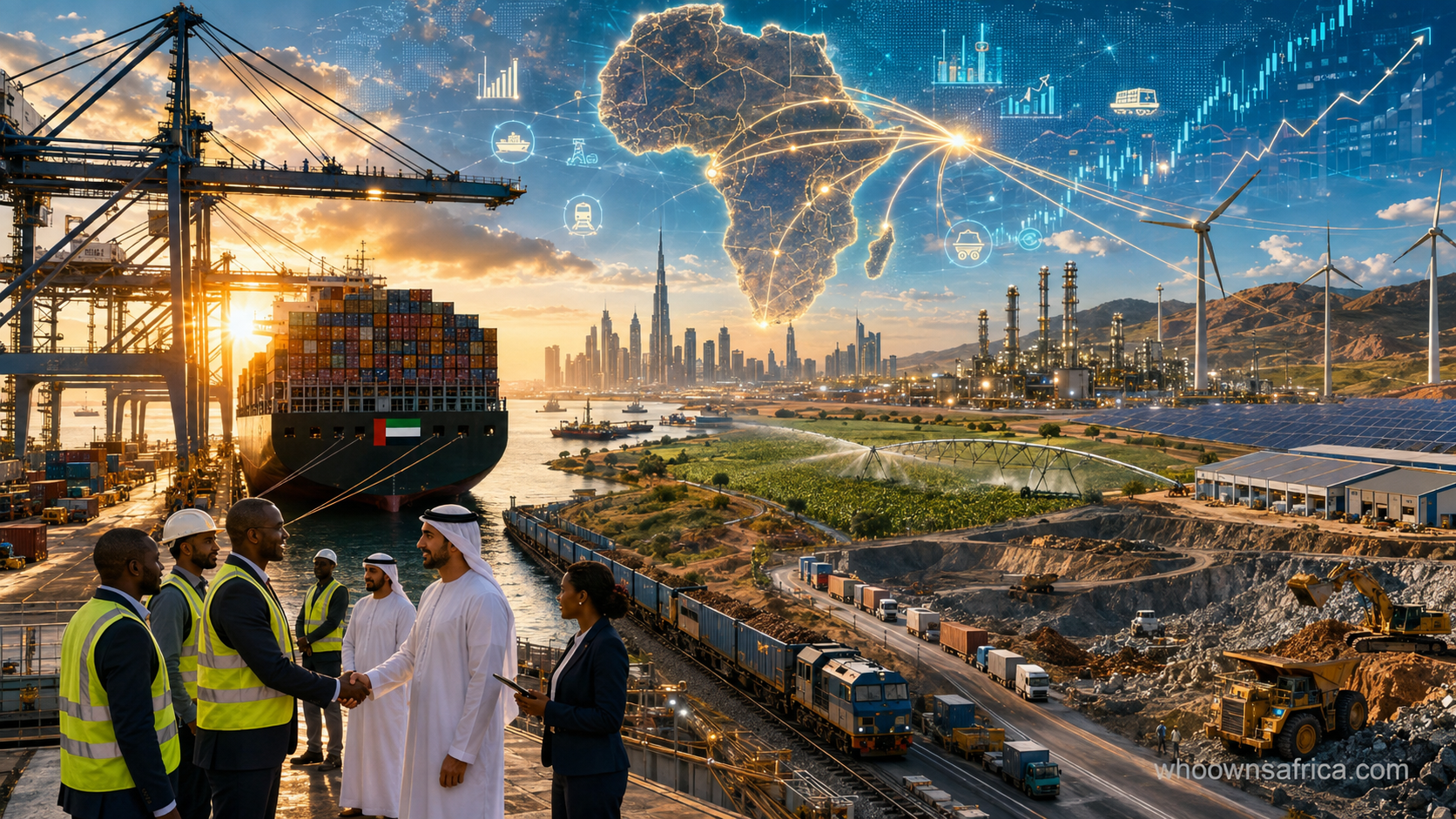
For decades, discussions about foreign investment in Africa were dominated by China, Europe and the United States. Today, another global player has quietly become one of the continent’s most influential economic partners. The United Arab Emirates is investing billions of dollars in African ports, mining, agriculture, renewable energy and logistics, reshaping trade routes and strengthening its influence across one of the world’s fastest growing regions.
From modern container terminals on the Atlantic coast to renewable energy projects in East Africa and mining ventures in Central Africa, Emirati companies are expanding at a remarkable pace. Their investments are helping governments finance projects that have struggled to attract funding while opening new markets for African exports.
The relationship represents more than a commercial opportunity. It reflects a strategic shift in global economics. As competition for critical minerals, food security and international trade routes intensifies, Africa has become central to the ambitions of several global powers. The UAE has positioned itself at the heart of that transformation.
For many African leaders, the arrival of Emirati capital is welcome. Infrastructure gaps remain one of the continent’s greatest barriers to economic growth. Ports require expansion, electricity networks need investment and transport systems must keep pace with rapidly growing populations.
Unlike many traditional development partners, the UAE often combines government support with private sector investment, allowing projects to move quickly from planning to construction. Emirati firms have built a reputation for financing commercially viable infrastructure while creating long term operating partnerships.
Supporters argue that this approach delivers practical results. New ports reduce shipping delays. Modern logistics networks improve exports. Renewable energy projects expand electricity access. Mining investments generate foreign exchange earnings and create employment opportunities.
Critics, however, caution that Africa’s experience with foreign investment has not always translated into broad based prosperity. They argue that governments must negotiate carefully to ensure strategic assets remain under national control and that local communities receive a fair share of the economic benefits.
As billions of dollars continue flowing into the continent, one question is becoming increasingly important.
Who ultimately owns the value created by Africa’s resources and infrastructure?
Why the UAE Is Investing in Africa
The UAE’s growing presence across Africa is no accident.
It forms part of a broader strategy to diversify its economy beyond oil while strengthening its position as one of the world’s leading trade and logistics hubs.
Located between Europe, Asia and Africa, the Emirates has built an economy centered on global commerce. Dubai has become one of the busiest transport and financial gateways in the world, connecting businesses across continents through aviation, shipping and financial services.
Africa fits naturally into that vision.
The continent is home to more than 1.5 billion people, a rapidly expanding middle class and some of the world’s richest deposits of minerals essential for the global energy transition. It also possesses vast agricultural land and enormous renewable energy potential.
For the UAE, investing in Africa serves multiple strategic objectives.
It secures access to important supply chains.
It strengthens food security by supporting agricultural production.
It creates commercial opportunities for Emirati companies.
It expands political and diplomatic influence across one of the world’s most important emerging markets.
This strategy is increasingly visible through state backed investment funds as well as private companies that operate across transport, energy, logistics and industrial sectors.
Rather than focusing on a single country, the UAE has developed partnerships across North, East, West and Southern Africa, allowing it to diversify investment while reducing commercial risk.
This continental approach has distinguished Emirati investors from many competitors who concentrate primarily on individual markets.
Another important factor is speed.
African governments often describe Emirati investors as commercially driven and capable of making decisions relatively quickly. In sectors where infrastructure shortages delay economic growth, rapid execution can become a significant competitive advantage.
The result is a growing network of commercial relationships that extends beyond investment alone.
Trade volumes continue expanding.
Direct flights between African cities and the Gulf have increased.
Financial links are becoming stronger.
Business leaders increasingly view Dubai as a gateway for African companies seeking access to international markets.
Together, these developments are gradually reshaping the economic relationship between Africa and the Gulf.
UAE Investment in African Ports
Perhaps nowhere is the UAE’s influence more visible than in African ports.
Modern ports are no longer simply places where ships load and unload cargo.
They are the backbone of international trade, determining how efficiently countries import machinery, export agricultural products and connect manufacturers with global supply chains.
Recognizing this, Emirati companies have invested heavily in maritime infrastructure across Africa.
Dubai based logistics giant DP World has become one of the continent’s most prominent port operators through investments in container terminals, logistics parks and transport corridors. Abu Dhabi Ports Group has also expanded its African footprint by investing in port management and maritime infrastructure.
For African economies, these investments can deliver immediate benefits.
Expanded terminals increase cargo handling capacity.
Modern digital systems reduce customs delays.
Improved logistics lower transportation costs for exporters.
Faster turnaround times make African ports more competitive against regional rivals.
These improvements can have effects that extend far beyond the ports themselves.
Farmers gain quicker access to export markets.
Manufacturers reduce delivery times.
Importers face fewer delays when bringing machinery and industrial equipment into the country.
Consumers ultimately benefit through more efficient supply chains.
Yet ports are also strategic national assets.
Control over maritime infrastructure influences trade flows, customs revenues and regional economic development.
That reality explains why port investments often attract close public scrutiny.
Supporters argue that foreign operators bring expertise, technology and investment that governments may struggle to provide on their own.
Critics counter that long term operating agreements require careful oversight to ensure countries retain sufficient control over critical infrastructure and receive appropriate financial returns.
The debate reflects a broader challenge facing many African governments.
Infrastructure requires capital.
Foreign investors require commercial certainty.
Balancing those two priorities is becoming one of the defining policy questions of Africa’s new investment era.
For the UAE, the commercial logic remains clear.
Efficient African ports strengthen trade routes connecting the Gulf with Europe, Asia and the wider African continent. They reinforce Dubai’s role as a global logistics hub while creating opportunities for Emirati shipping, finance and transport companies.
For Africa, the opportunity is equally significant.
If managed effectively, modern ports can become catalysts for industrialization rather than simply gateways for exporting raw materials.
The next stage will depend on whether governments succeed in linking these investments to manufacturing, value addition and regional trade under the African Continental Free Trade Area.
The future of African ports may therefore determine more than shipping efficiency.
It may shape how much of Africa’s economic value remains on the continent itself.
Mining and Critical Minerals Drive New Partnerships
If ports represent the arteries of African trade, critical minerals have become the lifeblood of the global green economy.
The rapid growth of electric vehicles, battery storage, artificial intelligence and renewable energy technologies has transformed minerals such as lithium, cobalt, copper, manganese, graphite and rare earth elements into strategic assets. Africa holds some of the world’s largest reserves of these resources, placing the continent at the center of an increasingly competitive global race.
The UAE has recognized this shift and is moving aggressively to establish itself as a major player in Africa’s mining sector.
Emirati companies and investment funds have expanded their presence through acquisitions, joint ventures and long term partnerships with governments and private mining firms. Their focus extends from copper in Zambia to cobalt in the Democratic Republic of Congo, bauxite in Guinea and gold production across several African countries.
For African governments, the renewed interest presents an opportunity to attract capital into an industry that often requires billions of dollars before a single mineral is exported.
Mining projects demand roads, railways, electricity networks and processing facilities. When structured effectively, these investments can stimulate broader economic development by creating supporting industries and improving infrastructure that benefits surrounding communities.
The challenge, however, lies in ensuring that Africa captures more value from its natural resources.
For decades, many countries exported raw minerals while higher value processing and manufacturing took place overseas. That model generated export earnings but left much of the economic value outside the continent.
Today, governments are increasingly seeking agreements that encourage local processing, mineral refining and battery manufacturing.
Several countries have introduced policies requiring investors to process part of their production domestically before export. These measures are intended to create skilled employment, expand industrial capacity and reduce dependence on raw commodity exports.
Whether Emirati investors embrace this transition could determine the long term impact of their mining activities.
If investment supports local manufacturing alongside extraction, Africa could move further up the global value chain.
If the focus remains primarily on exporting raw materials, the continent risks repeating a familiar cycle in which natural wealth creates limited industrial transformation.
Mining also raises important environmental and social questions.
Communities living near mining operations often expect improved healthcare, education, clean water and employment opportunities. Governments face growing pressure to ensure that investors meet environmental standards while protecting workers’ rights and respecting local communities.
Increasingly, responsible mining is becoming a competitive advantage rather than simply a regulatory requirement.
For the UAE, success in Africa’s mining industry will depend not only on financial investment but also on building trust with governments and communities that expect lasting economic benefits.
Agriculture and Food Security
Agriculture has become another cornerstone of the UAE’s engagement with Africa.
Unlike many African nations, the Emirates has limited farmland and scarce freshwater resources. It imports the vast majority of its food, making food security a national priority.
Africa offers a different picture.
The continent possesses around 60 percent of the world’s uncultivated arable land and enormous potential to expand agricultural production. From East African horticulture to West African grains and Southern African livestock, the opportunities are significant.
This has encouraged Emirati investors to finance commercial farming, irrigation systems, food processing facilities, storage infrastructure and agricultural logistics.
These investments are not simply about producing more food.
Modern agriculture depends on reliable transport, cold storage, efficient ports and processing plants capable of reducing post harvest losses. By investing across the entire value chain, Emirati companies are helping create more integrated food systems.
For African farmers, access to investment can increase productivity through improved irrigation, better seed varieties, modern machinery and stronger links to international markets.
Export oriented agriculture has already generated employment in several countries while increasing foreign exchange earnings.
However, agricultural investment also generates debate.
Civil society organizations have raised concerns about land rights, particularly where large scale farming projects involve long term land leases. Questions often arise about whether local communities are adequately consulted and fairly compensated.
Food security is another consideration.
Governments must strike a balance between encouraging agricultural exports and ensuring sufficient production for domestic markets. Export revenues are important, but they should not come at the expense of affordable food for local populations.
Many economists argue that the greatest opportunity lies in value addition.
Instead of exporting raw agricultural products, African countries can attract investment into food processing industries that create higher value products for regional and international markets.
This approach generates more employment, strengthens manufacturing and increases export earnings.
For the UAE, supporting food processing alongside agricultural production could create more resilient supply chains while contributing to Africa’s industrial development.
Renewable Energy Is Becoming a Priority
Energy is perhaps the most important ingredient of economic transformation.
Without reliable electricity, factories cannot operate efficiently, hospitals struggle to provide essential services and businesses face higher operating costs.
Despite significant progress over the past decade, hundreds of millions of Africans still lack dependable access to electricity.
This challenge has created one of the world’s largest opportunities for renewable energy investment.
The UAE has positioned itself as a major partner in this transition.
Through companies specializing in clean energy, Emirati investors are financing solar farms, wind projects and electricity infrastructure across multiple African countries.
For some observers, the strategy appears surprising.
The UAE built much of its wealth through oil and gas production. Yet it has also become one of the world’s leading investors in renewable energy, recognizing that global demand is gradually shifting toward cleaner sources of power.
Africa offers an ideal environment for this transition.
The continent receives some of the highest levels of solar radiation in the world. Large areas also possess significant wind, geothermal and hydroelectric potential.
Harnessing these resources could transform industries, expand electricity access and reduce dependence on expensive imported fuels.
Renewable energy also supports economic diversification.
Reliable power encourages manufacturing, technology development, digital services and industrial processing. Small businesses become more productive when electricity is stable, while rural communities gain new opportunities through expanded energy access.
For investors, renewable energy projects offer long term commercial returns supported by growing electricity demand.
For governments, they provide an opportunity to address one of the continent’s biggest development constraints.
The success of these projects will depend on more than financing alone.
Strong regulation, modern electricity grids and transparent procurement processes remain essential for attracting additional private investment.
If these conditions continue improving, renewable energy could become one of the defining pillars of the Africa and UAE economic relationship over the coming decades.
Logistics and Trade Corridors
Modern economies are built on more than ports and highways. They depend on integrated logistics systems that move goods quickly, efficiently and at competitive costs. Across Africa, the UAE has expanded beyond maritime infrastructure into warehouses, inland container depots, free trade zones, aviation and digital logistics platforms.
This broader strategy reflects a simple reality. A modern port has limited value if roads are congested, customs procedures are slow or cargo cannot reach inland markets efficiently.
Emirati companies are therefore investing across the entire supply chain.
The objective is to create trade corridors that connect African producers with regional and international markets while reinforcing the UAE’s position as a global logistics hub linking Africa, Asia and Europe.
For African exporters, improved logistics can reduce transport costs, shorten delivery times and increase competitiveness in international markets.
Agricultural producers can move perishable goods more quickly.
Manufacturers can import machinery with fewer delays.
Mining companies can transport minerals to ports more efficiently.
These improvements may appear technical, but they have significant economic consequences.
According to the African Development Bank, logistics costs remain among the highest in the world across many African economies. Reducing those costs can encourage industrial investment, strengthen regional trade and improve the competitiveness of African businesses.
The African Continental Free Trade Area adds another dimension.
As African countries lower trade barriers among themselves, demand for efficient transport and logistics networks is expected to increase substantially. Investors capable of building these networks are likely to play an increasingly important role in shaping the continent’s economic future.
The UAE is positioning itself to become one of those partners.
Why African Governments Welcome UAE Investment
African governments are actively seeking foreign investment, not simply because they need capital but because they need partners capable of delivering infrastructure, technology and commercial expertise.
Many countries face significant budget pressures.
Population growth is increasing demand for roads, ports, electricity and public services at a pace that government finances alone cannot sustain.
Private investment has therefore become an essential part of national development strategies.
The UAE offers several advantages.
Its companies often combine commercial financing with operational expertise.
Many have decades of experience managing ports, logistics networks, renewable energy projects and industrial infrastructure around the world.
African policymakers also value the speed at which many Emirati investors move from negotiations to implementation.
Large infrastructure projects frequently take years to secure financing from traditional development institutions.
Commercial investors from the Gulf are often viewed as more flexible and commercially driven.
Diplomatic relations have also strengthened.
Over the past decade, the UAE has expanded its political engagement across Africa through investment forums, trade agreements and high level government visits.
This growing diplomatic relationship has reinforced commercial partnerships while opening new opportunities for business cooperation.
For many African governments, the relationship is not viewed as a choice between the UAE, China, Europe or the United States.
Instead, leaders increasingly pursue diversified partnerships that reduce dependence on any single foreign investor.
Competition among investors can strengthen Africa’s negotiating position if governments are able to secure agreements that protect national interests.
Who Really Benefits From UAE Investments?
This is the question that sits at the center of every major foreign investment.
Who captures the value?
The answer is rarely straightforward.
For African governments, foreign investment brings capital that finances projects which might otherwise remain on the drawing board.
New ports increase trade.
Renewable energy expands electricity access.
Mining projects generate export earnings.
Agricultural investment supports food production and creates employment.
Communities often benefit from improved infrastructure, new business opportunities and better transport connections.
Thousands of workers find employment during construction and operations.
Local suppliers gain contracts.
Small businesses emerge around large investment projects.
The UAE also benefits.
Its companies earn commercial returns.
Its logistics sector gains access to growing African trade.
Its economy secures supplies of critical minerals and agricultural products.
Its global influence expands through stronger commercial relationships.
The challenge is ensuring that benefits are distributed fairly.
History has shown that natural resources alone do not guarantee prosperity.
Countries rich in oil, minerals or agricultural land have sometimes struggled to convert that wealth into higher living standards.
Good governance remains the deciding factor.
Transparent contracts, fair taxation, strong environmental regulation and effective public institutions determine whether investment creates broad based development or concentrates wealth among a small number of stakeholders.
For African countries, attracting investment is only the first step.
Managing it successfully is the greater challenge.
Challenges Facing African Countries
Transparency and Accountability
Public confidence depends on openness.
Citizens increasingly expect governments to disclose the terms of major investment agreements involving strategic national assets.
Transparent procurement processes reduce corruption risks and strengthen investor confidence.
When contracts remain confidential, public suspicion often grows regardless of whether projects ultimately succeed.
Local Value Addition
Exporting raw materials generates income, but processing those resources domestically creates significantly greater economic value.
Governments are increasingly encouraging investors to establish refineries, processing plants and manufacturing facilities alongside extraction projects.
This approach creates skilled employment while strengthening domestic industries.
Skills Development
Infrastructure alone cannot transform economies.
African workers need technical training that enables them to manage increasingly sophisticated industries.
Successful investment partnerships include knowledge transfer, vocational education and opportunities for local businesses to participate in supply chains.
These investments in human capital often deliver benefits that outlast individual projects.
Environmental Sustainability
Mining, agriculture and infrastructure development all have environmental impacts.
Governments must ensure that economic growth does not come at the expense of forests, water resources, biodiversity or local communities.
Investors that adopt international environmental standards are likely to face fewer disputes and enjoy stronger public support over the long term.
What the Future Holds
The economic relationship between Africa and the UAE is still evolving.
Several trends suggest that investment is likely to increase over the coming decade.
Demand for critical minerals is expected to remain strong as countries accelerate the transition toward cleaner energy technologies.
Renewable energy investment is likely to expand as African governments seek affordable electricity solutions.
Trade under the African Continental Free Trade Area is expected to create new demand for logistics infrastructure and transport corridors.
Agriculture will remain strategically important as Gulf countries continue strengthening food security.
Digital infrastructure, financial technology and artificial intelligence may also emerge as new areas of cooperation.
These developments point to a broader transformation.
The relationship is moving beyond aid and diplomacy toward long term commercial partnerships that influence trade, industrialization and economic policy.
Africa is no longer viewed simply as a source of raw materials.
It is increasingly seen as one of the world’s most important growth markets.
Conclusion
The United Arab Emirates has quietly become one of Africa’s most influential investors.
Its companies are reshaping ports, logistics networks, renewable energy projects, mining operations and agricultural supply chains across the continent.
These investments are creating opportunities that many African economies urgently need.
Modern infrastructure can reduce business costs.
Reliable electricity can support industrial growth.
Improved logistics can increase exports.
Strategic partnerships can accelerate economic development.
Yet investment alone cannot guarantee prosperity.
The countries that benefit most will be those that negotiate transparent agreements, strengthen public institutions and ensure that local businesses and workers participate in new industries.
Africa possesses the resources, the population and the markets needed to become a global economic powerhouse.
Foreign capital can help unlock that potential, but ownership of Africa’s future will ultimately depend on the decisions made by African governments, businesses and citizens.
The UAE’s investment story is therefore not just about billions of dollars flowing into the continent.
It is about whether those billions become the foundation for lasting African prosperity or another chapter in the long history of external powers seeking value from one of the world’s richest continents.
Frequently Asked Questions
Why is the UAE investing heavily in Africa?
The UAE is seeking to diversify its economy, strengthen food security, secure access to critical minerals, expand global trade routes and deepen economic partnerships with one of the world’s fastest growing regions.
Which sectors receive the most UAE investment in Africa?
Major sectors include ports, logistics, mining, renewable energy, agriculture, aviation, manufacturing and digital infrastructure.
What are the benefits of UAE investment in Africa?
Investment can improve infrastructure, create jobs, expand electricity access, strengthen exports, attract additional foreign capital and support industrial development.
What concerns do critics raise?
Common concerns include transparency, ownership of strategic assets, environmental protection, community benefits and ensuring African countries receive fair value from their natural resources.
What should African governments prioritize?
Experts say governments should focus on transparent contracts, value addition, local employment, skills development, environmental standards and policies that maximize long term economic benefits for citizens.

More from Finance

Who will own Africa’s next trillion-dollar businesses?
Africa’s next corporate giants may emerge from AI, energy, finance, mining, logistics and consumer markets rather than traditional industries.

MTN Rwanda’s profit surge shows how mobile money is reshaping Africa’s digital economy
Rwanda’s mobile-money boom is turning telecom networks into financial infrastructure, creating a new investment frontier across Africa.
Who will control East Africa’s new digital payments network?
East Africa is building a faster, more connected payments ecosystem, opening a new contest among banks, fintechs, central banks and technology companies.