

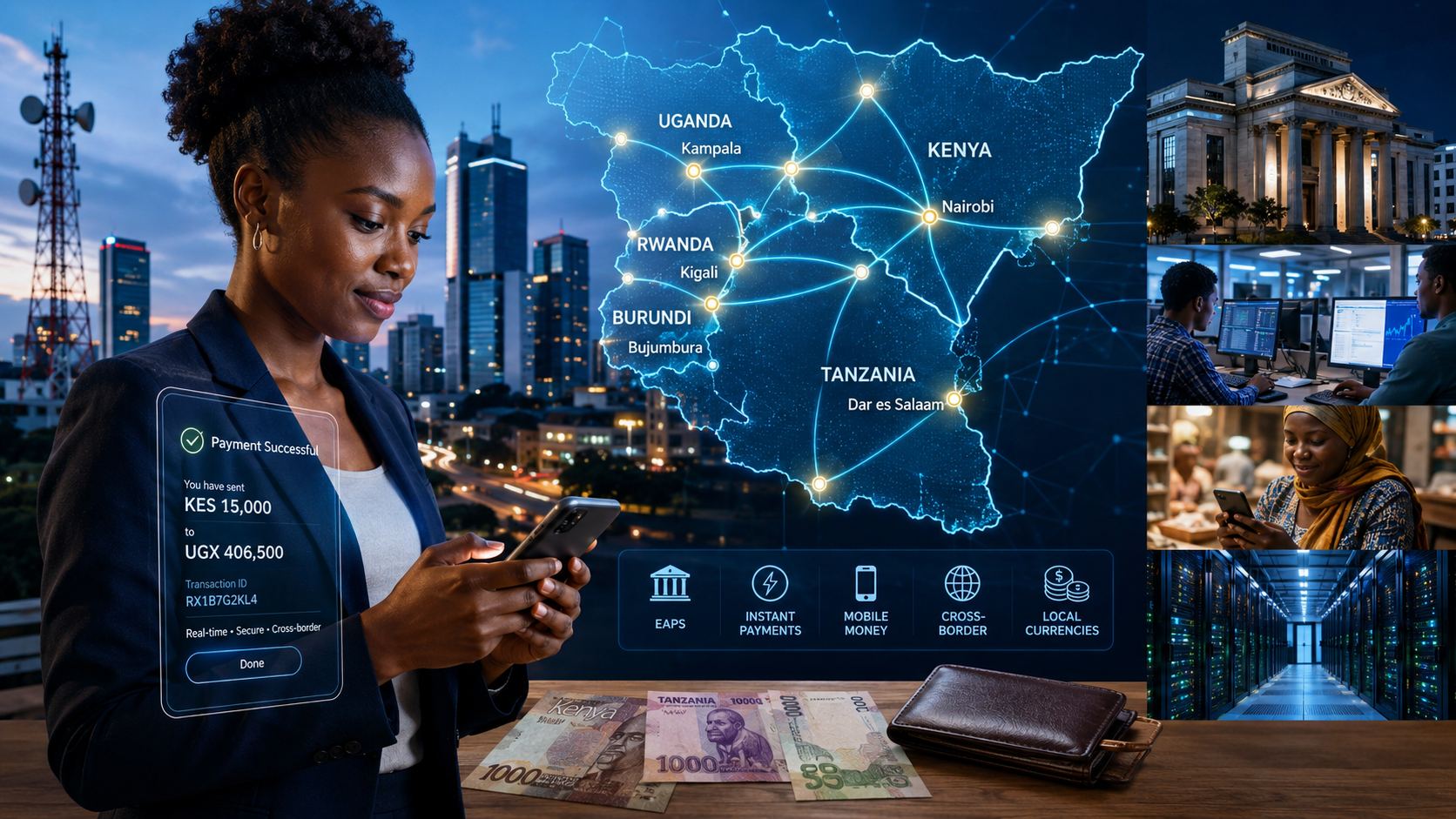
East Africa is entering a new phase of financial integration as Kenya, Uganda, Tanzania and Rwanda deepen cross-border payment links, while Burundi works toward integration. The emerging network could reshape how money moves across the region and determine which institutions capture the next wave of digital finance growth.
For years, sending money across an East African border could be surprisingly complicated. A trader in Kampala paying a supplier in Nairobi, a Tanzanian business settling an invoice in Kigali or a Kenyan company receiving money from Uganda often had to navigate banks, foreign exchange costs and settlement systems that were designed primarily for national markets.
That is beginning to change.
The East African Payment System, known as EAPS, already links the real-time gross settlement systems of Kenya, Uganda, Tanzania and Rwanda. The system allows participating commercial banks to process cross-border payments using regional currencies, providing a foundation for deeper financial integration.
But EAPS is only part of the story.
The East African Community is now pursuing a broader regional payment architecture that reaches beyond traditional bank-to-bank transfers. The ambition is to connect instant payment systems, banks, mobile money platforms and other payment service providers so that money can move across borders as easily as it does within national markets.
That raises a bigger question for investors and businesses: who will control the rails through which East Africa’s money moves?
The network is getting bigger
EAPS went live in November 2013 and was designed to improve the speed, security and efficiency of cross-border payments. Today, Kenya, Tanzania, Uganda and Rwanda are connected through their respective central bank settlement infrastructure.
Burundi remains an important piece of the expansion puzzle.
The EAC’s Cross-Border Payment System Masterplan identifies Burundi’s EAPS connection as under development. It also shows that the region is working toward a wider architecture capable of supporting more countries and more types of payment providers.
Burundi is expected to strengthen its participation as the necessary infrastructure and integration work progresses. A December 2026 target has been discussed in the regional payments conversation, but current EAC documentation describes Burundi’s EAPS connection as under development rather than confirming a final go-live date.
That distinction matters.
The strategic direction is clear even if individual implementation dates can move.
The EAC says it wants a payment environment that is faster, cheaper, safer and more interoperable. Its 2025 Cross-Border Payment System Masterplan calls for upgrades to EAPS, including improvements to clearing, settlement, liquidity management, foreign exchange processes, governance and connectivity.
Central banks hold the keys
At the centre of the system are the region’s central banks.
The Central Bank of Kenya, Bank of Uganda, Bank of Tanzania and National Bank of Rwanda provide the infrastructure and regulatory oversight that allows commercial banks to participate in regional settlement.
Their role gives them considerable influence over the future of East African payments.
Central banks determine the rules under which payment systems operate, oversee settlement risks and help shape standards for banks and payment service providers.
But central banks are unlikely to capture all of the economic value created by the new network.
Their infrastructure creates the foundation. Commercial banks, fintechs and technology companies will compete for the customer relationship built on top of it.
That is where the next contest begins.
Banks still control the money pipes
Commercial banks remain among the biggest beneficiaries of EAPS because the system is fundamentally connected to national banking infrastructure.
Banks can use regional payment rails to serve exporters, importers, multinational companies and consumers with cross-border financial services.
For a bank with large corporate customers, the opportunity goes beyond simply transferring money.
Cross-border payments can lead to foreign exchange transactions, working-capital loans, trade finance, cash management, merchant services and other financial products.
The institution that controls a company’s payment relationship can potentially control a much larger share of its financial activity.
Kenyan banks have an especially important position because Kenya has developed one of Africa’s most sophisticated digital financial ecosystems. But competition is regional, and banks in Tanzania, Uganda and Rwanda are also positioned to benefit as payment links deepen.
Fintechs want the customer
The most disruptive players may not be traditional banks.
East Africa’s fintech industry has already demonstrated that customers do not necessarily need to interact with a bank branch to move money.
Mobile money has transformed payments in Kenya, Uganda, Tanzania and Rwanda, while digital wallets and payment switches are creating new ways for consumers and businesses to transact.
The next opportunity is interoperability.
Imagine a Kenyan customer sending money to a Ugandan mobile wallet without manually navigating a complex international transfer process. Or a Tanzanian small business paying a supplier in Rwanda directly from its digital account.
That is the type of experience regional payment integration is designed to make possible.
The EAC is already working on this broader vision. In 2025, Rwanda and Tanzania began work to link Tanzania’s Instant Payment System, TIPS, with Rwanda’s national payment switch, RSwitch. In July 2026, the two countries advanced a proof of concept aimed at enabling real-time, secure and affordable cross-border transactions.
This could prove more important for ordinary consumers than traditional EAPS transfers.
The battle moves beyond EAPS
EAPS is primarily associated with bank and central-bank settlement infrastructure.
The emerging regional instant-payment architecture is broader.
The EAC’s masterplan envisages stronger links between national instant payment systems and payment providers, including banks and non-bank providers. Kenya, for example, has PesaLink, while Tanzania operates TIPS and Rwanda has RSwitch and eKash infrastructure.
This creates the possibility of a layered payments market.
At the bottom are central bank settlement systems.
Above them are national switches and instant payment platforms.
Then come banks, mobile money operators, fintechs and merchants.
At the top is the customer experience, where applications and digital wallets compete for users.
The company that owns the infrastructure does not necessarily own the customer.
Conversely, the company that owns the customer may have enormous commercial power even if it does not operate the underlying settlement infrastructure.
Kenya’s advantage
Kenya enters the contest with a strong digital payments base.
The country has a mature mobile money market, a large banking sector and private payment infrastructure connecting banks and other financial institutions.
In February 2026, PesaLink announced a partnership with the Pan-African Payment and Settlement System, or PAPSS, allowing instant cross-border payments from PAPSS participants into banks and mobile money operators within Kenya’s PesaLink network, with settlement in local currencies.
That development illustrates how the payments race is no longer confined to EAC institutions.
East African companies are becoming connected to continental payment networks at the same time that the EAC is building its own regional architecture.
The result could be a highly interconnected African payments market.
Tanzania and Rwanda are building alternatives
Tanzania and Rwanda could become important centres of innovation because both are pursuing direct interoperability between national instant payment systems.
The Rwanda-Tanzania pilot is particularly significant because it seeks to connect bank accounts and mobile money wallets across borders in real time.
The EAC says the initiative could serve as a model for expanding interoperable payment systems across the region.
If that model succeeds, the competitive advantage may shift from simply having a national payment system to having a system that connects efficiently with everyone else.
In that environment, interoperability becomes an asset.
The technology companies
Behind the banks and fintechs is another group with enormous influence: technology providers.
Payment systems depend on telecommunications networks, cloud infrastructure, cybersecurity, identity verification, software, data centres and messaging standards.
The EAC masterplan recognises the need for technical upgrades, stronger connectivity and improved integration with other financial market infrastructure.
Technology companies therefore have an opportunity to become the invisible infrastructure behind East Africa’s financial integration.
But the risks are significant.
A regional payment network becomes a highly attractive target for fraudsters and cybercriminals. The EAC’s masterplan highlights persistent challenges around money laundering, fraud, cybersecurity, consumer protection and inconsistent regulatory frameworks across member states.
The bigger the network becomes, the greater the consequences of a major disruption.
The currency problem
East Africa’s payment revolution also faces a fundamental obstacle: there is no single regional currency.
EAPS works across local currencies, but foreign exchange remains an important part of the cross-border payment process.
The EAC masterplan notes that multiple settlement currencies create additional liquidity and foreign exchange requirements for payment providers. It proposes examining ways to improve currency convertibility, liquidity management and settlement arrangements.
That means the future of digital payments is closely connected to the future of monetary integration.
EAC central bank governors renewed efforts in July 2026 to advance reforms toward a regional monetary union, with a target of establishing a single currency by 2031.
A common currency would fundamentally change the economics of cross-border payments.
Until then, payment providers will have to manage a multi-currency environment.
Who owns the future?
The answer may not be one bank, one fintech or one technology company.
The future East African payments network is more likely to be controlled through layers of influence.
Central banks will control the rules and settlement foundations.
Commercial banks will control major corporate relationships and significant pools of liquidity.
Mobile money operators and fintechs will compete for everyday consumers and small businesses.
Payment switches will connect different parts of the ecosystem.
Technology companies will provide much of the infrastructure beneath it.
And governments will determine how open, competitive and interoperable the market becomes.
The biggest winner may therefore be the institution that can connect all these layers rather than simply dominate one.
A new financial battleground
The significance of East Africa’s payments transformation extends beyond sending money.
A seamless regional payment system could make it easier for businesses to trade, workers to receive money, consumers to shop across borders and entrepreneurs to sell services throughout the EAC.
The African Development Fund approved a $9 million grant in June 2026 for a regional project aimed at strengthening financial integration, payment systems and capital markets across East and the Horn of Africa. The project covers Burundi, the Democratic Republic of Congo, Ethiopia, Kenya, Rwanda, Somalia, South Sudan, Tanzania and Uganda.
That investment reflects a wider economic reality.
Payment infrastructure is becoming economic infrastructure.
The companies that capture the flows moving through these systems could gain valuable data, customers and transaction revenue. Governments, meanwhile, could gain stronger visibility over economic activity and cross-border trade.
For consumers, the prize is simpler: cheaper, faster and more reliable payments.
For businesses, it is access to a larger regional market.
For investors, it is the emergence of a new digital infrastructure sector.
And for East Africa, it could be one of the most important steps yet toward making regional economic integration work in everyday life.
The question is no longer whether East Africa will build a digital payments network.
It is who will control the gateways, platforms, technology and customer relationships that make the network valuable.
That contest is only beginning.

More from Business

Who owns Quickmart? Inside Kenya’s KSh15 billion supermarket IPO
Quickmart’s public listing exposes how Kenyan retail, private equity and everyday consumer power are quietly reshaping who owns the country’s economy.

How Mr Eazi became a major shareholder in Ghana’s pharmaceutical industry
Nigerian musician Mr Eazi's investment firm Zagadat Capital has quietly built a major stake in a Ghanaian drug maker.

Who owns Africa’s new wealth? The companies and sectors creating the continent’s next billionaires
African governments are competing for global capital with tax incentives, but the bigger question is who will own the wealth created.