
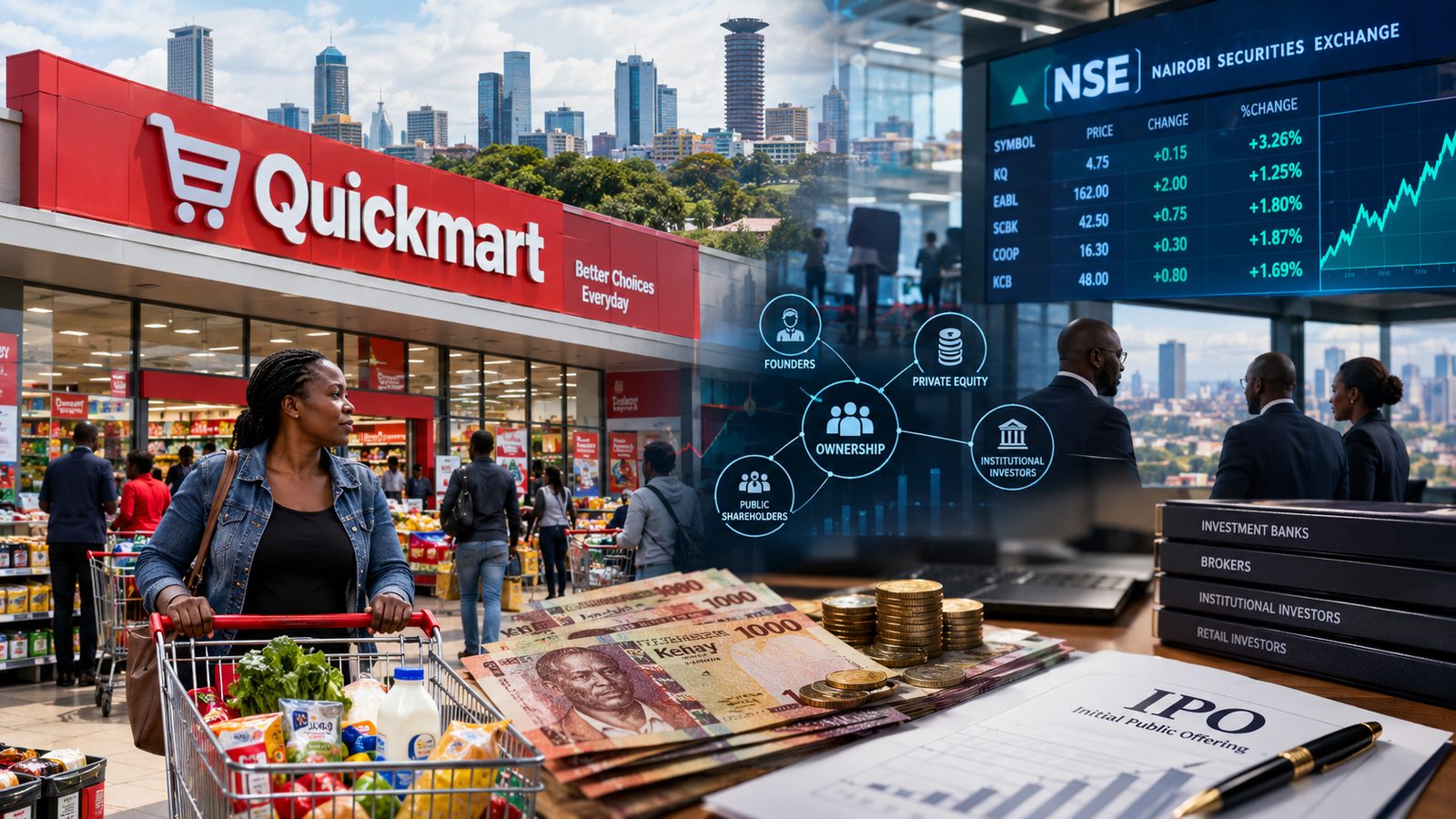
There is something deceptively ordinary about Quickmart’s planned journey to the Nairobi Securities Exchange. Millions of Kenyans know the red signs, the crowded aisles and the familiar ritual of buying milk, bread, vegetables and household goods. Yet behind that everyday experience sits a far more consequential question: when a supermarket becomes a public company, who actually owns the economic power built from millions of ordinary shopping decisions?
That is the question worth asking about Quickmart.
The supermarket’s planned listing has been presented as an opportunity for Kenyans to buy a piece of a business they already use. That is true, but it is only part of the story. The deeper story is about how a family business that began in Nakuru became an institutional investment, how private equity helped accelerate its national expansion, and why its existing owners are now prepared to sell a substantial portion of their stake to the public.
Quickmart says the offer involves 2 billion existing ordinary shares, representing 50% of its issued share capital. The shares are being sold by Sokoni Retail Kenya Limited, the company’s existing shareholder. At the announced offer price of KSh7.50 per share, the transaction represents KSh15 billion before any additional allotment. Importantly, Quickmart itself is not receiving the proceeds from the sale. The money goes to the existing shareholder.
That distinction changes the meaning of the IPO.
This is not simply a growth story
The easy interpretation is that Quickmart is going public because it needs money to build more stores.
But that is not what this transaction principally does.
This is an offer for sale. Existing owners are opening the shareholder register and monetising part of their investment. Quickmart will become publicly owned in part, but the company is not issuing new shares to refill its balance sheet with IPO cash.
That makes the transaction less about rescuing a company or financing survival and more about turning private ownership into liquid public ownership.
It is a significant difference.
For the public investor, the question is therefore not simply whether Quickmart can grow. The question is whether the price being paid for that future growth represents a fair exchange between the people selling today and the people buying tomorrow.
That is where the real story begins.
From Nakuru family business to national retailer
Quickmart’s origins are distinctly Kenyan.
The company says it began in Nakuru in 2006 as a family-owned supermarket founded by the late John Kinuthia. From that single-store beginning, the business expanded beyond Nakuru and eventually became a much larger national retailer.
The decisive transformation came later.
In 2019, Adenia Partners invested in Quickmart following its earlier investment in Tumaini Self Service. The two businesses were subsequently brought together under the Quickmart brand. The combination created a larger platform and introduced a more institutional model of management and expansion.
This is the part of Quickmart’s history that deserves more attention.
The supermarket did not simply grow because Kenyans suddenly started shopping more.
It grew through a combination of entrepreneurship, consolidation, private capital, professional management and an opportunity created by the collapse of several once-dominant Kenyan supermarket chains.
The failure of Nakumatt, Tuskys and Uchumi changed the competitive landscape. Space was suddenly available. Customers needed alternatives. Prime retail locations became available. A company with capital and ambition could move quickly.
Quickmart did.
Today, the company says it has more than 70 stores across Kenya, employs thousands of people and works with hundreds of suppliers. It has become part of the infrastructure of everyday consumption.
That is why its ownership matters.
So who actually owns Quickmart?
The answer is more complicated than a single name.
Quickmart is wholly owned by Sokoni Retail Kenya Limited before the public offer. Sokoni is the investment vehicle through which Adenia-managed funds, Quickmart and Tumaini founders, and Group CEO Peter Kang’iri hold their interests.
The exact proportions of those underlying interests have not been publicly disclosed in the material available to investors.
That opacity is not necessarily unusual in private equity structures. Investors frequently hold companies through special-purpose or holding vehicles. But it does make the question of ownership more interesting.
Because when Kenyans hear that they will be able to “own Quickmart”, they may imagine a clean transition from private ownership to public ownership.
It is not that simple.
The existing shareholder group is not disappearing.
Without the over-allotment option, Sokoni is expected to retain roughly 50% of Quickmart after the offer. If the additional allotment is fully exercised, that holding could fall to approximately 42.5%.
In other words, the public can become a significant new shareholder base while the existing owners retain substantial influence.
That is not a flaw.
It is simply the structure investors need to understand.
The private equity question
There is another reason the Quickmart transaction deserves scrutiny.
Adenia Partners is a private equity investor.
Private equity is built around a basic proposition: invest capital in businesses, improve their value, grow them, and eventually realise returns for investors.
That is not inherently controversial. In fact, private capital has played an important role in expanding businesses across Africa where traditional sources of long-term financing can be limited.
But private equity also forces an uncomfortable question.
Who captures the value created by growth?
In Quickmart’s case, the answer is changing.
For years, the value created by the business was largely captured within a private ownership structure. Now the ownership is being widened. Pension funds, asset managers, institutions and individual Kenyans can potentially participate in the future economics of the retailer.
The IPO therefore represents more than a change in financing.
It represents a transfer of economic participation.
What are investors actually buying?
They are buying exposure to Kenyan consumption.
That may sound simple, but it is one of the most important economic themes in Africa.
Every Quickmart branch is effectively a collection point for thousands of economic relationships.
There are farmers producing food.
Manufacturers supplying packaged goods.
Transport companies moving products.
Banks financing transactions.
Technology companies powering payments and inventory systems.
Landlords providing retail space.
Workers earning wages.
Customers converting income into consumption.
Quickmart sits in the middle of all of this.
Its reported FY2025 revenue was KSh50.4 billion, with reported profit after tax of KSh1.51 billion. For the first half of 2026, the company reported unaudited revenue of KSh27.3 billion and profit after tax of KSh873 million.
Those figures illustrate the scale of the machine.
But revenue is not ownership.
And size is not automatically profitability.
Investors will still have to consider competition, consumer purchasing power, rents, wages, logistics, supplier relationships and the cost of opening new stores.
The Naivas comparison matters
Quickmart cannot be understood in isolation.
Its real test is the structure of Kenyan modern retail.
Naivas remains a major player. Carrefour has established a strong presence. Smaller supermarket chains and specialist retailers continue to compete for the same increasingly sophisticated consumer.
The competitive question is no longer simply who has the most branches.
It is who can offer the right combination of price, location, product availability, convenience, technology and customer loyalty.
This is where Quickmart’s future becomes particularly interesting.
Its advantage is its understanding of the Kenyan mass market and its broad physical footprint. Its challenge is maintaining that advantage as competition becomes more sophisticated.
Modern retail is expensive.
A store must be stocked before customers arrive. Products can expire. Theft must be controlled. Refrigeration costs money. Employees must be paid. Logistics must work every day. Rent continues even when sales weaken.
The supermarket business looks simple from the customer’s side.
It is anything but simple behind the shelves.
The IPO may test Kenya’s capital market
There is another question that should concern policymakers.
Can ordinary Kenyans become meaningful owners of the businesses that dominate their daily lives?
Kenya has a long history of public participation in major share offerings. But enthusiasm at the IPO stage is not the same as sustained ownership.
A successful listing should ideally create long-term shareholders, not merely short-term speculation.
That means financial education matters.
It also means transparency matters.
Investors need to understand the difference between revenue and profit, between a primary issue and an offer for sale, between valuation and market price, and between owning a few shares and having meaningful influence.
The Quickmart transaction provides an opportunity for that education.
The money question
At KSh7.50 per share, the offer values the entire 4 billion-share company at roughly KSh30 billion.
The headline KSh15 billion figure can therefore be misleading if readers assume all of that money will flow into Quickmart’s expansion.
It will not.
The offer is principally a partial exit by existing shareholders.
That does not make it bad.
It makes it different.
The sellers are effectively saying that this is the point at which part of the value they have built can be converted into cash while the company continues under public ownership.
The buyers, meanwhile, are saying they believe Quickmart’s future is worth investing in at the offered valuation.
Every IPO is ultimately a negotiation between those two beliefs.
Who wins if Quickmart succeeds?
Ideally, everyone involved.
The company benefits from a stronger public profile and potentially broader access to capital markets in the future.
Employees benefit if growth produces better jobs and career opportunities.
Suppliers benefit if the retailer continues expanding.
Farmers benefit if procurement grows and local supply chains deepen.
Customers benefit if competition keeps prices and service levels under pressure.
Public shareholders benefit if profits and dividends grow.
But there is a more profound possibility.
A successful Quickmart listing could help change the relationship between Kenyan consumers and Kenyan companies.
For decades, many people have experienced large businesses primarily as customers, workers or borrowers.
Share ownership creates another relationship.
It makes them investors.
That is potentially more important than the IPO itself.
The real question is ownership
The phrase “Who Owns Quickmart?” sounds like it should produce a list of names.
The more important answer is structural.
A Kenyan entrepreneur started the business.
Private equity helped transform and scale it.
Professional managers helped build the national operation.
Thousands of employees now sustain it.
Hundreds of suppliers depend on it.
Millions of customers generate its revenue.
And now the public is being invited to own part of it.
That is the evolution of modern African capitalism in miniature.
The ownership of Africa’s economy is increasingly moving through layers of founders, private equity funds, institutional investors, pension money and ordinary shareholders.
The supermarket aisle rarely looks like a capital market.
But it is one.
Every basket tells a story about income. Every supplier relationship tells a story about industrial power. Every store tells a story about land and urbanisation. Every share tells a story about who gets to participate in the wealth created.
Quickmart’s IPO is therefore not simply about whether Kenyans should buy supermarket shares.
It is about whether Kenyans can increasingly become owners of the economy they spend their lives building.
That is the bigger test.
And that is why the most important question is not only who owns Quickmart today?
It is who will own Kenya’s next generation of companies tomorrow?

More from Business

How Mr Eazi became a major shareholder in Ghana’s pharmaceutical industry
Nigerian musician Mr Eazi's investment firm Zagadat Capital has quietly built a major stake in a Ghanaian drug maker.

Who owns Africa’s new wealth? The companies and sectors creating the continent’s next billionaires
African governments are competing for global capital with tax incentives, but the bigger question is who will own the wealth created.

Uganda’s oil gets a name: “Pearl Sweet” as first oil draws near
Uganda’s long-awaited oil era is nearing reality, but questions remain over ownership, revenues, local benefits and who ultimately controls the wealth.