

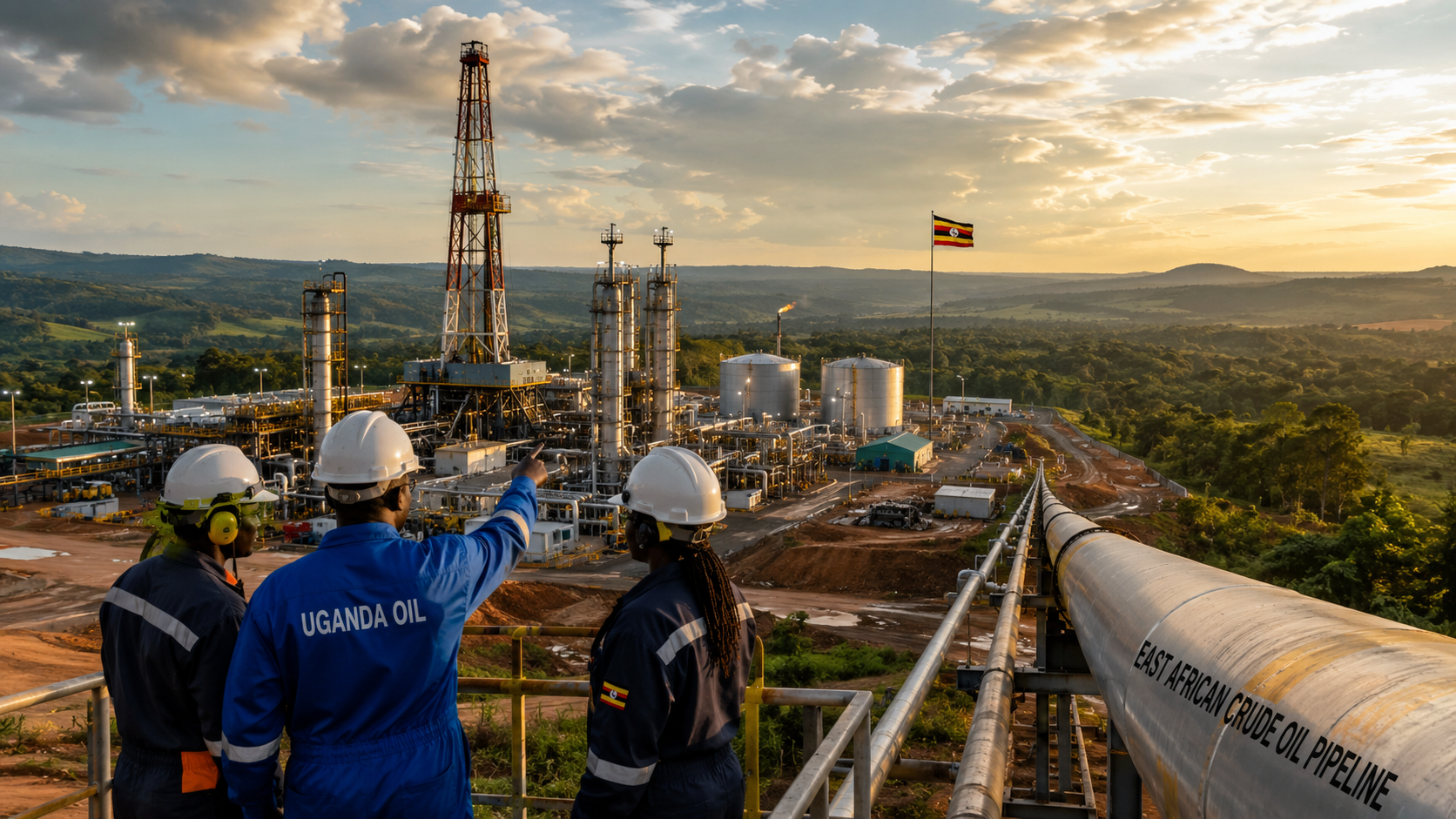
Uganda has given its crude oil a name, “Pearl Sweet”, marking a symbolic moment for a country that has spent nearly two decades waiting to turn its petroleum discoveries into commercial production.
But as the first barrels move closer to the market, the more consequential question is no longer simply when Uganda will produce oil, but who will own, control and benefit from the wealth it generates.
President Yoweri Museveni unveiled the name on Wednesday at the Kingfisher Development Area in Kikuube District, giving Uganda’s crude a commercial identity ahead of expected first oil. The timing is significant. After years of delays, construction and infrastructure challenges, the country’s petroleum industry is now moving from development towards production, export and revenue collection. Reuters reported that Uganda expects commercial oil production to begin by the end of 2026.
The name “Pearl Sweet” carries both national symbolism and a technical meaning. “Pearl” refers to Uganda’s long-standing description as the Pearl of Africa, while “sweet” reflects the crude’s low sulphur content. Uganda’s crude is expected to be exported as a blended grade produced from the Kingfisher and Tilenga developments. Its market identity will matter because crude grades are traded according to characteristics such as density, sulphur content and refining properties.
First oil is finally within reach
The latest project figures suggest Uganda is approaching one of the most important milestones in its economic history.
At Kingfisher, operated by China’s CNOOC Uganda, the project is reported to be about 80% complete overall, while first oil readiness has reached 98%. Commissioning and testing are underway, with government officials expecting first oil by the end of September. The central processing facility has reached mechanical completion and is designed to handle about 40,000 barrels of crude per day.
Kingfisher is only one part of the production system. The much larger Tilenga development, operated by TotalEnergies, is expected to produce about 190,000 barrels per day at peak. Together, the two projects are expected to reach approximately 230,000 barrels per day at plateau production.
More than 210 wells had been drilled by July, according to officials, exceeding the minimum number required for initial production. That progress indicates that the physical production system is becoming increasingly ready, although commercial oil production still depends on the successful completion and commissioning of the wider infrastructure network.
The crude itself presents an unusual transportation challenge. Uganda’s oil is waxy and can solidify at normal temperatures, meaning it must be kept heated during transportation. That requirement has shaped the design of the East African Crude Oil Pipeline, or EACOP.
The pipeline changes everything
The 1,443 kilometre EACOP will connect Uganda’s oil fields in the Albertine region to the export terminal at Tanga on Tanzania’s Indian Ocean coast.
The pipeline has reached 92.7% overall completion, according to EACOP and Uganda’s energy officials. The company said the project had generated more than 12,000 direct jobs, including more than 4,000 Ugandans, as well as more than 20,000 indirect employment opportunities.
The pipeline is strategically important because Uganda is landlocked. Without an export route to the coast, commercial production on the scale planned by the government and its partners would be difficult to realise.
EACOP will therefore become more than a piece of infrastructure. It will be the physical link between Uganda’s underground reserves and the international oil market. Once production begins, the pipeline will determine how a substantial portion of Uganda’s crude reaches global buyers.
The project also illustrates why Uganda’s oil story is not simply about the oil fields. It is about an interconnected chain involving drilling, processing, transportation, trading, refining, taxation, government revenues and international investment.
That is where the question of ownership becomes much more important.
So, who owns Uganda’s oil?
The ownership structure is straightforward on paper, but the economics are more complicated.
The upstream projects are being developed by a joint venture in which TotalEnergies holds 56.67%, CNOOC holds 28.33% and Uganda National Oil Company, or UNOC, holds 15%. TotalEnergies operates Tilenga, while CNOOC operates Kingfisher.
This means Uganda does have a direct commercial stake through its national oil company. But the country’s interests extend beyond UNOC’s 15% participating interest.
The Ugandan state also has a claim on petroleum revenues through the fiscal and production-sharing arrangements governing the industry. Government revenues can include taxes, royalties and other payments associated with petroleum operations, while the state’s commercial participation provides another avenue through which Uganda can benefit.
The distinction matters because ownership of an oil field is not the same thing as ownership of every dollar generated by the resource.
A foreign company can hold a majority participating interest while the host government captures a significant share of the economic value through the fiscal system. Conversely, a government can have a formal stake in an oil project while still losing much of the potential national benefit if costs rise, oil prices fall, production disappoints or revenues are poorly managed.
Uganda is therefore entering a period in which the quality of governance could matter as much as the volume of oil beneath the ground.
The real test begins after first oil
The excitement surrounding first oil is understandable. Uganda has waited years for this moment and invested billions of dollars in developing its petroleum industry.
But first oil itself will not make Uganda wealthy.
The real test will be what happens to the revenues after production begins.
President Museveni has repeatedly warned against using oil income for short-term consumption. At the Pearl Sweet ceremony, he argued that an exhaustible resource should be used to build productive assets that remain after the oil has been depleted. His priorities include electricity generation, transport infrastructure, railways, education and other long-term investments.
That argument reflects a broader challenge faced by oil-producing African economies. Petroleum can generate enormous revenues, but it can also create dependence, corruption risks, inequality and weak incentives to diversify the wider economy.
Uganda has a framework for managing petroleum revenues. The Public Finance Management Act provides for petroleum revenues to be deposited into a Petroleum Fund, with oversight mechanisms intended to support accountability and intergenerational benefit. Uganda also joined the Extractive Industries Transparency Initiative in 2020 as part of efforts to improve transparency in the sector.
The existence of these systems, however, is only the beginning. Their effectiveness will depend on how consistently they are implemented, scrutinised and protected from political pressure.
Local businesses want a bigger share
There is another ownership question that is often overlooked: who owns the businesses created around the oil industry?
Uganda’s energy ministry said on Wednesday that investment in the oil and gas industry had reached about $7 billion, with Ugandan companies securing contracts worth approximately $2.27 billion. More than 18,000 Ugandans were reportedly directly employed across the sector.
Those numbers matter because the long-term economic impact of oil will not be measured only by government revenue.
It will also be measured by whether Ugandan companies become suppliers, contractors, technology providers, logistics operators, financiers and service companies capable of competing after the major construction projects are completed.
The danger is that an oil boom can create the appearance of economic transformation while leaving the most valuable parts of the supply chain controlled by foreign companies.
For Uganda, local content is therefore central to the ownership debate. The more domestic companies can capture value across the petroleum supply chain, the greater the chance that oil production will stimulate broader industrial development.
Refining could change the equation
Uganda is also seeking to capture more value by developing refining capacity.
Museveni has argued that Uganda should not simply export crude and continue importing large quantities of refined petroleum products. The government has linked the refinery to energy security, industrialisation and a reduction in the country’s petroleum import bill.
This is an important part of the wider strategy.
Selling crude is one business. Producing refined fuels, petrochemicals and other higher-value products is another. If Uganda can successfully develop downstream industries around its petroleum resources, the economic impact could extend well beyond the value of exported barrels.
But that opportunity also comes with risks. Refining projects require substantial capital, reliable infrastructure, competent management and access to markets. The economics can change rapidly depending on crude prices, refining margins and global energy demand.
The environmental question remains
Uganda’s oil development has also attracted criticism over environmental and climate concerns, particularly surrounding EACOP and the development of oil resources near sensitive ecosystems.
The government and project partners argue that petroleum development can finance economic transformation while infrastructure projects are accompanied by environmental management and restoration measures. EACOP says it has committed to planting 500,000 indigenous trees as part of restoration efforts along the pipeline corridor.
The debate is unlikely to disappear once oil begins flowing.
Instead, it will become part of the broader question of whether Uganda can balance petroleum development with environmental protection and a gradual transition towards lower-carbon energy systems.
Pearl Sweet is only the beginning
For Uganda, the naming of Pearl Sweet is more than branding.
It signals that the country is moving closer to becoming an oil-producing and exporting nation after years of preparation. Kingfisher is nearing first oil, Tilenga is advancing, and EACOP is approaching completion.
But the most important chapter will begin after the cameras leave the oil fields.
Ugandans will want to know how much money the government receives, where that money goes, which companies benefit, how many local businesses grow, whether oil-producing communities see lasting improvements and whether the country converts temporary petroleum income into permanent economic capacity.
That is why the question behind Uganda’s new crude name is bigger than the name itself.
Pearl Sweet may soon enter international oil markets, but the real measure of Uganda’s oil success will be whether the wealth beneath the ground becomes wealth that Ugandans can see, own and pass on to future generations.

More from Business

Who gets to own Africa’s biggest industrial projects? The Dangote IPO reveals the barriers
Africa’s biggest refinery share sale raises a fundamental question about wealth creation: can Africans invest across borders as easily as capital moves across continents?

ICEA Lion: The Ndegwas buy back what they once sold
The ICEA Lion buyback is more than a family deal; it exposes the changing balance between local capital, foreign investors and control.
DP World extends Luanda port deal to 2051 as Gulf influence expands in Angola
DP World’s Luanda extension reveals how Gulf capital is reshaping African trade infrastructure through long-term concessions, logistics and strategic access.