

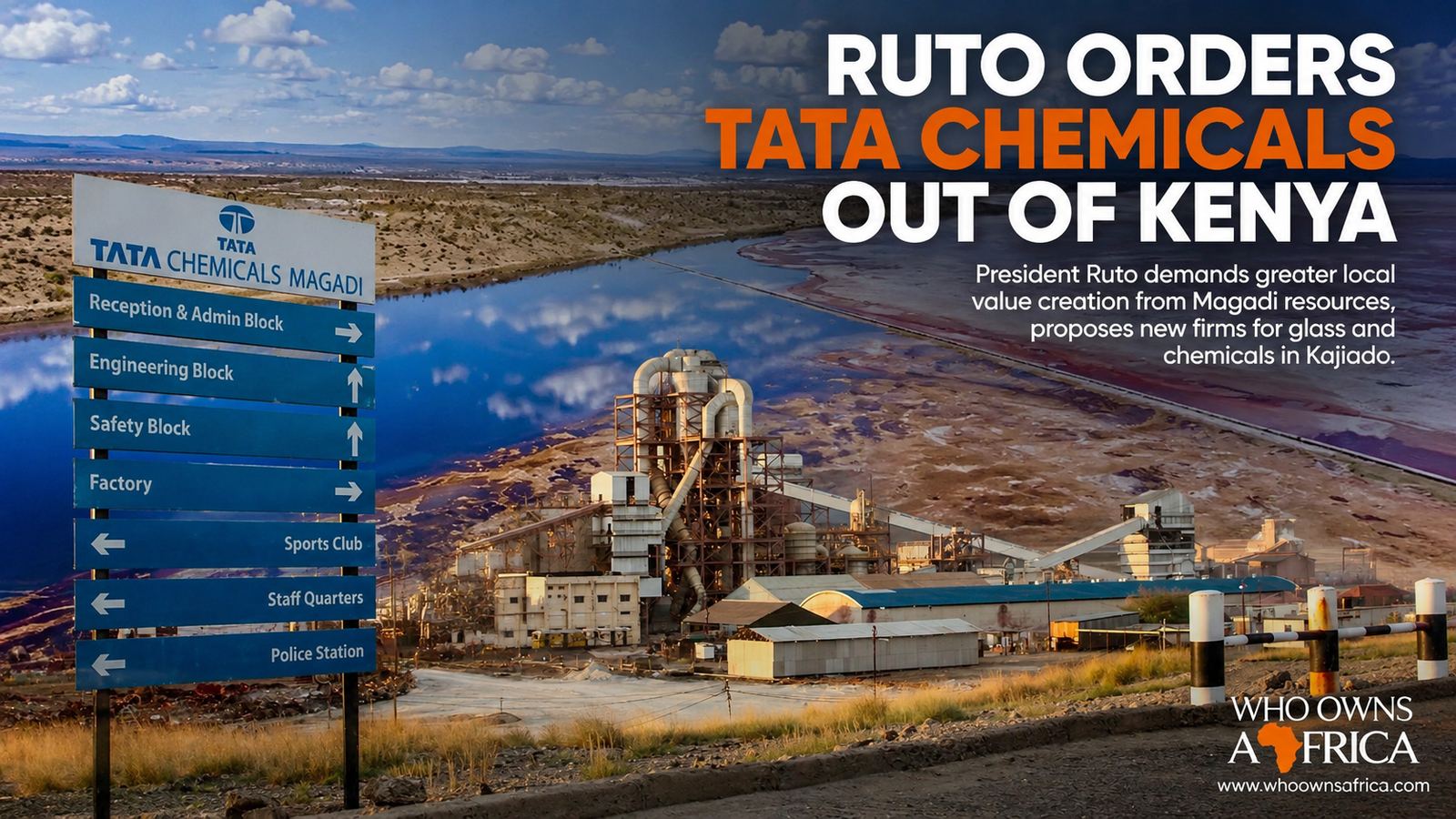
President William Ruto has ordered Tata Chemicals to leave Kenya, escalating a dispute over the exploitation of soda ash at Lake Magadi and putting the future of one of the country’s oldest foreign-linked mining operations in doubt.
Ruto said on Thursday that Tata Chemicals had operated under a contract for more than a century while failing to deliver enough investment and economic benefits to Kajiado County, where the Magadi operation is located. He said the government would bring in a new investor under conditions requiring greater local processing, including the establishment of a glass manufacturing plant and a separate chemicals manufacturing operation in Kajiado.
The announcement marks a sharp turn in a dispute that began as a regulatory confrontation. In July, Kenya’s Mining Cabinet Secretary Hassan Joho ordered the immediate suspension of Tata Chemicals Magadi’s mining operations, citing unresolved compliance issues under the country’s mining laws. The government said the concerns included mineral beneficiation and value addition, royalty reconciliation and payments, export reporting, community development agreements, employment and skills transfer, local procurement and environmental obligations.
A century-old operation
Tata Chemicals Magadi traces its history at Lake Magadi to the early 20th century. The company says it has produced soda ash at the site for more than 100 years and describes the operation as Africa’s largest natural soda ash producer and one of Kenya’s leading exporters.
The company extracts trona, a naturally occurring mineral containing sodium carbonate compounds, from deposits at Lake Magadi. The soda ash is then processed and transported by rail to the Port of Mombasa for export. Tata Chemicals says more than 95% of its production is exported to markets in Southeast Asia, the Indian subcontinent, Africa and the Middle East.
The significance of the operation extends beyond soda ash. The mineral is widely used in glass manufacturing, detergents and industrial chemicals, making it a strategic input for manufacturing industries. That helps explain why the Kenyan government’s argument is not simply about who extracts the mineral, but about what happens to it after extraction.
Ruto’s proposal is therefore aimed at changing the economic structure surrounding the resource. Instead of exporting a largely processed mineral and capturing value elsewhere, the government wants more industrial activity to take place near the source.
Why Kenya suspended Tata
The July suspension provided the immediate background to Ruto’s latest order.
Joho said the government had engaged Tata Chemicals over its statutory obligations for years but that several important matters remained unresolved. The ministry specifically cited concerns over beneficiation and value addition, royalty payments, export reconciliation and community development commitments.
The government also raised questions about employment and skills transfer for Kenyan citizens, procurement of local goods and services and environmental compliance. The suspension was intended to remain in force until the company demonstrated compliance with the Mining Act and related regulations.
Tata Chemicals said in August that it had submitted information, reports and documentation requested by the Ministry of Mining and had demonstrated compliance with applicable regulatory requirements. The company said mining operations had remained suspended since July 28 while it awaited further direction from the ministry.
The company has also pointed to investments made at Magadi. In 2025, Tata Chemicals announced the commissioning of an electric calciner and a 5-megawatt solar photovoltaic plant as part of efforts to reduce emissions and modernise the operation.
That contrast is central to the dispute. The company points to its industrial investment, employment and community programmes, while the government argues that the broader economic value generated from the country’s natural resource has not been sufficient.
The 1928 concession
The roots of the controversy run deeper than the current administration.
Kenya’s Court of Appeal recorded that Tata Chemicals Magadi’s rights originated in a lease dated March 20, 1928, under which the government allowed the company to search for, excavate, extract and carry away deposits at Lake Magadi and Lake Natron. The court described the company as Africa’s largest soda ash manufacturer and one of Kenya’s leading exporters.
The existence of such an old concession highlights a recurring question across Africa: how should governments treat agreements negotiated under economic and political conditions that are radically different from those of today?
Foreign mining companies can bring capital, technology, markets and employment. Long-term agreements can also provide investors with the certainty required to develop expensive infrastructure and industrial projects. But governments and communities increasingly want contracts to deliver more visible benefits at the local level.
That tension is particularly important in countries where valuable minerals are extracted close to communities that remain economically marginal.
Who owns the resource?
Ruto’s intervention brings the broader question of resource ownership into sharper focus.
Legally, the state may control or regulate mineral resources through licences, leases and statutory frameworks. Economically, however, ownership is more complicated. Value can be divided between governments, investors, workers, communities, contractors, exporters and manufacturers.
A country may receive royalties and taxes while still exporting commodities in forms that generate much larger industrial profits elsewhere. Governments seeking industrialisation therefore increasingly focus on beneficiation, meaning the processing of raw materials into higher-value products before export.
Kenya’s Magadi strategy fits into that wider debate.
If the government succeeds in attracting an investor that builds glass and chemical manufacturing facilities in Kajiado, the region could potentially gain new factories, supply chains, technical jobs and a broader industrial base. But such a transition would require significant capital, infrastructure, reliable energy, skilled labour and access to markets.
Replacing an established operator is therefore more complicated than issuing a new licence.
A test for foreign investors
The dispute could also influence how multinational companies view Kenya’s mining sector.
Kenya wants to attract foreign investment while asserting greater control over strategic resources. Those objectives do not necessarily conflict, but investors need predictable rules, enforceable contracts and confidence that regulatory requirements will remain clear.
The government, meanwhile, needs to demonstrate that renegotiating or terminating old arrangements is based on transparent legal and economic principles rather than political pressure.
That balance will be closely watched by companies operating in mining, energy, infrastructure and manufacturing.
The Magadi dispute is also unfolding against a background of legal battles involving Tata Chemicals and Kajiado authorities. Kenya’s courts have considered disputes involving the company and county government, including litigation concerning land and the company’s operations. The Court of Appeal issued a judgment in 2025 in a case between Tata Chemicals Magadi and the County Government of Kajiado.
What happens next?
The immediate question is whether Tata Chemicals will challenge Ruto’s directive and what legal process will govern any transfer of the Magadi operation.
The government has said a new investor will be required to establish glass and chemicals manufacturing capacity in Kajiado. Ruto did not, in his remarks reported on Thursday, provide full details of the proposed investor, the timetable for a transition or the precise legal mechanism for replacing Tata Chemicals.
Tata Chemicals had not publicly responded to Ruto’s latest announcement at the time of reporting, according to Reuters.
For workers and communities around Magadi, the outcome will matter as much as the ownership question. Tata Chemicals says it has more than 600 employees and has supported health, education and other community initiatives around its operations.
Any transition will therefore need to address jobs, local businesses, community agreements, environmental obligations and the continuity of industrial production.
Africa’s bigger ownership debate
The Magadi dispute is ultimately about more than Tata Chemicals or soda ash.
Across Africa, governments are under pressure to secure a larger share of the economic value generated by natural resources. Communities are demanding jobs and infrastructure. Governments want greater tax and royalty revenues. Investors want stability and returns. Manufacturers want reliable supplies of raw materials.
Those interests can coexist, but only when contracts and policies are designed to distribute value in ways that are viewed as legitimate.
Kenya’s decision to confront a century-old foreign-linked concession sends a clear political message: extracting Africa’s resources may no longer be enough. Governments increasingly want processing, manufacturing, employment and industrial ownership to remain closer to the resource itself.
For Kajiado, the success of that strategy will ultimately be measured not by the departure of Tata Chemicals, but by what replaces it.
The central question is therefore no longer simply who owns Lake Magadi’s mineral wealth. It is who captures the value created from it, who gets the jobs, who builds the factories and whether the communities living alongside Africa’s natural resources finally see a larger share of the wealth beneath their feet.

More from Business

Uganda’s oil gets a name: “Pearl Sweet” as first oil draws near
Uganda’s long-awaited oil era is nearing reality, but questions remain over ownership, revenues, local benefits and who ultimately controls the wealth.

Why Uber exited Nigeria after 12 years
Uber's departure highlights shifting economics, regulatory pressures, fierce local competition, and the growing influence of African-owned mobility platforms across the continent.

Who will own Kenya Airways? Global investors circle Africa’s national carrier
Kenya Airways seeks fresh capital as global investors circle its future, testing Kenya’s control over its strategic national airline.