

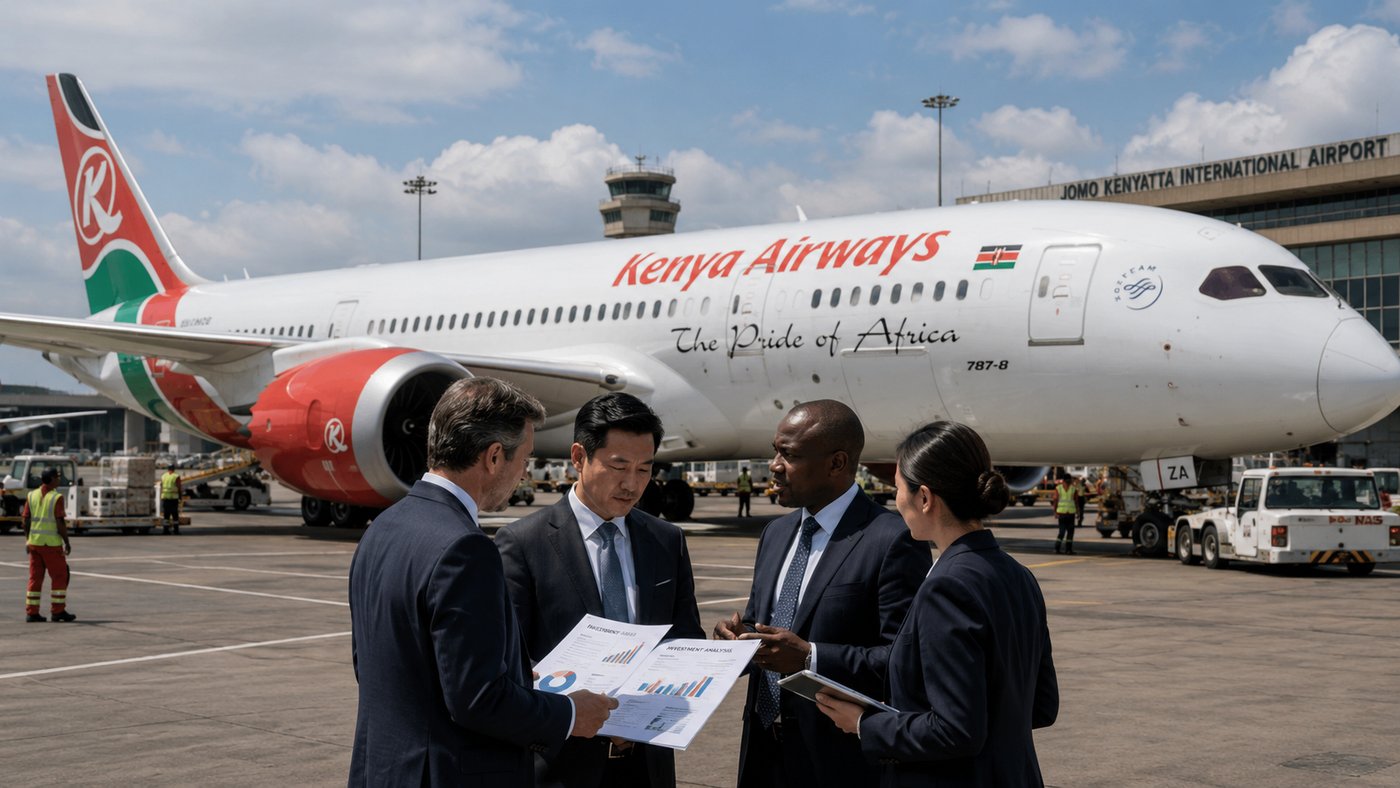
Kenya Airways is preparing to reveal potential new investors within weeks as the loss-making national carrier seeks fresh capital, strategic support and a path back to sustainable profitability, putting the future ownership and control of one of Africa’s most important airlines firmly in focus.
The planned announcement comes at a difficult moment for the airline. Kenya Airways reported a pre-tax loss of KSh15.92 billion ($123 million) for the first half of 2026, wider than the KSh12.17 billion loss recorded during the same period last year. The result highlights the pressure facing the carrier despite continued demand for air travel.
Chairman Kiprono Kittony said the airline had received interest from both local and international investors prepared to inject capital and other resources into the business. Investors from the United States, China, South Africa and Singapore have expressed interest, although the airline has not publicly identified the individual companies or funds involved.
For Kenya Airways, however, this is about more than raising money.
The eventual deal could determine who has influence over the airline, how much control Kenya retains and what role foreign capital will play in the future of a company that connects the country to major markets across Africa and beyond.
Kenya Airways needs fresh capital
The financial numbers explain why the search for investors has become urgent.
Kenya Airways’ pre-tax loss increased substantially in the first half of 2026 even as revenue continued to grow. The airline has been hit by higher fuel expenses, aircraft maintenance delays and shortages of spare parts that have reduced the number of aircraft available for service. Reuters reported that fuel costs rose 72% during the first half of the year, with fuel accounting for as much as half of the airline’s total costs.
The Middle East conflict has added another layer of uncertainty. Disruptions have affected fuel prices as well as the delivery of aircraft spare parts and maintenance services, making it harder for Kenya Airways to restore capacity at a time when passenger demand remains strong.
That has created a difficult financial equation.
The airline needs more aircraft flying in order to capture available demand and generate revenue, but restoring aircraft requires significant spending. At the same time, the carrier is already carrying substantial financial obligations and reporting billions of shillings in losses.
A new investor could therefore provide more than working capital. The right partner could help finance fleet restoration, strengthen the balance sheet and provide expertise needed to improve the airline’s operating performance.
The investors are coming from four markets
The countries identified by Kittony offer a glimpse of the different interests that could converge around Kenya Airways.
Investors from the United States could bring access to deep capital markets, financial expertise and commercial relationships with one of the world’s largest aviation markets. American participation could also create opportunities for stronger links between East Africa and North America.
China presents a different proposition. Chinese companies and investors have expanded their presence across African infrastructure, trade and transport sectors over the past two decades. A Chinese investor in Kenya Airways could potentially strengthen commercial links between Kenya and Asia while bringing access to capital and international business networks.
South Africa is another important market because of its established aviation industry and experience operating across African markets. A South African strategic investor could potentially bring regional aviation expertise and a better understanding of the commercial realities facing African airlines.
Singapore, meanwhile, is one of the world’s major aviation and logistics centres. Investors from the city-state could offer experience in international aviation, aircraft financing, logistics and Asian markets.
The identity of the eventual investor will matter because Kenya Airways is not simply looking for a cheque.
Kenya wants a strategic partner
Kittony said Kenya Airways expects to secure both a capital-raising partner and a strategic partner from the aviation industry.
That distinction could become one of the most important features of the deal.
A financial investor may primarily be interested in returns, valuation and the long-term appreciation of its investment. A strategic aviation investor could bring operational capabilities that directly address some of Kenya Airways’ biggest problems.
Those capabilities could include fleet management, maintenance expertise, aircraft procurement, route development, commercial partnerships and access to international passenger networks.
For a carrier dealing with aircraft availability problems, such support could be valuable.
Kenya Airways has been attempting to rebuild its finances after years of heavy losses. The airline’s turnaround therefore requires capital, but it also requires a business model capable of producing sustainable returns.
That is why the investor selection process could ultimately be more important than the amount of money raised.
Who owns Kenya Airways?
The ownership question is at the heart of the investment process.
The Kenyan government is the airline’s largest shareholder, and the state has made clear that it does not want to lose significant equity control.
Kittony said maintaining substantial Kenyan ownership was a strategic imperative because losing significant equity control could threaten Kenya Airways’ status as the country’s national carrier.
That position puts a clear limit on the potential transaction.
Kenya wants foreign capital but does not want to surrender the national character of the airline.
The challenge is that a large capital injection could require the issuance of new shares, potentially diluting existing shareholders. The size and structure of any investment could therefore change the balance of ownership even if the government remains the largest individual shareholder.
The eventual agreement will need to balance the need for new money with Kenya’s desire to retain influence.
Debt is part of the ownership equation
Kenya Airways’ ownership structure cannot be considered separately from its debt.
The airline has undergone several restructuring efforts following years of financial difficulties. Its current turnaround strategy includes plans to strengthen the balance sheet, and Kittony said the restructuring could involve converting principal debt owed to the Kenyan government and a consortium of local banks into equity.
Such a move could materially change the ownership structure.
Debt conversion means creditors receive equity instead of being repaid solely through conventional debt arrangements. For Kenya Airways, that could reduce financial pressure while increasing the importance of shareholders in the airline’s future.
It could also make the company more attractive to a new strategic investor.
A stronger balance sheet would give potential investors greater visibility over the financial position of the airline. It could also reduce some of the concerns associated with investing in a carrier that has experienced years of losses.
But restructuring alone will not solve the airline’s underlying operational challenges.
The aircraft problem
Aircraft availability remains one of the biggest issues facing Kenya Airways.
Airlines cannot generate meaningful revenue from aircraft sitting on the ground. Maintenance delays and shortages of engines, components and spare parts can therefore have a direct impact on revenue while costs continue to accumulate.
Kenya Airways experienced this problem in 2025 when three Boeing 787-8 Dreamliner aircraft were temporarily grounded because of global supply chain disruptions and engine availability constraints. The resulting reduction in capacity contributed to weaker financial performance.
The current shortage of spare parts shows that the problem has not disappeared.
A strategic investor with aviation expertise could potentially help Kenya Airways address these constraints through better access to maintenance resources, aircraft financing and international supplier networks.
That could make the difference between simply raising capital and actually turning the airline around.
Why Nairobi matters
Kenya Airways’ importance extends beyond its financial statements.
Its main hub at Jomo Kenyatta International Airport in Nairobi gives the airline a strategic position in East African aviation. The carrier connects Kenya with destinations across Africa and international markets, making it an important part of the country’s tourism, trade and business infrastructure.
Nairobi is also one of the major commercial centres on the continent.
For an international investor, a stake in Kenya Airways could therefore provide access to a strategically positioned African aviation platform.
That may explain why investors from geographically diverse markets are showing interest.
The airline offers something that cannot easily be replicated by simply investing in another company. It has an established brand, an existing route network, experienced personnel and a hub located in one of Africa’s most important economic centres.
But those advantages only have value if the airline can convert them into sustainable profits.
National interest versus commercial reality
The biggest challenge facing Kenya may be reconciling the national role of Kenya Airways with the demands of private investment.
A national carrier is expected to support connectivity, tourism, trade and economic development. It may operate routes that are strategically important even when they are not the most profitable.
A private investor, however, will ultimately want evidence that capital can generate an acceptable return.
That difference can create tension.
The government may want to preserve routes and strategic relationships that support Kenya’s wider economic interests. A private investor may push for greater commercial discipline, cost reductions and a sharper focus on profitable routes.
Neither objective is necessarily wrong.
The challenge is finding a structure that allows Kenya Airways to remain commercially competitive while continuing to serve its strategic national role.
Why foreign ownership matters
The debate over Kenya Airways reflects a wider issue across Africa.
Governments across the continent are increasingly looking for private and foreign capital to finance strategic businesses. Airlines, telecommunications companies, energy firms, ports and other infrastructure assets require investment on a scale that governments often struggle to provide alone.
Foreign investors can bring much-needed capital and expertise.
But ownership also brings influence.
A significant shareholder can influence board appointments, strategy, capital allocation and major commercial decisions. In a strategic company such as Kenya Airways, that influence can extend beyond ordinary corporate considerations.
For Kenya, the investor therefore needs to be evaluated on more than financial strength.
The government will need to consider what the investor wants, what it can contribute and how much influence it expects in return.
What investors will examine
Potential investors will have several questions before committing significant capital.
The first will be whether Kenya Airways can become consistently profitable.
The second will be whether its balance sheet can be repaired.
The third will be whether the airline can restore enough aircraft to take advantage of passenger demand.
The fourth will be whether fuel costs and geopolitical disruptions can be managed.
The fifth will be how much influence a new investor can obtain.
The sixth will be whether the Kenyan government can provide a stable policy environment for the airline’s long-term recovery.
The first-half results provide both reasons for concern and reasons for optimism.
The KSh15.92 billion pre-tax loss demonstrates the depth of the problem. But revenue rose 9% to KSh81.25 billion, suggesting that demand for Kenya Airways’ services remains significant even as costs continue to rise.
That distinction will matter to investors.
A company with no demand has a fundamentally different problem from a company with strong demand but high costs and inadequate capacity.
Kenya Airways appears to be facing the latter challenge.
The turnaround is not starting from zero
Kenya Airways has already demonstrated that a financial recovery is possible.
In 2024, the airline reported a return to profitability after years of losses, although that improvement was not sustained. The carrier subsequently faced capacity problems and higher costs that pushed it back into losses.
That history means investors will likely examine the airline’s turnaround strategy closely.
The question will be whether the latest losses represent another temporary setback or evidence that the previous recovery was not structurally strong enough.
Management will need to demonstrate that additional capital can produce measurable improvements.
Investors will want to see aircraft returned to service, costs controlled, debt reduced and revenue converted into stronger earnings.
The price of control
For Kenya, the difficult part of the transaction will be determining how much ownership it is willing to give up.
A strategic investor providing substantial capital may expect a meaningful stake and representation in decision-making. The government, meanwhile, wants to preserve significant Kenyan ownership.
This creates a negotiation over more than money.
It becomes a negotiation over control.
If Kenya retains a majority stake, it can preserve formal control while benefiting from private capital. But even a minority investor with significant financial exposure could wield considerable influence.
Board representation, shareholder agreements and strategic partnerships could become just as important as the percentage of shares held.
The final structure could therefore produce an airline that remains majority Kenyan-owned but has a foreign strategic investor with substantial influence over its commercial direction.
What happens next?
Kenya Airways is expected to disclose potential investors within the coming weeks.
Because the company is listed on the Nairobi Securities Exchange, Kittony said the selection process would be transparent.
That announcement will provide the first major indication of which investors have moved beyond preliminary interest and are prepared to participate in the airline’s future.
The names will matter.
So will the size of the proposed investment, the form it takes and the rights attached to it.
Investors will want clarity over valuation and control. The Kenyan government will want assurances over national ownership. Kenya Airways will need a partner capable of helping it solve its operational and financial problems.
The transaction will therefore need to satisfy three different interests: the government, the investor and the airline itself.
The bigger African question
Kenya Airways is part of a much larger African debate about ownership.
Across the continent, governments are trying to attract international capital while protecting strategic national interests. The question is no longer simply whether foreign investors should be allowed into important companies.
It is increasingly about how much influence they should have once they arrive.
Kenya Airways provides a clear example because aviation is closely connected to national identity and economic connectivity.
The airline is a commercial company, but it also represents Kenya abroad.
That dual role makes the ownership decision unusually sensitive.
The government cannot ignore the need for capital. But it also cannot ignore the strategic consequences of giving a major foreign investor a significant stake.
Who will own Kenya Airways?
For now, the answer remains uncertain.
What is clear is that Kenya Airways has reached another critical point in its long-running turnaround. The airline needs fresh capital, stronger aircraft availability and a healthier balance sheet, while Kenya wants to preserve significant ownership of its national carrier.
Investors from the United States, China, South Africa and Singapore are reportedly interested, creating a potentially competitive field for a stake in one of Africa’s most strategically positioned airlines.
The KSh15.92 billion first-half pre-tax loss has increased the urgency.
But the most important question is not simply how much money Kenya Airways can raise.
It is what that money will buy.
If the new capital restores aircraft, strengthens the balance sheet and supports sustainable profitability, Kenya could emerge with a stronger national carrier and a more commercially resilient airline.
If the deal gives an investor too much influence without solving the underlying financial problems, Kenya could face another difficult ownership debate in the future.
The coming weeks should therefore reveal more than the names of potential investors.
They could reveal the next chapter in the ownership of Kenya’s national airline.
For Kenya Airways, the question is who will invest.
For Kenya, the question is who will control.
And for Africa, the bigger question is increasingly familiar: who owns the strategic assets that connect the continent to the world?

More from Business

Who gets to own Africa’s biggest industrial projects? The Dangote IPO reveals the barriers
Africa’s biggest refinery share sale raises a fundamental question about wealth creation: can Africans invest across borders as easily as capital moves across continents?

ICEA Lion: The Ndegwas buy back what they once sold
The ICEA Lion buyback is more than a family deal; it exposes the changing balance between local capital, foreign investors and control.

DP World extends Luanda port deal to 2051 as Gulf influence expands in Angola
DP World’s Luanda extension reveals how Gulf capital is reshaping African trade infrastructure through long-term concessions, logistics and strategic access.