

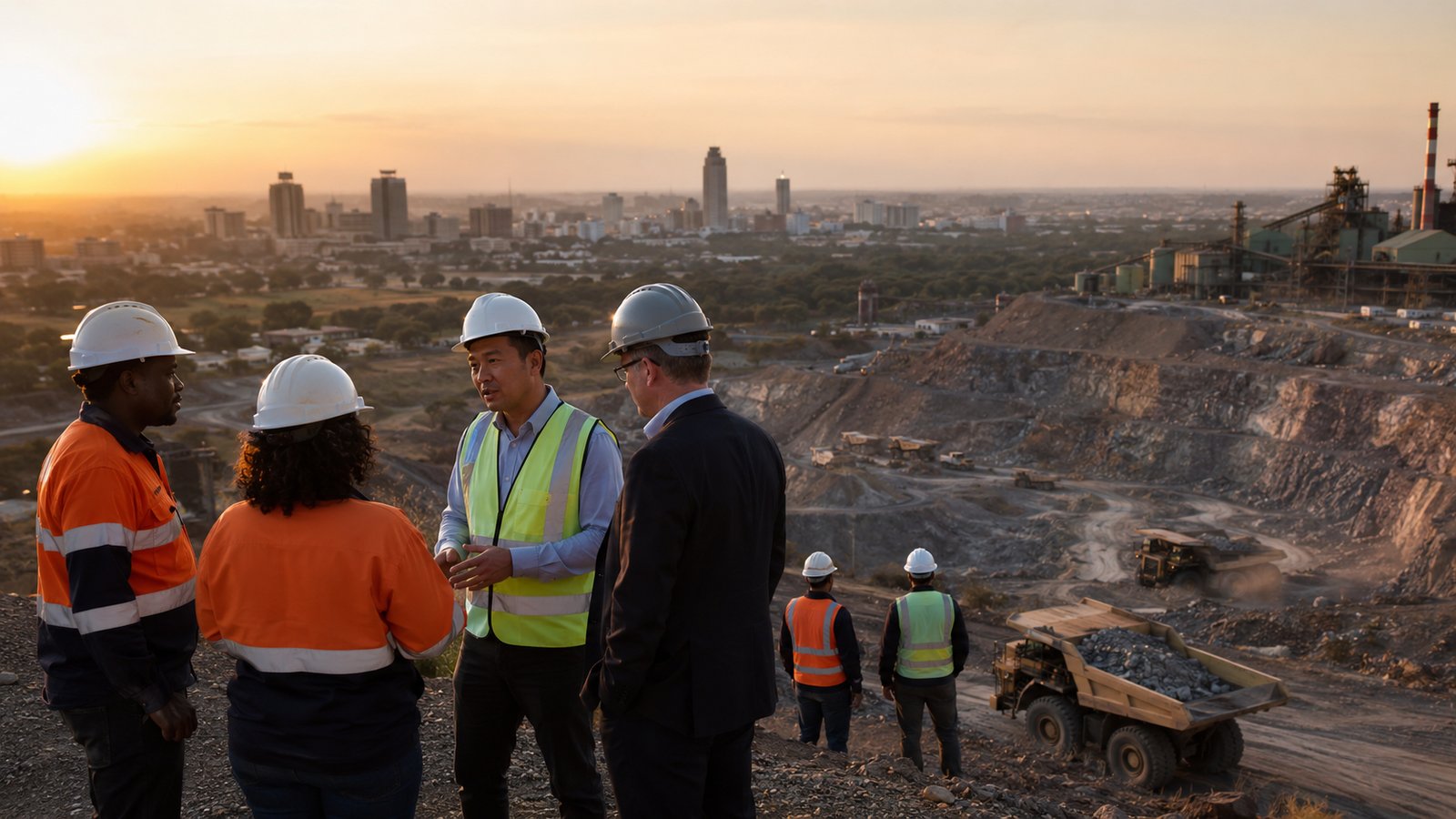
President Hakainde Hichilema’s re-election has removed one of the biggest uncertainties facing investors in Zambia, but it has also raised a harder question: can the country turn economic stability and a copper investment boom into sustained growth that reaches beyond the mining sector?
Hichilema was declared the winner of the Aug. 13 presidential election with roughly 60% of valid votes, defeating opposition leader Brian Mundubile, who won about 38%. Mundubile has said he will challenge the result in court, alleging serious irregularities in the electoral process. The dispute adds a political risk to what investors had expected to be a relatively straightforward transition into Hichilema’s second term.
For investors, however, the immediate message from the vote is continuity.
Hichilema took office in 2021 after Zambia became the first African sovereign to default during the COVID-19 pandemic. His first term was dominated by debt restructuring, negotiations with creditors and an IMF-backed programme designed to restore fiscal credibility.
The second term begins from a very different position.
Zambia has restructured much of its debt, rebuilt relations with international lenders and attracted billions of dollars of investment into mining. The challenge now is to make that stability productive.
As Reuters reported after the election, investors broadly see Hichilema as offering policy continuity. They are now looking for stronger growth, investment and job creation.
The copper test
Everything starts with copper.
Zambia is Africa’s second-largest copper producer after the Democratic Republic of Congo, and the metal generates around 70% of the country’s export earnings. Mining also accounts for more than 10% of GDP and is a major source of government revenue.
The government has set an ambitious target of producing 3 million metric tons of copper a year, almost three times current levels.
That ambition is being supported by an unusually favourable global backdrop. Copper has become one of the most strategically important industrial metals as countries invest in electricity grids, renewable energy, electric vehicles and data infrastructure.
Benchmark copper prices rose more than 40% in the year to early August, reaching about $14,000 a ton, according to Reuters.
For Zambia, the opportunity is enormous.
But so is the execution challenge.
Mining companies say the country needs more electricity, better infrastructure, stronger exploration incentives and greater local processing if it is to reach its production target. The industry estimates that roughly 2,000 megawatts of additional power capacity will be needed.
That matters because Zambia’s dependence on hydropower has exposed the mining sector to climate shocks. A severe drought previously reduced electricity generation and forced rolling blackouts, contributing to lower copper production. Another strong El Niño event could again put pressure on the power system.
The copper boom therefore cannot simply be measured in tonnes produced.
It will also be measured in megawatts generated, railways built, processing facilities established and Zambian companies brought into mining supply chains.
Debt is no longer the only story
The defining economic achievement of Hichilema’s first term was the restructuring of Zambia’s debt.
The country spent years negotiating with official and private creditors after its 2020 default. The previous $1.7 billion IMF programme ended in January, and the government now wants to secure a new arrangement by the end of 2026.
That will be one of the first tests of the new administration.
Investors want a programme that preserves fiscal discipline while allowing the government to shift from crisis management towards economic expansion.
Finance Minister Situmbeko Musokotwane has said Zambia needs to move beyond simply escaping the debt crisis and attract investment capable of creating growth and jobs. The government is not yet ready to return immediately to international bond markets, although investors see a future Eurobond issue as potentially useful for rebuilding Zambia’s international financing benchmark.
That caution is understandable.
Zambia cannot afford another cycle in which borrowing finances consumption while commodity revenues remain vulnerable to global price movements.
The next phase will require investment that generates productive capacity.
China is still in the room
For anyone asking who owns Africa’s next investment cycle, Zambia offers an important case study.
China remains deeply embedded in the country’s economic story.
Chinese companies have invested around $6 billion in Zambia over the past two decades, with most of that money going into metals, according to data cited by Reuters. China was also Zambia’s largest official creditor, with about $5.7 billion owed to Chinese lenders.
That relationship is evolving.
The era in which African governments could simply borrow for infrastructure and postpone the question of repayment has become much harder. Zambia’s debt restructuring demonstrated the risks of excessive dependence on external borrowing, regardless of the identity of the lender.
Beijing, however, is not withdrawing.
Chinese companies remain major participants in mining, infrastructure and industrial projects. China is also involved in the refurbishment of the TAZARA railway, which provides an important route from Zambia’s copper-producing areas towards Tanzania and the Indian Ocean.
At the same time, Western governments and companies are increasing their presence.
The Western push
The contest for Zambia’s minerals is increasingly part of a much larger geopolitical competition.
The United States and Europe want greater access to critical mineral supply chains that have historically been dominated by Chinese companies. Zambia sits at the centre of that strategy because of its copper deposits and its location between the mineral-rich Copperbelt and major transport corridors.
The Western-backed Lobito Corridor is one example. The project is designed to move copper and cobalt from Zambia and the DRC westwards through Angola to the Atlantic Ocean.
China-backed infrastructure provides a competing route east through TAZARA towards Tanzania.
For Zambia, the competition could be an advantage.
Rather than choosing between Beijing and Washington, Lusaka has an opportunity to make competing investors compete for better terms.
That will require careful negotiation.
Zambia’s mining minister has stressed that investment agreements must produce benefits for both the country and investors. The government is also seeking investment from a broad group of countries, with mining companies from China, Canada, India, the United Arab Emirates and the United States already active in the sector.
The real question is whether Zambia can turn this competition into domestic industrial development.
Who benefits from copper?
This is where the political story becomes more complicated.
International investors may see Hichilema’s victory as confirmation of economic stability. But stability is not necessarily the same thing as prosperity for ordinary Zambians.
The election campaign exposed frustration over living costs, unemployment and the distribution of mining wealth. Critics argue that the benefits of higher investment and improved macroeconomic conditions have not been felt evenly across the country.
That creates a difficult political calculation for Hichilema.
Mining companies need predictable taxation, reliable power and protection for capital. Investors want stable rules and the ability to repatriate profits. The government needs revenue. Local communities want jobs, infrastructure and greater participation in the economic value generated by resources extracted from their land.
Those interests do not always align.
Zambia is therefore pushing for greater local content in mining. Investors are watching how new requirements will work in practice, particularly proposals requiring miners to increase domestic procurement. Local suppliers often lack the financing and technical capacity required by large mining operations.
If handled well, the policy could help create a Zambian mining services industry.
If handled poorly, it could raise costs and slow investment.
Beyond the mine
The larger test of Hichilema’s second term is whether Zambia can reduce its dependence on the copper cycle.
Agriculture is one obvious area.
The country expects a large maize harvest, but government purchases of surplus grain are also creating fiscal pressure. Investors want reforms that allow private buyers to play a larger role rather than leaving the state to absorb rising production.
Energy is another.
A copper expansion without reliable electricity will remain a target rather than an achievement. Zambia needs investment in generation, transmission and alternative energy sources to reduce its exposure to drought.
Infrastructure is equally important.
Railways and roads determine whether copper can move efficiently from mine to market. Processing capacity determines whether Zambia captures more value before minerals leave the country.
That is the difference between being a mining economy and becoming a mining-based industrial economy.
Governance will matter
The election challenge will now test Zambia’s institutions.
Mundubile has alleged irregularities and plans to contest the result in court. The European Union observer mission also raised concerns about transparency and procedural issues during the election process.
For investors, governance is not a secondary issue.
The same institutions that protect electoral rights also underpin contracts, licences, property rights and dispute resolution.
Mining is particularly sensitive to perceptions of political interference because projects require large amounts of capital and operate over decades.
Hichilema’s business-oriented image helped attract investment during his first term. Maintaining that confidence will require the government to demonstrate that rule of law and institutional independence remain stronger than political convenience.
The second-term opportunity
Zambia enters Hichilema’s second term with something it did not have five years ago: bargaining power.
Copper is valuable. Global demand is strong. China wants to retain its position. Western governments want alternatives. Mining companies want access to new production. Infrastructure investors want corridors.
Lusaka can use that competition.
But bargaining power only matters if the government has the institutional capacity to negotiate effectively.
The opportunity is not simply to sell more copper.
It is to use copper to finance electricity, railways, manufacturing, technology, agriculture and skills. It is to develop Zambian suppliers around foreign mining companies. It is to attract capital without recreating the debt vulnerabilities of the past.
That is why the election is only the beginning.
Investors got the continuity they wanted. Hichilema now has to demonstrate that continuity can produce something more ambitious than stability.
The measure of his second term will ultimately be whether Zambia moves from debt recovery to investment-led growth, and whether the wealth beneath its soil creates opportunities above it.
For Who Owns Africa, that is the bigger story.
The contest over Zambia is no longer simply about who owns the mines. It is about who finances the infrastructure, who controls the supply chains, who processes the minerals, who captures the profits and, ultimately, who owns the next chapter of Zambia’s economic transformation.

More from Business

Who owns Quickmart? Inside Kenya’s KSh15 billion supermarket IPO
Quickmart’s public listing exposes how Kenyan retail, private equity and everyday consumer power are quietly reshaping who owns the country’s economy.

How Mr Eazi became a major shareholder in Ghana’s pharmaceutical industry
Nigerian musician Mr Eazi's investment firm Zagadat Capital has quietly built a major stake in a Ghanaian drug maker.

Who owns Africa’s new wealth? The companies and sectors creating the continent’s next billionaires
African governments are competing for global capital with tax incentives, but the bigger question is who will own the wealth created.