


Africa is entering a new phase in the global competition for investment, as governments from Kenya and Rwanda to Egypt, Ghana and Morocco offer tax incentives, free zones and business-friendly regimes to attract multinational companies, entrepreneurs and wealthy investors.
The race is no longer simply about which country can offer the lowest tax bill. It is increasingly about who controls the companies, land, infrastructure, technology and financial assets created when that capital arrives.
The question matters because Africa’s investment story is growing even as global capital becomes more selective. UN Trade and Development said foreign investment into Africa reached a record $97 billion in 2024, a 75% increase from the previous year. But the headline figure was heavily influenced by a major international project finance transaction in Egypt. Excluding that deal, investment still increased by about 12% to roughly $62 billion.
A recent Forbes Finance Council analysis of the global competition between free zones captures the broader trend. Governments are increasingly using special economic zones, tax holidays and other incentives to persuade companies and investors to locate their businesses within their borders.
For Africa, however, the more important question is what happens after the investment arrives.
The race for global capital
Tax incentives have become one of the most visible weapons in Africa’s competition for international capital. Countries are attempting to reduce the cost of establishing factories, headquarters, technology businesses, logistics operations and financial structures while improving infrastructure and simplifying regulation.
Kenya, for example, offers a 10-year corporate tax holiday for qualifying companies operating in export processing zones, followed by a reduced rate for another decade. Its special economic zones also provide tax and customs advantages, while the government promotes unrestricted foreign ownership as one of the features available to investors.
The country’s investment strategy is evolving beyond traditional manufacturing. In May 2026, President William Ruto signed legislation affecting income tax, special economic zones and the development of technopolis projects, with the government saying the measures were designed to create a more predictable and competitive investment environment.
Ghana has followed a similar path. Its free-zone enterprises can receive a 10-year income-tax holiday, after which export-oriented businesses face a reduced corporate tax rate. The Ghana Free Zones Authority also says investors can hold 100% of the shares in a free-zone enterprise and repatriate dividends and profits without restrictions under the applicable framework.
That combination is attractive to foreign investors because it reduces both tax and ownership barriers. But it also raises a fundamental question for African economies: when foreign capital finances a business, who eventually owns the business?
Rwanda bets on headquarters and finance
Rwanda is taking a different route, competing not only for factories but also for headquarters, holding companies, investment vehicles and regional business operations.
The country’s tax system provides preferential corporate income tax rates for qualifying investors. Rwanda Revenue Authority information shows that qualifying international companies with headquarters or regional offices in Rwanda can access a zero percent corporate income tax rate under specified investment conditions. Certain holding companies, special-purpose vehicles and collective investment schemes can also qualify for preferential rates.
That strategy is significant because ownership does not always sit where production takes place.
A factory may operate in one African country while its parent company, intellectual property, financing structure or investment vehicle is registered elsewhere. The economic activity can therefore be African while ultimate ownership remains outside the country where employees, consumers and physical assets are located.
This distinction is central to understanding Africa’s new investment geography.
Egypt has scale on its side
Egypt is competing from a different position. Its large domestic market, strategic location and access to the Suez Canal give it advantages that cannot be replicated simply through tax rates.
UNCTAD identified Egypt as the principal reason for Africa’s exceptional 2024 FDI increase, with a major international project finance transaction helping push continental investment to a record level.
Egypt’s investment framework includes free zones, investment zones and technological zones, with incentives covering taxes, customs and administrative procedures. The country’s investment authorities also provide deductions linked to investment costs in designated areas and sectors.
The significance goes beyond the immediate tax benefit. Egypt is attempting to position itself as a production and logistics platform connecting Africa, the Middle East, Europe and Asia.
If that strategy succeeds, ownership of ports, industrial facilities, logistics companies, energy infrastructure and technology businesses could become as important as the number of foreign investors attracted.
Morocco offers a manufacturing challenge
Morocco has built another model around export manufacturing and integration into international supply chains.
Its free-zone framework provides qualifying businesses with substantial tax advantages, including corporate tax exemptions during an initial period and a reduced rate thereafter. The Moroccan government also highlights customs and administrative advantages designed to make export-oriented investment easier.
The country’s position near European markets has helped it attract manufacturing investment, particularly in industries that depend on efficient logistics and access to international consumers.
For Africa, Morocco demonstrates why tax incentives work best when combined with infrastructure, market access and industrial capabilities.
A low tax rate alone cannot create a competitive investment destination. Investors also need electricity, roads, ports, skilled workers, reliable courts, digital infrastructure and the ability to move money and goods efficiently.
The ownership question
This is where the African investment story becomes more complicated.
Foreign direct investment is not necessarily foreign ownership in a simple sense. A multinational may establish a subsidiary in Africa while its ultimate parent remains headquartered in Europe, North America, Asia or the Middle East.
UNCTAD’s research shows that European investors remain the largest holders of FDI stock in Africa. The United States and China are also major investors, while Chinese investment, estimated at $42 billion, is increasingly moving beyond traditional extractive industries into areas including pharmaceuticals, food processing, building materials and manufacturing.
The ownership structure can become even more complicated when companies use holding companies or investment vehicles registered in third countries.
UNCTAD has noted, for example, that some European FDI stock recorded in the Netherlands reflects indirect investment by ultimate owners elsewhere, particularly the United States.
That means headline FDI figures do not necessarily tell Africans who owns the underlying assets.
A company may employ thousands of people locally and pay taxes locally while its shares are ultimately controlled by investors outside Africa. Another business may have African shareholders but rely on foreign private equity for expansion. A third may have a government, pension fund or sovereign wealth fund as a major shareholder.
Ownership is therefore a deeper measure of economic power than investment flows alone.
African capital is becoming more important
The answer is not simply that foreigners own Africa’s new wealth.
African pension funds, banks, family businesses, entrepreneurs, sovereign institutions and private-equity firms are increasingly important sources of capital.
The continent also has a growing group of entrepreneurs building businesses capable of attracting international investment while retaining meaningful African ownership.
That distinction could become critical in sectors such as fintech, renewable energy, logistics, healthcare, telecommunications, agriculture and data infrastructure.
UNCTAD’s latest investment data shows that Africa’s share of global FDI remains relatively small. In 2025, developing Africa attracted about $70 billion, representing roughly 4% of global FDI, down from the exceptional 2024 level.
The opportunity, therefore, is not merely to attract more capital. It is to increase the amount of African capital participating in the ownership of the assets that capital creates.
Who owns the next data centres?
Digital infrastructure could become one of the clearest tests of this model.
Africa needs substantial investment in data centres, cloud infrastructure, fibre networks and digital services as internet usage, artificial intelligence and digital payments expand.
Yet UNCTAD reported that Africa accounted for only about 3% of total data-centre investment in 2024. It also recorded just 18 fintech projects in Africa that year, compared with 206 in developing Asia.
That creates an opening for governments and African institutional investors.
If the continent relies almost entirely on foreign companies to finance and own its digital infrastructure, a growing share of future digital wealth could leave Africa through dividends, licensing payments and capital gains.
If African pension funds, sovereign investors, banks and entrepreneurs become shareholders, the economic impact could be very different.
Tax holidays have limits
The tax-free investment race also carries risks.
Governments must balance the desire to attract capital against the cost of granting tax exemptions. A company that receives a decade-long tax holiday may create jobs, exports and technology transfer, but governments must assess whether the economic benefits justify the revenue forgone.
There is also a risk of competition between African states becoming a race to offer increasingly generous incentives without addressing deeper constraints.
A multinational company may compare two countries and choose the one with the best tax package. But it can also reconsider its decision if electricity costs are high, regulations are unpredictable or transport infrastructure is weak.
The strongest investment destinations will therefore be those that combine competitive taxation with institutional reliability.
The new African investment leaderboard
There is unlikely to be a single winner in the continent’s investment race.
Kenya has an advantage in East Africa’s technology, finance and services ecosystem. Rwanda is positioning itself as a regional headquarters and investment hub. Egypt offers scale, logistics and strategic geography. Morocco has developed strong manufacturing and export capabilities. Ghana offers a significant West African market and an established free-zone framework.
Other African economies are competing through their own combinations of tax incentives, natural resources, renewable energy potential, market size and infrastructure.
The real winners will be the countries that convert investment incentives into locally owned productive capacity.
For Who Owns Africa, that is the more important metric.
The headline question is no longer simply which African country has the lowest corporate tax rate. It is which country can attract global capital while ensuring that Africans retain meaningful stakes in the companies, infrastructure, technology and land that the investment creates.
Who will own Africa’s next wealth?
Africa’s investment race is entering a new stage.
The continent needs foreign capital because its infrastructure, manufacturing and digital investment requirements are too large to be financed by domestic savings alone. But attracting capital is only the first step.
The bigger challenge is building ownership.
The countries that succeed will be those that use tax incentives to attract multinational companies while developing local suppliers, African shareholders, pension-fund participation, domestic capital markets and entrepreneurs capable of taking equity positions in growing industries.
That could determine whether Africa’s next investment boom produces mainly foreign-owned assets operating on African soil or a new generation of African-owned companies with global reach.
The distinction is critical.
Capital can cross a border in seconds. Ownership lasts much longer.
And as governments compete for the next wave of global investment, the question that ultimately matters for Africa may not be who brings the money, but who owns what the money builds.

More from Business

Who gets to own Africa’s biggest industrial projects? The Dangote IPO reveals the barriers
Africa’s biggest refinery share sale raises a fundamental question about wealth creation: can Africans invest across borders as easily as capital moves across continents?

ICEA Lion: The Ndegwas buy back what they once sold
The ICEA Lion buyback is more than a family deal; it exposes the changing balance between local capital, foreign investors and control.
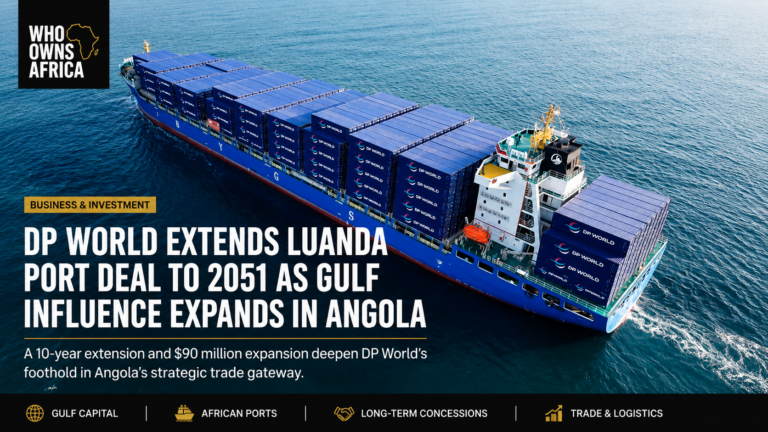
DP World extends Luanda port deal to 2051 as Gulf influence expands in Angola
DP World’s Luanda extension reveals how Gulf capital is reshaping African trade infrastructure through long-term concessions, logistics and strategic access.