

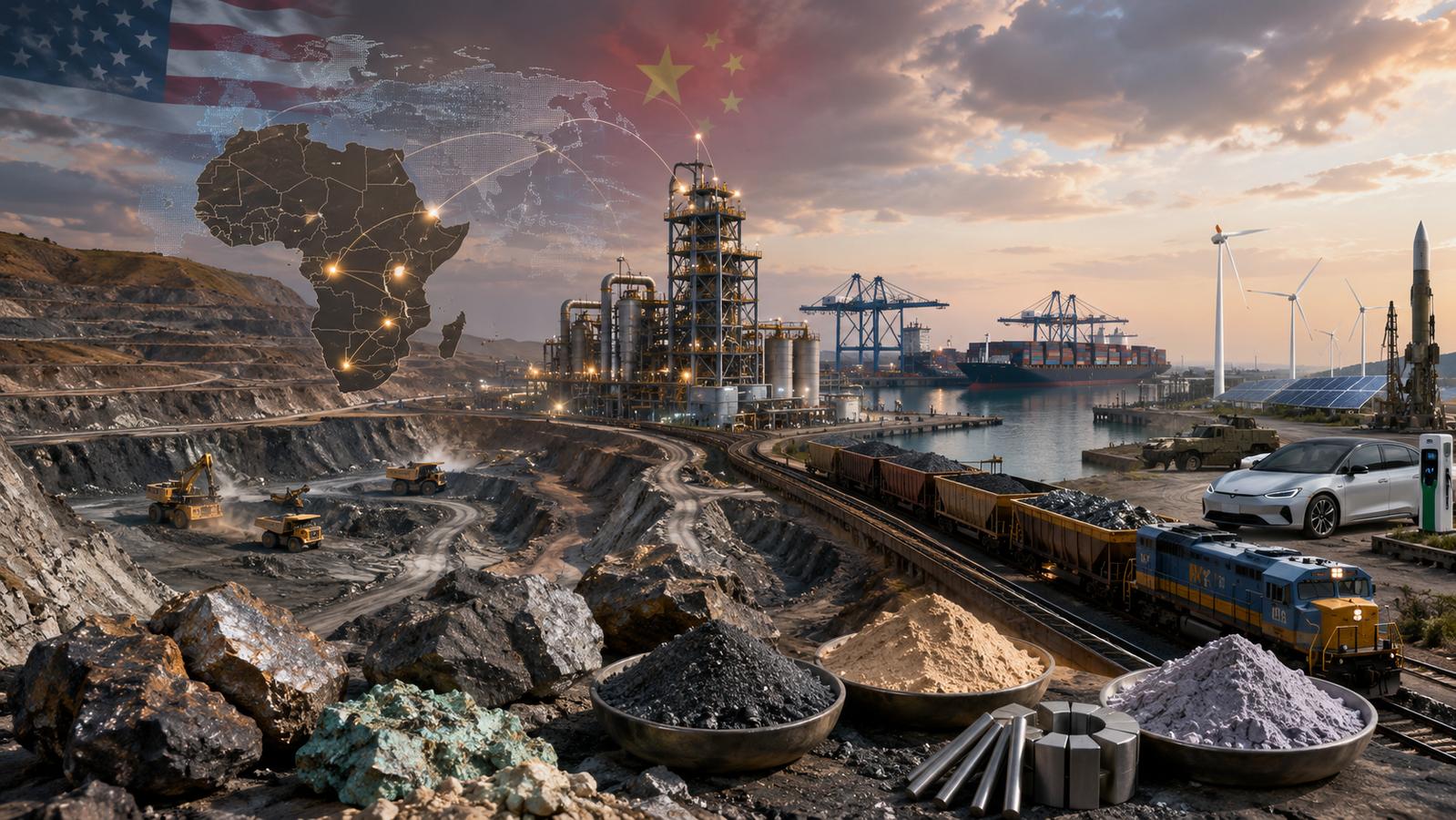
Africa’s mineral map is becoming the latest battleground in the global contest between Washington and Beijing, with the United States increasingly willing to put public money behind African projects that have struggled to attract conventional private capital.
The objective is larger than mining. It is about who controls the raw materials needed for electric vehicles, advanced electronics, renewable energy, robotics and modern weapons, and who ultimately captures the industrial value created from them.
The shift is already visible. In South Africa, the U.S. International Development Finance Corporation has backed the Phalaborwa rare earths project with $50 million through TechMet. In Madagascar, Washington has committed $4.84 million for early development work at the Ampasindava project. In the Democratic Republic of Congo, the U.S. is combining mineral diplomacy with infrastructure finance and plans to expand access to Congolese assets.
The emerging strategy is clear: secure supply, build alternative logistics and encourage processing outside China’s dominant supply chain.
A new minerals race
Rare earths are a group of 17 elements whose names are unfamiliar to most consumers but whose properties are central to modern industry.
Neodymium and praseodymium, for example, are used in powerful permanent magnets found in electric motors and wind turbines. Dysprosium and terbium can improve the performance of magnets exposed to high temperatures, making them important for demanding industrial and defence applications.
The strategic problem for Washington is not simply where the minerals are found. It is where they are processed.
China has built a formidable position across the rare earth value chain, particularly in processing and refining. That means a country can possess a deposit but still depend on Chinese infrastructure and expertise before the material becomes useful to manufacturers.
That vulnerability has turned mineral security into an industrial policy issue.
The U.S. held a Critical Minerals Ministerial in February, bringing together dozens of governments to discuss resilient supply chains. Its development-finance arm has also increasingly treated critical minerals as strategic investments rather than conventional development projects.
Brookings researchers wrote in July that reliable access to critical minerals is becoming central to U.S. economic and strategic interests and that Africa is well positioned to help create alternative supply chains.
South Africa’s unusual opportunity
South Africa offers one of the clearest examples of the new approach.
At Phalaborwa, Rainbow Rare Earths is pursuing a project that does not depend on opening a conventional new mine. Instead, it aims to recover rare earth elements from phosphogypsum waste left behind by earlier phosphate processing.
That distinction matters.
Traditional mining projects can require years of exploration, permitting, construction and infrastructure development. Phalaborwa’s proposition is that an existing industrial waste stream can become a source of strategically valuable minerals.
The U.S. DFC has provided support through a $50 million investment via TechMet, while South African research institutions have been involved in developing the processing technology.
For Washington, the attraction is obvious. For South Africa, the opportunity is potentially broader than exporting another raw commodity.
If the project succeeds, it could demonstrate how Africa’s existing industrial waste can be converted into higher-value strategic materials.
Tanzania waits for capital
Tanzania’s Ngualla deposit illustrates another side of the story.
The Ngualla rare earth project has long been regarded as one of Africa’s significant undeveloped rare earth resources. U.S. involvement has not yet transformed the project in the same way as Phalaborwa, but its existence demonstrates why Tanzania matters in the emerging supply-chain contest.
The project has been designed around producing rare earth products that could ultimately feed global manufacturing markets. Earlier development arrangements also gave the Tanzanian government an interest in the operating companies.
The challenge is financing.
Rare earth projects are capital intensive, technically complex and exposed to volatile commodity prices. Investors therefore face a difficult calculation: spending hundreds of millions of dollars today on a mine whose commercial returns depend partly on future demand and future prices.
This is precisely where government-backed finance can change the equation.
Washington does not necessarily need to own the mine. It can help make the mine financeable.
Uganda’s giant clay deposit
Uganda presents another potentially important piece of the puzzle.
The Makuutu project in eastern Uganda is based on ionic adsorption clay, a type of deposit that has attracted considerable attention because of its relatively different extraction characteristics compared with hard-rock rare earth deposits.
Uganda’s National Mining Company says the project contains an estimated 532 million tonnes of ionic adsorption clay containing about 340,000 tonnes of rare earth oxides. It estimates project costs at about $121 million.
The significance goes beyond Uganda.
China’s strength in rare earths was built partly around expertise in processing these types of deposits. If African projects can develop commercially viable extraction and processing outside China, they could become strategically important to Western manufacturers.
But resources underground do not automatically become supply chains above ground.
Uganda will need capital, processing technology, infrastructure, environmental safeguards and reliable buyers.
Burundi and the Great Lakes
Burundi sits in a more complicated position.
The country is home to the Gakara rare earth project, once regarded as one of the more advanced rare earth developments in Africa. But its history also demonstrates the political and financial risks that can accompany strategic mineral assets.
The project has faced operational and regulatory difficulties, illustrating why investors care about more than geology.
The broader Great Lakes region is now drawing attention from Washington for precisely this reason. A U.S. State Department funding opportunity announced in August seeks to strengthen critical-minerals governance and improve conditions for investment across Burundi, the DRC, Rwanda and Uganda.
This is significant because Washington’s strategy is becoming less about individual mines and more about the systems around them.
Transparent licensing.
Cross-border trade.
Infrastructure.
Traceability.
Governance.
These issues can determine whether a mineral deposit becomes a strategic asset or remains stranded underground.
The DRC is the bigger prize
If rare earths are one part of the new scramble, the Democratic Republic of Congo represents something much larger.
The DRC is the world’s leading cobalt producer and has enormous reserves of copper, lithium and other minerals essential to modern industry. Washington and Kinshasa have therefore been discussing a much broader minerals partnership.
In January, Reuters reported that Congo had offered U.S. investors a shortlist of state-owned mineral assets including manganese, copper-cobalt, lithium and gold projects. The U.S. DFC has also backed the Lobito Corridor, a major infrastructure route intended to move minerals from the Copperbelt towards Angola’s Atlantic coast.
The DRC-U.S. strategic partnership includes provisions designed to improve American access to mineral offtake and establish mechanisms for identifying strategic mineral assets.
The geography matters.
A mine is only as valuable as its ability to move material to a refinery, manufacturer or port.
The Lobito calculation
The Lobito Corridor may ultimately prove to be one of Washington’s most important African investments.
The DFC has committed $553 million to the rehabilitation and development of the Lobito Atlantic Railway, a roughly 1,300-kilometre route linking the Angolan port of Lobito to the DRC border. The investment is expected to increase transport capacity substantially and reduce the cost and time involved in moving minerals to market.
This changes the meaning of mineral investment.
Washington is not simply looking for rocks.
It is trying to construct a supply-chain alternative.
Railways, ports, mines, processing plants and long-term purchase agreements can work together to create an ecosystem that competes with established Chinese-linked networks.
That is why the DRC matters even in a story about rare earths. The broader contest is over critical minerals as a category.
Namibia attracts Japan
The U.S. is not alone.
Namibia shows how the scramble is becoming genuinely global.
In July, Japan’s JOGMEC committed up to C$47.668 million to a special-purpose company established by Toyota Tsusho to develop the Lofdal heavy rare earth project in Namibia.
Heavy rare earths are particularly valuable because they are difficult to replace in some high-performance applications.
The Japanese involvement also illustrates a key feature of Africa’s new minerals politics: governments do not necessarily have to choose between Washington and Beijing.
They can negotiate with Japan, the United States, Europe, China, Gulf investors and others.
For African governments, this competition can create leverage.
Who owns the minerals?
This is where the Who Owns Africa question becomes unavoidable.
The first answer is that African states generally retain sovereignty over their mineral resources.
The second answer is more complicated.
Ownership can be divided between governments, local communities, mining companies, international investors, financiers and downstream manufacturers. A company may hold a mining licence. Another may provide the technology. A government may receive royalties and an equity stake. A foreign financier may provide debt. An international manufacturer may sign an offtake agreement.
The entity controlling the mine is therefore not necessarily the entity controlling the supply chain.
And the company selling the final magnet or motor may capture far more value than the company exporting the mineral concentrate.
That is the central economic question facing African governments.
From digging to processing
Africa has spent decades exporting raw materials and importing finished products.
The rare earth race offers a chance to break that pattern, but only if processing becomes part of the strategy.
A deposit containing valuable minerals does not automatically create an industrial economy. Processing requires power, chemical expertise, water, transport, skilled workers, capital and stable regulation.
The United States itself is investing heavily in rebuilding parts of its rare earth supply chain, including mining, processing and magnet manufacturing.
Africa therefore faces a choice.
It can become a preferred source of ore for competing industrial powers.
Or it can use the competition to negotiate for refineries, processing plants, technical partnerships and manufacturing capacity on the continent.
The second path would be harder.
It could also be worth much more.
The Chinese factor
China remains the benchmark against which the American strategy is being measured.
Chinese companies have spent years building relationships, mines, processing capacity and infrastructure across Africa. In critical minerals, that early investment gives Beijing a major advantage.
The U.S. strategy is now attempting to close part of that gap.
But Washington faces a difficult question: can government-backed financing move quickly enough to compete with China’s established commercial networks?
The answer may determine whether America’s African minerals push becomes a durable industrial strategy or another cycle of announcements and feasibility studies.
A different scramble
Africa has seen mineral scrambles before.
Gold, oil, diamonds, copper and cobalt have all attracted foreign powers and multinational companies.
The rare earth race is different in one important respect.
These minerals sit directly at the intersection of technology, energy and national security.
That makes them more than commodities.
For Tanzania, Uganda, South Africa, Burundi, the DRC and Namibia, the opportunity is considerable. But so is the danger of repeating the old model in which Africa exports resources while value, technology and manufacturing remain elsewhere.
Washington’s arrival gives African governments another negotiating partner.
China’s established presence gives them another benchmark.
Japan, Europe, the Gulf states and other investors add further competition.
The countries that benefit most will not necessarily be those with the biggest deposits.
They will be those capable of turning geological wealth into industrial leverage.
The next scramble for Africa’s minerals is already underway.
The real question is not who will dig them out.
It is who will own the value chain once they are above ground.

More from Business

Who owns Quickmart? Inside Kenya’s KSh15 billion supermarket IPO
Quickmart’s public listing exposes how Kenyan retail, private equity and everyday consumer power are quietly reshaping who owns the country’s economy.

How Mr Eazi became a major shareholder in Ghana’s pharmaceutical industry
Nigerian musician Mr Eazi's investment firm Zagadat Capital has quietly built a major stake in a Ghanaian drug maker.

Who owns Africa’s new wealth? The companies and sectors creating the continent’s next billionaires
African governments are competing for global capital with tax incentives, but the bigger question is who will own the wealth created.