

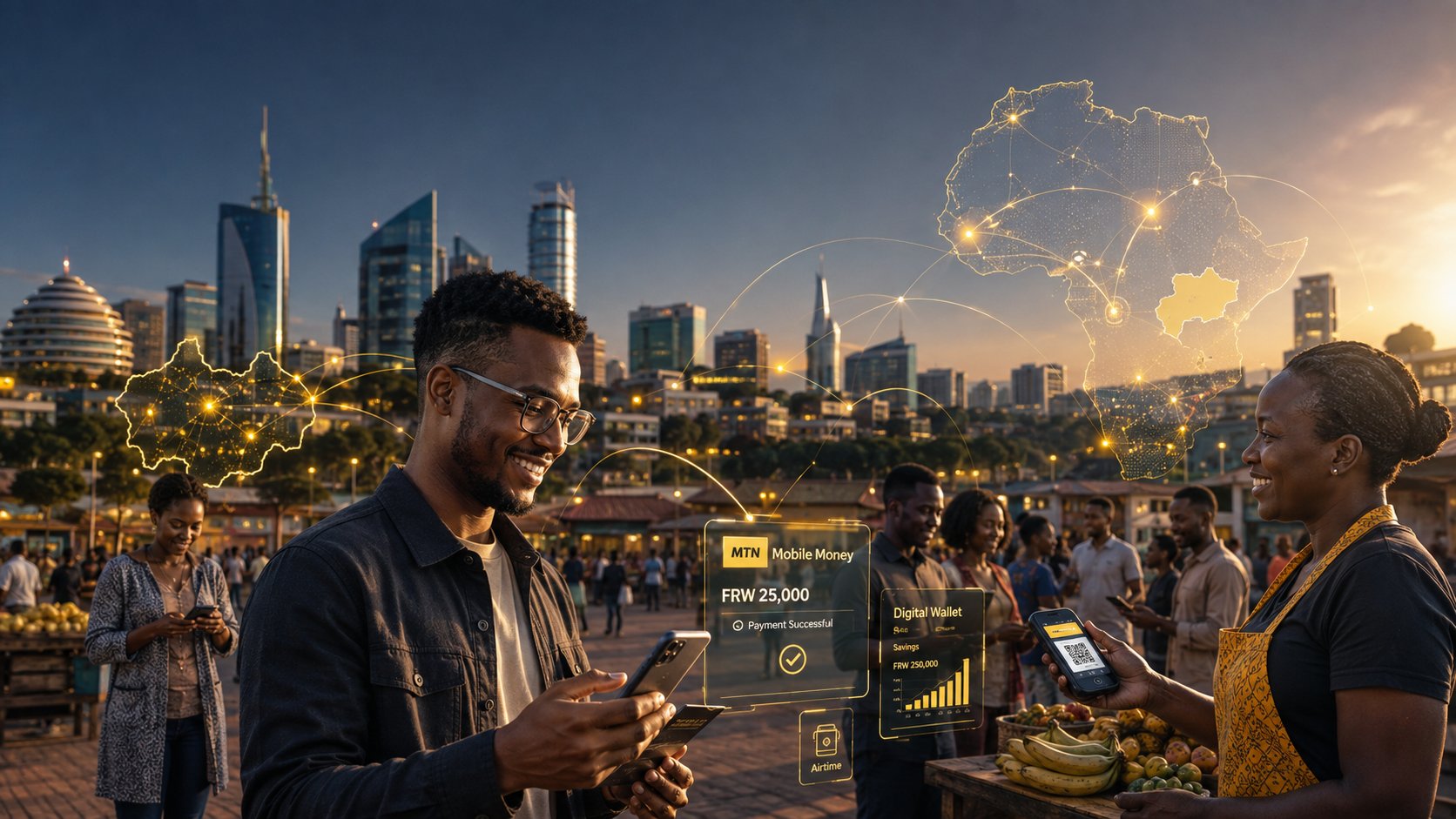
MTN Rwanda’s sharp rise in first-half profit is more than a strong earnings story for one of the country’s largest telecom operators. It is a sign of how rapidly mobile connectivity is becoming financial infrastructure across Africa, as consumers, merchants and businesses increasingly use phones not only to communicate but also to save, pay, transfer money and access digital services.
MTN Rwanda reported profit after tax of 17.2 billion Rwandan francs ($13.3 million) for the six months ended June, an increase of 191.2% from the same period a year earlier. Revenue rose 21.5% to 168.6 billion francs, while earnings before interest, tax, depreciation and amortisation increased 30.4% to 70.5 billion francs.
The numbers put Rwanda at an important intersection in Africa’s digital economy. Mobile networks are no longer simply competing on voice calls and internet packages. They are building ecosystems around payments, financial services, merchant transactions, digital identity and access to increasingly sophisticated financial products.
For investors watching Africa’s next phase of digital growth, that shift may prove more important than the headline profit figure.
The MoMo effect
MTN’s mobile-money platform is at the centre of the story.
The company said active mobile-money users increased 14.9% year on year to 6.4 million by the end of June. Active data subscribers rose 14.5% to 2.7 million, while total subscribers increased 11.4% to 8.7 million.
The growth shows the relationship between connectivity and financial technology.
As more people use mobile internet, the potential market for digital payments expands. As more merchants accept digital payments, consumers have greater incentives to keep money in digital wallets. And as transaction histories accumulate, financial institutions gain more opportunities to develop services around customers who may previously have been difficult to reach through traditional banking.
That creates a reinforcing cycle.
MTN Rwanda’s experience is part of a broader evolution in which telecom operators across Africa have moved into territory once dominated by banks. Mobile-money services can reach customers in areas where bank branches and traditional financial infrastructure remain limited.
The opportunity is particularly significant in countries where smartphones and mobile networks are spreading faster than conventional banking infrastructure.
Rwanda’s digital bet
Rwanda has spent years positioning itself as a technology and financial-services hub in East Africa.
Its policy framework increasingly treats digital payments as part of the country’s economic infrastructure rather than simply a commercial product.
The National Bank of Rwanda and the Ministry of Finance have outlined a 2026-2030 financial inclusion roadmap that includes expanding payment infrastructure, supporting fintech development, improving data-sharing infrastructure and increasing adoption of interoperable digital payments. The strategy also envisages exploring a central bank digital currency.
The country’s national digital payment system, known as eKash, is central to that ambition.
Interoperability matters because digital financial ecosystems can become fragmented when customers using one wallet cannot easily transact with customers using another platform.
Rwanda is attempting to address that problem by building infrastructure that allows different financial-service providers and payment platforms to connect.
For MTN, that creates both an opportunity and a challenge.
The opportunity is a larger digital-payments market. The challenge is that interoperability can reduce the competitive advantage of having customers locked into one particular network or wallet.
Why eKash matters
MTN Rwanda’s chief executive, Monzer Ali, described fintech as a core growth pillar and said the launch of eKash could help accelerate financial inclusion and support the wider ecosystem.
The significance goes beyond MTN.
A payment system that allows money to move more easily between mobile wallets and bank accounts can make digital transactions more useful for consumers and businesses.
A small retailer, for example, does not necessarily need customers to use the same mobile-money provider. A worker can potentially receive money through one financial channel and transfer it to another. A business can accept digital payments while maintaining relationships with different banks and financial-service providers.
That interoperability can help digital payments move from being a telecom product into becoming a broader economic utility.
Rwanda’s financial-sector strategy explicitly identifies fintech and digital infrastructure as important tools for financial inclusion and economic development. It also points to regulatory sandboxes and national payment infrastructure as mechanisms for encouraging innovation.
That policy direction could attract more fintech companies and investors into the market.
Data is the other engine
Mobile money is only one part of MTN Rwanda’s growth story.
Data services are becoming increasingly important as African consumers move from basic mobile phones towards smartphones and as demand rises for video, social media, digital banking, e-commerce and other internet-based services.
MTN’s first-half results showed double-digit growth across its data and fintech businesses.
The two businesses increasingly reinforce each other.
A customer using mobile money through a smartphone is also more likely to consume data. A customer who regularly uses mobile internet has more opportunities to interact with digital financial products.
That means telecom companies can increasingly monetise the same customer through several layers of the digital economy.
The model is different from the traditional telecommunications business, where revenue largely depended on voice calls, text messages and basic data packages.
Today, the bigger opportunity may be the digital ecosystem surrounding the connection.
From telecom to fintech
The transformation is visible across MTN’s African operations, but Rwanda provides a particularly interesting case because of its policy focus on digitalisation.
MTN Rwanda’s previous results already showed the acceleration. In the first half of 2025, the company reported 5.6 million active Mobile Money users, while MoMo revenue increased 29.1% and active MoMo merchants rose 29.7% to 572,000. Transaction volumes reached 1.4 billion, with transaction value of 21.9 trillion francs.
Those figures help explain why investors are paying closer attention to fintech within telecom groups.
The economics can be attractive because once a digital platform has a large customer base, additional services can potentially be introduced without building an entirely new physical distribution network.
The challenge is maintaining trust, security and affordability while expanding that ecosystem.
The investor question
For investors, MTN Rwanda’s 191.2% increase in profit is impressive, but it should not be viewed in isolation.
A key question is whether the company can sustain earnings growth as the market becomes more mature.
Revenue growth of 21.5% and EBITDA growth of 30.4% indicate that the improvement was supported by both stronger commercial performance and operational efficiencies.
MTN has reaffirmed medium-term guidance for mid-teens service-revenue growth and an EBITDA margin of between 40% and 42%, while targeting capital expenditure intensity of 7% to 10%.
That gives investors several indicators to monitor.
The first is whether mobile-money users continue to grow.
The second is transaction activity. User numbers alone do not tell the full story. The frequency and value of transactions can be equally important.
The third is data consumption. Rising smartphone adoption and data usage can provide another source of revenue growth.
The fourth is cost discipline. MTN’s improved profitability has been helped by operational efficiencies, meaning investors will want to see whether those gains can be sustained.
The fifth is regulation.
Regulation will shape the market
The future of African fintech will not be determined by telecom companies alone.
Central banks and regulators are increasingly influencing how mobile-money platforms operate, how payment systems connect and how customer data can be used.
Rwanda’s financial-sector strategy calls for clearer regulatory guidance for fintech companies and greater integration with national payment infrastructure. It also includes plans to support a fintech ecosystem and explore a CBDC.
For companies such as MTN, regulation can open markets but also change the economics of those markets.
Interoperability can increase the total number of digital transactions while simultaneously reducing the ability of individual platforms to control customers.
That is a trade-off investors will need to understand.
The next frontier
The next stage of Rwanda’s digital-finance story could move beyond simple person-to-person transfers.
Payments between businesses, government-to-person transfers, digital lending, insurance, savings products and cross-border transactions could all become more important.
The financial inclusion roadmap identifies areas including person-to-person and person-to-business payments, government payments, bulk payments and business-to-business transactions as part of the development of Rwanda’s digital payment infrastructure.
If those markets expand, telecom operators could become gateways into a much wider financial ecosystem.
That would fundamentally change how investors value these companies.
A telecom operator with millions of subscribers and millions of active financial-services users is not simply selling connectivity. It is operating a distribution network for digital commerce.
Africa’s bigger lesson
MTN Rwanda’s latest results also offer a broader lesson for Africa.
The continent’s digital economy will not necessarily be built by banks, technology companies or telecom operators working independently.
It is increasingly being built through overlapping ecosystems.
Telecommunications provide the connection. Smartphones provide the interface. Mobile money provides the transaction layer. Banks provide financial products. Governments provide regulation and payment infrastructure. Fintech companies build new services on top.
The strongest companies may be those capable of connecting these pieces.
Rwanda is attempting to create the conditions for that ecosystem to grow, while MTN is demonstrating the commercial potential of participating in it.
The company’s first-half performance therefore deserves attention beyond Kigali.
Its 17.2 billion franc profit is a financial result, but it is also a measure of a deeper transformation.
For millions of Africans, the mobile phone is becoming the place where communication, commerce and finance meet.
The companies that control those digital gateways could become some of the most important businesses in Africa’s next economic cycle.
For investors, the question is no longer simply who has the most subscribers.
It is who can turn those connections into durable digital businesses while maintaining customer trust, navigating regulation and keeping services affordable.
MTN Rwanda’s latest results suggest that race is already well under way.

More from Finance

Who will own Africa’s next trillion-dollar businesses?
Africa’s next corporate giants may emerge from AI, energy, finance, mining, logistics and consumer markets rather than traditional industries.
Who will control East Africa’s new digital payments network?
East Africa is building a faster, more connected payments ecosystem, opening a new contest among banks, fintechs, central banks and technology companies.