


Africa’s next generation of trillion-dollar businesses is likely to emerge where technology, natural resources, capital and the continent’s growing consumer market meet.
Africa has already produced billion-dollar fortunes from cement, mining, telecommunications, finance, retail and energy. The next phase could be considerably larger.
The question facing investors and entrepreneurs is no longer simply which African companies can become billion-dollar businesses. It is which companies can build platforms large enough to serve hundreds of millions of people across multiple markets and eventually compete with the world’s largest corporations.
Forbes’ 2026 Africa billionaires ranking offers an important clue. The continent’s 23 billionaires were collectively worth $126.7 billion, up $20.3 billion from a year earlier. Fourteen of them were self-made, while the largest fortunes remained concentrated in industries linked to physical infrastructure, natural resources, finance, manufacturing and telecommunications.
That history matters because Africa’s future billion-dollar companies are likely to follow a familiar pattern. The biggest fortunes may not necessarily come from inventing an entirely new product. They may come from identifying a structural shortage and building the infrastructure needed to solve it at continental scale.
The Dangote lesson
Aliko Dangote remains the clearest example.
Forbes valued the Nigerian industrialist’s fortune at $28.5 billion when it compiled its 2026 Africa billionaires list. His business empire spans cement, fertilizer and oil refining, with Dangote Cement operating across 10 African countries and annual production capacity of 48.6 million metric tons.
The refinery may become an even bigger part of the story.
Reuters reported this week that Nigeria’s Securities and Exchange Commission approved an initial public offering for Dangote’s refinery that could raise about $1.63 billion, valuing the business at roughly $47 billion based on its registered shares. The company plans to expand refining capacity from 650,000 barrels per day to 1.4 million barrels per day.
The broader lesson is important. Africa’s largest fortunes have often been built by controlling bottlenecks.
Cement was a bottleneck. Refined petroleum has been a bottleneck. Electricity remains a bottleneck. Formal financial services remain inaccessible to large parts of the population. Logistics remain expensive. Data infrastructure is still limited.
The entrepreneur who controls one of these bottlenecks at scale could have the foundations of the next continental giant.
AI will need more than software
Artificial intelligence is likely to create some of Africa’s most valuable new companies, but the opportunity may not be limited to companies developing AI models.
The bigger opportunity could be the infrastructure surrounding AI.
Data centres require reliable electricity, fibre networks, land, cooling systems and large amounts of capital. Africa’s relatively young digital economy gives the continent an opportunity to build new infrastructure while demand for computing power accelerates.
Globally, the scale of investment is already enormous. Reuters reported this week that McKinsey expects nearly $7 trillion in global data-centre investment by 2030. At the same time, electricity demand from AI infrastructure is becoming a major constraint.
Africa’s opportunity is therefore broader than creating an African version of a Silicon Valley software company.
A company that combines renewable energy, data centres, cloud computing and regional fibre networks could become strategically important across several African markets.
South Africa and Nigeria are already emerging as important testing grounds. MTN, Africa’s largest telecommunications operator, is developing AI-ready data centres in the two countries through a joint venture targeting an initial 150 megawatts of capacity.
The eventual winners may be businesses that understand that AI is ultimately an infrastructure story as much as a software story.
Fintech could become financial infrastructure
Africa’s fintech revolution has already produced some of the continent’s most closely watched technology companies.
Mobile money demonstrated that consumers could leapfrog traditional banking infrastructure. The next stage may involve turning payment networks into full financial ecosystems.
Payments, lending, savings, insurance, investment and commerce can increasingly operate through the same digital platforms.
MTN’s strategy illustrates the direction of travel. Reuters reported in August that the telecommunications group was considering banking licences in selected markets as it seeks to expand lending from its mobile-money operations. The company said lending was emerging as one of the fastest-growing areas of its fintech business.
That creates a potentially powerful business model.
A platform with tens of millions of customers already making payments can develop detailed information about transaction behaviour. With appropriate regulation and risk controls, that network can support credit, insurance and other financial products.
The next African financial giant may therefore not look like a traditional bank.
It may look like a technology company that gradually becomes a bank.
Energy could produce the biggest industrial fortunes
If Africa’s technology sector produces the continent’s fastest-growing companies, energy could produce some of its largest.
Africa has abundant solar resources, major natural gas reserves and significant potential for hydroelectric and geothermal power. Yet inadequate electricity supply remains one of the continent’s most persistent constraints on industrialisation.
The opportunity is enormous because every other sector depends on reliable power.
Factories need electricity. Data centres need electricity. Mines need electricity. Cold-storage facilities need electricity. Electric transport will need electricity. Cities will need more electricity as populations grow.
This creates opportunities for independent power producers, renewable-energy developers, battery-storage companies, transmission businesses and distributed-energy platforms.
The convergence with AI makes the opportunity even more interesting. As data centres consume increasing amounts of electricity globally, power availability is becoming a competitive advantage for digital infrastructure.
The company that can reliably deliver large quantities of affordable electricity could become more valuable than many companies consuming that power.
Mining meets the energy transition
Africa’s mining sector already sits at the centre of several global supply chains, but the next opportunity may come from moving further up the value chain.
Copper, lithium, graphite, manganese, cobalt and other minerals are central to electric vehicles, batteries, renewable-energy systems and modern industrial technology.
The historical African model has often involved extracting resources and exporting them in relatively raw form. A more ambitious model would involve processing those resources locally and eventually manufacturing products closer to the source.
That would require enormous investment, better infrastructure and more predictable regulation.
It could also create entirely new industrial champions.
South Africa’s Patrice Motsepe provides one example of how mining wealth can become a platform for broader investment. Forbes identifies him as the founder and chairman of African Rainbow Minerals, while his investment interests have expanded into financial services and private equity.
The next mining billionaire may therefore not simply own a mine. The bigger opportunity could be controlling a chain that connects mineral extraction to processing, energy, transport and manufacturing.
Telecoms are becoming platforms
Telecommunications companies were once primarily businesses selling voice calls and data.
That model is changing.
The largest operators now possess something potentially more valuable than spectrum and towers: enormous customer networks.
Those networks can support mobile payments, financial services, digital advertising, e-commerce, entertainment, cloud services and enterprise technology.
MTN’s expansion into lending and AI-ready data centres demonstrates how the traditional boundaries between telecommunications, banking and technology are disappearing.
Other operators are likely to follow.
The winning strategy may be to transform telecom customers into users of a broader digital ecosystem.
That creates a powerful possibility for Africa’s next corporate giants: one company serving consumers across communications, finance and commerce.
Logistics may be the quiet giant
Africa’s geography creates a difficult logistics problem.
Goods must move across long distances, often through fragmented national markets and infrastructure networks. The African Continental Free Trade Area could eventually make this market much larger by reducing barriers between economies.
The opportunity extends from ports and warehouses to trucking, rail, air freight, last-mile delivery and digital logistics platforms.
The company that can make African trade cheaper and more predictable could capture enormous value.
This may be particularly important as African manufacturing expands.
Factories cannot scale without dependable supply chains, while retailers cannot serve continental markets without reliable distribution. Logistics therefore sits underneath almost every other opportunity on this list.
Agriculture is still a technology business
Agriculture may appear less glamorous than AI, but its scale could make it one of Africa’s most consequential industries.
Africa has a large share of the world’s uncultivated agricultural land and a rapidly growing population. Yet productivity, storage, irrigation, financing and market access remain significant challenges.
Technology can change the economics.
Digital marketplaces can connect farmers with buyers. Financial platforms can provide credit. Satellite data can improve crop monitoring. Cold chains can reduce food losses. Irrigation technology can increase yields.
The biggest opportunity may not be farming alone.
It could be building integrated food businesses that control production, processing, logistics, distribution and retail.
Africa’s existing billionaires already show the power of this approach. Forbes’ 2026 list includes fortunes connected to food and beverage, retail, manufacturing and diversified industrial businesses.
Real estate will follow the population
Africa’s urban population is expected to continue expanding rapidly, creating demand for housing, offices, industrial parks, shopping centres, hospitals and data-centre campuses.
Real estate fortunes are already visible on the continent. Morocco’s Anas Sefrioui, for example, appears on Forbes’ 2026 list through his real estate interests.
But the next opportunity may be more specialised.
Affordable housing, logistics parks, student accommodation, healthcare property and industrial real estate could attract capital as cities grow.
Data centres also create a new real estate category, linking land ownership with power, fibre and digital infrastructure.
Healthcare could become a continental industry
Africa’s healthcare market is another sector where population growth and infrastructure shortages intersect.
Private hospitals, diagnostics, pharmaceutical manufacturing, medical distribution and digital health could all expand as incomes rise and governments seek more efficient healthcare systems.
The opportunity is particularly large in pharmaceutical production.
Africa imports substantial quantities of medicines, creating an opening for companies that can manufacture essential drugs locally while developing regional distribution networks.
Healthcare businesses may not produce spectacular valuations overnight, but companies that establish trusted brands and distribution systems across multiple countries could become extremely valuable over time.
Consumer markets will decide the winners
Ultimately, almost every sector leads back to the same factor: Africa’s consumers.
The continent has a large and comparatively young population. More people are moving into cities, using smartphones, earning incomes and participating in formal and digital markets.
That creates demand for everything from packaged food and financial services to housing, entertainment and healthcare.
Forbes’ billionaire rankings show that consumer-facing industries remain a significant source of wealth, with fortunes spanning fashion and retail, food and beverage, finance and diversified businesses.
The biggest companies of the future may combine several of these markets.
A fintech company could become a retailer. A telecom company could become a bank. An energy company could become a data-centre operator. A mining company could become a manufacturer.
The lines are becoming harder to see.
The trillion-dollar question
Africa’s next trillion-dollar businesses are unlikely to emerge from one sector alone.
They will probably sit at intersections.
Energy plus AI. Finance plus telecommunications. Mining plus manufacturing. Agriculture plus logistics. Real estate plus digital infrastructure. Healthcare plus pharmaceuticals.
That is also why the next generation of African billionaires may look different from today’s list.
Forbes’ 2026 ranking is still dominated by older industrial fortunes. Fourteen of the 23 billionaires are self-made, but almost all are older than 60, with Tanzania’s Mohammed Dewji the notable exception. There are also no women on the list.
The next generation has an opportunity to change that profile.
The entrepreneurs who build Africa’s largest companies may come from Nairobi, Lagos, Johannesburg, Cairo, Casablanca, Accra, Kigali or cities that are not yet recognised as continental business centres.
They will not necessarily be the people with the biggest idea.
They may be the people who understand the biggest unmet need.
Africa’s history of corporate wealth suggests that fortunes are built when entrepreneurs turn structural problems into scalable businesses. The next wave could be larger because the market itself is becoming more connected.
The trillion-dollar company, if Africa produces one, may not begin with a revolutionary invention.
It may begin with a simple observation: hundreds of millions of people need something, and nobody has yet built the system capable of serving them at continental scale.

More from Billionaire Watch
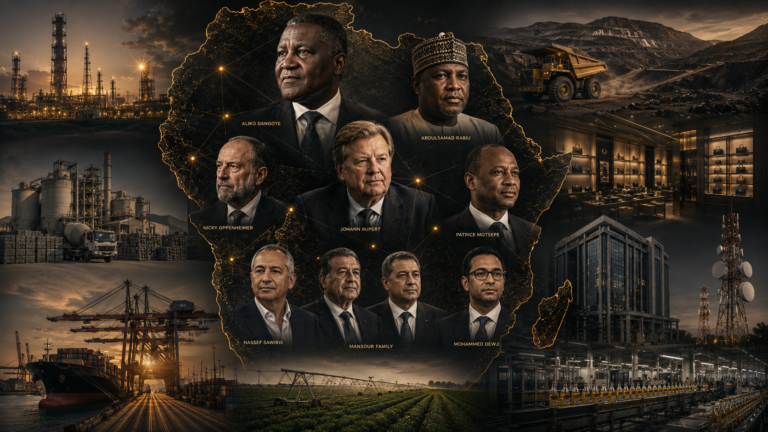
How Africa’s richest families control the continent’s biggest companies
Across Africa, powerful families build lasting corporate empires spanning industries, markets and generations while shaping the continent’s economic future.
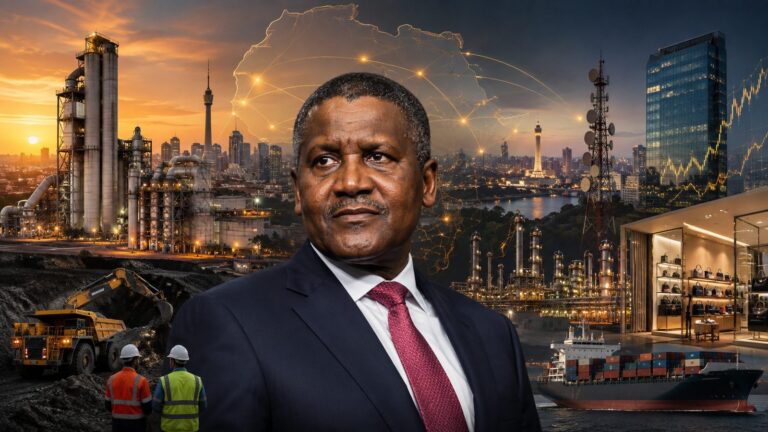
How Africa’s 10 richest billionaires built their $121.3 billion empires
From cement and oil to luxury goods and banking, Africa’s richest entrepreneurs built fortunes around essential industries and global markets.