
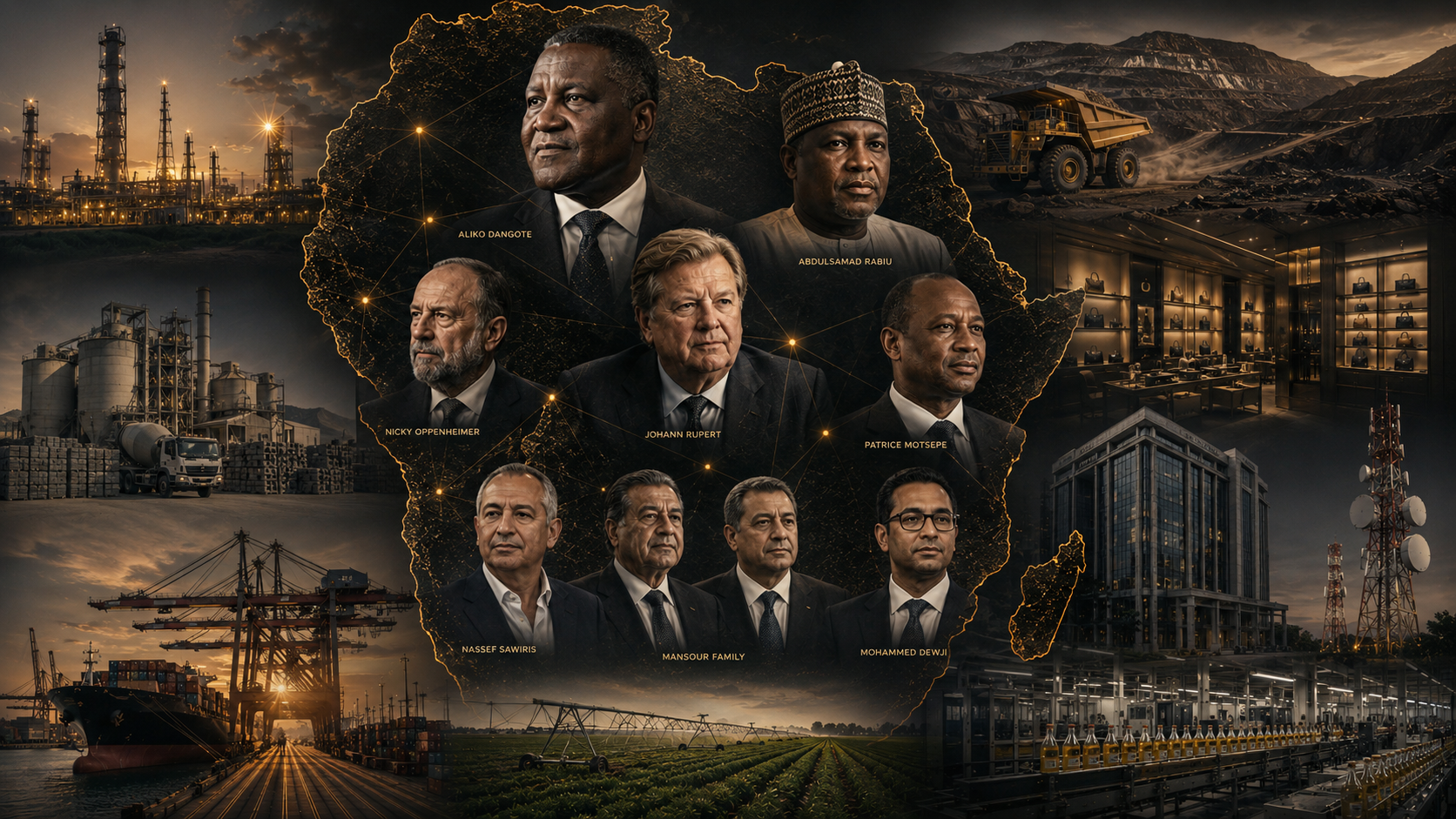
Across Africa, powerful families are converting generations of capital into corporate control spanning cement, mining, banking, telecoms, retail, manufacturing and energy. The real story behind Africa’s biggest business empires is not simply the size of their fortunes. It is the ownership architecture underneath them: holding companies, listed subsidiaries, private investment vehicles, family stakes and businesses passed from one generation to the next.
In Lagos, one of Africa’s most consequential industrial assets is preparing for a public-market test that could change the ownership story of the continent’s largest refinery. In South Africa, fortunes built through mining, tobacco and luxury goods have evolved into sophisticated investment structures stretching far beyond their original industries. In Cairo, family capital has moved from construction into automobiles, banking, technology and consumer markets. In Dar es Salaam, a trading business started by a family decades ago has become a diversified industrial group.
Across these markets, ownership remains one of the least understood forces shaping African capitalism.
Forbes estimates that Africa’s 23 billionaires were worth a combined $126.7 billion in its 2026 annual ranking, up 21% from the previous year. Aliko Dangote alone was valued at $28.5 billion in that ranking. By September, real-time valuations had pushed Dangote’s fortune higher, illustrating how quickly listed equity prices can reshape the hierarchy of African wealth.
But billionaire rankings tell only part of the story.
The deeper question is what sits beneath those numbers.
Who owns the cement plants? Who controls the banks? Which families hold the voting power? Which businesses remain private? Where has ownership moved from founder to children? And where does family wealth now operate through professionally managed investment companies rather than traditional operating businesses?
Who Owns Africa maps the answer across six of the continent’s most important commercial economies.
The ownership map
| Family / business dynasty | Core market | Principal business interests | Ownership model |
|---|---|---|---|
| Dangote | Nigeria | Cement, refinery, fertilizer, food, infrastructure | Founder-controlled group and major listed stakes |
| Rabiu | Nigeria | Cement, food, sugar, agriculture, logistics | Family-controlled listed companies and private holdings |
| Dantata | Nigeria | Trading, agriculture, real estate, energy, logistics | Family-owned diversified group |
| Rupert | South Africa | Luxury goods, investment, financial interests | Strategic family holdings and investment companies |
| Oppenheimer | South Africa | Mining legacy, investments, conservation | Family investment and private capital |
| Motsepe | South Africa | Mining, financial interests, investments | Founder-controlled investment interests |
| Shah | Kenya | FMCG, manufacturing, consumer products | Family-controlled operating group |
| Kenyatta | Kenya | Banking, agriculture, hospitality, property | Family-linked private and listed interests |
| Mansour | Egypt | Automotive, banking, consumer goods, logistics | Multi-generational family conglomerate |
| Sawiris | Egypt | Construction, investment, telecoms, chemicals | Family investment structures and strategic stakes |
| Dewji | Tanzania | Manufacturing, agriculture, logistics, trading | Family-founded diversified conglomerate |
| Al-Amoudi | Ethiopia | Agriculture, mining, construction, hospitality | Private investment group |
Ownership structures change over time. The table distinguishes family control, strategic stakes and broader business influence rather than implying that every family owns every company associated with its business network.
Nigeria: where industrial power is becoming concentrated
Nigeria is the clearest example of how family capital can move from trading into industrial infrastructure.
The most powerful example is Dangote.
Aliko Dangote’s fortune is built around an empire whose centre of gravity has moved progressively from commodities and trading into manufacturing and infrastructure. Dangote Cement is publicly listed, while the wider group extends into fertilizer, food processing and refining. Forbes says Dangote owns about 85% of publicly traded Dangote Cement through a holding company, while the company has operations in 10 African countries.
The refinery represents the next stage.
On Sept. 4, Nigeria’s Securities and Exchange Commission approved an IPO for the Dangote refinery that could raise about $1.63 billion, making it Africa’s largest-ever share sale if fully subscribed. The refinery, with capacity of 650,000 barrels per day, has been valued at roughly $47 billion based on the registered shares. Dangote plans to use the capital to support a doubling of capacity to 1.4 million barrels per day.
That is more than a fundraising event.
It is potentially a major change in the ownership architecture of one of Africa’s most strategically important private assets.
Dangote family corporate map
Family capital
→ Aliko Dangote
→ Dangote Industries
→ Dangote Cement
→ Dangote Refinery
→ Dangote Fertilizer
→ Food and agricultural businesses
→ Infrastructure and industrial investments
The distinguishing feature is vertical integration.
Dangote has repeatedly moved deeper into the supply chains surrounding products Nigeria imports heavily. Cement replaces imported building material. Fertilizer addresses agricultural inputs. The refinery targets petroleum products. The strategy is not simply to own businesses, but to own infrastructure connecting multiple parts of the economy.
That helps explain why the Dangote empire matters beyond its billionaire valuation.
The Rabiu counterweight
Abdulsamad Rabiu represents another model of Nigerian family capitalism.
BUA began as a trading business and expanded into manufacturing, cement, food processing, agriculture, logistics and related infrastructure. The group now has two particularly important listed businesses, BUA Cement and BUA Foods.
Forbes estimated Rabiu’s fortune at $11.2 billion in its March 2026 annual ranking, making him Africa’s third-richest person at that point.
By September, real-time valuations had moved significantly higher.
The ownership strategy is important because Rabiu has retained substantial control over the listed businesses rather than using public markets to dilute family influence dramatically.
Rabiu family corporate map
Rabiu family
→ BUA Group
→ BUA Cement
→ BUA Foods
→ Sugar and food processing
→ Agriculture
→ Logistics
→ Energy and infrastructure
The competition between Dangote and Rabiu also illustrates a broader feature of Nigerian capitalism: a small number of industrial families have become major players in essential sectors.
The Dantata dynasty
The Dantata family represents an older generation of Nigerian commercial power.
Its business interests extend across manufacturing, agriculture, real estate, energy, commodity trading and marine logistics. The group’s roots predate the modern wave of Nigerian industrial billionaires and demonstrate how family wealth can survive multiple economic cycles by continuously changing sectors.
The important distinction is that not every powerful family is represented by a single billionaire on Forbes.
Some are dynasties.
Their influence can be distributed among several relatives, private companies, properties and investment vehicles, making their aggregate economic footprint much harder to measure.
South Africa: from mining fortunes to global portfolios
South Africa’s richest families illustrate a different path.
Here, some of the continent’s oldest fortunes were built around mining, tobacco and industrial capital before evolving into global investment portfolios.
Rupert family corporate map
Rupert family
→ Remgro
→ Richemont
→ Reinet
→ Global luxury brands
→ Financial and industrial investments
Johann Rupert’s wealth is closely associated with luxury goods through Richemont and with diversified investments through Remgro and Reinet.
The structure represents an important transition in African family capitalism.
The family does not need to operate every company directly.
Instead, capital can be deployed through investment companies that own stakes in businesses across sectors and jurisdictions.
That creates a form of control that is less visible than a traditional family conglomerate.
Oppenheimer: the mining fortune after De Beers
The Oppenheimer family provides an even clearer example.
For three generations, the family was associated with De Beers and Anglo American. Nicky Oppenheimer ultimately sold the family’s 40% interest in De Beers to Anglo American in 2012 for $5.1 billion.
The family then moved much of that capital into private investment structures.
That distinction matters.
The Oppenheimer story is no longer simply about who owns diamonds. It is about how a resource fortune can be converted into diversified capital that survives the sale of the original operating asset.
Motsepe: building a modern African mining fortune
Patrice Motsepe’s African Rainbow Minerals represents another route into ownership.
Motsepe founded ARM in 2003 and built his fortune through mining and related investments. Reuters reported in February 2026 that he stepped from executive chairman to non-executive chairman because of Johannesburg Stock Exchange governance requirements.
The transition illustrates a recurring feature of mature family and founder-led businesses: as companies become larger and more regulated, direct founder management increasingly gives way to board-level influence and professional management.
Kenya: family capital beyond the billionaire rankings
Kenya’s family business landscape is less dominated by a handful of globally ranked billionaires, but family ownership remains deeply embedded in the economy.
The Shah business networks provide one of the strongest examples.
Shah family corporate map
Shah family
→ Bidco Africa
→ Consumer goods
→ Manufacturing
→ Food products
→ Personal care
→ Regional distribution
→ East African markets
Bidco Africa traces its origins to a soap venture established in 1985 and has grown into a diversified consumer-products group with more than 60 brands across 18 countries. Vimal Shah is chairman and co-founder, while other members of the Shah family occupy senior ownership and management roles.
The strategy is distinctly regional.
Rather than building one giant African company, the group has developed a portfolio of everyday consumer products distributed across multiple markets.
That gives family ownership an advantage that is often overlooked: distribution itself becomes an asset.
Kenyatta and Ndegwa networks
Kenya also demonstrates how family wealth can become difficult to classify.
The Kenyatta and Ndegwa families have interests spanning agriculture, property, hospitality, banking and other investments, while their corporate relationships overlap with publicly traded companies and privately held businesses.
This is where the traditional billionaire ranking becomes less useful.
A family’s economic influence may exceed the value of the assets that can be attributed to a single individual.
Egypt: where family empires became regional platforms
Egypt’s largest family businesses have developed some of the continent’s most sophisticated corporate structures.
The Mansour family is the clearest example.
Mansour family corporate map
Loutfy Mansour legacy
→ Mohamed Mansour
→ Youssef Mansour
→ Yasseen Mansour
→ Mansour Group
→ Automotive
→ Banking and financial services
→ Consumer goods
→ Healthcare
→ Education
→ Logistics
→ Real estate
→ Technology
→ Sports
Mansour Group says it operates in more than 100 countries and employs more than 60,000 people. Its interests include automotive, banking, consumer products, education, healthcare, logistics, machinery, real estate and technology.
The family has also demonstrated how ownership can be separated from day-to-day management.
Different members of the next generation have developed their own areas of responsibility while retaining connections to the wider family enterprise.
That creates resilience.
If one business underperforms, the family is not dependent on a single company or industry.
The Sawiris model
The Sawiris family represents a parallel Egyptian model.
Its fortunes have been built through construction, telecommunications, chemicals, investment and tourism.
Nassef Sawiris, Africa’s wealthiest Egyptian in Forbes’ 2026 ranking, has interests extending well beyond the family’s original construction business. Forbes valued him at $9.6 billion in March.
The Sawiris story shows how family wealth can evolve from an operating company into an investment platform.
The operating business creates the original capital.
The investment structure preserves and redeploys it.
Tanzania: the Dewji family’s industrial expansion
In Tanzania, the Dewji family offers one of East Africa’s clearest examples of industrial family ownership.
MeTL Group began as a trading business established by Gulamabbas Dewji in the 1970s. Mohammed Dewji joined the family business in 1999 and helped expand it into manufacturing, agriculture, logistics, trading and business services.
Dewji family corporate map
Dewji family
→ MeTL Group
→ Manufacturing
→ Agribusiness
→ Logistics
→ Commodity trading
→ Distribution
→ Financial and business services
→ Regional operations
Mohammed Dewji’s Forbes fortune was estimated at $2.1 billion in March 2026.
But the billionaire figure understates the family-business story.
The real asset is the operating network built around MeTL.
This is a recurring theme across Africa.
Family-controlled businesses often accumulate value not only through share prices, but through factories, warehouses, land, supply chains, distribution networks and relationships with customers across several countries.
Ethiopia: private capital on a different scale
Ethiopia presents a different ownership environment.
Among the country’s most prominent private business groups is MIDROC Ethiopia, associated with Sheikh Mohammed Hussein Ali Al-Amoudi.
Al-Amoudi family corporate map
Al-Amoudi family
→ MIDROC Investment Group
→ Agriculture
→ Agro-processing
→ Manufacturing
→ Mining
→ Construction
→ Real estate
→ Hotels and resorts
→ Commerce
MIDROC describes itself as one of Ethiopia’s largest private business groups, with interests spanning agriculture, manufacturing, mining, construction, real estate and hospitality.
The structure is again diversified.
Rather than depending on one listed corporation, the business group operates through a collection of companies and investments.
This model can be particularly powerful in markets where large private enterprises remain outside public stock markets.
The hidden advantage of family ownership
Why do these families remain so powerful?
The answer is not simply inherited wealth.
It is patient capital.
A publicly traded company is judged every quarter. A family business can sometimes operate according to a longer horizon.
A founder can invest heavily in a factory that may take years to mature. Children can inherit an operating platform instead of starting from zero. Family shareholders can maintain strategic stakes while professional executives run daily operations.
The second advantage is access to networks.
A family that has operated for decades accumulates relationships with suppliers, banks, governments, investors and customers.
The third is diversification.
The strongest families rarely remain dependent on the business that created their fortune.
Trading becomes manufacturing.
Manufacturing becomes logistics.
Logistics becomes infrastructure.
Infrastructure creates financing opportunities.
And the resulting capital is eventually moved into investment companies.
The new ownership architecture
The next generation is likely to make African family businesses less visible, not less powerful.
Founders traditionally put their names on companies.
Their children increasingly use holding companies, private equity structures, family offices and investment vehicles.
That makes ownership harder to follow.
It also means the future map of African corporate power may not be defined by famous surnames on factory gates.
It may be defined by who controls the shares behind those companies.
The Dangote refinery IPO provides a glimpse of that future.
A family-controlled asset can enter public markets while its founding shareholder retains substantial influence. Public capital can finance expansion without necessarily ending family control.
That is a powerful model.
It allows African industrial families to unlock billions of dollars of capital while retaining strategic influence over the businesses they built.
The concentration question
There is another side to the story.
When a small number of families control large portions of strategic industries, questions inevitably arise around competition, succession, transparency and economic concentration.
In Nigeria, cement and food processing are dominated by a small group of powerful industrial players.
In South Africa, historic fortunes have been transformed into investment structures with stakes across major industries.
In Kenya, family-owned conglomerates remain significant forces in consumer products, banking, agriculture and property.
In Egypt, large family businesses operate across multiple sectors and international markets.
In Tanzania, family-owned industrial groups have become important manufacturing and distribution platforms.
In Ethiopia, private conglomerates play an important role in sectors ranging from agriculture to hospitality.
The result is an African economy in which ownership remains highly concentrated even as the corporate structures themselves become increasingly sophisticated.
Who really owns Africa?
The answer is more complicated than a billionaire ranking.
Africa’s richest families do not necessarily control every company associated with their names. Some own majority stakes. Others exercise influence through holding companies, trusts, investment vehicles or strategic minority positions. Some fortunes are split among several relatives.
But the pattern is unmistakable.
Capital accumulated by one generation is increasingly being converted into institutional ownership by the next.
The family conglomerate is becoming the family investment platform.
And that may prove to be the most important shift in African corporate ownership over the next decade.
The question for investors, regulators and the public is therefore no longer simply who is Africa’s richest person?
It is more consequential:
Who owns the companies that Africans depend on every day, and how much of that ownership will remain concentrated in the same families for another generation?

More from Billionaire Watch
How Africa’s 10 richest billionaires built their $121.3 billion empires
From cement and oil to luxury goods and banking, Africa’s richest entrepreneurs built fortunes around essential industries and global markets.

Who will own Africa’s next trillion-dollar businesses?
Africa’s next corporate giants may emerge from AI, energy, finance, mining, logistics and consumer markets rather than traditional industries.