
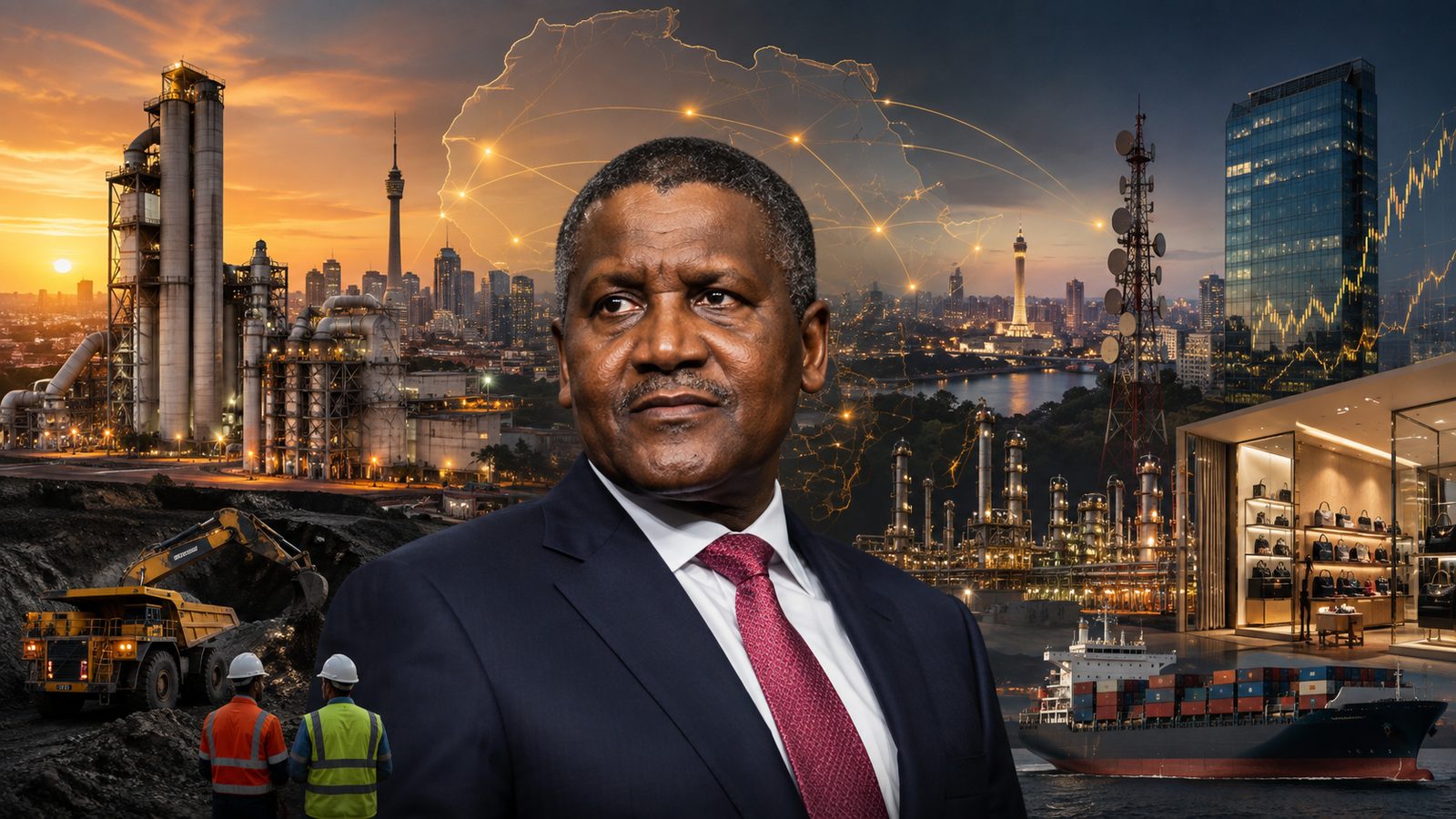
Africa’s 10 richest billionaires are now worth a combined $121.3 billion, but behind that number are very different stories of industrial ambition, inherited wealth, market timing and business expansion.
The fortunes of Africa’s wealthiest entrepreneurs and business families have risen from the $119.1 billion recorded in March 2026, according to Forbes estimates tracked in a September 3 snapshot. The latest figures show Aliko Dangote extending his lead at the top, while Johann Rupert, Abdulsamad Rabiu and Nicky Oppenheimer remain among the continent’s dominant private fortunes.
The ranking provides more than a list of Africa’s richest people. It offers a picture of where private economic power has accumulated across the continent. Cement, oil, telecommunications, mining, banking, fertilizer, luxury goods, automotive distribution and industrial manufacturing feature prominently among the businesses that created these fortunes.
The fortunes are also constantly changing. Forbes says its real-time billionaire tracker updates public holdings as markets move, while fortunes tied significantly to private companies are updated using other valuation methods. That means a billionaire’s estimated wealth can change substantially without a major transaction taking place.
For this feature, the September 3 figures provide the snapshot. They should be read as estimated wealth at that point rather than permanent valuations.
10. Michiel Le Roux: $3.7 billion
South African banking entrepreneur Michiel Le Roux built his fortune by helping create a bank designed for a new generation of South African consumers.
Le Roux was one of the founders of Capitec Bank, which was established in 2001 with a focus on the country’s emerging middle class. He owns about 11% of the Johannesburg-listed lender and remains on its board.
His estimated fortune stood at $3.7 billion in the September snapshot, down from $3.8 billion in Forbes’ March 2026 annual Africa ranking. Forbes’ annual list placed Le Roux 10th among Africa’s billionaires, with his wealth closely linked to his Capitec holding.
Before Capitec, Le Roux ran Boland Bank, a smaller regional lender serving communities around Cape Town. His experience in banking helped shape the model that later made Capitec one of South Africa’s major retail financial institutions.
His story is important because it demonstrates how financial services can create immense private wealth even without the natural resources that dominate many African billionaire fortunes.
Capitec’s growth turned Le Roux’s ownership stake into a multibillion-dollar asset. As the bank expanded its customer base and market value, the value of his holding increased with it.
The business remains central to his fortune today.
9. Mohamed Mansour: $4 billion
Egyptian businessman Mohamed Mansour built his fortune through a family business that grew from a domestic enterprise into a major international distributor and industrial group.
Mansour oversees Mansour Group, founded by his father, Loutfy Mansour, in 1952. The conglomerate has interests spanning automotive distribution, industrial equipment, consumer goods and other businesses and employs about 60,000 people, according to the supplied profile.
Mansour’s path into major business began with automobiles. In 1975, he established General Motors dealerships in Egypt, eventually developing the business into one of GM’s largest distributors globally.
The group also became a major distributor of Caterpillar equipment in Egypt and several other African markets, giving the family exposure to construction, infrastructure and industrial development.
His fortune stood at $4 billion in the September snapshot, unchanged from the March Forbes valuation.
Unlike fortunes based primarily on a single listed company, the Mansour family’s wealth is spread across a broad private conglomerate.
Mohamed Mansour has also occupied an unusual position between business and government. He served as Egypt’s minister of transportation from 2006 to 2009.
His brothers Yasseen Mansour and Youssef Mansour are also billionaires, making the Mansours one of Egypt’s most powerful business families.
The family’s story illustrates how wealth can compound across generations when a family business continuously enters new industries and markets.
8. Patrice Motsepe: $3.6 billion
Patrice Motsepe’s fortune was built in one of Africa’s oldest wealth-generating industries: mining.
The South African businessman founded African Rainbow Minerals, a mining group with interests in commodities including platinum, manganese, iron ore and copper.
Motsepe became a billionaire in 2008 and was the first Black African to appear on the Forbes billionaire list, according to Forbes.
But his business interests have expanded beyond mining.
In 2016, he launched African Rainbow Capital, a private equity business focused on investments across Africa. He also owns a stake in financial services group Sanlam.
Motsepe’s estimated fortune fell sharply during the period covered by this ranking, from $4.3 billion in March to $3.6 billion in September, a decline of roughly $700 million.
The movement demonstrates how fortunes tied to listed companies and commodity-related businesses can change quickly.
Motsepe has also become a major figure in African sport. He owns and serves as president of Mamelodi Sundowns, one of South Africa’s leading football clubs, and in 2021 became president of the Confederation of African Football.
His empire therefore extends across natural resources, investment and sport.
7. Naguib Sawiris: $5.6 billion
Naguib Sawiris built his original fortune through telecommunications before transforming himself into a global investor.
The Egyptian businessman was closely associated with Orascom Telecom, which became a major telecommunications company under his leadership. In 2011, the business was sold to Russian telecommunications operator VimpelCom, now known as VEON, in a multibillion-dollar transaction.
The sale gave Sawiris capital to pursue investments beyond telecommunications.
He later became chairman of Orascom TMT Investments, with interests spanning telecommunications, technology and financial services.
His portfolio has also reached the European technology market and the international hospitality industry. He developed Silversands, a luxury resort project in the Caribbean, illustrating how his investment interests have moved beyond his Egyptian roots.
Sawiris’ fortune was estimated at $5.6 billion in the September snapshot, matching his March valuation. Forbes’ annual Africa ranking also placed him at $5.6 billion.
His business journey illustrates one of the most important themes in African billionaire wealth: fortunes created in African markets are increasingly being redeployed into global assets.
6. Mike Adenuga: $7 billion
Mike Adenuga built one of Nigeria’s most diversified private fortunes by combining telecommunications with oil.
His biggest business is Globacom, or Glo, the telecommunications company he founded. Glo became Nigeria’s third-largest telecommunications operator and built a large subscriber base in one of Africa’s biggest mobile markets.
But Adenuga’s wealth is not dependent on mobile communications alone.
His energy interests include Conoil Producing, which operates oil blocks in Nigeria’s Niger Delta. He also owns a major stake in publicly traded Conoil.
The businessman has invested in telecommunications infrastructure as well. Globacom built Glo-1, a submarine cable connecting West Africa with the United Kingdom through Ghana and Portugal.
That infrastructure has become increasingly important as Africa’s economy shifts toward digital services, mobile payments, streaming, cloud services and data-driven businesses.
Adenuga’s fortune increased to about $7 billion from the $6.5 billion recorded in Forbes’ March annual ranking.
His wealth demonstrates the power of controlling businesses that serve both basic economic needs and rapidly expanding consumer markets.
Nigeria’s enormous population has provided the scale required for both telecommunications and consumer-facing companies to grow into multibillion-dollar businesses.
5. Nassef Sawiris: $9.6 billion
Nassef Sawiris occupies fifth place with an estimated $9.6 billion.
His fortune has remained broadly stable, but his portfolio is one of the most internationally diversified among Africa’s richest billionaires.
Sawiris has built wealth through fertilizer, construction, investments and sport. He runs OCI, one of the world’s major nitrogen fertilizer producers, and has accumulated stakes in global companies outside his core industrial interests.
He owns nearly 6% of Adidas and acquired a 5% interest in Madison Square Garden Sports in 2020, giving him exposure to major American sports franchises.
His sports portfolio also includes Aston Villa, the English Premier League football club he co-owns with Wes Edens of Fortress Investment Group.
This international diversification has helped separate Sawiris from entrepreneurs whose fortunes depend primarily on one African market.
His family background is equally significant.
Nassef is one of the three billionaire Sawiris brothers. Naguib Sawiris built his fortune in telecommunications and investments, while Samih Sawiris developed major interests in tourism and real estate.
Together, the brothers represent one of Egypt’s most successful business dynasties.
Nassef’s fortune remained at $9.6 billion in the September snapshot, matching his March Forbes valuation.
4. Nicky Oppenheimer and family: $10.7 billion
Nicky Oppenheimer’s fortune is rooted in one of the world’s most famous commodities: diamonds.
Oppenheimer inherited the De Beers fortune and became the third generation of his family to run the diamond company.
In 2012, Oppenheimer and his family sold their 40% stake in De Beers to Anglo American for $5.1 billion in cash, ending an 85-year period during which the family held a controlling position in the global diamond business.
The sale fundamentally changed the family’s relationship with the diamond industry, but it did not end the Oppenheimer fortune.
Oppenheimer subsequently expanded into other investments. In 2014, he founded Fireblade Aviation in Johannesburg, a charter aviation company.
He also holds extensive conservation land across southern Africa.
His estimated fortune increased to $10.7 billion from $10.6 billion in March, according to the September snapshot.
Oppenheimer’s story differs from that of entrepreneurs such as Dangote and Rabiu because a large part of the family’s wealth originated through ownership passed down across generations.
Yet the family’s decision to sell De Beers and diversify illustrates how inherited wealth can be transformed into a broader investment portfolio.
The Oppenheimer fortune remains one of the clearest examples of how Africa’s historical resource industries created fortunes that continue to shape the continent’s private wealth landscape.
3. Abdulsamad Rabiu: $11.7 billion
Abdulsamad Rabiu’s rise demonstrates how manufacturing can transform a trading fortune into a major African industrial empire.
Rabiu founded BUA Group, a Nigerian conglomerate with interests in cement, sugar refining and real estate.
He started his own business in 1988, initially importing iron, steel and chemicals. Over time, he moved increasingly into manufacturing.
That transition became central to his rise.
In 2020, his privately owned Obu Cement merged with the Cement Company of Northern Nigeria to form BUA Cement Plc. Rabiu now controls major stakes in BUA Cement and BUA Foods.
Forbes’ March 2026 ranking valued his fortune at $11.2 billion, placing him third among Africa’s billionaires.
By September, the estimate used for this feature had risen to $11.7 billion.
Rabiu’s business strategy mirrors a broader trend among Nigeria’s largest entrepreneurs: replacing imports with locally produced goods.
Cement and food are particularly important because Nigeria’s growing population creates persistent demand for construction materials and consumer products.
His wealth is consequently linked not only to financial markets but also to the long-term industrialisation of Nigeria.
2. Johann Rupert and family: $17.1 billion
Johann Rupert and his family have built Africa’s second-largest fortune around global luxury goods and investment holdings.
Rupert is chairman of Swiss luxury group Compagnie Financière Richemont, whose portfolio includes brands such as Cartier and Montblanc.
The company was created in 1998 through a spinoff of assets owned by Rembrandt Group, the business founded by Rupert’s father, Anton Rupert.
That history makes Rupert’s fortune both entrepreneurial and generational.
The family’s interests extend beyond Richemont. Rupert owns about 7% of investment company Remgro, which he chairs, and approximately 26% of Reinet, a Luxembourg-based investment holding company.
His fortune increased to $17.1 billion in the September snapshot, compared with $16.1 billion in Forbes’ March ranking.
The structure of Rupert’s wealth offers a lesson in diversification.
Luxury goods provide exposure to global consumers, while investment companies provide access to multiple industries and markets.
That combination has helped make the Rupert family one of Africa’s most powerful private investment groups.
It has also allowed the family’s wealth to become increasingly detached from the South African economy where the business empire began.
1. Aliko Dangote: $31.1 billion
At the top of Africa’s wealth hierarchy is Aliko Dangote, whose estimated fortune reached $31.1 billion in the September 3 snapshot.
His fortune was valued at $28.5 billion in Forbes’ March 2026 annual ranking, meaning the September estimate represented an increase of $2.6 billion from the annual-list figure. The supplied September 3 report, however, compares it with a March valuation of $26.5 billion and calculates a $4.6 billion gain over that reference point.
The difference illustrates why publication dates matter when discussing billionaire wealth.
Forbes’ real-time profile recorded Dangote at about $31.4 billion around September 3, while the Nairametrics snapshot used $31.1 billion.
Regardless of the precise intraday figure, the direction is clear: Dangote remains Africa’s richest person by a substantial margin.
His empire was built around commodities and manufacturing, particularly cement.
Dangote founded and chairs Dangote Cement, which Forbes describes as Africa’s largest cement producer. The company has annual production capacity of 48.6 million metric tons and operations in 10 African countries.
But Dangote’s strategy has moved beyond cement.
His fertilizer plant in Nigeria began operations in 2022. His massive Dangote Refinery began refining operations in early 2024 after years of construction.
The businesses reflect a consistent theme in Dangote’s strategy: build large-scale industrial capacity around products Africa already consumes in enormous quantities.
Cement serves construction. Fertilizer serves agriculture. Refining serves energy.
That model has allowed Dangote to move from being primarily a cement billionaire to becoming one of Africa’s most important industrialists.
His fortune also demonstrates the relationship between listed companies and billionaire wealth. Dangote owns 85% of publicly traded Dangote Cement through a holding company, according to Forbes. When the company’s market value rises, the estimated value of his stake rises with it.
Forbes reported that Dangote Cement shares surged nearly 69% over the year leading to its March 2026 ranking, helping drive his annual wealth increase.
The businessman has therefore benefited from both operating expansion and market valuation.
The business models behind Africa’s biggest fortunes
The 10 richest African billionaires do not share a single blueprint.
Some built fortunes from scratch. Others inherited family wealth. Several transformed existing businesses into multinational enterprises.
But their businesses have one thing in common: they operate in industries with enormous markets.
Dangote and Rabiu built around cement, manufacturing and consumer demand. Adenuga combined oil with telecommunications. The Sawiris family moved from telecommunications and industrial businesses into global investments, sport and tourism.
Rupert’s wealth comes from luxury brands with global reach. Oppenheimer’s fortune began with diamonds. Motsepe built his empire in mining, while Le Roux turned banking into a multibillion-dollar fortune.
Mansour’s family built around distribution and industrial equipment.
The result is a remarkably concentrated picture of African private wealth.
Nigeria, South Africa and Egypt account for all 10 names in the September ranking.
Nigeria contributes Dangote, Rabiu and Adenuga. South Africa contributes Rupert, Oppenheimer, Motsepe and Le Roux. Egypt contributes Nassef Sawiris, Naguib Sawiris and Mohamed Mansour.
That concentration reflects the economic weight, financial markets and corporate histories of the three countries.
Why Dangote’s empire stands apart
Dangote’s position is unusual because his wealth is increasingly tied to several critical sectors simultaneously.
Cement gave him scale. Fertilizer expanded his industrial footprint. The refinery created a new pillar around energy.
The strategy also reflects a broader economic argument about Africa: the continent’s biggest opportunities may lie in producing locally what its rapidly growing population already needs.
For decades, many African economies have relied heavily on imports for refined petroleum products, manufactured goods, fertilizer and industrial materials.
Large domestic producers can capture part of that spending.
Dangote’s businesses are positioned directly within that opportunity.
Wealth that moves with markets
The $121.3 billion figure should therefore be viewed as a snapshot rather than a permanent measure.
Forbes’ real-time methodology tracks listed holdings as stock markets move and adjusts some private-company valuations using market benchmarks.
That matters particularly in Africa, where currency movements can also affect dollar-denominated wealth.
A billionaire whose primary assets are listed on a local exchange can gain or lose hundreds of millions of dollars on paper without buying or selling anything.
That is why the ranking can change between the time a story is written and the time a reader sees it.
Africa’s changing billionaire class
The deeper story behind the $121.3 billion combined fortune is the changing nature of African business.
The continent’s richest entrepreneurs are no longer confined to traditional trading businesses.
They control banks, telecommunications networks, cement factories, oil blocks, fertilizer plants, luxury brands, investment companies and global sports assets.
Their fortunes also increasingly cross borders.
A South African billionaire can derive most of his wealth from a Swiss luxury company. An Egyptian billionaire can own major interests in American sports and European consumer brands. A Nigerian industrialist can operate factories across multiple African countries.
Africa’s wealthiest businesspeople are therefore becoming global investors while remaining deeply connected to the continent’s economic needs.
The ranking also reveals the continuing importance of family wealth.
The Oppenheimers, Ruperts, Sawirises and Mansours show how fortunes can be preserved and expanded across generations.
At the same time, Dangote, Rabiu and Adenuga demonstrate how entrepreneurs can build immense fortunes through businesses that scale with Africa’s population and economic growth.
The $121.3 billion picture
Taken together, Africa’s 10 richest billionaires controlled an estimated $121.3 billion in the September 3 snapshot.
But the number tells only part of the story.
The real story is how that wealth was built.
It was built through cement plants and banks, oil fields and telecom towers, diamond mines and luxury brands, fertilizer factories and industrial distribution networks.
Some fortunes began with family businesses. Others were created through entrepreneurship and aggressive expansion.
The common thread is control of assets and companies positioned in markets with enormous economic importance.
At the centre of the ranking is Dangote, whose industrial empire has made him Africa’s dominant billionaire and one of the world’s most prominent African business figures.
Behind him, Rupert, Rabiu, Oppenheimer, Sawiris, Adenuga, Motsepe, Mansour and Le Roux represent different versions of African capitalism.
Their fortunes will continue to rise and fall with markets.
But the businesses that created them point to something more durable.
Africa’s biggest fortunes are increasingly being built around the continent’s long-term demand for construction, energy, food, finance, communications and industrial goods.
That is perhaps the most important lesson in the $121.3 billion wealth story: Africa’s richest billionaires did not simply accumulate wealth. They built, inherited or acquired positions at the centre of some of the continent’s most valuable economic industries.

More from Billionaire Watch
How Africa’s richest families control the continent’s biggest companies
Across Africa, powerful families build lasting corporate empires spanning industries, markets and generations while shaping the continent’s economic future.

Who will own Africa’s next trillion-dollar businesses?
Africa’s next corporate giants may emerge from AI, energy, finance, mining, logistics and consumer markets rather than traditional industries.