

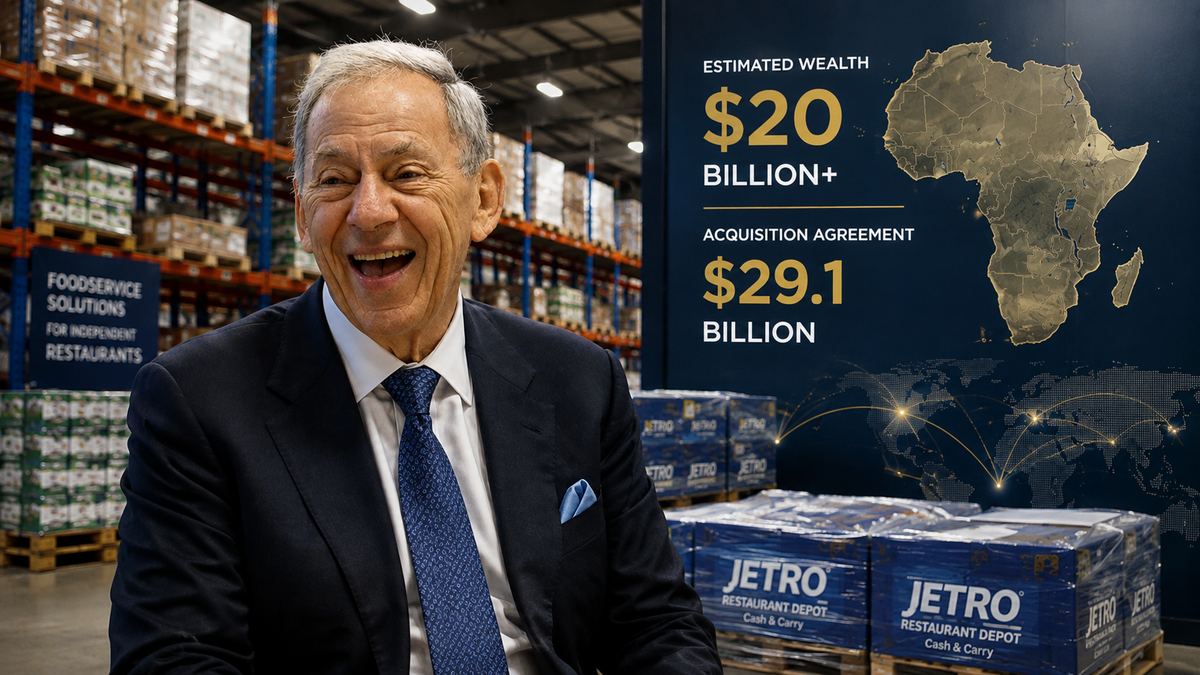
Nathan Kirsh has briefly crossed the $20 billion mark in estimated wealth, making him the third African billionaire to reach the threshold, according to recent billionaire rankings.
The jump follows Sysco’s agreement to acquire Jetro Restaurant Depot, the U.S. food wholesale business in which Kirsh holds a majority stake, in a deal valued at about $29.1 billion including debt. The transaction has turned a relatively low-profile African entrepreneur into one of the biggest wealth stories on the continent in 2026.
A fortune built quietly
Nathan “Natie” Kirsh is not the kind of billionaire whose name has dominated African business headlines for decades. Unlike industrialist Aliko Dangote or luxury-goods magnate Johann Rupert, Kirsh built much of his fortune through a business that operates largely behind the scenes: supplying food and other goods to restaurants, small retailers and foodservice businesses in the United States. That business, Jetro Holdings, owns Jetro Cash & Carry and Restaurant Depot, and Forbes says Kirsh owns about 70% of the company.
The scale of Kirsh’s fortune changed dramatically after Sysco agreed in March to buy Jetro Restaurant Depot. The transaction gave investors a clearer valuation of a privately held business that Kirsh had built over decades, and the resulting increase in the estimated value of his stake pushed him rapidly up Africa’s wealth rankings. Billionaires.Africa reported on Aug. 15 that Kirsh had crossed $20 billion, while Forbes’ real-time profile on Aug. 17 placed his wealth at $19.7 billion. The difference illustrates how quickly billionaire fortunes can move when they are tied to private-company valuations and corporate transactions.
The $29.1 billion deal
Sysco announced on March 30 that it had agreed to acquire Jetro Restaurant Depot for an enterprise value of approximately $29.1 billion, including debt. Under the agreement, Jetro shareholders are to receive $21.6 billion in cash and 91.5 million Sysco shares. Based on Sysco’s closing share price at the time of the announcement, the consideration represented a valuation of about 14.6 times Jetro Restaurant Depot’s operating income.
The transaction is significant for both companies. For Sysco, it is a move into the cash-and-carry food wholesale market, a segment where customers buy products directly from warehouse stores rather than relying solely on conventional delivery. For Kirsh, it represents the monetisation of a business that has been a major source of his wealth. Forbes reported that the deal added at least $10 billion to his fortune, helping push him sharply higher in the global and African wealth rankings.
From South Africa to the United States
Kirsh was born in Potchefstroom, South Africa, in 1932 and began building businesses in southern Africa before expanding overseas. Forbes says he made his first fortune in what was then Swaziland, now Eswatini, after launching a corn milling business in 1958. He later moved into wholesale food distribution and other businesses before turning his attention to the United States, where he established Jetro in Brooklyn in 1976.
The American business became the foundation for his modern fortune. According to The Wall Street Journal, Kirsh built Restaurant Depot from a single warehouse in Brooklyn, developing a model aimed at small retailers and restaurant operators. Over time, the company expanded into a national network, giving Kirsh ownership of an increasingly valuable business in one of the world’s largest consumer markets.
That journey is central to understanding Kirsh’s wealth. The $20 billion milestone did not emerge from a single investment made in recent years. It is the result of decades of business ownership, expansion and reinvestment, followed by a corporate transaction that put a market value on an asset that had largely remained private. In that sense, the Sysco deal is less the beginning of Kirsh’s wealth story than the moment when the scale of that wealth became impossible to overlook.
How Restaurant Depot grew
Restaurant Depot’s business model is based on a straightforward proposition. Independent restaurants and other foodservice operators can visit large warehouse locations, buy products in bulk and transport them directly to their businesses. The model gives customers access to food and supplies while reducing their dependence on conventional delivery arrangements. For a business operating on narrow margins, the ability to buy at wholesale prices can be important, particularly when food costs and other operating expenses are rising.
The company had grown substantially by the time Sysco agreed to acquire it. Sysco said Jetro Restaurant Depot operated 166 large-format warehouse stores across 35 U.S. states and served more than 725,000 independent restaurants and foodservice operators. The company generated about $16 billion in revenue, $2.1 billion in EBITDA and $1.9 billion in free cash flow in 2025, figures that help explain the scale of the valuation attached to the transaction.
The numbers also show why Kirsh’s fortune has been so closely linked to Restaurant Depot. This was not a small private business that suddenly received a speculative valuation. It was a mature operation with physical infrastructure, a large customer base and substantial cash generation. Its value was built through years of expansion in a market where restaurants and other foodservice businesses require supplies regardless of whether the broader economy is growing rapidly or facing a slowdown.
Why Sysco wanted the business
For Sysco, the acquisition offers an opportunity to broaden its position in foodservice distribution. The company is already one of the world’s largest food distributors, but Restaurant Depot gives it access to a different customer model. Sysco said the cash-and-carry market represents an addressable market of between $60 billion and $70 billion and described the channel as growing, resilient and higher margin.
Sysco also sees opportunities to expand the Restaurant Depot network. The company expects the transaction to generate about $250 million in annualised net cost synergies within three years and said it sees the potential for more than 125 additional Restaurant Depot warehouses over time. That means the acquisition is not simply about acquiring an existing network of stores. Sysco is also buying a platform it believes can be expanded using its purchasing power, supply chain and other resources.
For Kirsh, the transaction represents the other side of that calculation. After decades of owning and developing the business, he is positioned to benefit from a sale to a much larger public company. The proceeds will include cash and Sysco shares, giving the existing shareholders a combination of immediate value and continued exposure to the future performance of Sysco.
What $20 billion really means
The phrase “Nathan Kirsh net worth” has attracted renewed attention because his estimated fortune has moved so sharply this year. But a billionaire’s net worth should not be confused with cash available in a bank account. It represents the estimated value of assets and ownership interests, and those estimates can change with stock prices, company valuations and the terms of major transactions.
That is why Kirsh can move above and below the $20 billion threshold without any equivalent amount of money entering or leaving his personal accounts. Forbes’ Aug. 17 real-time estimate placed him at $19.7 billion, while Billionaires.Africa reported that he had crossed $20 billion earlier in the month. The underlying business story remains the same even as the ranking changes: the planned Sysco acquisition has dramatically increased the value attributed to Kirsh’s holdings.
The African billionaire club
Kirsh’s rise has placed him in an unusually small group of African billionaires. Billionaires.Africa reported that he became the third African to cross $20 billion, after Dangote and Rupert. The ranking at the very top can change as asset values move, but the milestone is significant because it highlights the concentration of private wealth among a handful of entrepreneurs whose businesses operate on a global scale.
The three fortunes also illustrate the diversity of African business. Dangote’s wealth is heavily connected to industrial businesses, particularly cement and manufacturing. Rupert’s fortune is associated with luxury goods and investments. Kirsh’s wealth has been built around food wholesale and other investments. Their paths are different, but all three demonstrate the importance of maintaining ownership in businesses that can grow substantially over long periods.
An African story with a global footprint
Kirsh’s inclusion among Africa’s richest people also raises a question about the meaning of African wealth. He was born in South Africa, built his first fortune in southern Africa and became closely associated with Eswatini, yet the business responsible for most of his current wealth operates primarily in the United States. His story illustrates how African entrepreneurship can become global, with capital, companies and ownership extending far beyond the continent’s borders.
That matters because African business is increasingly difficult to define purely by geography. An entrepreneur can be born in Africa, establish a company in another country, employ thousands of people abroad and create billions of dollars in value while remaining connected to African business history. Kirsh’s journey is an example of that cross-border model, and it raises a broader question for African economies: how much of the wealth created by African entrepreneurs eventually returns to the continent through investment and new businesses?
The lesson for African entrepreneurs
There is a straightforward business lesson in Kirsh’s rise. He built around a basic economic need rather than a fashionable trend. Restaurants need food, independent retailers need supplies and wholesalers need efficient ways to move goods. By focusing on that part of the economy and expanding the business over many years, Kirsh created an operation large enough to attract one of the world’s biggest foodservice companies.
The same principle could apply to many African markets. Food distribution, agricultural processing, cold storage, logistics, transport and wholesale remain fragmented in parts of the continent, creating opportunities for entrepreneurs who can build efficient networks. Africa’s growing population and expanding urban centres are likely to increase demand for companies capable of moving goods more efficiently from producers to businesses and consumers.
Kirsh’s story also demonstrates the value of patience. His fortune was built over decades, and the transaction with Sysco is the result of a business journey that began long before today’s technology-driven wealth creation. The eventual $29.1 billion valuation is a snapshot of the value created by that long process. For entrepreneurs, the lesson is that retaining ownership in a strong business can become increasingly valuable when the company is allowed to compound over time.
Who owns Africa’s next big businesses?
For Who Owns Africa, the bigger question is not simply who appears at the top of a billionaire ranking. It is who owns the companies that will shape the continent’s next economic cycle. Africa has significant opportunities in energy, manufacturing, logistics, agriculture, financial services, technology and infrastructure, but turning those opportunities into large companies will require capital, management expertise and long-term ownership.
Kirsh’s rise demonstrates that the most valuable business does not always operate in the sector attracting the most attention. Food distribution is a relatively ordinary industry, yet a company built around it became valuable enough to command a $29.1 billion acquisition price. The same could happen in Africa as entrepreneurs turn fragmented markets into large regional businesses.
A quiet fortune reaches the spotlight
Nathan Kirsh’s rise above $20 billion is therefore about more than another billionaire joining an exclusive wealth club. It is the latest development in a business career that began in southern Africa and eventually produced a major U.S. food distribution empire. The Sysco transaction has put a value of about $29.1 billion on that business and pushed Kirsh into the centre of Africa’s wealth rankings.
The deal also provides a rare look at how ownership creates wealth. Kirsh did not become one of Africa’s richest people by earning $20 billion in salary or taking home the entire value of the Sysco transaction. His wealth comes primarily from ownership of a large business, and the value of that ownership increased dramatically when another major company agreed to buy it.
That may be the most important lesson from the Kirsh story. Wealth at this level is ultimately about owning assets that become more valuable over time. His journey from southern Africa to a $29.1 billion U.S. corporate transaction shows how an entrepreneur can build global economic power through a business that most consumers never see.
For Africa, the story offers an equally important question. Who will own the companies that build the continent’s next generation of wealth, and where will those companies operate? Nathan Kirsh’s career suggests that African entrepreneurship can reach far beyond national borders. The challenge now is for a new generation of African business owners to build companies capable of doing the same while creating more of that value within the continent.
