


Kenya’s debt crisis is no longer simply a question of how much the government owes. It is increasingly a question of what the country must sacrifice to keep paying, which interests benefit from continued borrowing, and whether an entire generation will inherit an economy with fewer opportunities because of financial decisions made in its name.
The latest official figures place Kenya’s public debt at approximately KSh13.53 trillion at the end of September 2026. The National Treasury’s September debt bulletin puts the figure at KSh13,532.78 billion, equivalent to 72.7% of gross domestic product in nominal terms. Domestic borrowing accounts for 57.5% of the outstanding debt, while external obligations represent the remaining 42.5%.
The numbers are enormous, but their significance extends beyond the balance sheet. They expose a difficult economic reality: the government must finance its development ambitions, meet its existing obligations, maintain essential public services and collect enough revenue to prevent borrowing from becoming a permanent substitute for economic reform.
For ordinary Kenyans, the consequences are experienced through taxation, the cost of living, employment opportunities, public investment and the quality of essential services. The central question is therefore not whether Kenya should borrow at all. It is whether the country is borrowing in ways that create enough economic value to justify the burden being transferred to taxpayers.
The borrowing machine has become increasingly domestic
One of the most important developments in Kenya’s debt story is the changing composition of government borrowing.
Domestic debt stood at approximately KSh7.78 trillion in September 2026, compared with external debt of approximately KSh5.75 trillion. The National Treasury’s figures show that domestic borrowing now represents the larger share of government obligations.
This shift matters because domestic borrowing creates a different economic relationship between the government and its citizens.
When the Treasury issues government bonds, it raises money from financial institutions, banks, pension funds, insurance companies and individual investors. These investors receive interest in exchange for financing government expenditure.
There is nothing inherently wrong with this arrangement. Domestic capital markets are important instruments of economic development, and a country that can finance itself locally is less exposed to some of the risks associated with international borrowing.
However, the scale and frequency of government borrowing can create competing demands for capital.
Banks and institutional investors may find government securities attractive because they offer established repayment arrangements and comparatively predictable returns. Private companies, particularly small and medium-sized enterprises, must then compete for financing in a market where the government is a major borrower.
This can make credit more expensive or harder to obtain for businesses seeking money to expand operations, purchase equipment or employ additional workers.
The consequences extend beyond interest rates.
If businesses struggle to access affordable financing, investment may weaken. Manufacturing expansion can slow, entrepreneurs may postpone projects and employment creation can suffer.
The government may therefore find itself financing today’s budget deficit at the expense of some of tomorrow’s private-sector growth.
This is the central contradiction of domestic borrowing: money raised from within the economy can support national development, but excessive reliance on it can also constrain the very businesses expected to generate future tax revenue.
The hidden cost of debt servicing
The most revealing measure of a country’s debt problem is not necessarily the total amount borrowed. It is the amount of public revenue consumed by repayments and interest.
Kenya’s 2026/27 Budget Policy Statement provides a troubling illustration.
The government projected public debt-related costs of approximately KSh1.542 trillion for the financial year, compared with KSh1.438 trillion allocated in the previous financial year.
This is money that must be provided for debt obligations before the government can freely redirect the same resources towards other priorities.
The distinction between debt principal and interest is important. Principal repayments reduce outstanding obligations, while interest represents the cost of financing. Both require cash, but only the latter is the direct financing cost of the debt.
The pressure becomes clearer when compared with the government’s broader expenditure requirements.
Kenya’s FY2026/27 budget projections include approximately KSh3.53 trillion in total revenue, against expenditure of approximately KSh4.70 trillion under the original Budget Policy Statement framework. The projected fiscal deficit is approximately KSh1.12 trillion.
In practical terms, the government is attempting to finance a substantial expenditure programme while simultaneously meeting large existing financial obligations.
That creates difficult choices.
Every additional shilling allocated to interest payments is a shilling that cannot be spent on another priority. It does not mean that every interest payment directly removes money from a hospital or school budget, since public expenditure is financed through an overall budget framework. But it does mean that debt obligations narrow the government’s fiscal flexibility.
The opportunity cost is particularly important in a country where healthcare facilities require investment, public schools face infrastructure demands, roads need maintenance and young people continue searching for meaningful employment.
A government can continue meeting its financial obligations while public services deteriorate. The fact that creditors are being paid does not automatically mean the wider economy is becoming healthier.
External creditors and the limits of financial independence
Kenya’s external debt presents a different set of challenges.
The September 2026 debt bulletin places external obligations at approximately KSh5.75 trillion. These obligations involve multilateral institutions, bilateral lenders and commercial creditors.
Multilateral lenders include institutions such as the World Bank and the African Development Bank, while bilateral financing involves agreements between governments. Commercial borrowing includes international financial markets and private creditors.
These categories carry different repayment conditions, interest rates, maturities and currency risks.
Concessional financing can provide governments with relatively affordable long-term capital. It can be particularly useful for infrastructure, health, education and other development projects that require substantial initial investment.
Commercial borrowing, meanwhile, can provide access to larger amounts of financing but may expose a country to higher interest costs and refinancing risks.
The currency dimension is particularly important.
Kenya collects most of its domestic taxes in Kenyan shillings, but foreign-currency obligations must ultimately be serviced using foreign exchange.
The country therefore needs sufficient export earnings, investment inflows, tourism receipts and remittances to maintain its capacity to meet external obligations.
If the shilling weakens significantly against currencies in which external debt is denominated, the domestic-currency cost of servicing that debt can increase even without additional borrowing.
This is why debt management cannot be separated from export development.
Kenya needs to produce and sell more competitive goods and services internationally, diversify its export markets and strengthen the productive sectors capable of generating foreign exchange.
The country’s agricultural exports, manufacturing industry, tourism sector, financial services and emerging petroleum industry all have a role to play.
Without stronger foreign-exchange-generating capacity, external debt repayments can remain a recurring source of economic vulnerability.
The question is not whether Kenya should disengage from international creditors. It is whether international financing is being used to strengthen the country’s economic independence over time.
The taxation dilemma facing ordinary Kenyans
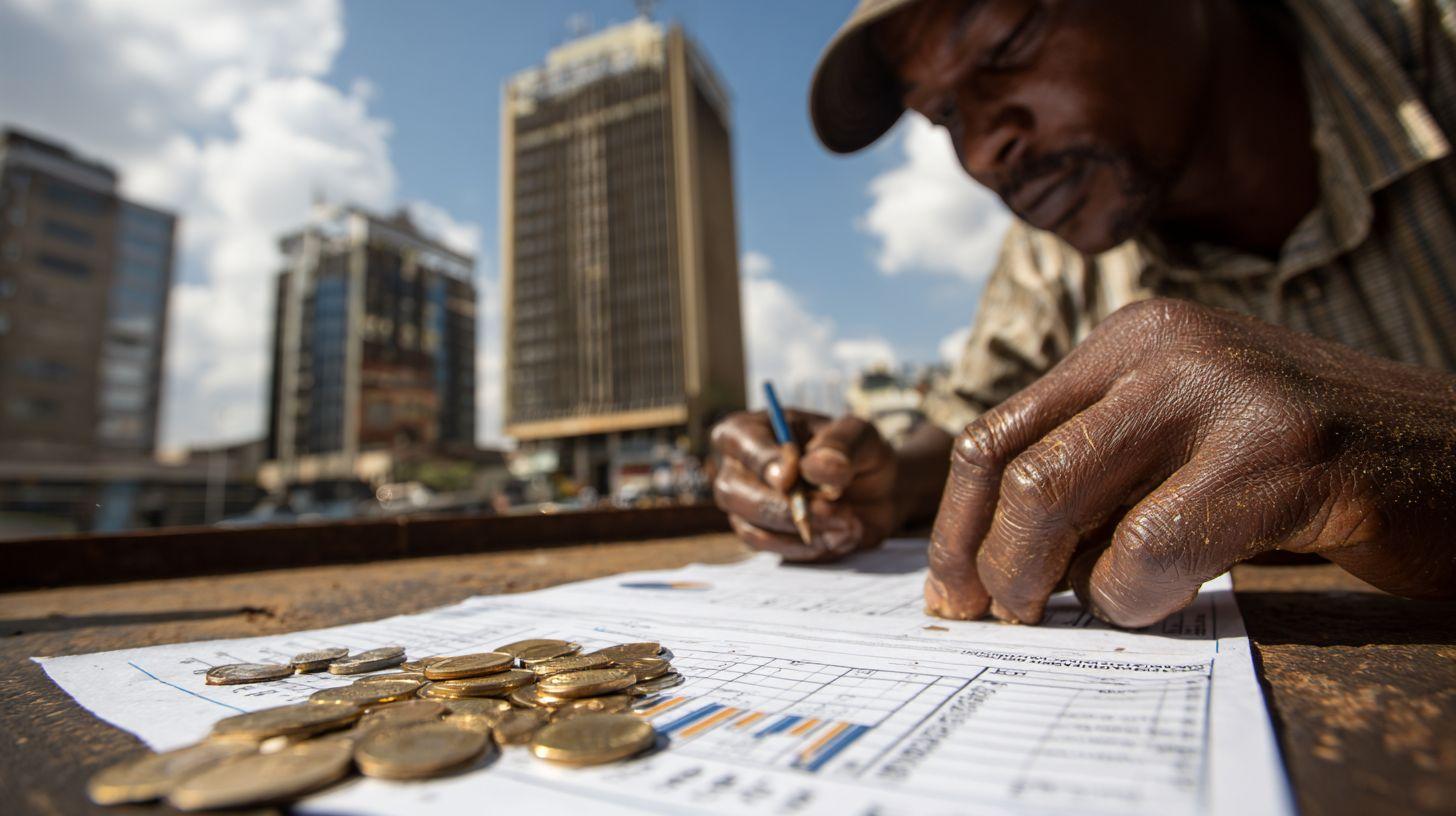
When governments struggle to meet expenditure commitments, increasing revenue collection becomes an obvious policy response.
Kenya is no exception.
The government has repeatedly emphasised the need to broaden the tax base, improve compliance and strengthen revenue administration. Its FY2026/27 Budget Policy Statement projected ordinary revenue of approximately KSh2.90 trillion.
However, the political and economic challenge is determining how additional revenue should be collected.
Taxation is necessary to finance public services and maintain the government’s ability to meet its obligations. But the design of tax policy matters as much as the amount collected.
Increasing taxes on consumption can affect households across different income levels. Higher costs for essential goods and services can reduce purchasing power, particularly among lower-income families.
Increasing the tax burden on formal employment can also affect disposable incomes, while businesses facing higher compliance costs may respond by delaying investment, reducing recruitment or increasing prices.
The informal economy presents another challenge.
Millions of Kenyans earn their livelihoods through small businesses, informal trading, transport, construction and other activities that are not fully captured by conventional tax administration.
Bringing more economic activity into the formal system could improve revenue collection. But attempting to achieve this through aggressive enforcement without improving public services, trust and business conditions risks discouraging formalisation.
The government must therefore confront a fundamental question: why should citizens accept additional taxation if they cannot clearly see how existing public revenue is being used?
Tax compliance is not simply an enforcement issue. It is also a question of confidence in public institutions.
The credibility of fiscal policy depends on whether taxpayers believe their contributions are producing measurable public benefits.
Kenya’s experience with additional household and payroll obligations makes this question particularly important.
Who pays, who benefits and who is accountable for the money collected should be central considerations in every major revenue policy.
Parliament is demanding a credible debt-reduction strategy
The political debate over Kenya’s borrowing position intensified on November 25, 2026, when members of the National Assembly’s Public Debt and Privatisation Committee questioned the National Treasury over the country’s rising obligations.
According to People Daily’s report of the parliamentary proceedings, committee members demanded a clearer strategy for reducing public debt and moving towards the statutory debt anchor.
Committee chairperson Shurie Abdi Omar Balambala questioned whether the Treasury had an overarching plan capable of bringing the debt ratio down. Treasury Principal Secretary Chris Kiptoo presented the 2027 Medium-Term Debt Management Strategy and acknowledged the difficulty of meeting the target under existing fiscal pressures.
The significance of this exchange goes beyond parliamentary disagreement.
Kenya’s statutory debt anchor is 55% of GDP, with a permitted margin of five percentage points either side. The September debt bulletin reports a nominal debt-to-GDP ratio of 72.7%.
These figures should be interpreted carefully because the government’s debt sustainability framework also uses present-value measurements, which adjust for the concessional terms of some obligations. The two measures are not interchangeable.
Nevertheless, the difference between the nominal debt ratio and the statutory anchor illustrates the scale of the fiscal challenge.
Parliament’s demand for a credible reduction strategy is therefore reasonable.
A debt strategy should not simply describe how much the government intends to borrow next year. It should explain how the overall debt burden will decline relative to the economy, how refinancing risks will be managed, what revenue improvements are realistic and which expenditures will be prioritised.
It should also identify measurable milestones against which the Treasury can be held accountable.
Without such benchmarks, debt reduction risks becoming a recurring political promise rather than a verifiable economic objective.
The intergenerational cost of government borrowing
Perhaps the most overlooked dimension of Kenya’s debt crisis is its effect on generations that have had little influence over the decisions creating these obligations.
Public borrowing is often justified on the grounds that infrastructure and development projects will benefit future citizens. That argument is legitimate when borrowed money finances productive assets whose economic benefits extend beyond the repayment period.
A railway, electricity transmission network, irrigation scheme or modern port can generate economic returns over several decades.
The problem emerges when borrowing finances expenditure that produces limited lasting economic value, when projects become unnecessarily expensive or when implementation delays prevent infrastructure from delivering its expected benefits.
Future taxpayers inherit the repayment obligations regardless of whether the original projects achieved their objectives.
This creates an important question of fairness.
A young Kenyan entering the labour market today may spend decades contributing to a tax system that must service borrowing accumulated before that person had any meaningful political participation.
The burden is not limited to future tax payments.
High debt servicing can reduce the government’s ability to finance universities, vocational training, public healthcare, transport infrastructure and other services that determine whether young people can improve their economic circumstances.
It can also limit the resources available to respond to future crises.
A country with substantial financial obligations has less room to borrow when confronted with drought, floods, commodity-price shocks or an international economic downturn.
Kenya must therefore distinguish between borrowing that creates assets for future generations and borrowing that transfers costs without creating comparable economic benefits.
The issue is not simply how much debt the country has accumulated. It is what the country owns, produces and earns in return.
Kenya’s pension funds reveal another side of the debt problem
There is another important dimension to domestic borrowing that deserves greater public attention.
Kenya has developed a substantial pension industry, with retirement funds accumulating long-term savings from workers and employers.
These institutions are natural investors in government securities because they need relatively predictable investments capable of meeting future retirement obligations.
However, this arrangement creates a relationship between public borrowing and citizens’ private financial futures.
When pension funds purchase government bonds, they effectively lend part of workers’ retirement savings to the state. The government receives financing, while pension funds earn interest on behalf of their members.
This can be mutually beneficial when borrowing remains sustainable and the returns are competitive.
But the relationship also means that government debt is not simply an obligation owed to distant international creditors. A considerable portion is connected to domestic financial institutions holding the savings of ordinary workers.
Kenya must protect the integrity of this relationship.
Pension funds should not become instruments for financing government deficits at the expense of sound investment principles. Their primary responsibility remains protecting members’ retirement savings.
At the same time, a stronger domestic capital market could help direct more institutional investment towards infrastructure, productive businesses and long-term economic development, provided appropriate safeguards and commercial returns exist.
This is a broader question about how Kenya mobilises its own financial resources.
For further reading, see our analysis: Africa Has Billions in Pension Savings. Why Isn’t This Money Building African Businesses?.
What Kenya must do differently
Reducing public debt requires more than announcing expenditure cuts or promising to increase tax collection.
The country needs a credible fiscal adjustment programme that addresses the underlying reasons government borrowing continues to grow.
First, the Treasury must improve transparency around borrowing and public expenditure. Citizens should be able to identify the purpose of major loans, their repayment terms, the projects they finance and the institutions responsible for implementation.
Second, the government must improve the efficiency of public investment. Projects should undergo rigorous economic appraisal before borrowing is approved. Independent monitoring should establish whether expected benefits are being achieved and whether costs are justified.
Third, Kenya must manage domestic borrowing more carefully. A predictable borrowing programme, improved cash management and longer debt maturities could reduce refinancing pressure while helping maintain confidence in the local financial market.
Fourth, the government should strengthen revenue collection without making formal employment and legitimate business activity increasingly expensive. Broadening the tax base, improving compliance and reducing leakages are more sustainable than repeatedly placing additional pressure on the same taxpayers.
Fifth, economic growth must become more productive and export-oriented. Manufacturing, agricultural processing, technology, tourism and regional trade can expand employment, strengthen the tax base and generate the foreign exchange needed to service external obligations.
Finally, Parliament must exercise meaningful oversight. Debt management should be treated as a continuous accountability responsibility rather than an annual budget exercise.
Kenya’s proposed borrowing arrangements also deserve scrutiny. Our earlier analysis, Kenya’s $300 Million Panda Bond: Why Nairobi Is Turning to China, explores the government’s search for alternative sources of international financing and the implications of entering new capital markets.
The objective should not be to eliminate borrowing. It should be to ensure that every new obligation has a clear economic justification and a credible repayment strategy.
The real price of Kenya’s debt crisis
Kenya’s KSh13.53 trillion debt burden presents a test of economic leadership, institutional accountability and national priorities.
The government has a legitimate responsibility to finance development, maintain essential services and protect economic stability. Creditors also have legitimate expectations that agreed financial obligations will be honoured.
But the interests of creditors and taxpayers cannot be treated as the only considerations.
The wider economy must have the opportunity to grow, businesses must be able to access capital, workers must retain meaningful purchasing power and future generations must inherit institutions capable of delivering development rather than simply managing repayment schedules.
The most dangerous outcome would not necessarily be an immediate inability to meet debt obligations. It would be a prolonged period in which Kenya continues servicing its financial commitments while struggling to invest sufficiently in the productive capacity needed to escape dependence on borrowing.
That is the economic trap policymakers must avoid.
The question posed by Kenya’s debt crisis is ultimately one of national ownership. Who benefits from the money borrowed in the country’s name, who is accountable when it is poorly spent, and who carries the consequences when repayment becomes more expensive than the development it was supposed to finance?
Kenya’s future will not be determined by the size of its debt alone. It will be determined by whether the country can transform borrowed money into lasting economic value before the bill comes due.

More from Debt Crisis
Africa’s debt crisis: Can $93 billion unlock economic growth
A new African Union and OECD proposal challenges conventional debt thinking, arguing strategic investment could unlock growth, create jobs and strengthen public finances.