

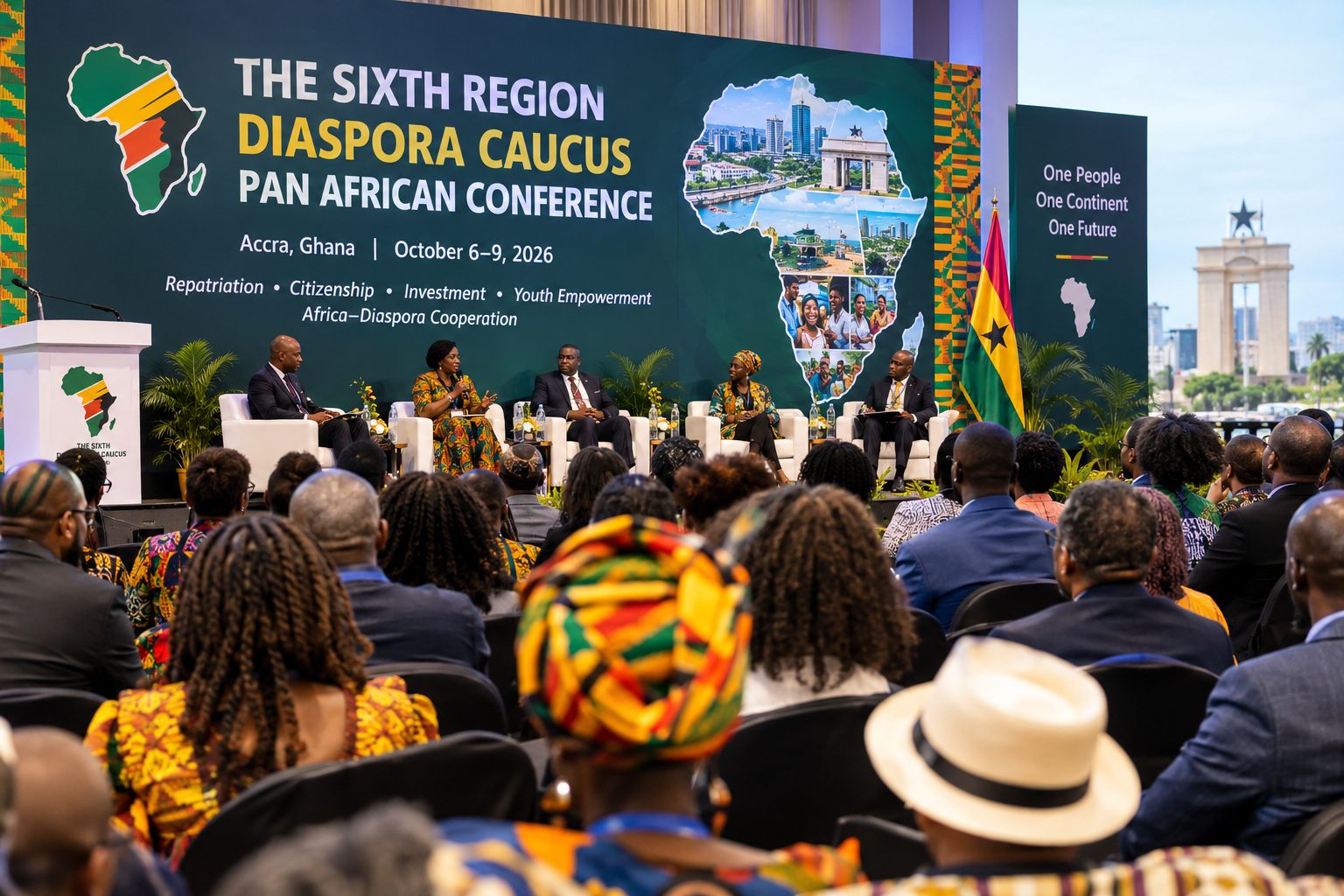
The gathering of Africa’s diaspora in Accra this week is important not simply because another Pan-African conference is taking place, but because it exposes a question that Africa has postponed for too long: what does it actually mean to belong to Africa when millions of Africans and people of African descent live beyond the continent?
The Sixth Region Diaspora Caucus Pan African Conference, running from October 6 to 9 at the University of Ghana, has placed that question at the centre of its agenda. The programme focuses on repatriation, integration, youth empowerment, citizenship and sustainable diaspora investment, while also examining the diaspora’s relationship with African Union institutions.
Those subjects can sound familiar. They have appeared in Pan-African declarations, African Union programmes and diaspora gatherings for years.
But familiarity should not be mistaken for resolution.
The real significance of the Accra meeting is that it arrives at a moment when the language of Pan-African unity increasingly needs to be translated into institutions, rights, capital and practical opportunities.
Africa’s diaspora has long been described as a sixth region. The harder question is whether that region can become an effective political and economic constituency.
The unfinished meaning of the Sixth Region
The African Union has recognised the importance of the African diaspora in the construction of the Union. Article 3 of the amended AU Constitutive Act calls for the full participation of the African diaspora as an important part of the continent. The AU also defines the diaspora broadly, encompassing people of African origin living outside the continent who are willing to contribute to Africa’s development and the building of the Union.
The idea has deep roots.
The 2012 Global African Diaspora Summit in Johannesburg produced a declaration calling for greater diaspora participation in African affairs and encouraging diaspora communities to organise themselves into regional networks. The declaration envisaged increasing participation in the AU, initially as observers and ultimately through a more structured Sixth Region.
Yet more than a decade later, the political architecture remains incomplete.
The diaspora has platforms. It has networks. It has representation within parts of the AU system. ECOSOCC, the African Union’s Economic, Social and Cultural Council, includes civil society organisations from the diaspora, while the AU’s Citizens and Diaspora Directorate is responsible for engagement with diaspora communities.
But representation is not the same thing as power.
A community can be invited into a room and still have little influence over what happens inside it.
That distinction should be central to the Accra discussions.
Pan-Africanism must become practical
For generations, Pan-Africanism has been one of Africa’s most powerful political ideas.
It helped inspire anti-colonial movements. It created intellectual and political bridges between Africans on the continent and people of African descent in the Caribbean, the Americas and elsewhere. It gave political meaning to the idea that Africa’s historical fragmentation did not erase a broader shared identity.
But political ideas eventually face a practical test.
What happens when someone in Jamaica, Brazil, the United States, Britain or Canada wants to invest in Africa? What happens when a member of the diaspora wants to move permanently to Ghana, Kenya, Nigeria, Senegal or another African country? What rights should they receive? Can they obtain citizenship? Can they own land? Can they participate in public life? Can their children claim the same connection?
These are not philosophical questions.
They are administrative questions, legal questions and economic questions.
That is why the conference’s emphasis on citizenship and the right to return matters.
The emotional connection to Africa may be powerful, but emotional belonging alone cannot create durable integration.
The right to return is bigger than migration
Repatriation is often discussed as though it were simply about people moving from the diaspora to the continent.
It is more complicated than that.
The right to return touches history, identity, citizenship, property, culture and political recognition. For communities whose ancestors were displaced through slavery and colonialism, returning to Africa can carry a meaning that goes beyond tourism or investment.
Ghana has understood part of this equation better than many countries. Its efforts over several decades to engage the African diaspora have helped position the country as an important destination for people seeking cultural reconnection and permanent residence.
But the wider African system remains fragmented.
A person can be welcomed culturally while encountering significant legal or bureaucratic barriers.
That contradiction deserves attention.
If African governments genuinely want the diaspora to participate in the continent’s future, then the continent must make it easier for people to build that future.
Citizenship cannot remain a slogan
Citizenship is perhaps the most revealing test of serious Pan-Africanism.
Investment programmes are useful. Conferences are useful. cultural festivals are useful. But citizenship determines whether an individual is treated as a temporary visitor, an investor, a foreign national or part of a political community.
The AU itself has recognised the importance of creating mechanisms for diaspora participation. ECOSOCC has previously worked on an institutional framework for diaspora civil society participation, including mechanisms for representation and engagement.
The challenge is moving from continental principles to national implementation.
African countries have different citizenship laws, immigration regimes and political systems. Some have created diaspora engagement policies or dual citizenship provisions. Others remain restrictive.
This produces an obvious problem.
How can Africa speak convincingly about one people, one continent and one future while Africans abroad encounter 55 different political realities when they attempt to reconnect with the continent?
Pan-Africanism does not require identical national laws.
It does require greater compatibility.
Diaspora capital needs a better home
The economic dimension is equally important.
Africa’s diaspora represents not merely a source of remittances but a reservoir of skills, networks, entrepreneurial experience, professional expertise and international connections.
The Accra conference’s emphasis on sustainable diaspora direct investment therefore deserves more attention than it may receive.
The question should not simply be how much money Africans abroad can send home.
It should be what kind of economic relationship Africa wants to build with its diaspora.
A remittance helps a household.
A well-structured investment can create jobs.
A professional network can open markets.
A returning entrepreneur can transfer skills.
A diaspora-backed technology company can connect African businesses to global customers.
A researcher returning to an African university can strengthen an institution.
That is the difference between seeing the diaspora as a financial resource and seeing it as a development partner.
Africa should choose the second.
The youth question may decide everything
There is another reason the Accra conference matters: generational change.
Many of the people who built the modern Pan-African diaspora movement are ageing. The next generation is growing up with a different relationship to Africa.
Young Africans in the diaspora can move between cultures with unprecedented ease. They can build businesses across borders, communicate instantly and maintain relationships with people on the continent without physically relocating.
But they can also be less interested in traditional political organisations.
This creates both a challenge and an opportunity.
If Pan-African institutions remain dominated by conferences, declarations and established organisations, younger generations may eventually regard the movement as historical rather than living.
Youth empowerment therefore cannot mean simply giving young people seats on panels.
It means giving them ownership.
Young Africans abroad should be involved in designing investment platforms, cultural programmes, digital networks, education partnerships and political engagement mechanisms.
They should not merely inherit the Pan-African project.
They should be allowed to redefine it.
The continent also has responsibilities
There is a tendency in diaspora conversations to place most of the responsibility on Africans abroad.
That is understandable, but incomplete.
The continent itself must answer difficult questions.
Is Africa ready for returning populations?
Can governments provide transparent investment rules?
Can institutions reduce bureaucratic obstacles?
Can countries protect investors without creating systems that favour wealthy outsiders over local communities?
Can diaspora engagement avoid becoming another form of elite networking?
These questions matter because the diaspora is not a single class.
It includes billionaires and students, entrepreneurs and workers, academics and artists, recent migrants and communities whose African ancestry goes back centuries.
A serious Sixth Region cannot be designed only for people with money or political access.
It must also speak to ordinary people.
Representation must mean influence
The African Union has already created mechanisms for diaspora engagement. Its Diaspora Division works to connect diaspora networks with AU institutions including ECOSOCC and the Pan-African Parliament.
ECOSOCC’s framework also recognises the diaspora as an important constituency. An AU document notes that 20 seats on the ECOSOCC General Assembly are reserved for civil society organisations in the African diaspora.
That is significant.
But the next stage should be judged by outcomes.
Can diaspora representatives influence policy?
Can they help shape migration policy?
Can they participate meaningfully in discussions about trade, investment, culture and citizenship?
Can diaspora networks develop mechanisms that are transparent enough to represent communities rather than individual organisations?
These are the questions that will determine whether the Sixth Region becomes an effective institution or remains primarily an inspiring political metaphor.
Accra offers the right setting
There is something fitting about these conversations taking place in Accra.
Ghana has become one of the continent’s most visible meeting points between Africa and its global diaspora. The country has invested heavily in cultural diplomacy and diaspora engagement, while Accra has become a major destination for Africans abroad seeking to reconnect with the continent.
The University of Ghana provides another useful setting because the conversation is not only political. It is intellectual.
Pan-Africanism needs scholarship as much as activism.
It needs historians to explain how displacement shaped modern identity. It needs economists to examine the potential of diaspora capital. It needs lawyers to confront citizenship and mobility. It needs young entrepreneurs to question outdated assumptions. It needs policymakers willing to turn declarations into workable systems.
The conference brings many of these constituencies together.
That is its opportunity.
Beyond the conference room
The danger facing Pan-African conferences is obvious.
People meet. They speak passionately. They produce recommendations. They take photographs. Then everyone returns home.
The real measure of Accra will come after October 9.
Will participating organisations develop a practical diaspora investment framework?
Will African governments expand meaningful pathways to citizenship and residence?
Will diaspora communities build stronger regional networks?
Will youth participation become institutional rather than ceremonial?
Will the AU strengthen mechanisms through which diaspora voices can influence policy?
Those outcomes matter more than the speeches.
The history of Pan-Africanism is already full of powerful words.
Africa now needs systems.
A new definition of belonging
Perhaps the most important idea emerging from the Sixth Region debate is that African identity does not have to be confined by geography.
Africa is a continent, but it is also a global community.
Its people live in Accra, Lagos and Nairobi, but also in London, Toronto, Kingston, New York, São Paulo and Paris.
The challenge is to make that global identity useful without reducing it to symbolism.
True Pan-Africanism should mean that an African living outside the continent can contribute to Africa without being treated merely as a source of money.
It should mean that a person of African descent seeking to reconnect with the continent has a meaningful pathway to do so.
It should mean that investment is reciprocal, that knowledge moves in both directions and that young people are treated as architects rather than spectators.
Most importantly, it should mean that the diaspora has a voice where decisions affecting Africa’s future are made.
The Accra conference is therefore about more than the Sixth Region.
It is about whether Africa can finally close the distance between identity and institution.
The African Union has already established the principle that the diaspora is an important part of the continent. Its current engagement structures show that the idea has moved beyond rhetoric.
But principles become meaningful only when people can experience them in their everyday lives.
If Pan-Africanism is to have a new political life, the next generation will need more than a shared history.
It will need rights.
It will need access.
It will need opportunity.
And it will need a genuine seat at the table.
That is the deeper test facing Africa’s Sixth Region in Accra: not whether the diaspora belongs to Africa, but whether Africa is prepared to build institutions that prove it.

More from Diaspora
Who owns Africa’s languages? Inside the new diaspora economy
African languages are becoming a fast-growing global digital industry, with diaspora families, startups and AI labs competing to own it.