
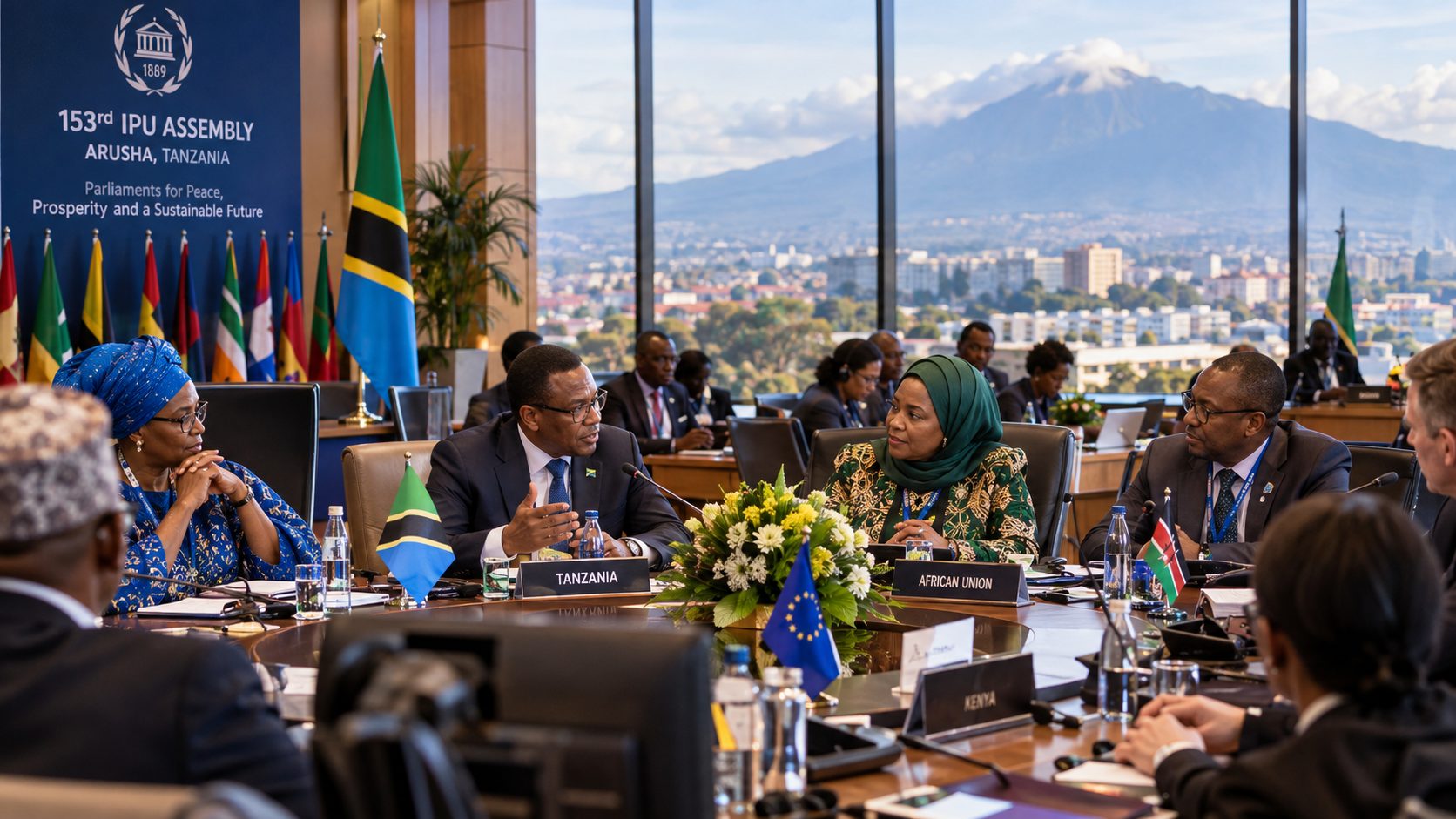
Tanzania is discovering that diplomatic influence is not measured only by treaties signed in capitals, but also by who can bring rivals, neighbours and global powers into the same room. That is what makes Arusha significant this week. The city is hosting the 153rd Assembly of the Inter-Parliamentary Union, bringing hundreds of lawmakers from across the world to Tanzania at a moment when geopolitical tensions are deepening, conflicts are multiplying and confidence in multilateral institutions is under strain.
The election of Tanzania’s National Assembly Speaker Mussa Azzan Zungu to preside over the assembly adds another layer to what is increasingly becoming a broader Tanzanian diplomatic story.
Arusha is more than a venue
There is a temptation to see the IPU gathering simply as another international conference, complete with speeches, official photographs and carefully negotiated resolutions.
That would miss the larger point.
Arusha has spent decades acquiring a diplomatic identity that extends well beyond Tanzania’s borders. It is home to the East African Community and has repeatedly provided a setting where governments, regional institutions and international actors can meet away from the political intensity of national capitals.
The city now has another opportunity to consolidate that reputation.
The IPU assembly brings parliamentarians together around questions of governance, inclusion, trust and opportunity. Its agenda reaches far beyond parliamentary procedure, touching on conflict, security, artificial intelligence, extractive industries, climate change and the future of work.
That breadth matters.
Modern diplomacy is no longer conducted only by presidents and foreign ministers. Questions once considered domestic, including technology regulation, resource governance, climate policy and democratic accountability, increasingly cross borders.
Parliaments therefore occupy a useful space between governments and societies.
Tanzania appears to understand that space.
Zungu’s election carries symbolism
Zungu’s election as president of the 153rd Assembly should not be confused with becoming president of the IPU itself. The two positions are separate.
Yet politically, the symbolism is still considerable.
His selection places a Tanzanian parliamentarian at the centre of one of the world’s largest parliamentary gatherings at a moment when international cooperation is under unusual pressure.
That is more than ceremonial visibility.
A speaker chairing an international parliamentary assembly gains a platform from which Tanzania’s diplomatic priorities can be heard alongside those of much larger powers. The country gets an opportunity to frame itself not as an observer of international politics, but as an active convenor within it.
That distinction matters for a middle-sized African state seeking greater influence without adopting the posture of a great power.
Tanzania’s diplomatic model is changing
For years, Tanzania’s international identity was strongly associated with Pan-Africanism, non-alignment and a preference for dialogue.
Those traditions have not disappeared.
But Tanzania is operating in a considerably more competitive environment.
China wants deeper economic and strategic access to Africa. Gulf states are expanding their commercial and political footprint. Western governments are looking for reliable partnerships. India is strengthening its engagement. African regional organisations are confronting increasingly complicated security and economic pressures.
Tanzania sits in the middle of many of these currents.
Its coastline gives it access to the Indian Ocean. Its borders connect it to a large part of East and Central Africa. Its political relationships extend across the continent. Its ports, transport corridors, natural resources, tourism industry and economy give external powers reasons to maintain close relations.
That geography makes diplomacy an economic asset.
And Arusha gives Tanzania something else: convening power.
The real currency is trust
President Samia Suluhu Hassan’s intervention at the IPU gathering is revealing for another reason.
She called for a stronger role for parliaments in addressing global conflicts and challenges, pointing to geopolitical uncertainty, prolonged conflicts and economic pressures.
This language fits Tanzania’s traditional diplomatic instinct.
Tanzania is unlikely to compete with major powers through military reach or financial firepower. Its comparative advantage lies elsewhere.
It can offer a place where conversations remain possible.
That may sound modest in an age dominated by military alliances and strategic competition. It is not.
When relations between states deteriorate, communication becomes an asset. A country that can maintain channels with different sides has diplomatic room that others may not possess.
The importance of such room becomes clearer as tensions rise across Africa.
The Horn of Africa is experiencing renewed instability. Sudan’s war continues to draw in external actors. The Red Sea has become a major strategic theatre. Competition over ports, energy, minerals and transport corridors is intensifying.
In such an environment, countries capable of convening dialogue acquire a form of influence that cannot easily be measured in military budgets.
Parliamentarians speak a different language
Presidents negotiate national interests.
Parliamentarians can sometimes negotiate relationships.
That distinction is increasingly relevant.
Members of parliament belong to political systems rather than governments alone. They interact with opposition parties, civil society, business communities and constituencies. They can build parliamentary friendship groups and maintain relationships even when executive diplomacy becomes politically difficult.
The IPU exists precisely within this space.
Its global parliamentary network is designed to promote dialogue, peace, democracy and sustainable development.
Tanzania hosting the organisation’s major gathering in Arusha therefore offers more than ceremonial visibility.
It creates thousands of possible relationships.
Those relationships can later translate into investment conversations, political partnerships, educational exchanges, tourism links and cooperation on regional questions.
This is soft power in its most practical form.
The Tulia Ackson factor
There is another reason Tanzania’s parliamentary diplomacy deserves attention.
Tulia Ackson, a former Speaker of Tanzania’s National Assembly, served as IPU president from 2023 to 2026. Her tenure gave Tanzania an unusually visible role within the organisation.
Now, as the 153rd Assembly takes place on Tanzanian soil, Zungu has been selected to preside over the meeting itself.
The timing is politically useful.
It means Tanzania is not merely hosting the IPU at the end of a successful presidential term by one of its own parliamentarians. It is also placing another senior Tanzanian parliamentary figure at the centre of the organisation’s deliberations.
The result is a concentration of parliamentary diplomatic capital that few African countries can currently match.
The significance extends beyond personalities.
It suggests that Tanzania has recognised parliament-to-parliament engagement as an instrument of foreign policy rather than simply an administrative function.
Arusha’s diplomatic ecosystem is expanding
The IPU assembly also fits into a longer pattern.
The East African Community has its headquarters in Arusha, and regional parliamentary leaders met there days before the IPU assembly. The EAC Speakers Bureau recently concluded a meeting in the city, with discussions focused on parliamentary cooperation and regional integration.
That sequence is significant.
One international parliamentary gathering follows a regional parliamentary meeting. The EAC’s institutional presence remains permanent. Then thousands of international delegates arrive for the IPU.
Arusha is consequently becoming something more than a conference destination.
It is developing into an ecosystem of political convening.
That can have long-term consequences.
Cities acquire diplomatic importance through repetition. Geneva has the United Nations and a dense network of international organisations. Addis Ababa hosts the African Union and has become synonymous with continental diplomacy. Nairobi has built a powerful identity around the United Nations, development organisations and international civil society.
Arusha has a different opportunity.
It can become a specialised African centre for dialogue, regional integration and parliamentary diplomacy.
There is an economic calculation
Diplomacy is also commerce.
Tanzania’s parliament has described the IPU gathering as an economic opportunity, particularly for Arusha through accommodation, food, transport, tourism and related services. The assembly is expected to attract thousands of participants.
But the larger economic value is less immediate.
A minister, legislator or business leader who visits Tanzania for a conference may return later as an investor, partner or advocate.
That is how diplomatic hospitality can become economic diplomacy.
Tanzania already has a powerful tourism proposition. Kilimanjaro, the Serengeti, Ngorongoro and Zanzibar are globally recognised. The challenge is converting international familiarity with those destinations into a broader perception of Tanzania as a serious investment and political partner.
Hosting international institutions and conferences helps do that.
It places the country in front of decision-makers who might otherwise know Tanzania mainly through tourism.
Influence requires substance
Yet there is a warning here.
A country does not become a diplomatic power simply because it hosts large meetings.
The danger for Tanzania is to confuse visibility with influence.
Arusha can host thousands of delegates and still produce little lasting diplomatic impact if discussions end when the delegates leave.
The real test is what happens afterwards.
Does parliamentary cooperation produce stronger regional oversight?
Do diplomatic relationships generate investment?
Can Tanzania use its convening position to support practical conflict prevention?
Can parliamentary networks contribute to resolving tensions across East Africa?
Can Tanzania turn its reputation for dialogue into influence on issues such as regional security, trade corridors, climate finance and resource governance?
Those are harder questions.
They are also the questions that determine whether this moment becomes a milestone or simply another entry in the international conference calendar.
Tanzania’s middle-power opportunity
The broader opportunity for Tanzania is to embrace what might be called African middle-power diplomacy.
It does not need to choose between Washington and Beijing, between Europe and the Gulf, or between competing African blocs.
Its strongest position may be to maintain relationships across those divides while defending its own interests.
That approach requires consistency.
It also requires credibility.
A convening country must be seen as sufficiently independent to host difficult conversations, sufficiently stable to sustain relationships and sufficiently pragmatic to turn dialogue into outcomes.
Tanzania has many of those ingredients.
Its challenge is to use them strategically.
The bigger African picture
Africa’s diplomatic landscape is becoming increasingly fragmented.
Traditional Western influence is being challenged by China, Russia, Gulf states, India and a growing number of African actors pursuing independent foreign policies. The continent itself is also becoming more assertive about strategic autonomy.
That creates space for countries such as Tanzania.
The most influential African states of the next decade may not necessarily be those with the largest economies or militaries.
Some will be countries that can connect different worlds.
Tanzania is well placed for that role.
Its geography connects the Indian Ocean with the African interior. Its diplomatic history gives it credibility in parts of the Global South. Its relationship with East African institutions gives it regional relevance. And its parliamentary diplomacy is creating another channel through which it can influence international conversations.
Arusha brings these assets together in one place.
A city becoming a message
The most interesting story emerging from the IPU gathering is therefore not simply that Tanzania is hosting parliamentarians.
It is that Tanzania is experimenting with a different definition of power.
Power can be the ability to impose.
But it can also be the ability to convene.
In a fractured international system, the second kind may become increasingly valuable.
Arusha’s importance will ultimately depend on whether Tanzania can transform hospitality into relationships, relationships into trust, and trust into influence.
Zungu’s election to preside over the 153rd IPU Assembly is a useful symbol of that ambition. President Samia’s appeal for stronger parliamentary cooperation reinforces it. The EAC’s permanent presence in Arusha gives it an institutional foundation.
The pieces are already there.
The strategic question is whether Tanzania can put them together.
For a country that has historically preferred quiet diplomacy to grand geopolitical theatre, that may be its most consequential evolution yet.
Arusha is not becoming a diplomatic capital because Tanzania declared it one. It is becoming one because more of the world’s political conversations are increasingly finding their way there.
That is a form of influence worth watching.