

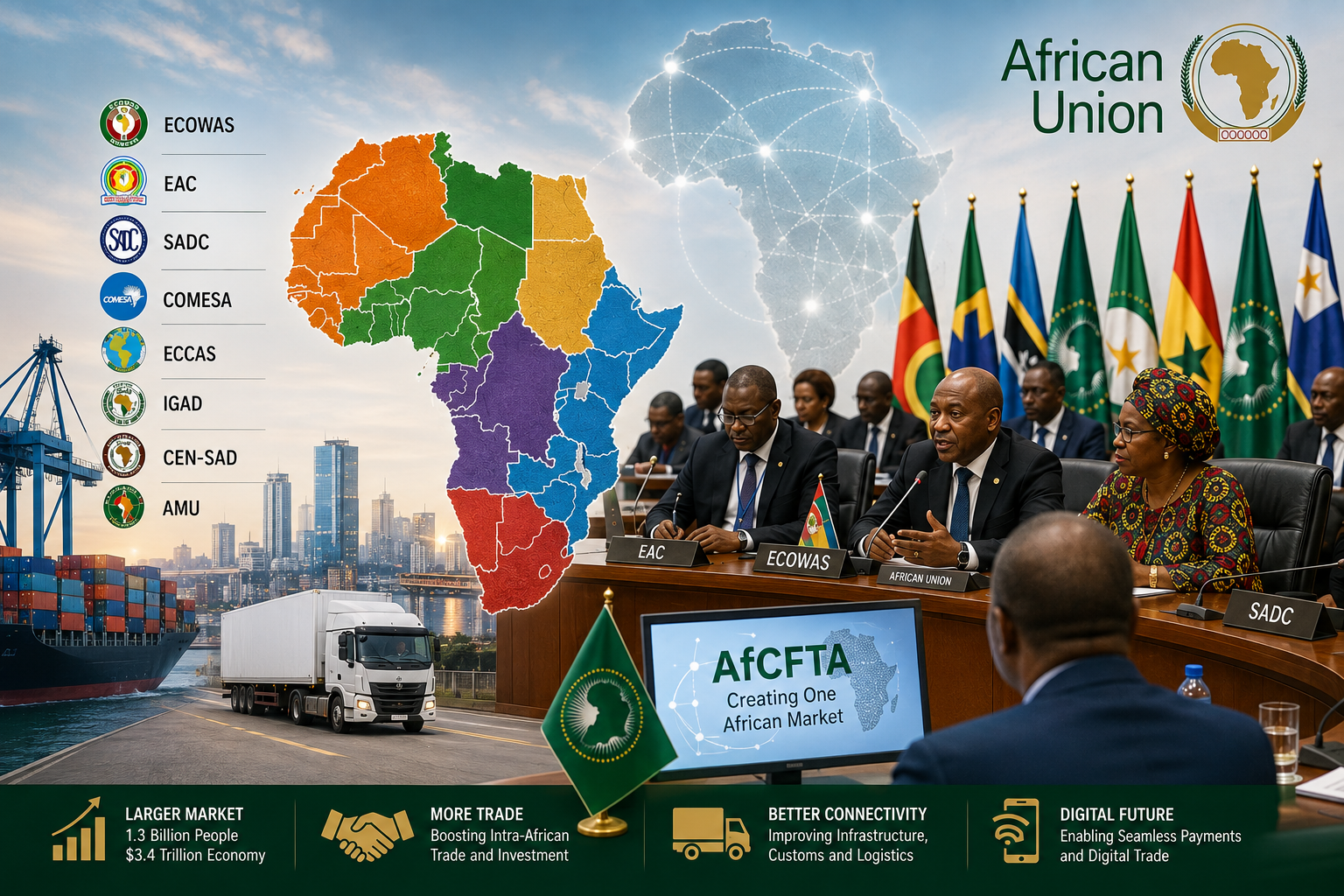
The African Union (AU) is seeking to reshape how Africa’s regional trade blocs work together, as governments push to turn the continent’s fragmented markets into a more integrated economic system.
The effort is centred on the African Continental Free Trade Area (AfCFTA), the continent’s main framework for reducing trade barriers and creating a single African market for goods and services.
Rather than replacing existing regional economic communities, the AU is seeking to make them work more closely with AfCFTA. The approach could determine how quickly Africa achieves its long-standing goal of increasing intra-African trade and building stronger regional supply chains.
Africa’s regional trade blocs
Africa has eight AU-recognised Regional Economic Communities (RECs), including the East African Community (EAC), Common Market for Eastern and Southern Africa (COMESA), Southern African Development Community (SADC) and Economic Community of West African States (ECOWAS).
These organisations have helped establish customs arrangements, common markets and transport corridors across neighbouring countries.
But overlapping memberships, different tariff structures, customs procedures and national regulations have also created challenges for companies trading across regional borders.
The AU views the regional economic communities as building blocks for continental economic integration.
The AfCFTA is intended to provide the wider framework linking those markets.
AfCFTA drives continental integration
The African Continental Free Trade Area entered into force in 2019, with trading under the agreement beginning in January 2021.
The agreement seeks to create a single African market, increase the movement of goods and services, encourage investment and address some of the problems caused by overlapping regional trade arrangements.
The AU says AfCFTA covers all 55 African countries, more than 1.3 billion people and a combined economy of about $3.4 trillion.
Despite that potential, intra-African trade remains relatively low compared with Africa’s trade with the rest of the world.
The AU has said intra-African trade accounts for roughly 16%-18% of the continent’s total trade, highlighting the scale of the opportunity if barriers between African markets can be reduced.
Why regional integration matters
For African manufacturers and exporters, tariffs are only one part of the problem.
Businesses also face lengthy border procedures, poor transport infrastructure, inconsistent product standards, limited access to trade finance and difficulties making cross-border payments.
Those costs can make it more expensive for an African company to sell to a neighbouring country than to import similar products from outside the continent.
The AU’s strategy therefore goes beyond reducing tariffs.
It includes efforts to harmonise regulations, improve customs systems, strengthen transport infrastructure and develop digital systems that can make cross-border trade faster and cheaper.
East Africa offers a key test
The East African Community provides one example of the opportunities and challenges facing regional integration.
The bloc brings together Burundi, Democratic Republic of Congo, Kenya, Rwanda, Somalia, South Sudan, Tanzania and Uganda.
EAC governments have made progress in removing some trade barriers, but businesses continue to report delays at borders and other administrative obstacles.
The bloc has been working on digital customs systems, electronic cargo tracking and other measures intended to reduce the time and cost of moving goods between member states.
The EAC is also seeking greater coordination between its regional trade commitments and AfCFTA.
Such coordination could eventually allow companies operating in East Africa to access a much larger continental market under more predictable rules.
The Tripartite Free Trade Area
Another important element of Africa’s regional trade strategy is the Tripartite Free Trade Area, which brings together COMESA, the EAC and SADC.
The three regional blocs cover a large part of eastern and southern Africa and include some of the continent’s biggest economies and most important transport corridors.
The Tripartite agreement is intended to reduce barriers between the three regions and create a larger market for businesses.
The AU’s support for both the Tripartite Free Trade Area and AfCFTA reflects its broader strategy of connecting existing regional markets rather than creating a completely new system.
West Africa faces political challenges
West Africa presents a more complicated picture.
Burkina Faso, Mali and Niger have withdrawn from ECOWAS following political disputes with the regional organisation after military takeovers in the three countries.
The three states have established the Alliance of Sahel States, creating a separate political and security framework.
The development has raised questions about the future of economic integration in West Africa.
However, the economic links created by ECOWAS remain important. Trade routes, labour movement and cross-border communities cannot easily be separated from political developments.
The situation demonstrates the difficulty of building a continent-wide trade system while political relationships between neighbouring governments remain fluid.
Digital trade and payments
Africa’s economic integration is also increasingly moving into the digital economy.
The Pan-African Payments and Settlement System, developed with Afreximbank, is designed to make cross-border payments between African countries easier and reduce the need to rely on external currencies for some transactions.
Digital trade systems could help address another major obstacle facing African businesses: the cost and complexity of conducting transactions across multiple jurisdictions.
Improved digital customs, electronic certificates and interoperable payment systems could eventually make it easier for small and medium-sized African businesses to enter regional markets.
The economic prize
The potential benefits of deeper African economic integration extend beyond trade.
Larger markets could help African manufacturers achieve economies of scale, attract investment and develop regional value chains.
Industries such as automotive manufacturing, pharmaceuticals, textiles, agriculture and food processing could benefit from production networks that span several African countries.
A more integrated market could also strengthen Africa’s bargaining position in global trade negotiations and reduce the continent’s dependence on imported manufactured goods.
But achieving those gains will require governments to implement commitments already made under AfCFTA and regional agreements.
Implementation is the biggest challenge
The AU’s push faces a familiar problem: Africa has no shortage of trade agreements, but implementation has often lagged behind political commitments.
Removing tariffs without addressing roads, ports, border procedures, regulations and payment systems will have limited impact.
Governments must also be willing to align national policies with regional and continental commitments.
For businesses, the test will be whether trade becomes measurably easier and cheaper.
For the AU, the challenge is to coordinate regional organisations that have different priorities, memberships and levels of economic integration.
Africa’s next trade frontier
The AU’s strategy is therefore not simply about creating another trade agreement.
It is an attempt to connect Africa’s existing regional trade blocs through a common continental framework.
The success of AfCFTA will ultimately depend on what happens beyond diplomatic meetings and official declarations: at border posts, ports, factories, warehouses and digital payment platforms.
If governments can reduce non-tariff barriers and align regional rules, Africa could move closer to a genuinely integrated continental market.
The prize would be a larger market for African businesses, stronger regional supply chains and greater opportunities for investment and industrialisation.
For the African Union, the task now is to turn the continent’s overlapping trade blocs from a source of fragmentation into the foundation of a single African market.

More from Diplomacy
Tanzania turns Arusha into a global diplomatic capital
Tanzania is using parliamentary diplomacy to deepen its influence, widen partnerships and strengthen Arusha’s role in global affairs.