

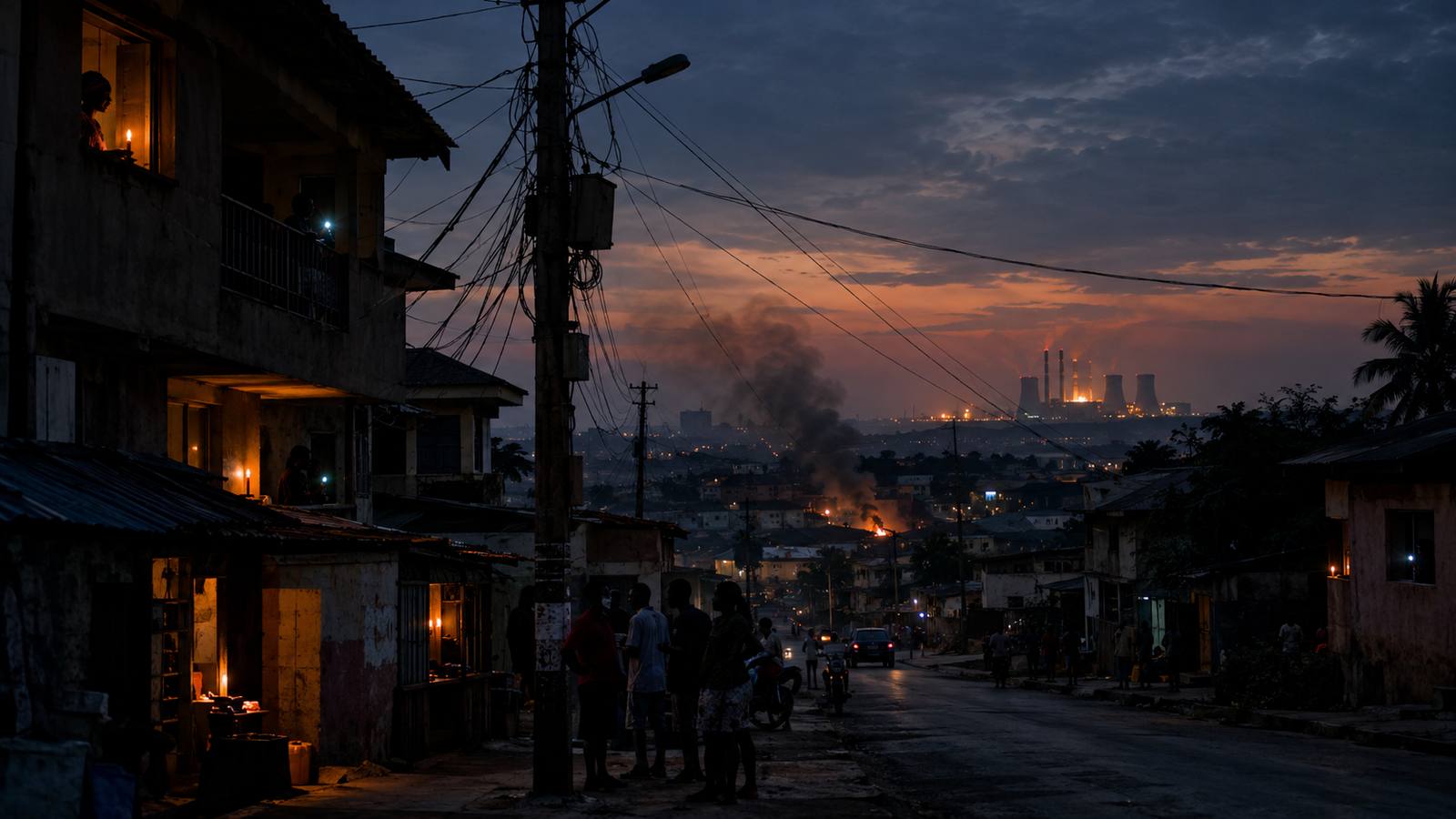
When the lights failed for the third night running in Kotu last week, nobody in the queue outside the fuel station was talking about the weather anymore. They were talking about money — where a decade of loans, grants and donor pledges for Gambia’s electricity grid had actually gone, and why the switch still would not stay on.
That question, more than any single blackout, is what has pulled thousands of Gambians into the streets of Banjul, Brusubi and Westfield this month, and it is the question this commentary sets out to answer.
President Adama Barrow called the outages a national security emergency this week, standing inside a NAWEC power station in Brikama as if proximity to the machinery might itself generate reassurance. He announced a new 24-megawatt generator arriving by the end of October, and a 50-megawatt solar plant in Soma still years from completion. Those are engineering fixes. They do not touch the real fault line running beneath this crisis, which is not technical at all. It is financial, institutional and, ultimately, political.
A Crisis That Was Not Supposed to Happen
The Gambia has, by its own government’s account, received more investment in its power sector between 2017 and 2026 than at any point in its history. The World Bank, the European Union and the European Investment Bank have all poured money into the National Water and Electricity Company, the state utility known as NAWEC, through projects with names like the Gambia Electricity Restoration and Modernization Project and the ECOWAS Regional Electricity Access Project. Solar plants, transmission upgrades, institutional support programs. On paper, this should have been the decade The Gambia finally solved its power problem.
Instead, blackouts have stretched to 48 hours in some neighborhoods. Fans stop turning. Mothers throw out spoiled food. Students study by candlelight. Hospitals run on generators that themselves strain under the same aging network. The gap between the money that went in and the electricity that comes out is not a rounding error. It is the entire story.
NAWEC’s Explanations Keep Shifting
Ask NAWEC why the grid keeps failing and the answer changes depending on the week. In mid-August, the utility blamed a surge in demand driven by high temperatures and constraints on electricity imports. By September, its managing director, Gallo Saidy, was citing climate change and the war between the United States and Israel over Iran as contributing factors, alongside aging infrastructure and transformer overloads. Each explanation contains a kernel of truth. None of them, taken together or apart, accounts for why hundreds of millions of dollars in donor financing has not produced a grid capable of surviving a hot season.
This is where commentary has to depart from stenography. A utility that cites geopolitical conflict thousands of miles away to explain rolling blackouts in Banjul is not offering an analysis. It is offering a deflection, and Gambians, judging by the tyres burning outside NAWEC’s headquarters this week, are no longer buying it.
The Audit Trail Nobody Wants to Follow
Months before the current unrest, a civil society coalition called Gambians Against Looted Assets issued NAWEC a ten-day ultimatum, backed by something more substantive than slogans: a review of audit reports, parliamentary proceedings and public inquiries. Their conclusion was blunt. The deterioration of Gambia’s power and water systems, they argued, cannot be blamed on a lack of funding or external support, because the funding has been unprecedented. What has been missing, they said, is accountability: deficiencies in internal controls, in procurement, in financial oversight, in the basic discipline of finishing what was promised and proving where the money went.
That framing matters more than any single generator announcement. Procurement records for NAWEC’s flagship modernization projects show a recurring pattern: World Bank and EU financing tied to specific components, on-grid solar, transmission restoration, institutional turnaround, each requiring its own external auditor, its own terms of reference, its own paper trail of expressions of interest. The mechanisms for scrutiny exist. What is less clear is whether their findings ever translate into consequence. The country’s Auditor General has separately flagged millions of dalasi in unrecovered government loans and lapses across state institutions, a pattern that predates this crisis and will almost certainly outlast it unless something structural changes.
Why This Is Also an Election Story
None of this is happening in a vacuum. Barrow is seeking a third term in December’s election, having first come to power in 2017 promising to end the authoritarian drift of the Yahya Jammeh years. A president who built his legitimacy on the promise of accountable, transparent governance is now facing protesters chanting for his resignation outside the very utility his government has spent nine years trying to fix. The optics are almost too on the nose: a leader elected to end opacity now presiding over a state company whose books, by campaigners’ own account, tell a story his ministers would rather not narrate.
Barrow’s government insists it is treating the crisis with urgency. Information Minister Ismaila Ceesay has promised relentless effort. But urgency announced during a protest is not the same as accountability built before one. Gambians have heard commitments before. What they have not seen, consistently, is a public account of where NAWEC’s project financing actually went, component by component, contract by contract, and why turnaround plans funded since at least 2016 have not turned anything around.
The Real Question Behind the Protests
Strip away the tear gas and the barricades, and the protest movement is asking a version of the same question posed by GALA’s spokesperson months ago: who, precisely, controls Gambia’s energy money, and who answers when it disappears into a grid that still cannot keep the lights on. That is not a rhetorical flourish. It is the actual, auditable question sitting inside NAWEC’s project files, inside World Bank grant disclosures, inside a decade of external auditor terms of reference that Gambians have every right to see translated into plain language.
A 24-megawatt generator commissioned by October will help. It will not answer that question. Neither will a solar plant in Soma that is, by the government’s own timeline, still being mobilized rather than built. Infrastructure announcements are the easy part of crisis management. They photograph well. They give ministers something concrete to point to when addressing an angry public. What they cannot do is substitute for the harder, less telegenic work of publishing audit findings, naming who was responsible for procurement failures, and demonstrating that the next tranche of donor financing will be spent differently from the last.
A Familiar Pattern Across the Region
Gambians watching their own crisis unfold might recognize the shape of it from neighboring capitals. Utilities across West Africa have absorbed billions in concessional financing over the past two decades, from Freetown to Conakry to Bissau, often through the same multilateral lenders and the same categories of project: transmission restoration, institutional turnaround, regional access expansion. The pattern repeats with unsettling consistency. Loan agreements are signed with genuine technical ambition. Terms of reference are drafted for external auditors. Expressions of interest go out for consultants to verify that the money was spent as intended. And yet, years later, the same capitals experience the same rolling blackouts, the same public anger, the same ministerial promises of imminent relief.
What distinguishes The Gambia this month is not the novelty of the crisis but the specificity of the challenge being put to it. Civil society groups are not simply demanding better service. They are pointing directly at the audit architecture already in place, the very mechanisms donors built to prevent exactly this outcome, and asking why those mechanisms have not been allowed to do their job publicly. That is a more dangerous question for a government to face than a generic complaint about blackouts, because it cannot be answered with a construction timeline. It can only be answered with disclosure.
What Comes After the Barricades
Protest movements in small states with limited institutional capacity for enforcement tend to burn hot and then fade, especially once a government makes a visible concession, in this case a generator delivery date and a solar contract. But the underlying grievance here will not fade with the barricades, because it predates this month’s blackouts by years and will outlast whatever temporary relief October’s new machine provides. The Gambia’s power sector has become a case study in a wider African pattern: donor capital flowing generously into state utilities that remain structurally unable, or politically unwilling, to convert that capital into reliable service, while the institutions meant to enforce accountability, the auditors, the parliamentary committees, the anti-corruption watchdogs, produce reports that circulate without consequence.
If Barrow wants to survive December’s election with his credibility intact, the announcement he needs is not another megawatt figure. It is a public, itemized accounting of NAWEC’s decade of financing, an independent review with teeth, and consequences for whoever let the turnaround plans gather dust while the grid deteriorated. Anything less simply postpones the next round of protests to the next hot season, when the fans stop turning again and Gambians once more have to ask where the money went.

More from Energy & Infrastructure
Ethiopia’s new Nile dams could rredraw Africa’s water and power map
Addis Ababa is moving beyond the Grand Ethiopian Renaissance Dam, seeking to turn its vast water resources into electricity, export revenue and regional influence.
Tanzania’s $3billion power bet: Who really wins from the Julius Nyerere dam?
Tanzania’s massive hydropower investment promises cheaper, more reliable electricity, but its biggest test is turning power into jobs, industry and economic growth.