

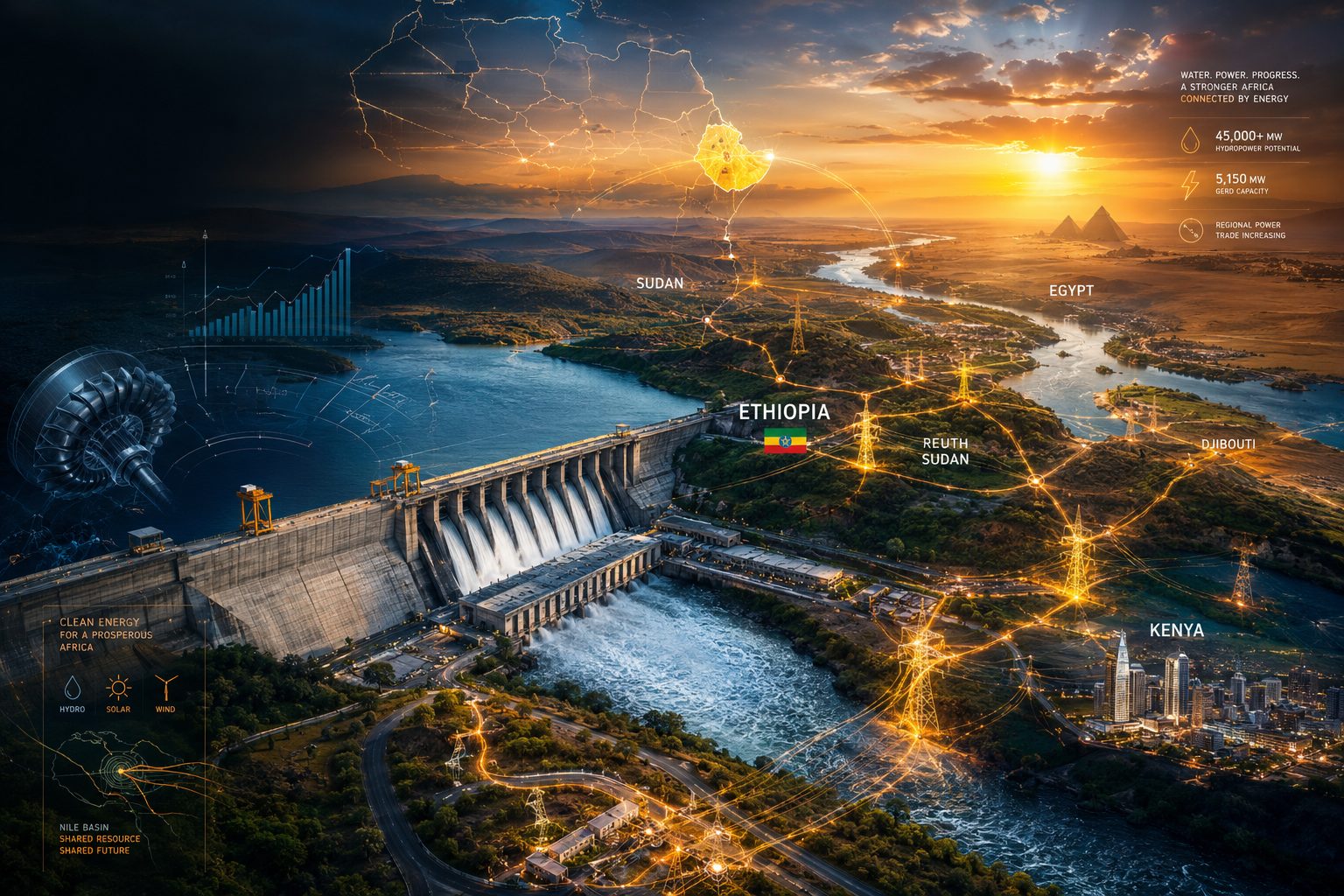
Ethiopia is preparing to take its most consequential step yet in its bid to become the Horn of Africa’s leading hydropower power, with plans for additional dams on the Blue Nile that could expand its electricity generation while giving Addis Ababa greater strategic weight over one of Africa’s most politically sensitive rivers.
The plans come less than a year after Ethiopia inaugurated the Grand Ethiopian Renaissance Dam, or GERD, Africa’s largest hydroelectric project, signalling that the $5 billion project was not the end of Addis Ababa’s hydropower ambitions but the beginning of a much larger strategy.
In March, Ethiopia announced plans for three additional hydroelectric projects on the Blue Nile, known as the Abbay in Ethiopia. The proposed Karadobi, Mandaya and Beko Abo dams are expected to take between four and seven years to build, according to reports on the plans. Their combined generating capacity has been put at about 5,700 megawatts.
The announcement has alarmed Egypt, which depends overwhelmingly on the Nile for freshwater and has spent years arguing that Ethiopia’s unilateral development of the river threatens its national water security.
The latest warning from Cairo has been unusually direct. Egyptian Foreign Minister Badr Abdelatty said this week that Egypt would not allow additional dams to be built on the Nile and that Cairo had a legitimate right to defend its interests and water security.
For Ethiopia, however, the issue is bigger than a dispute over individual dams.
It is about reshaping the country’s economic geography.
From GERD to a regional power hub
The GERD was conceived as an economic transformation project as much as an engineering achievement.
With a planned capacity of 5,150 MW, the dam gives Ethiopia a major new source of renewable electricity and a platform for exporting power to neighbouring countries. Reuters reported after the dam’s inauguration in September 2025 that Ethiopia viewed the project as central to expanding electricity access at home while selling surplus electricity to the region.
That ambition is already extending beyond Ethiopia’s borders.
Electricity exports can create a different kind of regional relationship from traditional diplomacy. Countries that depend on a neighbour for a significant share of their power supply become economically connected to that country through transmission lines, contracts and pricing arrangements.
Ethiopia is increasingly positioned to exploit that opportunity.
A recent analysis by Ethiopia’s Institute of Foreign Affairs described the country’s expanding electricity exports as creating a form of “latent energy leverage”, linking Ethiopia with Kenya, Djibouti, Sudan and Tanzania through cross-border power infrastructure and commercial arrangements.
That matters because Ethiopia is not simply seeking to generate more electricity.
It is trying to build a regional energy system around itself.
Why water is becoming power
Ethiopia has one of Africa’s largest untapped hydropower resources. A 2026 academic review estimated the country’s hydropower potential at more than 45,000 MW, while only a relatively small portion has been developed. The study also identified regional electricity exports as an important part of Ethiopia’s future hydropower strategy.
The geography is crucial.
Much of the water feeding the Nile originates in the Ethiopian Highlands. The Blue Nile carries enormous seasonal flows downstream through Sudan and into Egypt.
For decades, Egypt’s strategic position has rested partly on the fact that the country sits at the downstream end of the Nile system. Ethiopia’s dam-building programme changes that equation.
By controlling infrastructure at the headwaters, Addis Ababa gains greater capacity to regulate water for electricity production.
That does not automatically mean Ethiopia can simply turn the Nile on and off. River flows remain governed by rainfall, reservoir levels, dam design, operational rules and agreements with downstream states.
But the construction of multiple large reservoirs would make upstream infrastructure an increasingly important part of the Nile’s political economy.
That is precisely what worries Cairo.
Egypt’s water-security dilemma
Egypt receives about 90% of its freshwater from the Nile, according to Reuters reporting on the GERD dispute. Cairo has therefore treated changes to the river’s flow as a national security issue rather than simply an environmental or development question.
The Egyptian concern is not necessarily that Ethiopia will deliberately cut off water.
The deeper fear is what happens during prolonged drought.
A single reservoir can be managed through cooperation, rainfall forecasts and coordinated releases. A system containing several major dams introduces more variables.
Egypt wants legally binding rules governing the filling and operation of the GERD and has opposed additional upstream projects that could affect the river system.
Ethiopia, meanwhile, has consistently argued that it has the sovereign right to develop its water resources and that its dams are designed primarily to generate electricity and support economic development rather than deprive downstream countries of water.
That fundamental disagreement has survived years of negotiations.
In January, Egyptian President Abdel Fattah al-Sisi welcomed an offer from U.S. President Donald Trump to revive mediation over the GERD dispute, underlining the continuing importance Cairo attaches to the issue.
The power gap changes the equation
There is a strong economic argument behind Ethiopia’s strategy.
The country has a population of more than 120 million and has historically faced major electricity-access gaps. The World Bank says electricity access reached 65% of the population in 2025, but only 44% had access to a basic level of electricity service under its Tier 1 measure.
That means Ethiopia faces a paradox.
It has enormous renewable energy potential, yet millions of people still lack reliable electricity.
More dams could help close that gap while providing power for factories, mines, transport, agriculture and expanding cities.
The second opportunity is exports.
If Ethiopia can produce more electricity than its domestic market consumes at particular times, it can sell the surplus to neighbouring countries. That creates foreign exchange earnings at a time when Addis Ababa needs new sources of hard currency.
Ethiopia’s government reported electricity export revenues of about $365.9 million during the first nine months of its 2025/26 fiscal year, highlighting the commercial potential of the strategy.
The more interconnected the regional electricity market becomes, the more valuable Ethiopia’s renewable generation capacity could become.
A new form of regional influence
This is where the story moves beyond engineering.
Ethiopia could increasingly use electricity infrastructure as an instrument of regional economic integration.
A country that supplies affordable renewable power to Kenya, Djibouti, Sudan or other markets gains customers. Those customers, in turn, gain an interest in maintaining stable relations with the supplier.
The result is a form of influence that does not require military power.
It comes through infrastructure.
Transmission corridors can connect economies just as highways, ports and railways do.
For Ethiopia, this could be particularly significant because the country is landlocked and has been seeking stronger economic and strategic links beyond its borders.
Hydropower offers Addis Ababa something valuable: an exportable resource that can travel across borders without requiring a seaport.
The emerging model could therefore be described as water converted into electricity, electricity converted into revenue, and revenue converted into regional influence.
But dams carry risks
The strategy is not without vulnerabilities.
Large hydropower projects require enormous amounts of capital and take years to complete. They also depend on reliable rainfall and can be affected by drought.
Climate change adds another layer of uncertainty.
A country that builds its energy system heavily around hydropower must manage the risk of changing rainfall patterns while maintaining electricity reliability.
Ethiopia has begun diversifying its renewable energy mix with solar, wind and geothermal power, but hydropower remains dominant. The country’s electricity system therefore remains closely linked to water availability.
There are also environmental and social considerations.
Large reservoirs alter river ecosystems, affect communities and change the timing and volume of downstream flows. The experience of Ethiopia’s existing large dams shows that the development benefits must be balanced against local and downstream consequences.
For Ethiopia, the challenge will be demonstrating that its ambitions can deliver economic growth without turning the Nile into a permanent source of regional instability.
Sudan sits in the middle
Sudan has a particularly complicated position.
Like Egypt, it depends on the Nile. But unlike Egypt, Sudan could potentially gain substantial benefits from upstream Ethiopian dams.
More predictable river flows can improve water management. Hydropower exports could provide cheaper electricity. Better regulation of seasonal flows could also reduce some flood risks.
At the same time, Sudan has legitimate concerns about dam safety, sudden changes in river flows and the absence of a comprehensive agreement governing the operation of Ethiopia’s major reservoirs.
The country’s internal war makes these issues even more difficult to manage.
A weakened Sudan has less capacity to influence Nile negotiations, while Egypt and Ethiopia remain powerful actors with competing interests.
That makes Sudan a critical but vulnerable player in the emerging water and energy system.
The Nile dispute is becoming wider
The confrontation between Cairo and Addis Ababa can no longer be viewed solely through the GERD.
The wider competition includes energy markets, regional alliances, trade corridors and access to the Red Sea.
Ethiopia’s growing interest in regional power exports is developing alongside its wider search for strategic access to international markets.
Egypt, meanwhile, is strengthening relationships across the Horn of Africa and Red Sea region, where Ethiopia’s expanding influence intersects with Cairo’s own security interests.
The result is a geopolitical contest in which the Nile is only one part of a much larger strategic picture.
That raises the stakes surrounding every new dam announcement.
A test for African cooperation
The biggest question may not be whether Ethiopia should build more dams.
It is whether African countries can create institutions capable of managing the consequences.
The Nile Basin already demonstrates the difficulty of governing a river shared by multiple sovereign states with different economic needs.
Ethiopia wants development.
Egypt wants water security.
Sudan wants both water security and economic opportunity.
None of those objectives is inherently incompatible.
The difficulty is building enough trust to make them work together.
A durable agreement would need to address drought management, reservoir operations, data sharing, flood releases, electricity development and future infrastructure.
Without such mechanisms, every new dam could become a diplomatic crisis.
With them, the same infrastructure could become the foundation of a regional energy market.
Ethiopia’s strategic bet
The emerging Ethiopian strategy is therefore much more ambitious than simply adding turbines to the national grid.
Addis Ababa appears to be betting that its geography can become an economic advantage.
The mountains and rivers that once represented largely untapped natural resources are increasingly being treated as the foundation of an industrial and regional power strategy.
The GERD is the centrepiece.
The proposed Karadobi, Mandaya and Beko Abo projects could represent the next phase if they move from plans to construction. Together, the proposed projects could add roughly 5,700 MW, according to reports on Ethiopia’s plans.
If completed, they would reinforce Ethiopia’s position as one of Africa’s leading hydropower producers.
But Ethiopia’s ultimate ambition may be measured less by the number of megawatts it generates than by what those megawatts allow it to do.
Reliable domestic electricity could accelerate industrialisation.
Exports could bring foreign currency.
Transmission links could deepen regional integration.
And control of major water infrastructure could give Ethiopia a much greater voice in discussions about the future of the Nile.
Africa’s water-power map
For decades, Egypt was able to view the Nile primarily through the lens of downstream security.
Ethiopia is forcing a different conversation.
The question now is whether Africa’s rivers can become engines of shared prosperity without becoming instruments of strategic confrontation.
That will depend on what happens next.
If Ethiopia succeeds in building a larger network of dams while expanding regional electricity exports, the Horn of Africa’s economic map could change significantly. Power could become one of Addis Ababa’s most important exports and one of its strongest sources of regional influence.
If Egypt and Ethiopia fail to establish credible rules for managing the Nile, however, the same infrastructure could deepen one of Africa’s most persistent geopolitical disputes.
The GERD was once described as a national development project.
The next generation of Ethiopian dams could make it something larger.
They could turn Ethiopia into a central energy supplier for the Horn while giving the country greater influence over the river that connects it to Sudan and Egypt.
For Who Owns Africa, that is the bigger story.
The battle over the Nile is increasingly becoming a contest over who will shape Africa’s future energy system, who controls the infrastructure that powers it, and whether water can be transformed from a source of rivalry into a foundation for regional growth.

More from Energy & Infrastructure
Who controls Gambia’s energy money? Inside the NAWEC projects under audit
Gambia's blackout protests reveal a deeper crisis: years of unaccountable NAWEC financing that never delivered a reliable, functioning power grid.
Tanzania’s $3billion power bet: Who really wins from the Julius Nyerere dam?
Tanzania’s massive hydropower investment promises cheaper, more reliable electricity, but its biggest test is turning power into jobs, industry and economic growth.