
For decades, the single most valuable asset in the Democratic Republic of Congo was never the cobalt, the copper or the lithium sitting underground. It was the ignorance surrounding where, exactly, those minerals were.
Foreign companies who knew the terrain, who had inherited colonial-era surveys or funded their own exploration, held the real power. Everyone else was guessing. That asymmetry is now being dismantled, deliberately and methodically, by the Congolese state itself. What is unfolding in Kinshasa is not a mining story in the conventional sense. It is a sovereignty story, and it deserves to be read as one.
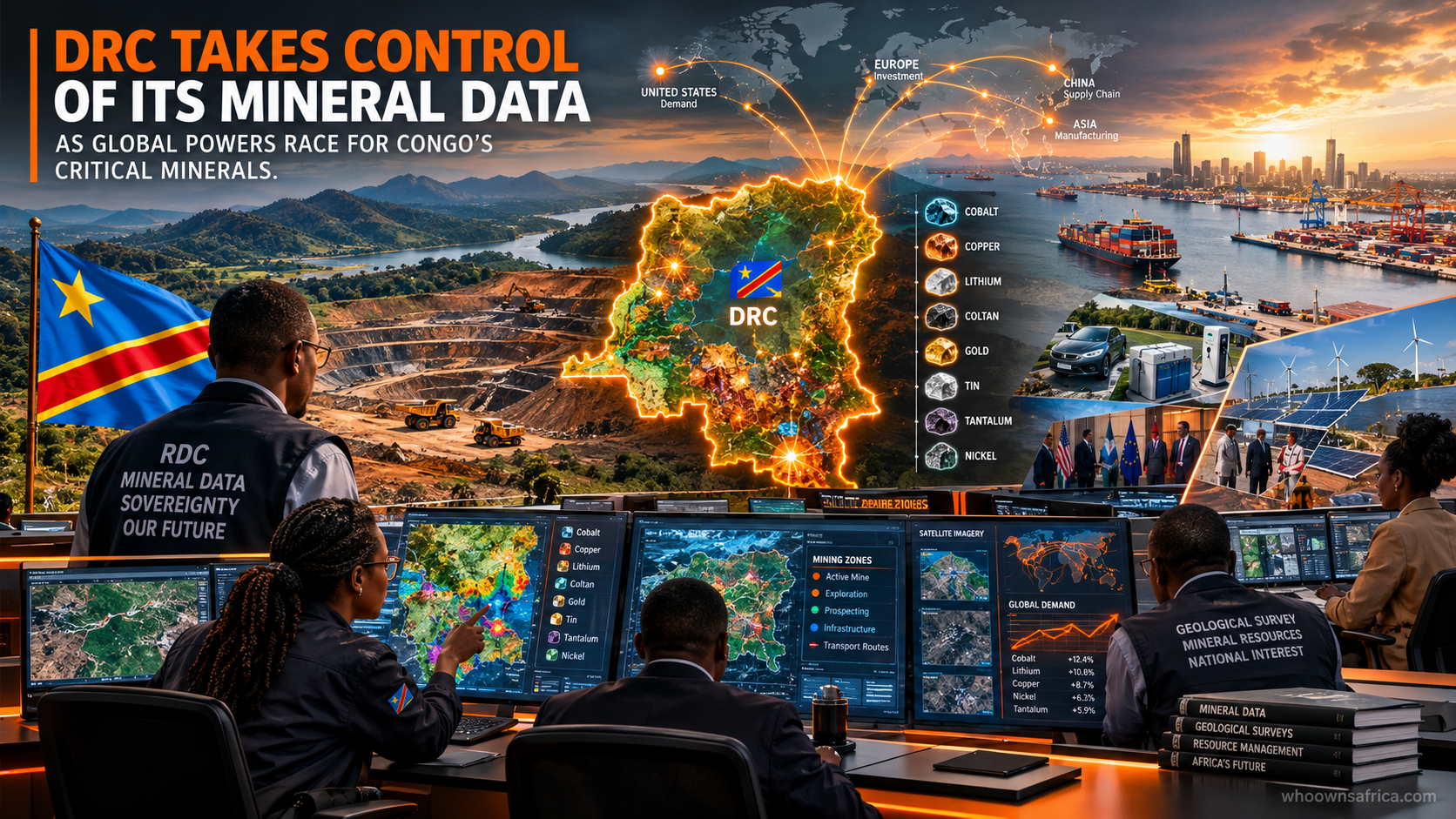
Reuters reported this week that Congo plans to tighten its grip on the geological data guiding billions of dollars in mining exploration, a move that could reshape how future discoveries are made and who profits from them. The country is accelerating airborne surveys, nationwide mapping and the digitisation of historical archives to build what officials call a comprehensive national geological databank. Unlike Australia and other established mining jurisdictions, where geological data tends to sit in the open for any investor to consult, Congo intends to keep the databank in state hands and charge for access to at least some of it.
That distinction is the whole story. It is also the part easiest to miss if you are only counting tonnes of cobalt.
Why data became the new resource
Minerals themselves are static. They do not move, negotiate or generate leverage on their own. Data about minerals, however, is dynamic. It determines which company gets to drill first, which government gets to set the terms, and which economy captures the exploration premium rather than merely the extraction royalty. For most of Congo’s modern history, that premium flowed elsewhere, often to the same institutions that had drawn the original maps a century earlier.
Raoul Wazenga Vitima, director general of Congo’s National Geological Survey, put it plainly when he described the data generated under the country’s new mapping programmes as a strategic asset of the state. That is not bureaucratic language. It is a statement of intent from a government that has watched foreign firms exploit informational gaps for generations and has decided the gap itself is worth closing.
A $180 million contract with Spain’s Xcalibur, which began in January, is now surveying more than 700,000 square kilometres using airborne geophysics and advanced analytics, according to Vitima. That is an area larger than Texas. Much of Congo, roughly 80 percent by some estimates, has never been properly mapped at all. Every square kilometre added to that databank is a square kilometre no longer dependent on a foreign company’s private files.
The colonial paper trail Congo wants back
None of this makes sense without understanding where the original data has been sitting all along: Belgium. The AfricaMuseum in Tervuren holds an archive spanning roughly 500 linear metres of shelving, packed with colonial-era survey reports, cartographic records and geochemical sampling data compiled during decades of Belgian administration. These are not museum curiosities gathering dust for historical interest. They are, in effect, a pre-existing exploration dataset for one of the most mineral-rich territories on the planet, assembled before the minerals they describe became indispensable to batteries, defence systems and the global energy transition.
Earlier this year, Congo’s mines minister reached an agreement with Belgian and European officials on a roadmap to digitise and gradually transfer those archives. It has not been a smooth process. An earlier attempt by KoBold Metals, the American exploration firm backed by Bill Gates and Jeff Bezos, to digitise the same records stalled after the museum declined to grant a private overseas company exclusive access. Belgian officials said they could not hand over millions of documents on Congo’s geology to one commercial actor. The museum instead committed to digitising the material itself and sending copies to Congolese authorities.
That standoff tells you something important. Even Congo’s closest historical counterpart in Europe now treats this data as too sensitive to privatise casually. If Brussels will not let one Western company monopolise the archive, Kinshasa is unlikely to let anyone else do so either.
The scramble that made data suddenly urgent
Congo is not digitising its geology in a vacuum. It is doing so at the exact moment Washington and Beijing are competing more openly for African critical minerals than at any point in recent memory. The country produces roughly 70 percent of the world’s cobalt and mined more than 3 million metric tons of copper in a recent year, figures that put it at the centre of supply chains for electric vehicles, smartphones and, increasingly, defence technology.
China’s dominance has been built over more than a decade, with firms including CMOC, Zijin Mining and Huayou Cobalt holding major stakes in Congo’s largest copper and cobalt assets, and Beijing remaining the country’s largest bilateral creditor. Washington, by contrast, has moved more recently and more aggressively, using offtake agreements, development finance and a peace mediation between Kinshasa and Rwanda to open the door for American investment. A cobalt cooperation pact, a push to reroute exports through Angola’s Lobito rail corridor toward the Atlantic, and support for firms like Virtus Minerals in acquiring Congolese cobalt assets all point in one direction: a deliberate American effort to peel strategic supply away from Chinese-aligned channels.
Congo has not chosen a side so much as it has chosen to extract value from both. In March, Kinshasa signed a mining cooperation agreement with China that explicitly covers geological data sharing alongside investment protection, even as it courted American mapping proposals from firms such as Dynamic Aviation. This is not indecision. It is leverage, and leverage requires owning the thing everyone wants access to.
What geological data actually buys a government
There is a temptation to read all of this as a technical footnote to the bigger mining story, a bureaucratic detail buried beneath headline cobalt export quotas and multibillion-dollar offtake deals. That reading understates what is happening. Comprehensive geological data lets a government make more informed licensing decisions instead of negotiating blind against companies who already know what lies beneath a given concession. It allows regulators to design royalty and tax frameworks around actual resource value rather than estimates supplied by the very companies seeking to extract that value. And it reduces a structural dependence on foreign geological expertise that has shaped, and often distorted, Congo’s mining sector for a century.
Artificial intelligence has raised the stakes further. Machine learning models can now identify hydrothermal alteration zones and structural features linked to mineralisation from remote sensing data alone, as researchers demonstrated recently in a study of copper deposits in Congo’s Lualaba province. A well-organised historical archive, once dismissed as an administrative relic, becomes a training dataset capable of guiding exploration decisions worth hundreds of millions of dollars. That is precisely the logic behind a $50 million American lithium exploration programme currently under way in Congo’s Manono region, one of the world’s most significant known lithium formations, where colonial-era survey maps and drill logs are being fed into modern analytics to reduce drilling uncertainty.
Sovereignty is the strategy, not a slogan
Skeptics will point out, fairly, that owning a database is not the same as owning outcomes. Congo still lacks the refining capacity that keeps most of its raw cobalt and copper flowing overseas for processing. State-run charges for data access could slow investment if they are set too high, or invite corruption if oversight is weak. And a government that controls information can also be tempted to withhold or manipulate it for political ends rather than developmental ones. These are legitimate risks, and how transparently Congo manages access requests, weighing investor needs against what officials call the protection of strategic interests, will determine whether this becomes genuine institution-building or simply a new gatekeeping mechanism dressed in sovereignty language.
But the direction of travel matters. For most of the past century, decisions about Congo’s mineral future were made using information the Congolese state did not control and, in many cases, had never even seen. Reclaiming that information, mapping what colonial surveyors never finished, digitising what sits in a Belgian museum basement, and charging outsiders for access to what is found, is a genuinely different posture from the one this country has occupied for generations. It will not resolve Congo’s deeper development challenges on its own. But it is, unmistakably, the first time in a long time that the country is trying to write its own geological story rather than have it written for others.

More from Featured

Who is fueling Sudan’s drone war? The foreign networks behind Africa’s forgotten conflict
Foreign weapons, contractors, technology and supply routes are transforming Sudan’s war, leaving civilians trapped between rival armies and outside interests.