

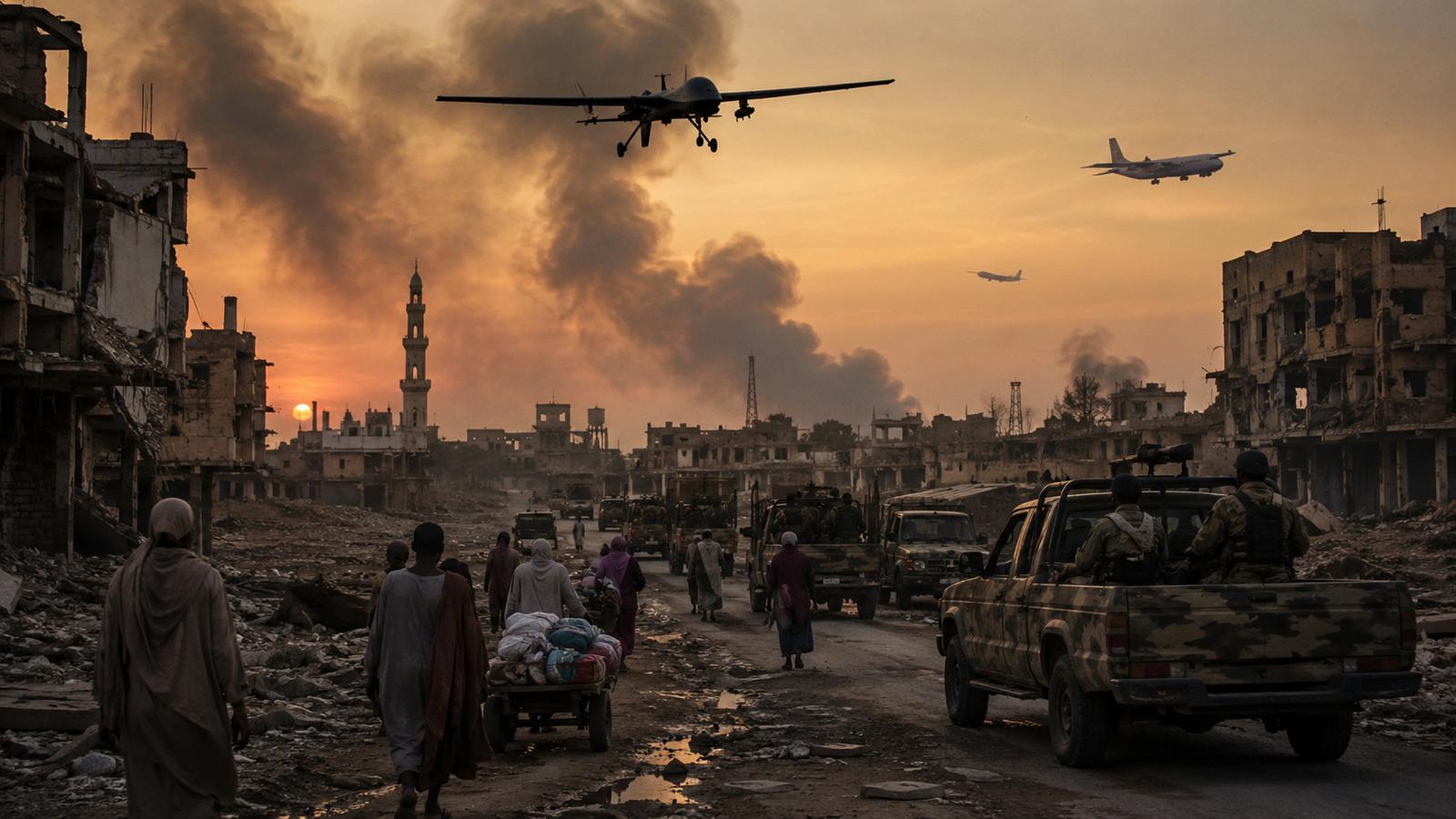
Sudan’s war is no longer being fought only by Sudanese forces. A United Nations investigation has identified a web of foreign weapons suppliers, military contractors, technology providers and logistical networks that are helping sustain the conflict and expanding the ability of both sides to strike targets far from the battlefield.
More than 1,000 people were killed in drone strikes during the first five months of 2026, according to the UN fact-finding mission, which said attacks by both the Sudanese Armed Forces and the Rapid Support Forces may amount to serious violations of international law.
The findings offer one of the clearest pictures yet of how Sudan’s conflict has evolved from a power struggle between two rival armed forces into a war sustained by international networks. At the centre of the latest investigation is the RSF, the powerful paramilitary force led by Mohamed Hamdan Dagalo, known as Hemedti. The UN mission said it had reasonable grounds to believe that individuals and entities connected to the United Arab Emirates, Chad, Libya and Somalia were involved in networks supplying the RSF with weapons, equipment, logistics, training and foreign personnel. The UAE has repeatedly denied providing military support to the RSF.
A war increasingly fought from the air
Sudan’s conflict began in April 2023 when fighting erupted between the Sudanese Armed Forces, led by army chief Abdel Fattah al-Burhan, and the RSF. What began as a struggle over political power and control of the state has since devastated cities, displaced millions and fractured the country into competing zones of influence.
Drones have changed the character of that war. They allow forces to attack positions, supply routes and populated areas without necessarily putting large numbers of soldiers directly in harm’s way. For civilians, however, the distance between operator and target can make the battlefield harder to see and the danger harder to predict.
The UN mission said more than 1,000 people died in drone attacks between January and May 2026. It accused both sides of using drones in ways that harmed civilians and civilian infrastructure, with some attacks potentially constituting war crimes. The investigation said foreign assistance had expanded the ability of the warring parties to conduct strikes at greater distances.
That development matters because Sudan’s humanitarian crisis is already among the world’s largest. More than 14 million people have been displaced since the war began, according to the UN findings cited by Reuters. The longer-range and increasingly sophisticated nature of the fighting risks pushing the conflict further into civilian areas.
The RSF’s international supply chain
The UN investigation points to a transnational system rather than a single supplier. Investigators said networks involving people and companies operating from or connected to the UAE, Chad, Libya and Somalia helped provide the RSF with military equipment, logistical support and personnel.
That distinction is important. The report does not simply describe weapons crossing one border. It describes a chain involving recruitment, financing, transportation, training and deployment. Such networks can make responsibility more difficult to establish because the person operating a drone may be thousands of kilometres from the company that recruited him or the country where equipment was originally obtained.
The UAE is particularly significant in the investigation. The UN said individuals and entities operating from, registered in or linked to the UAE played a significant role in networks involved in recruiting, financing, transporting and deploying foreign military contractors and providing military-related support benefiting the RSF. Abu Dhabi has consistently rejected accusations that it is militarily supporting the paramilitary force.
Chad and Libya also appear in the supply architecture identified by investigators. Their geographic position makes them strategically important because Sudan’s western battlefield borders both countries. Routes through the region can provide access to Darfur, where some of the conflict’s worst atrocities have taken place.
Somalia, meanwhile, has emerged in reporting as another transit point in the movement of foreign contractors and equipment. The routes demonstrate how Sudan’s war has become connected to a wider regional security economy stretching from the Gulf to North Africa and the Horn of Africa.
Colombian contractors bring new expertise
Perhaps the most striking finding concerns Colombian military contractors.
The UN mission said up to 2,000 Colombian contractors may have been involved in supporting the RSF. Investigators said the contractors played an important role in operating and maintaining drone systems and other advanced weapons. Some were present during military operations around El Fasher, the Darfur capital that the RSF captured in October 2025.
The presence of Colombian personnel is significant because Colombia has a large pool of former military personnel with experience gained through decades of armed conflict. Human Rights Watch separately documented recruitment of Colombian private military contractors for deployment to Sudan and found evidence linking recruitment companies in Colombia with an Abu Dhabi-based security company.
Human Rights Watch said its research identified several routes used by contractors travelling towards Sudan, including through the UAE, eastern Libya, Chad and Bossaso in Somalia. It also reported evidence that some contractors passed through UAE facilities before reaching Sudan.
The findings have added weight to concerns that the war is benefiting from a professionalised military labour market in which former soldiers can be recruited for specialist roles thousands of kilometres from their home countries.
Why El Fasher matters
El Fasher has become one of the defining battlegrounds of Sudan’s war.
The city was the last major stronghold in Darfur held by forces opposed to the RSF before its capture in October 2025. The UN and human rights investigators have documented mass killings and other grave abuses connected to the battle and its aftermath.
Human Rights Watch reported that Colombian contractors were present in El Fasher during the RSF’s offensive and found evidence that Colombian personnel had participated in combat and training activities. The organisation also linked the recruitment network to companies operating between Colombia and the UAE.
The UN’s latest findings therefore add another layer to an already complex story. The battle for Darfur is not only about territory. It is also about who can provide the money, weapons, technology and expertise needed to maintain military momentum.
The army is not outside the equation
The internationalisation of Sudan’s war is not limited to the RSF.
The UN investigation also found evidence that the Sudanese Armed Forces have acquired drone capabilities from foreign sources. However, investigators described their findings concerning external support to the army as preliminary.
That distinction matters. The available evidence does not suggest that the two sides receive identical forms of foreign assistance. Rather, it shows that external military support is increasingly affecting both sides’ ability to wage war.
The result is a dangerous feedback loop. As one side acquires more capable drones and weapons, the other has greater incentive to obtain comparable technology. A conflict that once depended heavily on soldiers, artillery and conventional air power can increasingly be fought through remotely operated systems and foreign technical expertise.
For civilians, technological sophistication does not necessarily mean greater safety. In Sudan, it may mean the opposite.
Who profits from the war?
The question of who is fueling Sudan’s war inevitably leads to another question: who benefits?
The answer is not limited to governments. Conflict creates markets for arms dealers, logistics companies, private military contractors, recruiters, aviation operators and intermediaries capable of moving people and equipment across borders.
The Colombian recruitment networks documented by Human Rights Watch illustrate how the private sector can become part of a modern African conflict without formally becoming a party to the war. The organisation said a Colombia-based recruitment company worked with an Abu Dhabi-based security company to recruit former Colombian military personnel for deployment to Sudan.
This creates a challenge for international accountability. A weapon may be manufactured in one country, sold through an intermediary in another, transported through a third and ultimately operated by a foreign contractor on Sudanese soil. By the time a drone strikes a target, the chain behind it can involve multiple jurisdictions and private actors.
The UAE faces renewed scrutiny
Among all the countries identified in the investigation, the UAE faces particular scrutiny because of the scale of allegations surrounding support networks benefiting the RSF.
Abu Dhabi has denied the accusations. The latest UN findings therefore do not constitute a criminal judgment against the UAE or its government. They represent the fact-finding mission’s assessment of evidence concerning individuals, companies and networks linked to the country.
The allegations are nevertheless significant because they reinforce findings from previous investigations. Human Rights Watch has separately documented evidence suggesting that Colombian contractors recruited for Sudan travelled through UAE facilities and that an Abu Dhabi-based security company had links to the recruitment process.
For the UAE, the issue also carries wider diplomatic implications. The country has positioned itself as a regional diplomatic and humanitarian actor, while accusations of military backing for the RSF have repeatedly challenged that image.
Sudan’s war is becoming a regional war
The most important message from the UN investigation may be that Sudan’s conflict can no longer be understood solely through the rivalry between Burhan and Hemedti.
The weapons, personnel, money and technology flowing into the conflict have created a regional dimension. Chad, Libya, Somalia and the Gulf are not simply observers of events inside Sudan. Their territory, companies, networks and political relationships can affect how the war is supplied and sustained.
That is why enforcement of the UN arms embargo is becoming increasingly important. The UN mission called on states to stop illicit supply networks and urged stronger implementation of restrictions on weapons transfers. It also called for the Security Council to extend the arms embargo across Sudan.
Yet an embargo is only effective if governments are willing and able to monitor the networks operating around it. Modern weapons transfers can move through private companies, contractors, aircraft and informal border routes, making enforcement considerably harder than simply inspecting a shipment of weapons.
The real battlefield is bigger than Sudan
Sudan’s drone war reveals something larger about modern conflicts in Africa.
Wars increasingly depend on international networks that can provide technology, money, transport and skilled personnel. The battlefield may be in Darfur or Kordofan, but the supply chain can stretch across continents.
For Sudanese civilians, that means the forces determining their fate are not always visible. A drone operator may be a foreign contractor. The equipment may have passed through several countries. The money may have originated outside Sudan. The aircraft carrying the personnel may belong to a private company.
That is the central finding behind the latest UN investigation: Sudan’s war is being sustained not only by the people pulling the trigger, but by the networks that make it possible.
Until those networks are disrupted, the conflict risks becoming even more technologically sophisticated, geographically entrenched and difficult to end.
And for the millions of Sudanese civilians caught between the rival forces, the question of who owns, supplies or profits from the war is not an abstract geopolitical debate. It is increasingly a question of who gets to live.

More from Featured
DRC takes control of its mineral data as global powers race for Congo’s critical minerals
Kinshasa is locking down its geological archives, betting that owning the map matters more than owning the mine.