
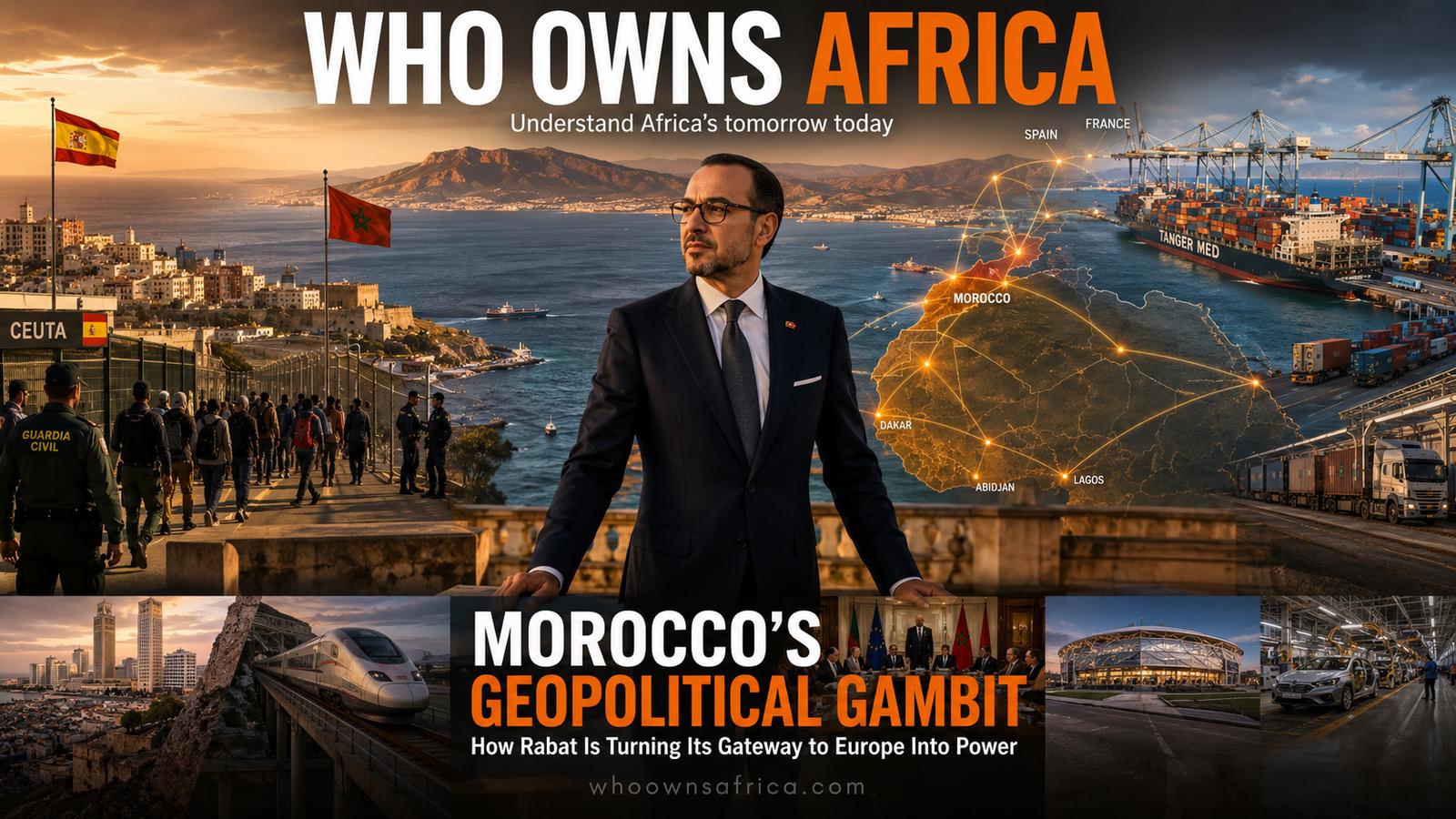
Morocco’s position at the western edge of the Mediterranean has long made it a bridge between Europe and Africa. But the latest crisis around the Spanish enclave of Ceuta shows that Rabat is increasingly able to turn that geography into political leverage, combining control of migration routes with expanding trade links, security cooperation, African investment and a rapidly modernising infrastructure network.
The timing is significant.
In recent weeks, the tiny Spanish territory of Ceuta has become the centre of a major diplomatic and migration confrontation. More than 72,000 migrants surged into the enclave during a mass crossing on July 30, according to Reuters, with at least 96 deaths reported. Morocco subsequently tightened security along the border and arrested migrants attempting to repeat the crossing. On Aug. 14, Moroccan authorities arrested at least 111 people, according to Reuters, after social media calls for another mass crossing.
The crisis has also revived one of the most sensitive territorial disputes between Rabat and Madrid.
Moroccan Justice Minister Abdellatif Ouahbi recently reiterated Morocco’s claim to Ceuta and Melilla, the two Spanish-administered enclaves on Morocco’s northern coast. Spain responded by rejecting any discussion of their sovereignty, saying its territorial integrity was non-negotiable.
For Morocco, however, the importance of Ceuta goes beyond the question of sovereignty.
It illustrates the strategic value of being the country through which Europe must manage some of its most difficult relationships with Africa: migration, security, trade, energy, logistics and political stability.
Geography as power
Morocco’s most important strategic asset may be something it cannot manufacture or easily lose: geography.
The country sits less than 15 kilometres from Europe at the Strait of Gibraltar, controls access to the Atlantic and Mediterranean, and borders the broader West African and Sahelian economic space.
That location has allowed Rabat to build a model that is increasingly different from the traditional relationship between Europe and North Africa.
Morocco is not simply seeking European investment or aid. It is positioning itself as an indispensable intermediary.
The European Union is Morocco’s largest trading partner, accounting for 33.7% of Morocco’s goods trade in 2025. Total EU-Morocco goods trade reached 62.2 billion euros last year, according to the European Commission.
That dependence works in both directions.
European manufacturers rely on Moroccan supply chains for products ranging from automobiles and machinery to agricultural goods and textiles. Morocco, meanwhile, depends heavily on European markets, capital, technology and consumers.
This interdependence gives Rabat room to negotiate.
Ceuta exposes the leverage
The Ceuta crisis provides perhaps the clearest demonstration of that leverage.
Migration is one of Europe’s most politically sensitive issues. Governments across the continent face pressure to reduce irregular arrivals, strengthen external borders and prevent human-smuggling networks from exploiting migration routes.
Morocco sits directly in that equation.
Its security forces are positioned between migrants and one of Europe’s most vulnerable external borders. When Rabat increases controls, migration pressure can fall. When border management breaks down, Spain can face an immediate humanitarian and political crisis.
The latest events have reinforced the lesson.
After the mass crossing, Morocco strengthened its security presence around Ceuta and moved against people attempting further crossings. Spain also reinforced its own forces. Reuters reported that Morocco arrested at least 111 people in a new operation, while Spain deployed more than 500 additional officers to Ceuta.
This creates a difficult equation for Madrid.
Spain needs Morocco’s cooperation to manage migration, but it does not want migration policy to become linked to territorial questions.
That is precisely why Morocco’s sovereignty claims have become so sensitive.
When Rabat raises Ceuta and Melilla while simultaneously controlling access to those borders, Madrid is forced to deal with two separate issues that are strategically connected.
Spain has made clear that it will not negotiate sovereignty over the enclaves.
Yet it cannot simply disengage from Morocco.
A relationship neither side can afford to lose
The paradox is at the heart of Morocco’s relationship with Spain.
The two countries have serious disagreements, but they also have strong economic and security interests in common.
The European Union and Morocco describe their relationship as a multidimensional strategic partnership covering trade, investment, security, migration, climate, justice, innovation and mobility.
Migration cooperation is particularly important.
For Europe, Morocco is a country of origin, transit and destination for migrants. That gives Rabat a role that extends beyond its own borders. A European migration strategy that ignores Morocco is difficult to implement effectively.
This does not mean Morocco controls European migration policy.
Rather, it means Rabat has acquired a negotiating position that many African countries do not possess.
The leverage comes from geography combined with institutional cooperation.
Tanger Med changes the equation
The second pillar of Morocco’s influence is trade infrastructure.
At the centre of that strategy is Tanger Med, the country’s enormous port complex on the Strait of Gibraltar.
The port is designed to connect European markets with Moroccan production and, increasingly, African markets.
Tanger Med’s Ro-Ro facilities can process up to 700,000 trucks annually and connect directly with Spanish, French and Italian ports. The port authority says Tanger Med handles more than half of Morocco’s exports and nearly 97% of the country’s export truck flows.
That is more than a transport achievement.
It is geopolitical infrastructure.
Every additional factory, logistics centre, road, railway connection or distribution hub linked to Tanger Med strengthens Morocco’s role as a gateway.
European companies can manufacture in Morocco, move products through Moroccan ports and reach European consumers quickly.
African businesses can potentially use the same infrastructure to connect to European markets.
The result is a country increasingly positioned between two economic systems.
Morocco’s African strategy
Rabat has also spent years expanding its economic and diplomatic footprint south of the Sahara.
The strategy is visible in banking, telecommunications, construction, fertiliser production, agriculture and infrastructure.
Moroccan companies have expanded into West Africa and other parts of the continent, while institutions such as OCP have built relationships around agricultural productivity and fertiliser supply.
The African Development Bank said in June that Morocco’s infrastructure, trade openness, private sector and growing role in regional financial integration were strategic assets linking North Africa, the Sahel, West Africa and Europe.
This is important because Morocco’s African strategy complements its European position.
The kingdom does not have to choose between being African and being European-facing.
Its geopolitical model depends on doing both.
The more Morocco can connect African production and consumption with European capital and markets, the more valuable its position becomes.
OCP and the politics of food security
Few institutions illustrate this strategy better than OCP, Morocco’s phosphate and fertiliser giant.
Fertiliser is not merely a commercial product. In a continent where agricultural productivity remains a major development challenge, access to fertiliser can become an instrument of economic diplomacy.
OCP has developed partnerships and investments across African agriculture, seeking to tailor fertiliser products to local soils and crops while supporting broader agricultural ecosystems.
In May, the African Development Bank signed a 450 million euro partial credit guarantee to support OCP’s 530 million euro green financing programme. The initiative forms part of the company’s broader investment strategy in industrial transition, energy and water management.
OCP also raised $1.5 billion through an international hybrid bond in April, attracting nearly $7 billion in orders from investors across 23 countries.
The significance is wider than corporate finance.
Morocco is building strategic influence around a resource that is essential to food production.
The World Cup as geopolitical infrastructure
The next major component of Morocco’s strategy is infrastructure.
The 2030 FIFA World Cup, which Morocco will co-host with Spain and Portugal, is accelerating investment in railways, airports, roads, stadiums and tourism infrastructure.
The International Monetary Fund estimates that Morocco’s accelerated connectivity and tourism investment programme between 2024 and 2030 will amount to about 11.9% of 2024 GDP, or roughly 190 billion dirhams.
The investment is designed to prepare the country for the World Cup, but its implications extend far beyond football.
Better airports increase tourism and business travel.
Better railways reduce domestic travel times.
Modern roads strengthen logistics.
Improved urban infrastructure makes cities more attractive to investors.
New hotels increase tourism capacity.
The infrastructure therefore becomes part of Morocco’s long-term geopolitical proposition.
Tourism becomes another source of influence
Morocco is already one of Africa’s leading tourism destinations, and Rabat wants to expand that advantage.
The government plans to add about 60,000 hotel beds before 2030, increasing capacity by roughly 20%. It is targeting 26 million tourists by 2030, compared with almost 20 million in 2025.
Tourism matters because it creates another channel through which Morocco connects Europe, Africa, the Middle East and global markets.
It also strengthens the country’s international brand.
The World Cup offers Morocco an opportunity to present itself not simply as a North African destination, but as an international business, logistics and investment hub.
Economic strength gives diplomacy more room
Morocco’s economic performance provides an important foundation for this strategy.
The World Bank expects the economy to grow 4.2% in 2026 after estimated growth of 4.9% in 2025. The bank said public investment linked to preparations for the 2030 World Cup and a recovery in agriculture were important drivers.
But the economic picture is not without weaknesses.
Youth unemployment remains high, with the IMF reporting a rate of 37.3% among people aged 15 to 24. Morocco also remains vulnerable to drought, which can damage agricultural output and increase pressure on household incomes.
That creates a challenge for Rabat.
Infrastructure can increase productivity, but the benefits have to translate into jobs and broader economic opportunity if Morocco is to maintain social stability.
The geopolitical strategy ultimately depends on domestic economic credibility.
The limits of leverage
Morocco’s growing influence should not be confused with unlimited power.
The Ceuta crisis has demonstrated the risks.
Migration can give Rabat bargaining power, but it can also generate political backlash in Europe. Any perception that migration is being used deliberately as a diplomatic instrument could harden European attitudes toward Morocco.
The same applies to sovereignty.
Spain’s rejection of negotiations shows that there are boundaries to what economic interdependence can achieve. Madrid may need Morocco on migration and trade while remaining unwilling to compromise on Ceuta and Melilla.
The European Union also has its own interests and institutions. Morocco may be an important partner, but it is not negotiating with a single European government.
A bridge with its own agenda
Morocco’s strategic ambition is therefore becoming clearer.
It wants to be the bridge between Europe and Africa, but not merely a bridge that others cross.
It wants to control important parts of the infrastructure, logistics, investment and diplomatic relationships that make the bridge valuable.
Ceuta demonstrates the power of geography.
Tanger Med demonstrates the power of logistics.
OCP demonstrates the power of strategic commodities.
The 2030 World Cup demonstrates the power of infrastructure and international visibility.
And Morocco’s growing African commercial footprint demonstrates how these assets can reinforce one another.
This is the essence of Rabat’s geopolitical model.
It is not based on military power alone. It is based on becoming difficult to bypass.
What comes next
The central question for Europe is no longer whether Morocco is an important partner.
It clearly is.
The more consequential question is how Europe manages a relationship with a country whose interests do not always align with European priorities.
For Morocco, the challenge is equally complex.
Rabat must demonstrate that its rise as a regional power can deliver economic gains without turning migration, territorial disputes or strategic dependencies into permanent sources of confrontation.
The Ceuta crisis has shown how quickly the relationship can become volatile.
But it has also shown why neither side can easily walk away.
Morocco sits at the intersection of Europe’s migration challenge, Africa’s development ambitions and the Mediterranean’s trade routes. Its ports are becoming more important. Its companies are expanding south. Its infrastructure is being upgraded at extraordinary speed. Its diplomatic relationships with Europe remain deep even when disagreements are sharp.
That combination gives Rabat something increasingly valuable in international politics: options.
For Who Owns Africa, the bigger story is not simply whether Morocco can use its position as Europe’s gateway to Africa. It is how far that gateway can become a source of power in its own right.
If Morocco succeeds, its influence will rest not on choosing between Europe and Africa, but on making itself indispensable to both.
