
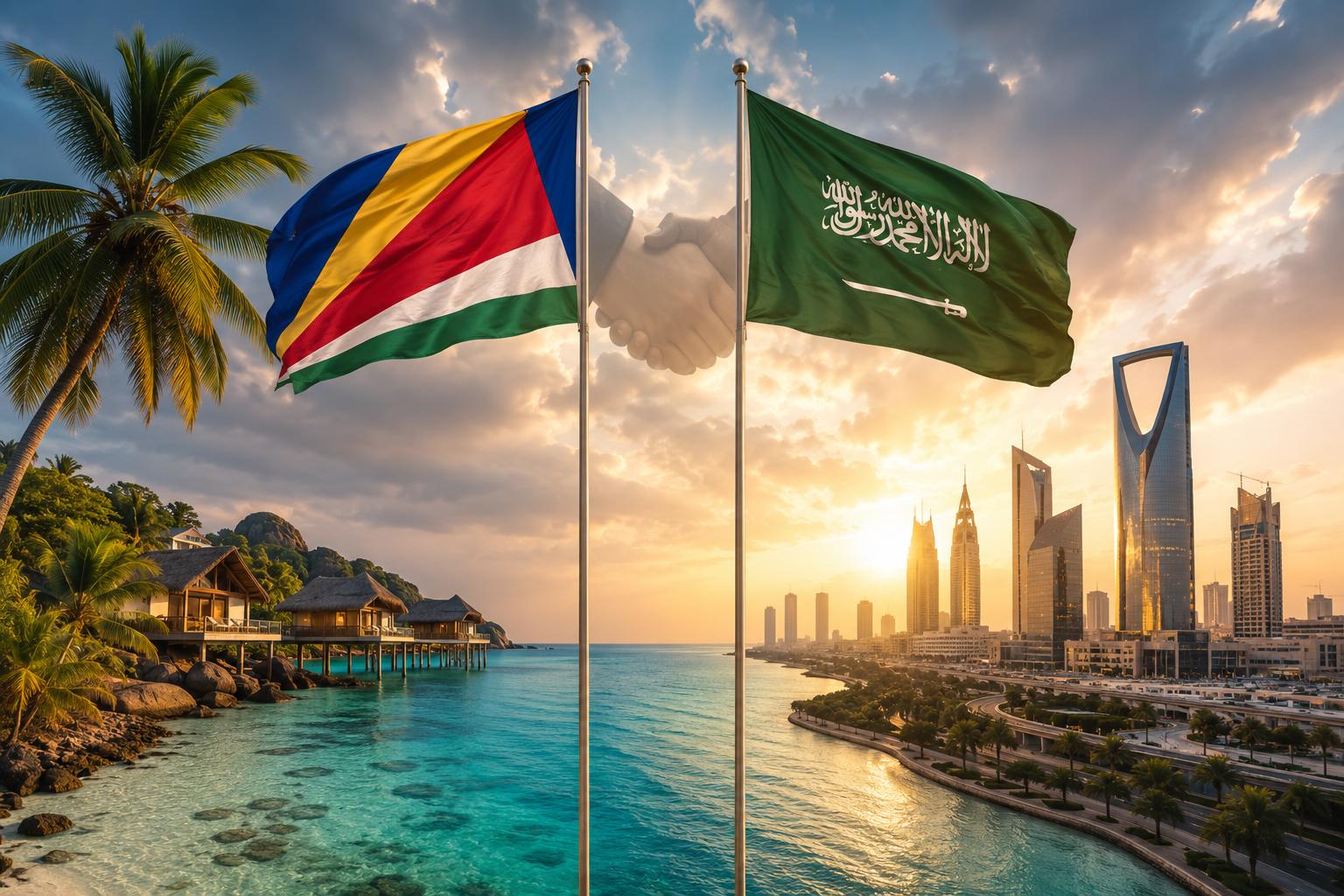
A Small Island State Seeks Bigger Partners
For Seychelles, an archipelago of 115 islands with a population of roughly 122,000 people, the meeting is more than diplomatic courtesy. It reflects a deliberate strategy to widen the country’s pool of foreign investors beyond its traditional European base. Vice-President Pillay reaffirmed Seychelles’ commitment to strengthening ties with the Kingdom and advancing cooperation for mutual benefit, according to the State House readout of the meeting. The two sides also touched on regional and international developments of shared interest, underscoring how Seychelles, despite its size, continues to position itself as a diplomatic bridge between Africa and the Gulf.
Seychelles has Africa’s highest gross domestic product per capita, but its economy remains narrowly built. Tourism directly and indirectly accounts for more than half of national output and about a quarter of employment, according to data compiled by Moody’s Analytics. That concentration leaves the country exposed to external shocks, from pandemics to regional conflicts, a vulnerability that has pushed successive governments to court new sources of capital that can diversify both tourism arrivals and investment flows.
Why Saudi Capital Matters Now
The timing of the visit lines up with Saudi Arabia’s own transformation into one of the world’s most active outbound investors. The Kingdom’s Public Investment Fund, chaired by Crown Prince Mohammed bin Salman, was named the world’s most active sovereign wealth fund in 2025, with assets exceeding $1.15 trillion as it pursues a target of $3 trillion by 2030, according to reporting by Gulf News. Where 2024 investment was largely domestic, 2025 marked a pivot toward global deployment, a shift that smaller economies such as Seychelles are eager to tap into.
Saudi Arabia has also been aggressively building out its own tourism sector under Vision 2030, with the PIF committing more than $100 billion to tourism, culture and entertainment projects, according to Arab News. That domestic build-out has been paired with growing outbound interest in hospitality assets abroad, giving destinations like Seychelles a chance to attract Saudi developers, hotel operators and sovereign capital looking to diversify beyond the Kingdom’s own giga-projects such as NEOM and the Red Sea coastline.
Tourism Remains the Central Pitch
Seychelles’ tourism sector has already shown resilience. Real GDP growth accelerated to 5.8 percent in 2025, up from 3.4 percent the previous year, driven by record tourism earnings and a 13 percent rise in visitor arrivals that surpassed pre-pandemic levels, according to the World Bank. Gulf visitors already feature among the country’s fastest-growing source markets, and government officials have repeatedly signalled interest in expanding air connectivity and hospitality investment from the region.
Deepening ties with Saudi Arabia could open access not only to Saudi tourists themselves but to the broader Gulf travel market, which generated an estimated $254.7 billion in 2025 across the Gulf Cooperation Council states, according to figures reported by Travel And Tour World. For a destination the size of Seychelles, even a modest reallocation of that regional travel spending toward the Indian Ocean would represent a meaningful boost to hotel occupancy, airline connectivity and foreign exchange earnings.
Investment Beyond Hotel Rooms
While tourism dominates the public framing of the Riyadh talks, Seychellois officials have also flagged interest in wider economic cooperation, language that in diplomatic practice typically covers infrastructure, real estate, financial services and renewable energy. Seychelles has been working with international partners, including the World Bank, on a renewable energy programme designed to attract private capital and reduce the country’s dependence on imported fuel, an area where Gulf sovereign funds have shown increasing appetite as they diversify beyond oil-linked assets at home.
The Saudi government has structured several vehicles to channel capital into overseas tourism and infrastructure projects, including a $4 billion Tourism Development Fund that supports qualified investors, according to the U.S. State Department’s Investment Climate Statement on Saudi Arabia. Analysts tracking Gulf dealmaking note that PIF and its regional peers, including funds in Abu Dhabi, Dubai, Kuwait and Qatar, collectively deployed $126 billion in 2025 alone, according to the same Gulf News report cited above, a scale of capital that dwarfs Seychelles’ entire economy but underscores the opportunity available if even a fraction is directed toward Indian Ocean tourism and real estate.
A Small Economy Punching Above Its Weight
Seychelles’ broader economic story adds context to why this diplomatic push matters. The country’s nominal GDP stood at roughly $2.2 billion in 2025, according to figures compiled on Wikipedia’s economy of Seychelles page, yet it carries Africa’s highest GDP per capita and a high-income classification from international lenders. The International Monetary Fund has credited Seychelles with a notable turnaround since its 2008 debt default, citing fiscal consolidation, reserve accumulation and structural reforms that have restored macroeconomic stability, as detailed in an IMF review published in 2025.
That stability is precisely the kind of backdrop that sovereign investors look for before committing capital to smaller markets. Gross international reserves reached $878 million by December 2025, equivalent to about four months of import cover, while the government has maintained a primary fiscal surplus for a fifth consecutive year, according to World Bank data. For Gulf investors weighing where to place tourism and real estate capital outside their home markets, that combination of political access, fiscal discipline and a proven hospitality track record makes Seychelles a comparatively low-risk entry point into the wider Indian Ocean and East African region.
Risks and Headwinds
The outlook is not without caution. The African Development Bank has flagged a more cautious growth trajectory for Seychelles in 2026 and 2027, pointing to disruptions from regional conflict in the Middle East that have affected air connectivity and tourism demand. The current account deficit is projected to widen before narrowing again in 2027, while the bank notes that Seychelles’ ability to mobilise large-scale finance is constrained by its small size, shallow capital markets and the higher costs associated with global financial fragmentation.
Those constraints make direct government-to-government engagement, of the kind on display in Riyadh this week, all the more important. Small states with limited access to international capital markets often rely on targeted diplomacy to attract sovereign wealth funds and state-linked developers who can absorb project risk that private lenders may avoid. Seychelles’ courtship of Saudi Arabia fits that pattern, echoing similar outreach the country has made toward other Gulf states and international financial institutions in recent years.
Seychelles’ Gulf Diplomacy in Context
The Riyadh meeting is part of a broader pattern of Seychellois engagement with Gulf capitals that has developed over the past decade. Seychelles has long maintained diplomatic and commercial ties with the United Arab Emirates, and Gulf visitors, including from the UAE, already rank among the archipelago’s established source markets, according to tourism data cited by industry analysts.
Formalising a closer relationship with Saudi Arabia, the largest economy in the Gulf Cooperation Council, gives Seychelles a more direct channel into a bloc of sovereign investors that collectively manage trillions of dollars in assets and have shown a growing willingness to deploy capital in Africa and the wider Indian Ocean basin.
Government-to-government meetings of this kind rarely produce immediate financial outcomes, but they typically set the stage for technical delegations, feasibility studies and eventual memoranda of understanding between state agencies. Seychelles’ Ministry of Investment, Entrepreneurship and Industry has in recent years pursued similar outreach with other Gulf states and international development partners, part of a wider effort to reduce the country’s reliance on European tour operators and diversify both its visitor base and its sources of development financing.
What Comes Next
Neither side detailed specific deals or financial commitments following the Riyadh meeting, and officials described the talks as an exploration of cooperation rather than a signing of new agreements. Still, the encounter adds Seychelles to a growing list of African and Indian Ocean nations seeking to tap Gulf sovereign capital as Western aid flows tighten and traditional donors recalibrate their overseas commitments. Whether the talks translate into concrete hotel developments, infrastructure financing or new direct flight routes will depend on follow-up technical discussions between Seychellois ministries and Saudi investment bodies in the months ahead.
For now, the meeting serves as a marker of intent: Seychelles wants a bigger seat at the table when Gulf capital decides where to travel next, and Saudi Arabia, flush with sovereign wealth and an expanding global investment mandate, appears willing to listen. Analysts who track sovereign wealth flows into Africa and the Indian Ocean say the real test will come in the following quarters, when technical teams typically translate ministerial goodwill into scoping visits, due diligence and, if all goes well, signed agreements on specific hotel, infrastructure or aviation projects.
Investors watching the relationship will also be looking for signs of reciprocity, including whether Seychelles eases regulatory or licensing conditions to make it easier for Saudi developers and financial institutions to enter its market, and whether Riyadh follows through with financing instruments similar to those it has extended to other partner nations.
Until such details emerge, the Riyadh talks stand as a statement of ambition rather than a finished deal, but for a country whose entire economic model rests on attracting outside capital, that statement of ambition is itself a meaningful step forward.

More from Investments
Rwanda’s $400 million agriculture bet: Who will own the next food economy?
Rwanda’s agricultural investment surge is opening a new battle for ownership, capital, technology, processing capacity and Africa’s growing food economy.

Who will own South Africa’s railways? The private capital moving into transnet
Private operators, mining companies and global investors are entering Transnet, challenging traditional state control over South Africa’s strategic railway infrastructure.