
Rwanda is preparing for a major new wave of investment in agriculture, with more than $400 million in planned financing and investment opportunities pointing toward a broader transformation of the sector.
The money could help modernize farming, expand food processing, improve irrigation and build stronger agricultural businesses. But behind the headline figure is a more consequential question: who will ultimately own the businesses, infrastructure and value chains created by this new capital?
For Rwanda, the stakes extend well beyond increasing crop yields. Agriculture remains central to the country’s economy and to the livelihoods of millions of people, while policymakers are seeking to move the sector away from low-productivity farming toward commercial agriculture, processing and export-oriented businesses.
The African Development Bank is preparing a $200 million Climate Smart Agriculture Results-Based Financing project as part of Rwanda’s Programme to Build Resilient and Sustainable Agri-Food Systems. The programme is designed to support production modernization, private-sector jobs, enterprise development, access to finance and digital agricultural services.
At the same time, Rwanda’s wider agricultural investment pipeline is considerably larger. The Food and Agriculture Organization’s 2026 Rwanda investment profile identifies $414.8 million in investment sought across priority opportunities, including high-value horticulture and other agrifood activities.
Together, these developments point to an emerging investment story that is less about aid and more about ownership.
The capital opportunity
Rwanda has spent years trying to make agriculture more productive and commercially attractive.
The government has placed agriculture at the centre of its development strategy, including the Fifth Strategic Plan for Agriculture Transformation, known as PSTA 5, which runs from 2024 to 2029. Its objective is to build more resilient, sustainable and market-oriented agri-food systems.
The opportunity is substantial.
The FAO says nearly 69% of Rwandan households are engaged in agriculture. Agriculture accounted for about 20% of GDP in 2025 and roughly 37% of total exports, according to figures cited in its 2026 investment profile.
Rwanda’s Development Board also highlights opportunities in food processing, horticulture, poultry, dairy, aquaculture, mechanisation, irrigation, cold-chain logistics and agricultural equipment.
That creates an investment landscape extending far beyond farms.
A company that provides irrigation equipment can capture value. So can a cold-storage operator, a food processor, a logistics company, a seed supplier, a digital agriculture platform or an exporter.
This is where the ownership question becomes important.
From farmers to businesses
Rwanda’s agricultural economy is still dominated by smallholders. The Rwanda Development Board says about 83.1% of agricultural production comes from smallholder farmers.
That structure presents both an opportunity and a challenge.
If new capital reaches farmers through better inputs, irrigation, technology, storage and reliable markets, productivity could rise while farmers retain a larger share of the value created.
But if investment concentrates ownership in processing plants, logistics networks, export companies and large-scale commercial operations without creating stronger links to farmers, much of the value could accrue elsewhere.
The distinction matters because agricultural value chains can generate considerably more revenue after production than at the farm gate.
Coffee provides a familiar example. A farmer may produce the crop, but roasting, packaging, branding, logistics and international distribution can determine where much of the final value is captured.
The same principle applies to horticulture, dairy, meat, grains and other food products.
Rwanda’s next agricultural transformation will therefore be measured not only by how much food it produces, but by how much of the value chain is owned and operated within the country.
Where investors will look
The investment opportunities already identified by Rwanda provide clues about where capital could flow.
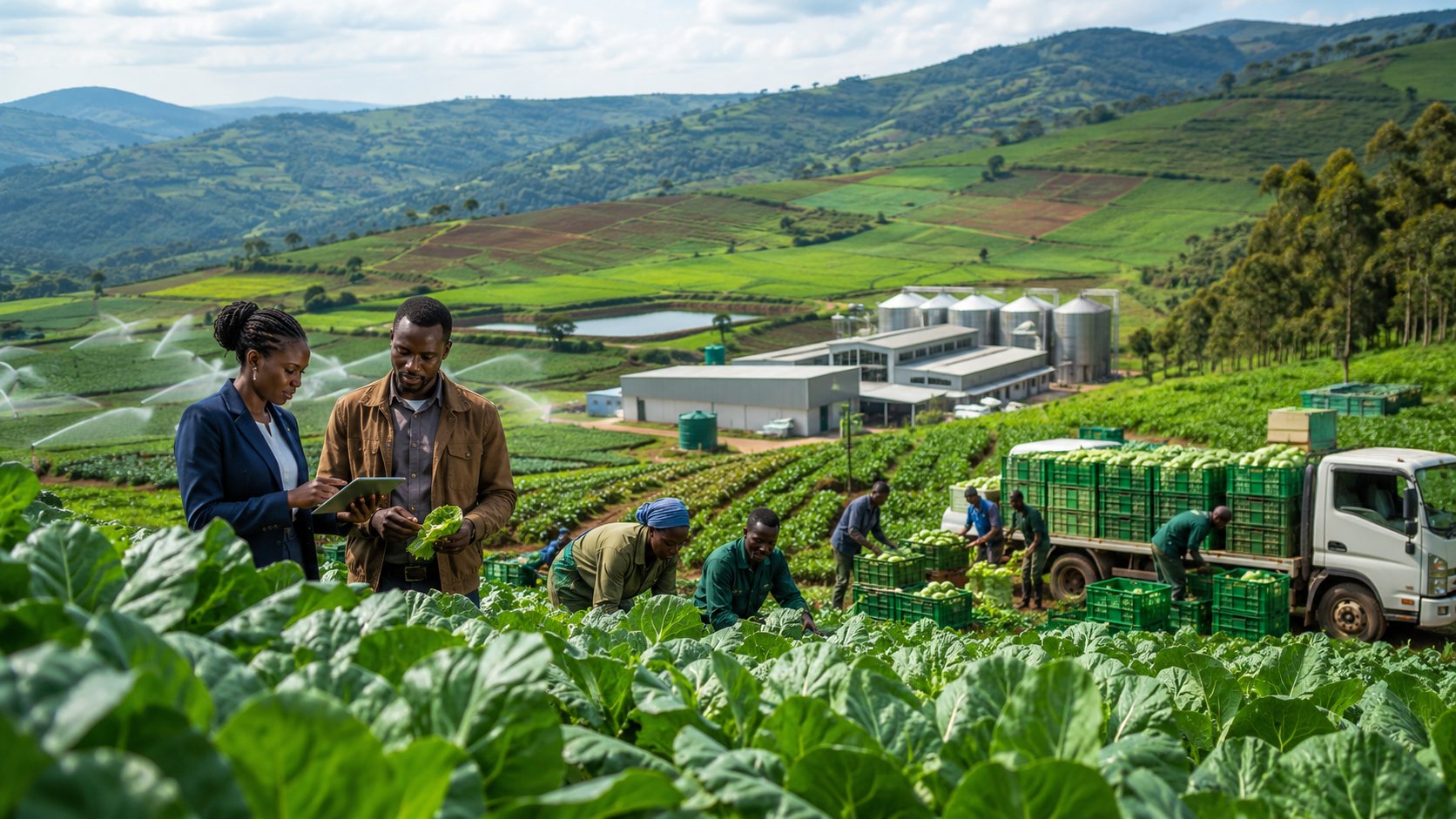
Horticulture is one of the most visible areas. The FAO identifies opportunities in avocado and chilli production, including production hubs, orchards, certified seeds, protected agriculture and irrigation. Its investment profile estimates $64 million for the chilli investment opportunity alone, with export potential extending to markets in the Middle East and Europe.
Cold-chain logistics could become another important business.
Fresh produce is highly sensitive to delays, inadequate storage and unreliable transport. Expanding cold storage and efficient distribution could allow producers to reach higher-value domestic and international markets.
Food processing offers another potential ownership battleground.
Rwanda produces agricultural commodities, but increasing the amount processed domestically could create businesses in milling, dairy products, packaged foods, beverages, meat processing and other consumer categories.
That could generate jobs and tax revenue while reducing the amount of value exported in raw form.
The private sector test
The AfDB programme is notable because private-sector participation is explicitly built into its design.
The proposed programme includes support for private-sector jobs, bundled enterprise assistance and access to finance, alongside production modernization and policy reforms.
That is significant because access to finance has historically been one of the constraints facing productive businesses in Rwanda.
An AfDB country report has previously identified high financing costs as a challenge, noting that commercial lending rates averaged around 18% and that banks were cautious about lending to sectors perceived as risky, including agriculture.
For investors, development finance can therefore play a catalytic role.
Public and development-bank money can help reduce risk, improve infrastructure and make projects more attractive to commercial lenders and private equity.
The ultimate test, however, will be whether businesses can survive without permanent public support.
A successful agricultural investment should eventually stand on its own through sales, exports and productivity gains.
Who owns the infrastructure?
The ownership question becomes even more important when considering infrastructure.
Irrigation systems, storage facilities, processing plants, warehouses, transport networks and digital platforms can become strategic assets in a food economy.
Who builds them matters.
Who finances them matters.
And who controls them after construction may matter even more.
Rwanda has sought to create an investment-friendly environment. The Rwanda Development Board lists incentives for agricultural investors, including duty-free importation of inputs, tax exemptions for agricultural equipment and incentives for export-oriented projects.
Such incentives can attract foreign capital and expertise.
But they also raise a policy question familiar across Africa: how can governments attract international investors while ensuring domestic companies, farmers and entrepreneurs build meaningful ownership positions?
The answer may lie in partnerships rather than choosing between foreign and local capital.
International investors can provide technology, financing, distribution networks and expertise. Local investors can provide market knowledge, relationships, labour and long-term commitment.
The strongest model could be one in which the two reinforce each other.
Rwanda’s wider investment momentum
The agricultural push is occurring as Rwanda attracts investment across the wider economy.
The Rwanda Development Board reported $2.62 billion in registered investments across 799 projects in 2025, compared with 612 projects in 2024. Foreign direct investment inflows reached $872.9 million in 2024, up 21.8% from the previous year, according to the board’s 2025 annual report.
That suggests agriculture will compete for capital with sectors such as manufacturing, real estate, mining, tourism and infrastructure.
For agriculture to attract sophisticated investors, projects will need predictable regulation, credible returns and infrastructure capable of moving products efficiently.
The investment opportunity is therefore not simply about putting money into farming.
It is about building an ecosystem around farming.
The smallholder question
For Rwanda’s farmers, the most important measure may be income.
A new processing plant is economically meaningful only if farmers have reliable markets for their produce. A new export opportunity matters if farmers can meet quality standards and obtain a fair return. Digital agriculture matters if smallholders can actually access the technology and financing.
This is why the proposed focus on bundled enterprise support and access to finance is important.
Rwanda’s agricultural transformation cannot depend exclusively on large commercial farms.
Smallholders will remain a central part of the food system, and connecting them to formal value chains could allow them to participate in the growth of agricultural businesses rather than simply supply raw materials.
That could also create opportunities for cooperatives to evolve from basic producer organisations into shareholders, processors, exporters and service providers.
The next African food economy
Rwanda’s agricultural strategy also reflects a wider African trend.
Across the continent, governments are increasingly looking at agriculture as an industrial sector rather than simply a rural livelihood activity.
The logic is straightforward. Africa has a large and growing population, rising urban demand and substantial agricultural potential. Yet much of the value generated by food systems remains outside primary production.
The opportunity is to capture more of that value locally.
For Rwanda, a relatively small domestic market means export markets will be particularly important. That makes quality standards, logistics, branding and market access critical components of the investment equation.
It also means Rwanda could position itself as a specialised producer and processor rather than trying to compete across every agricultural category.
The ownership race
The most interesting part of Rwanda’s agricultural investment story may therefore not be the $400 million headline.
It is what happens after the money arrives.
Will foreign investors own the processing companies?
Will Rwandan entrepreneurs build the logistics and technology businesses?
Will cooperatives become meaningful shareholders?
Will banks develop agricultural lending products that allow local businesses to scale?
Will pension funds and institutional investors participate?
And will farmers themselves capture a larger share of the value generated by the transformation?
These questions will determine whether Rwanda simply increases agricultural output or builds a genuinely deeper food economy.
The country’s broader economic strategy increasingly emphasises private-sector development. An IMF programme document says Rwanda intends to strengthen the private sector’s role in the economy while reviewing the viability and strategic relevance of state-owned enterprises, including through possible restructuring, privatisation or liquidation where appropriate.
That direction could have important implications for agriculture.
A market bigger than farming
The emerging opportunity is therefore not just to own farms.
It is to own the businesses around farms.
A farmer may grow the chilli. Another company may provide the greenhouse. A bank finances the equipment. A logistics operator moves the harvest. A processor packages it. An exporter sells it abroad. A retailer places it on a shelf.
Every step represents a business.
Every step can create jobs.
And every step can determine where the economic value ultimately sits.
Rwanda’s proposed agricultural financing therefore arrives at a strategic moment. The country has the policy ambition, investment incentives and growing pipeline of projects. The next challenge is to turn capital into commercially sustainable enterprises while ensuring that domestic businesses and farmers are not left at the bottom of the value chain.
The question facing Rwanda is no longer simply how to produce more food.
It is who will own Africa’s next food businesses, and how much of that ownership will remain in African hands?
For investors watching Rwanda, that may be the opportunity worth following most closely.

More from Investments

Seychelles turns to Saudi Arabia for new investment and tourism opportunities
Seychelles Vice-President Sebastien Pillay met Saudi Arabia's foreign minister in Riyadh to discuss stronger investment, tourism and bilateral economic ties.
Who will own South Africa’s railways? The private capital moving into transnet
Private operators, mining companies and global investors are entering Transnet, challenging traditional state control over South Africa’s strategic railway infrastructure.