

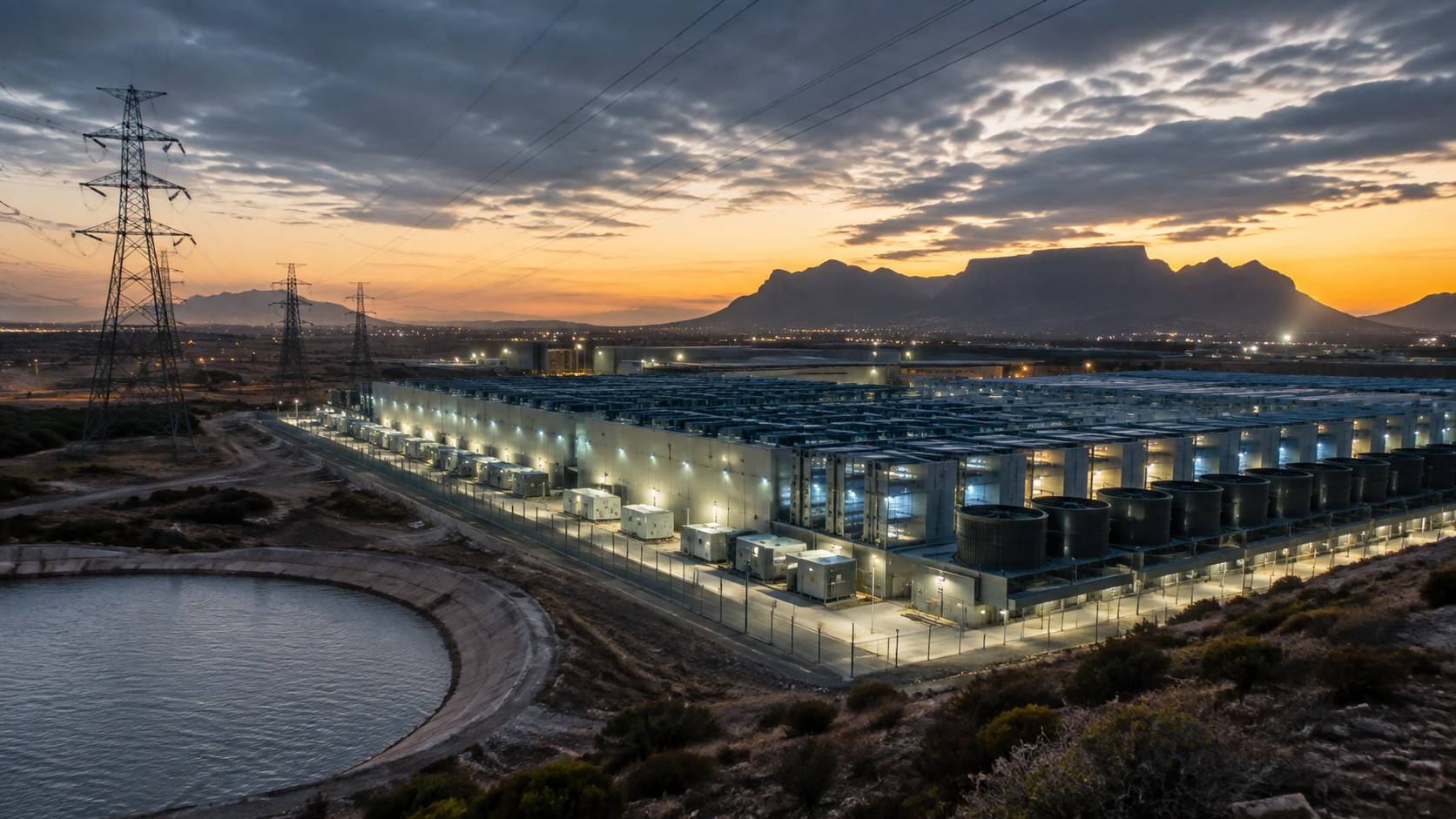
South Africa’s data-centre boom is turning the country into the backbone of Africa’s digital economy, but it is also sharpening questions over who controls the infrastructure, who pays for the resources it consumes and who captures the value created by the continent’s AI and cloud expansion.
Cape Town and Johannesburg are emerging as strategic nodes for cloud computing, payments, content delivery and artificial intelligence, drawing investment from some of the world’s largest technology and data-centre companies. The country’s advantages include established telecommunications networks, financial markets, submarine cable connections and a relatively mature technology ecosystem. But rapid construction is colliding with questions about water security, electricity supply, land use and public accountability.
A continental digital hub
South Africa hosts about 70% of Africa’s data-centre capacity, according to reporting this week, making it the continent’s leading market. That concentration reflects years of investment in Johannesburg and Cape Town and the country’s role as a gateway between African networks and global cloud platforms.
The market is being shaped by global hyperscalers, specialist operators, telecommunications groups and financial investors. Microsoft operates Azure regions in Johannesburg and Cape Town, while Amazon Web Services has expanded services from its Cape Town region. Visa opened its first African data centre in Johannesburg in 2025 as part of a broader investment programme in South Africa.
The ownership question becomes more complicated when physical buildings and digital services are separated. One company may own the facility, another provides the cloud platform, and a third supplies connectivity, electricity or cooling. Customers rent computing capacity rather than owning the underlying infrastructure. Control can therefore sit several layers above the land on which servers are installed.
Who owns the infrastructure?
One clear example is Teraco, South Africa’s largest data-centre platform. Digital Realty, a U.S.-listed global data-centre company, acquired about 55% of Teraco in a transaction that valued the business at about $3.5 billion. Existing investors and management retained the balance.
That deal illustrates the changing financial geography of African technology. Facilities are physically located in South Africa and employ local workers, while substantial capital and ownership can be international.
But ownership matters because data centres are not simply technology assets. They depend on electricity connections, roads, water systems, land and fibre networks, plus backup generation in many cases. Governments must therefore consider not only how much investment is coming in, but what economic and public value remains in the host country.
Water becomes a flashpoint
The sharpest controversy is emerging in Cape Town, a city still marked by the 2017-2018 drought that brought it close to a so-called Day Zero water crisis.
Municipal authorities have approved Equinix’s proposal for two data centres in the King Air Industria area, despite objections from community groups and UK-based advocacy organisation Foxglove. Reuters reported that the planned facilities could require about 170 megawatts of power. Earlier objections focused on limited public information about water use, electricity demand, emissions, backup generators, noise and other environmental effects.
For activists, the concern is less about technology than the principle of allocating scarce resources to projects whose benefits may be distributed globally while environmental costs are experienced locally. Cape Town’s water history makes that argument particularly powerful.
The industry says the picture is more nuanced. Modern facilities can use advanced cooling systems, renewable power and designs intended to reduce water consumption. Equinix already operates a Johannesburg site powered entirely by renewable energy, according to Reuters reporting. Industry representatives also argue that data centres should not be blamed for wider problems in municipal infrastructure or electricity pricing.
Power is the bigger question
Electricity may ultimately prove more important than water. A large AI-oriented data centre can consume power on an industrial scale, and demand is rising as companies deploy more powerful computing systems.
South Africa’s electricity system is in a better position than it was during the worst years of load-shedding. Eskom, the state-owned utility, recently reported that rolling blackouts occurred on only four days in its financial year to March 2026, compared with 329 days in 2024. Yet Eskom also faces high municipal debt and ageing infrastructure.
That creates a difficult policy question. If data centres secure large amounts of power through dedicated connections or private generation, they may improve the resilience of their own operations without strengthening the wider grid. If new grid infrastructure is built to serve them, governments and utilities need to determine who pays and how the investment benefits other users.
The benefits are real
It would be wrong to portray data centres only as resource consumers. They are critical infrastructure for African digital services.
Local computing capacity can reduce latency, improve reliability and help companies comply with data-residency requirements. It supports banking, fintech, e-commerce, streaming, government services and increasingly AI applications. Microsoft’s Azure regions in Johannesburg and Cape Town were established to provide cloud services from Africa and have expanded enterprise cloud capabilities available locally.
Data centres can also anchor broader ecosystems. Fibre networks, cloud engineering, cybersecurity, construction, facilities management and renewable energy projects can all benefit from investment. Large operators can therefore create skills, supplier and infrastructure opportunities beyond the server halls themselves.
A question of digital sovereignty
Africa’s digital infrastructure is increasingly part of a wider debate about sovereignty. Governments want local data storage, resilient networks and domestic AI capabilities, but many companies providing the underlying infrastructure are headquartered outside the continent.
That does not mean Africa is losing control of its digital future. It does mean ownership, regulation and bargaining power deserve greater attention.
The ownership of a data centre can determine who receives rental income and capital gains. Ownership of the cloud platform determines who captures recurring digital revenue. Control of data and AI models can determine who gains strategic knowledge. Control of the electricity, fibre and land required to operate the infrastructure can shape who has leverage when technology companies negotiate with governments.
Africa’s next phase of digital growth therefore requires African pension funds, banks, infrastructure investors, technology companies and governments to participate more deeply in ownership and value creation.
That imbalance is becoming harder to ignore as AI changes the economics of computing. The most valuable part of the chain is not the building itself, but the combination of chips, cloud platforms, data, software and customers that runs through it. Governments therefore have an opportunity to negotiate for skills, local suppliers, renewable energy investment and stronger domestic ownership while the market is expanding.
Regulation before resentment
South Africa’s emerging data-centre dispute offers an early warning for the rest of Africa. Governments do not need to choose between technology investment and environmental protection. They can demand both.
That means transparent disclosure of projected electricity and water use, meaningful environmental assessments, clear land-use rules and public reporting on tax, jobs and local procurement. It also means planning data centres around available power and water rather than expecting public systems to absorb unlimited new demand.
The lesson from Cape Town is not that Africa should slow its digital ambitions. It is that the continent should decide what kind of digital economy it wants before infrastructure decisions become irreversible.
The central question is no longer whether Africa needs data centres. It clearly does. The more consequential question is who owns them, who governs them and who benefits from the computing capacity they create.
If Africa’s AI economy is to become a foundation for broad-based development rather than another channel through which value flows outward, ownership and accountability will matter as much as servers, fibre and electricity.

More from Tech

India’s UPI is coming to Zimbabwe: Is Africa finally breaking free from expensive payments?
Zimbabwe's UPI talks reveal how digital payments could reshape financial sovereignty, regional commerce and Africa's relationship with global technology powers.

Africa’s digital revolution: 7 government tech projects reshaping the continent
Governments across Africa are accelerating digital transformation through AI, digital identity, cybersecurity, fintech, and e-government reforms that are reshaping economies.

Samsung widens lead in a declining MEA smartphone market
Samsung strengthens its market leadership across the Middle East and Africa as falling demand, supply shortages, and rising premium smartphone sales reshape competition.