

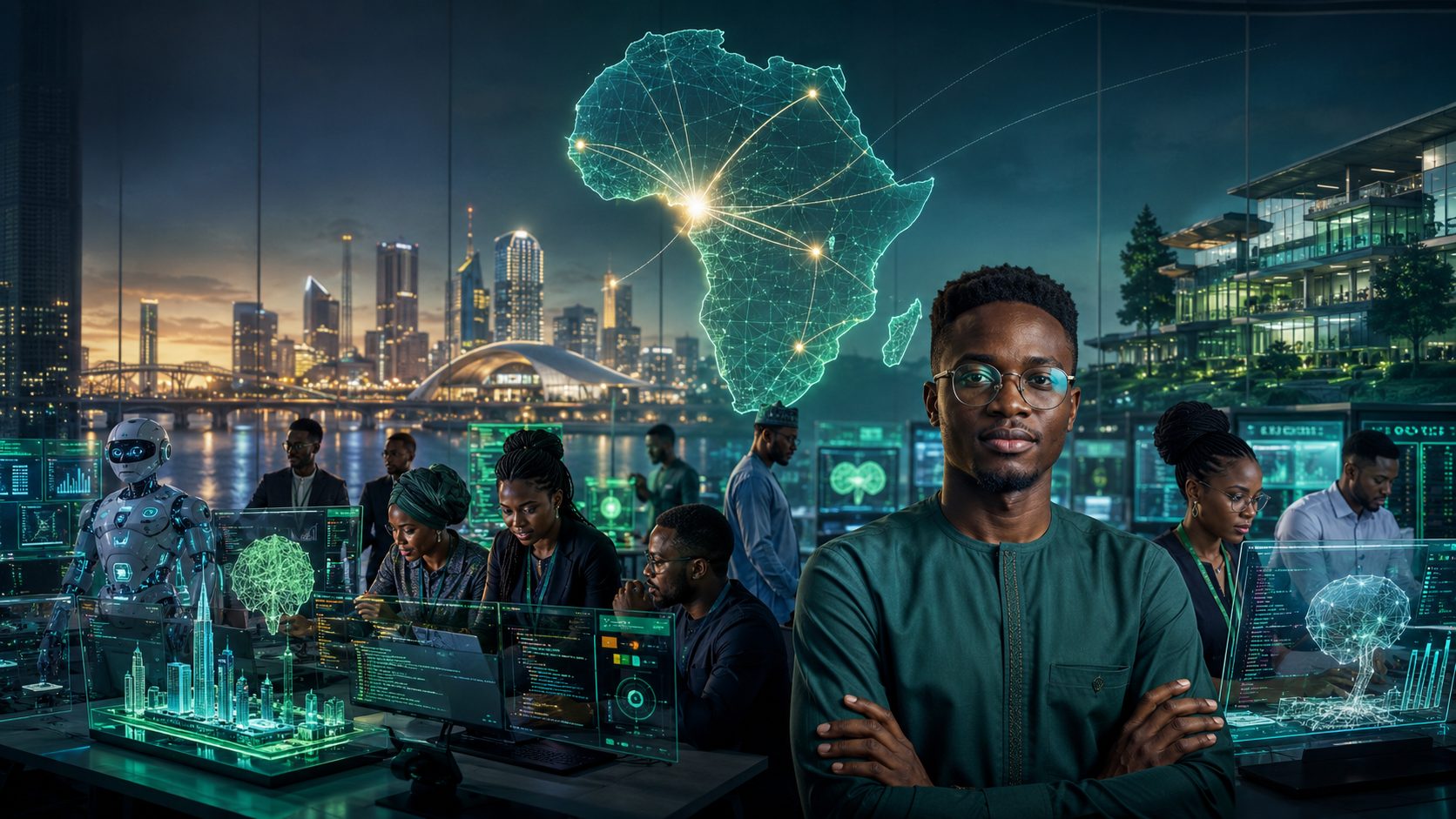
Nigeria’s artificial intelligence ambitions are moving from policy papers into physical infrastructure, training programmes and startup funding, as the country seeks to become a major source of AI talent for Africa and the global economy.
A new AI hub in Enugu
The latest move is unfolding in Enugu, where the Nigerian Communications Commission has agreed to lease its Digital Industrial Park and Learning Centre to the state government for 15 years.
The facilities are expected to be developed into Enugu Talent City and an Artificial Intelligence Institute, giving the southeastern state a dedicated platform for training, research, entrepreneurship and technology development. The agreement was announced in early August as part of Enugu’s wider push to build a digital economy.
The significance goes beyond the buildings themselves.
Nigeria has long produced technology workers for companies at home and abroad. Its fintech sector has created some of Africa’s best-known technology companies, while Nigerian engineers, developers and researchers are increasingly working in artificial intelligence, cloud computing and data science.
The challenge now is to turn that talent into an organised industrial advantage.
That is why the AI push matters.
From talent to an industry
Nigeria’s technology story has traditionally been driven by entrepreneurship rather than large-scale industrial planning. Lagos became a fintech centre because startups found ways to solve everyday problems in payments, banking, logistics and commerce.
Artificial intelligence could broaden that model.
AI can be applied to agriculture, healthcare, financial services, education, manufacturing, energy and government. For Nigeria, a country of more than 200 million people and one of Africa’s largest consumer markets, the opportunity is to develop systems that understand local languages, businesses and social conditions rather than simply importing technology developed elsewhere.
The country’s National Centre for Artificial Intelligence and Robotics, or NCAIR, has identified research, innovation, entrepreneurship and collaboration as core priorities. Its infrastructure already includes cloud computing capacity, while the centre is developing N-ATLAS, a multilingual and multimodal large language model designed around Yoruba, Hausa, Igbo and Nigerian-accented English.
That local focus could become one of Nigeria’s strongest competitive advantages.
Building the talent pipeline
The Enugu project is not happening in isolation.
Nigeria’s 3 Million Technical Talent programme, known as 3MTT, is designed to create a large pipeline of digitally skilled workers. Its initial training areas include AI and machine learning, data science, cloud computing, software development and cybersecurity.
The programme began with 30,000 fellows in its first phase and has expanded its ambitions through additional cohorts and partnerships.
Its importance for AI is straightforward: advanced computing infrastructure is useful only if there are enough people capable of building, deploying and maintaining AI systems.
The government is increasingly trying to connect those two sides of the equation.
The 3MTT partnership network says more than 160,000 fellows have been trained across three cohorts, while partnerships have expanded to thousands of delivery organisations. It also says Google has supported AI and data-science upskilling for 20,000 Nigerian young people.
This creates a potentially powerful ecosystem.
A student can enter through a training programme, move into an applied learning community, develop an AI product, join a startup and eventually sell that product to customers in Nigeria or overseas.
The economic value is not simply the number of people trained. It is whether those people can move into productive, well-paid work.
Universities join the race
Nigeria is also pushing AI deeper into higher education.
In April, the government, the United Nations Development Programme and the Tertiary Education Trust Fund launched an AI University Innovation Pod at the University of Lagos as part of a nationwide UniPod rollout. The programme is intended to create spaces where students and researchers can develop technology and innovation projects.
TETFund has also been working on technology-focused centres of excellence covering robotics, coding, artificial intelligence, machine learning and cybersecurity.
That matters because Africa’s AI challenge is not only about producing programmers.
The continent needs researchers, product managers, engineers, entrepreneurs, data scientists, AI policy specialists and people who understand how to apply technology to industries such as agriculture and healthcare.
Universities can provide the research base that private training programmes often lack.
The infrastructure problem
There is, however, a major constraint.
AI requires computing power, reliable electricity, fast connectivity and data centres capable of handling increasingly intensive workloads.
Nigeria is beginning to attract investment into that infrastructure.
Kasi Cloud has commissioned the first phase of a planned 100-megawatt AI-ready hyperscale data centre campus in Lagos. The wider project has been estimated at about $250 million and is designed to support AI workloads, cloud computing and enterprise storage.
The development is important because conventional data centres were not necessarily designed for the power density required by modern AI computing.
Nigeria’s broader data-centre market is also expanding, with industry estimates pointing to significant growth in capacity over the coming years.
But infrastructure alone will not make Nigeria an AI powerhouse.
The International Monetary Fund has warned that artificial intelligence could raise sub-Saharan Africa’s economic output by as much as 4% over the next decade if countries improve electricity, internet connectivity and digital skills. Without those improvements, the gains could be dramatically smaller.
Nigeria therefore faces the same contradiction as many African economies: it has a large pool of young people and strong demand for digital services, but unreliable power and uneven connectivity can limit how quickly that potential becomes productive capacity.
A chance for Nigerian startups
The emerging ecosystem is already producing companies applying AI to distinctly African problems.
NCAIR’s AI Fund, developed with Google, is supporting 10 Nigerian startups with grants of up to 10 million naira each, as well as technical support and access to Google’s AI resources. The selected companies are working across areas including healthcare, agriculture, financial services, energy and language technology.
This is an important shift.
For years, the African technology investment story was dominated by fintech. AI could create a wider range of technology companies because its applications cut across almost every sector.
A Nigerian startup does not necessarily have to compete with Silicon Valley by building the world’s largest general-purpose AI model.
It can build an agricultural model that works better for Nigerian farmers, a healthcare tool that understands local clinical environments, a language model trained on African languages, or software that helps small businesses analyse their finances.
Those businesses can then expand across borders.
Nigeria’s African advantage
Nigeria’s biggest advantage may be scale.
The country has a huge domestic market, a deep pool of technology workers, an established startup culture and a diaspora that has built careers in some of the world’s leading technology companies.
That combination gives Nigeria something many smaller markets struggle to develop: a large testing ground for technology and a potential pipeline of talent.
The country’s technology ecosystem also benefits from experience.
Fintech companies have already demonstrated that Nigerian startups can build products for complex markets and attract international capital. The next question is whether the same entrepreneurial energy can be redirected towards AI.
There are signs that it can.
Nigeria’s government has increasingly framed digital skills, infrastructure and artificial intelligence as components of economic diversification rather than standalone technology projects. NITDA’s mandate includes digital literacy, talent development and technology research, while NCAIR is positioning itself as a regional hub for AI and other Fourth Industrial Revolution technologies.
The brain-drain test
Nigeria must still confront one of its oldest problems: retaining skilled people.
Training more engineers can inadvertently increase the supply of talent available to overseas employers unless domestic companies can offer competitive opportunities.
Remote work has made that problem more complicated. A Nigerian engineer can live in Lagos, Enugu or Abuja while working for a company in London, New York or San Francisco.
For Nigeria, therefore, becoming an AI talent powerhouse is not simply about training millions of people.
It is about creating reasons for them to stay, return or build businesses at home.
That requires access to capital, reliable infrastructure, research opportunities, intellectual property protection and customers willing to buy locally developed technology.
It also requires a regulatory environment that encourages experimentation without compromising privacy, security or public trust.
Africa’s next AI battleground
Nigeria’s AI ambitions are unfolding as countries across Africa compete for a position in the emerging technology economy.
South Africa has a stronger established data-centre market. Kenya has developed a reputation for digital innovation and is attracting major investment in computing infrastructure. Rwanda has positioned itself around technology-enabled government and innovation.
Nigeria brings something different: scale, entrepreneurial depth and a vast labour market.
If its current initiatives connect effectively, Enugu’s planned AI institute could become more than a regional training centre. It could become one node in a national network linking universities, startups, investors, government agencies and international technology companies.
That is ultimately the bigger story.
The race to build Africa’s AI economy will not be won simply by the country with the biggest data centre or the most ambitious government strategy.
It will be won by the country that can connect people, computing power, research, capital and markets into an ecosystem capable of producing useful technology at scale.
Nigeria is trying to build exactly that.
The 15-year Enugu lease is one piece of the puzzle. The 3MTT talent pipeline, university AI centres, startup funding and expanding data-centre capacity are others.
The difficult part now is execution.
If Nigeria can turn training into jobs, research into companies and infrastructure into productive investment, it could move from being one of Africa’s largest sources of technology workers to one of the continent’s most important producers of artificial intelligence.
For Africa, that would make Nigeria’s AI experiment worth watching closely.
Why it matters
Nigeria’s AI strategy could influence the wider African technology market by creating a large pool of skilled workers, locally relevant AI products and companies capable of expanding across the continent. Its success would also demonstrate whether African economies can move beyond consuming imported AI systems to building technologies tailored to their own languages, markets and development needs.

More from Tech

Africa’s AI boom has a hidden cost: South Africa faces water and power questions
South Africa’s data-centre boom promises digital growth while raising urgent questions over water, electricity, ownership and public accountability in Africa.

Africa’s digital revolution: 7 government tech projects reshaping the continent
Governments across Africa are accelerating digital transformation through AI, digital identity, cybersecurity, fintech, and e-government reforms that are reshaping economies.

Samsung widens lead in a declining MEA smartphone market
Samsung strengthens its market leadership across the Middle East and Africa as falling demand, supply shortages, and rising premium smartphone sales reshape competition.