

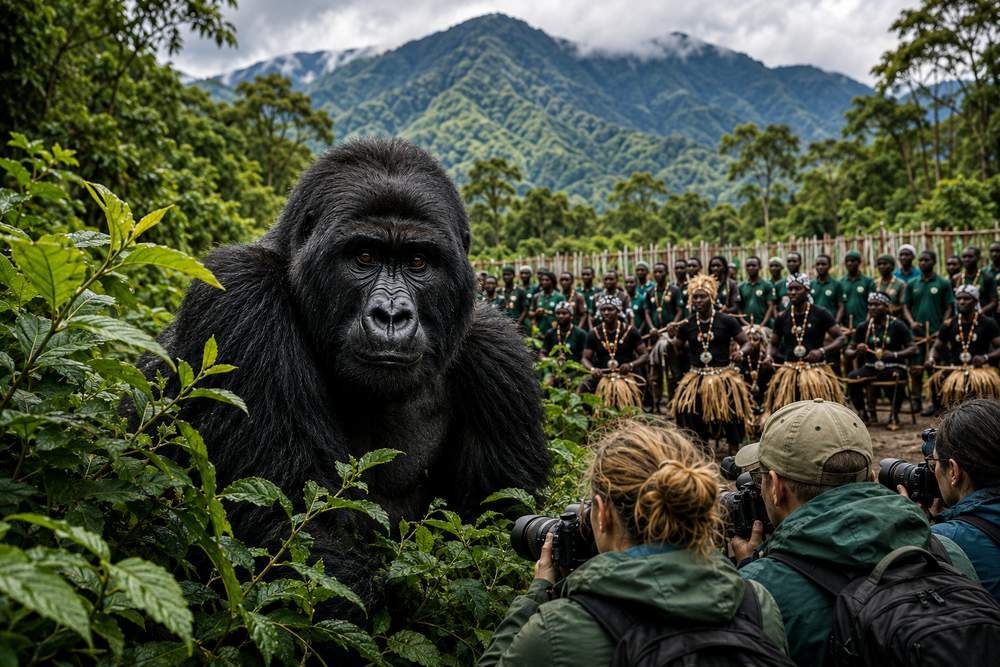
Rwanda’s mountain gorillas have become far more than a conservation success story. They are now at the centre of a high-value tourism economy that generates money for the state, private businesses, conservation organisations and communities, raising a bigger African question: who actually captures the economic value created by wildlife?
The question comes into sharper focus today as Rwanda hosts the 21st Kwita Izina gorilla-naming ceremony in Kinigi, Musanze District. The annual event has grown from a conservation ceremony into a global platform attracting international celebrities, football figures, musicians, business leaders, philanthropists and conservation specialists. Twenty-two baby mountain gorillas are being named this year, with the event presenting Rwanda’s conservation model to an international audience.
But behind the photographs and celebrity appearances sits a much larger business story. Rwanda generated a record $685 million in tourism revenue in 2025, up from $647 million in 2024, while national parks recorded 155,394 visits and generated $40.8 million in park revenue. Volcanoes National Park, the home of Rwanda’s mountain gorillas, accounted for $35.8 million of that park revenue.
The gorilla is the asset
The gorillas themselves are not privately owned commodities. The economic value comes from the controlled access to their habitat, the experience of seeing them and the wider tourism ecosystem that has developed around that experience.
Rwanda has deliberately positioned gorilla trekking as a premium tourism product. A gorilla permit costs $1,500 per person per day, while the number of visitors is tightly controlled. Rwanda says only 96 permits are available each day, with tourist encounters limited to one hour per gorilla group. The restrictions are designed to reduce pressure on the animals while maintaining the exclusivity that supports premium pricing.
That model has created a valuable economic chain. A visitor paying for a gorilla experience may also spend money on flights, hotels, restaurants, transport, guides, porters, clothing, crafts, coffee, cultural activities and other services. The gorilla therefore becomes the entry point to an economy much larger than the permit itself.
This distinction is important when asking who owns the gorilla economy. The answer is not one company or one institution. Value is distributed across a network, although the ability to control the most valuable parts of that network is concentrated.
Government holds the strategic hand
The Rwandan government has the strongest institutional position in the system because it controls national tourism policy, protected-area management and the framework under which gorilla tourism operates.
The Rwanda Development Board has been central to developing and marketing the tourism model, including the pricing and management of gorilla permits. Rwanda’s official tourism platform also promotes gorilla trekking as a premium attraction and directs visitors toward licensed private operators.
The government’s role goes beyond collecting tourism income. It also uses conservation policy as an economic-development strategy. Rwanda says 10% of national park tourism revenue is reinvested in communities surrounding protected areas. More than RWF23 billion, approximately $16 million, has been invested in nearly 1,300 community projects, including schools, health centres, water infrastructure and livelihood programmes.
That creates an important feedback loop. The state protects the resource, controls access to it, collects revenue and then directs part of that revenue into conservation and community development.
It is a model that other African governments have increasingly watched closely because it attempts to turn wildlife protection from a fiscal burden into an economic asset.
Where private business makes money
The second major group in the gorilla economy is private enterprise.
Hotels, tour operators, restaurants, transport companies, retailers and other businesses capture money from visitors before and after they enter the national park. Some operate directly around the tourism experience, while others benefit indirectly from the increased flow of visitors.
The impact is particularly visible in Musanze this week. Local businesses told The New Times that hotels are fully booked, taxis are making more trips and traders are experiencing increased demand as visitors arrive for Kwita Izina. One 80-room hotel reported occupancy rising from a normal average of about 50% to full capacity during the event, while another business said its hotel had been fully booked for three days.
The effect spreads beyond accommodation. Restaurants, bakeries and coffee shops are seeing more customers, taxi drivers are carrying additional passengers, retailers are stocking products for visitors and personal-service businesses are reporting higher demand.
This is where the ownership question becomes more complicated.
A government can collect permit revenue, but it does not necessarily capture every dollar a visitor spends. A private hotel captures accommodation revenue. A driver captures transport income. A restaurant captures food spending. A tour company captures part of the cost of organising the experience.
The gorilla creates the demand, but thousands of businesses compete to capture the spending generated around it.
Communities get a share, but not the whole economy
Rwanda has built community benefit into the official conservation model through its Tourism Revenue Sharing Programme.
The government says 10% of national park tourism revenues are reinvested in communities surrounding protected areas. In the areas around Volcanoes National Park, Northern Province officials say 738 projects worth about RWF8 billion have been implemented since 2005.
The projects have included education, healthcare, water infrastructure, agriculture and livelihoods. The objective is not simply redistribution. It is also to give people living next to protected areas an economic reason to support conservation.
Rwanda’s tourism authorities also say gorilla tourism creates employment for local rangers, trackers, porters, drivers and lodge workers.
But 10% should not be interpreted as meaning communities receive 10% of the entire gorilla economy.
The figure refers to the government’s tourism revenue-sharing mechanism. It does not represent all income earned by hotels, private tour operators, restaurants, transport providers, retailers or other businesses.
That distinction matters. A successful conservation economy is not measured only by how much money reaches a community fund. It is also measured by how many local people participate in the wider value chain.
Conservation organisations bring another form of capital
International conservation organisations occupy a different position.
Groups such as the Dian Fossey Gorilla Fund, Gorilla Doctors, Wildlife Conservation Society and other conservation partners contribute research, veterinary expertise, monitoring, training, conservation science and financial resources. Rwanda’s tourism authorities identify several such organisations as active in the country’s gorilla conservation landscape.
Their contribution is difficult to measure in the same way as a hotel room or a tourism permit because much of the value they provide is ecological rather than commercial.
A veterinary programme that prevents disease, a research team monitoring gorilla behaviour or a ranger programme that protects habitat may not generate a direct sale, but it helps preserve the underlying asset on which the entire tourism economy depends.
This is why the gorilla economy should not be understood simply as tourism. It is also a conservation-finance system.
Rwanda has turned conservation into a brand
Perhaps Rwanda’s biggest achievement is not the $1,500 permit. It is the creation of a global brand around conservation.
Kwita Izina is central to that strategy. The event has named 438 mountain gorillas since it became an official annual ceremony in 2005. It now combines conservation, tourism, business, entertainment and international visibility.
This year’s programme includes a conservation exhibition, community celebrations, gorilla trekking for invited guests, film screenings and concerts alongside the main naming ceremony.
The branding effect has economic consequences. A visitor who comes for gorillas may extend the trip to other destinations. A business executive attending Kwita Izina may explore an investment opportunity. A global celebrity posting from Rwanda can expose the destination to millions of potential travellers.
In that sense, the gorilla has become a national economic ambassador.
Can Africa copy the model?
Other African countries can replicate parts of Rwanda’s model, but not necessarily the entire system.
Uganda has mountain gorillas and a significant trekking industry. The Democratic Republic of Congo also has extraordinary biodiversity and the Virunga landscape. Kenya, Tanzania, South Africa, Botswana and other countries have built different forms of wildlife tourism around their protected areas.
The transferable lesson is not simply to raise wildlife permit prices. It is to create a system in which conservation, tourism infrastructure, community participation and private investment reinforce one another.
Rwanda has advantages that cannot easily be reproduced elsewhere, including the limited size of the country, strong central coordination and the exceptional scarcity of mountain gorillas.
Its model also carries a warning. High-value tourism can produce impressive national revenue while leaving questions about who receives the greatest share of the value chain.
The long-term test will therefore be whether economic opportunity continues to spread beyond the park gates.
The real owners of the economy
So, who owns Rwanda’s gorilla economy?
The state controls the strategic asset and tourism framework. Private companies capture substantial value from accommodation, transport, food, tours and other visitor spending. Conservation organisations supply expertise and resources that help keep the ecosystem viable. Communities receive a formal share of park tourism revenue and benefit from jobs and local commerce.
But the most important owner is arguably the ecosystem itself.
Without healthy forests, functioning conservation systems and growing gorilla populations, there is no premium tourism product to sell.
Rwanda’s latest conservation figures offer a powerful backdrop. Close to 1,100 mountain gorillas now live across the Virunga Massif and Bwindi ecosystem, with the population continuing to grow after decades of conservation work.
That is the real economic lesson behind Kwita Izina.
The gorillas are not merely attracting tourists. They are demonstrating that biodiversity can be treated as productive economic infrastructure.
For Rwanda, the challenge now is to ensure that the wealth created by that infrastructure remains sustainable, reaches communities, supports conservation and creates opportunities for local businesses.
For the rest of Africa, the bigger question is whether the continent can build conservation economies in which wildlife is not simply protected for its beauty, but valued highly enough that protecting it becomes one of the most rational economic decisions a country can make.
