
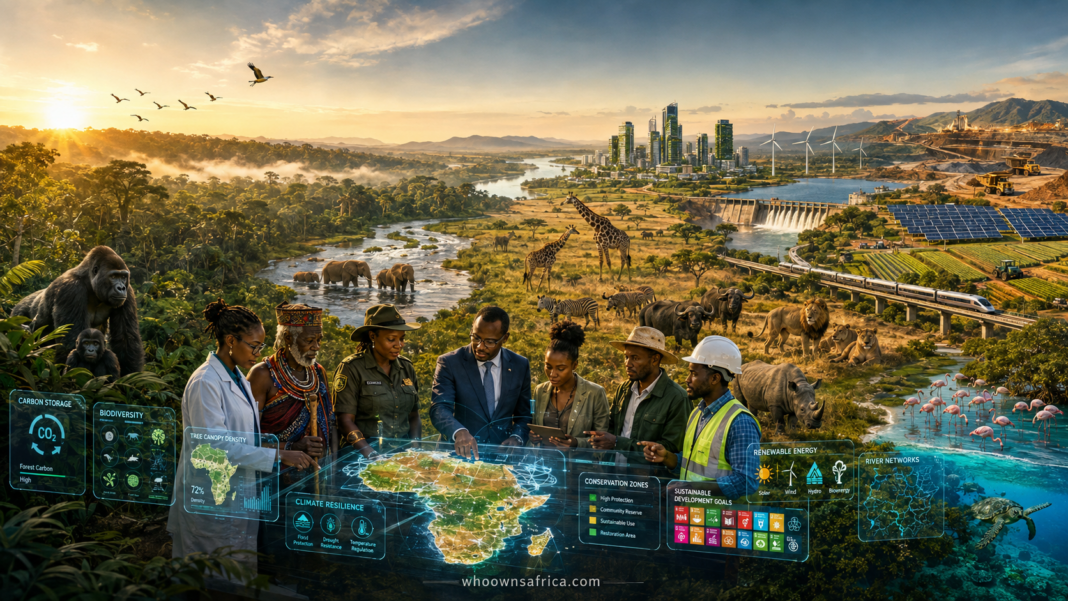

These ecosystems are far more than environmental treasures. They underpin agriculture, fisheries, tourism, energy production, water security and climate resilience, making them among Africa’s most valuable economic assets. Yet ownership and control of these resources are increasingly contested as governments seek economic growth, local communities defend ancestral lands, conservation groups expand protected areas and international investors pursue opportunities in carbon markets and biodiversity finance.
The question of who owns Africa’s ecosystems has become one of governance rather than simple land ownership. While national governments generally hold legal authority over forests, wildlife and protected areas, local communities often possess customary rights dating back generations. At the same time, multinational companies, conservation organizations and development finance institutions are playing an increasingly influential role in determining how ecosystems are managed and financed.
The outcome of this struggle will shape not only Africa’s environmental future but also its economic development, food security and response to climate change.
A Continent Built on Natural Capital
Africa possesses extraordinary ecological wealth.
The continent contains about one quarter of the world’s biodiversity hotspots and is home to globally significant forests, freshwater systems, grasslands, deserts and marine ecosystems. According to the Food and Agriculture Organization, Africa’s forests cover roughly 624 million hectares, representing about 21 percent of the continent’s land area. The Congo Basin alone is the world’s second largest tropical rainforest after the Amazon.
These natural systems provide services that often go unmeasured in national economic statistics.
Forests regulate rainfall, absorb carbon dioxide and supply timber, fuelwood and medicinal plants. Rivers generate hydropower, irrigate farms and sustain fisheries. Wetlands reduce flooding while mangroves protect coastlines from storms and rising sea levels.
The World Bank increasingly describes these benefits as natural capital, recognizing ecosystems as productive assets that generate economic value in much the same way as infrastructure or industrial investment.
In many African countries, this natural capital represents one of their greatest competitive advantages.
Tourism built around wildlife contributes billions of dollars annually to economies such as Kenya, Tanzania, Botswana, Namibia and South Africa. Fisheries support coastal communities from Senegal to Mozambique, while forests provide livelihoods for millions through timber, non timber forest products and subsistence agriculture.
Yet many of these benefits remain undervalued in national accounting systems, encouraging policies that prioritize short term extraction over long term sustainability.
Governments Hold Legal Authority
Across most of Africa, governments legally own or administer forests, national parks, wildlife reserves and protected areas.
Colonial era legislation often transferred ownership of vast natural landscapes from indigenous communities to the state. After independence, many governments retained these legal structures, arguing that national ownership was necessary to protect biodiversity and manage natural resources for the public good.
Today, ministries responsible for environment, forestry, wildlife and water oversee millions of hectares of protected land.
Countries including Botswana, Rwanda and Namibia have gained international recognition for strengthening conservation policies while balancing tourism and community participation.
However, legal ownership does not always translate into effective management.
Many environmental agencies face chronic funding shortages, limited technical capacity and growing pressure from illegal logging, poaching, mining and agricultural expansion.
Rapid population growth has intensified demand for land, placing governments under increasing pressure to authorize infrastructure projects, commercial farming and mineral extraction in environmentally sensitive areas.
Balancing economic development with conservation remains one of the continent’s greatest policy challenges.
Communities Have Long Managed Nature
Long before modern states established national parks, indigenous peoples and local communities managed forests, rivers and grazing lands through customary systems.
Across Africa, millions continue to depend directly on ecosystems for food, medicine, building materials and income.
Pastoralist communities move livestock across seasonal grazing routes that have existed for centuries. Forest communities harvest wild fruits, honey and medicinal plants while maintaining traditional conservation practices. Fishing communities rely on healthy lakes, rivers and coastal waters for survival.
Increasingly, researchers argue that community managed landscapes often perform as well as, or better than, centrally managed protected areas in conserving biodiversity.
Recognizing this, several African countries have introduced legal frameworks that give communities greater authority over natural resources.
Namibia’s communal conservancy model is widely regarded as one of Africa’s most successful examples. Communities receive legal rights to manage wildlife and tourism while sharing directly in revenues generated from conservation.
Kenya has also expanded community conservancies, particularly in northern counties, where local groups partner with conservation organizations and tourism operators to protect wildlife while creating employment opportunities.
These models have demonstrated that conservation can succeed when local people benefit economically rather than being excluded from protected areas.
Nevertheless, disputes over land rights remain widespread.
In some regions, communities argue they have been displaced from ancestral territories to make way for national parks, private conservancies or commercial investments without adequate consultation or compensation.
These tensions continue to shape debates over who truly owns Africa’s ecosystems.
Conservation Is Becoming Big Business
Conservation has evolved far beyond protecting wildlife.
Today it represents a rapidly expanding sector attracting billions of dollars from governments, philanthropies, multilateral institutions and private investors.
International organizations finance projects ranging from forest restoration and anti poaching operations to climate adaptation and biodiversity monitoring.
Nature based solutions are becoming central to climate policy as countries seek cost effective ways to reduce greenhouse gas emissions while protecting biodiversity.
According to recent assessments by the World Bank and conservation partners, investment in nature based solutions across Sub Saharan Africa has expanded significantly during the past decade, reflecting growing recognition that healthy ecosystems support both environmental sustainability and economic development.
Carbon markets have become another powerful driver.
Under voluntary carbon credit schemes, companies and governments purchase credits generated by projects that protect forests or restore degraded ecosystems.
Supporters argue these markets create financial incentives to conserve forests that might otherwise be cleared.
Critics, however, question whether carbon revenues reach local communities and whether projects adequately protect traditional land rights.
The debate reflects a broader question that increasingly defines Africa’s environmental future.
Who should benefit financially from ecosystems that provide global climate benefits while supporting local livelihoods?
That question is becoming more urgent as international demand for carbon credits, biodiversity offsets and ecosystem restoration continues to grow.
Mining, Agriculture and Infrastructure Are Reshaping the Landscape
Africa’s ecosystems are increasingly being reshaped by the continent’s push for economic growth.
Governments are investing heavily in roads, railways, dams, industrial parks and energy projects to support expanding populations and accelerate industrialization. At the same time, demand for minerals critical to the global energy transition, including cobalt, copper, lithium, graphite and rare earth elements, has intensified exploration across several African countries.
These investments promise jobs, export earnings and improved infrastructure. However, they also place growing pressure on forests, wetlands and wildlife habitats.
Mining operations can fragment ecosystems, pollute rivers and displace communities if environmental safeguards are weak. Large scale agricultural projects often require extensive land conversion, reducing forest cover and biodiversity. Hydropower dams, while providing renewable energy, can alter river systems, fisheries and downstream ecosystems that communities have relied on for generations.
The challenge for policymakers is not whether development should occur, but how it can proceed without permanently degrading the natural assets that sustain future economic growth.
Many governments now require environmental and social impact assessments before approving major projects. Enforcement, however, remains uneven across the continent, with limited institutional capacity often slowing effective monitoring.
The Congo Basin Stands at the Centre of the Debate
No ecosystem better illustrates the competing interests surrounding Africa’s natural wealth than the Congo Basin.
Stretching across six countries, the rainforest covers more than 500 million acres and stores vast quantities of carbon, making it one of the world’s most important natural carbon sinks. It also supports millions of people who depend on forests for food, fuel, medicine and income.
Scientists regard the Congo Basin as essential to global climate stability because of its ability to absorb carbon dioxide while regulating rainfall across Central Africa.
Yet the forest faces mounting pressures from commercial logging, mining, agricultural expansion and infrastructure development.
Governments argue that exploiting natural resources is necessary to reduce poverty and finance development. International conservation organizations counter that protecting intact forests generates long term environmental and economic benefits that far exceed short term extraction.
This difference in priorities has become increasingly visible during international climate negotiations.
Several Central African governments have argued that wealthier nations should provide greater financial support if they expect African countries to preserve forests that benefit the entire planet.
That position reflects a broader concern shared across much of Africa. While developed economies industrialized through extensive resource use, many African governments believe they are now being asked to limit development in order to meet global climate goals.
The debate has shifted from conservation alone to questions of fairness, financing and economic sovereignty.
Wildlife Has Become an Economic Asset
Africa’s wildlife is among its most globally recognized natural resources.
Elephants, lions, rhinos, gorillas and countless other species attract millions of tourists every year, supporting hotels, airlines, transport companies and local businesses.
Wildlife tourism contributes significantly to national economies in countries such as Kenya, Tanzania, Botswana, Namibia and South Africa. Beyond direct tourism revenue, healthy wildlife populations sustain employment in conservation, hospitality and related industries.
However, wildlife is increasingly viewed not only as a conservation priority but also as an economic asset requiring careful management.
Several countries have adopted community based conservation models that allow local residents to benefit directly from tourism revenues. These initiatives have helped reduce conflicts between communities and wildlife by creating financial incentives to protect animals rather than viewing them as threats to crops or livestock.
Despite these successes, illegal wildlife trafficking remains one of the greatest threats to biodiversity.
Poaching networks targeting elephants for ivory, pangolins for their scales and other endangered species continue to operate across parts of the continent despite stronger law enforcement and international cooperation.
Conservation experts argue that tackling wildlife crime requires addressing poverty, improving governance and reducing international demand for illegal wildlife products.
The Rise of Carbon Markets
One of the fastest growing influences on Africa’s ecosystems is the expansion of carbon markets.
Governments, private companies and conservation organizations are increasingly developing projects that generate carbon credits by protecting forests, restoring degraded land or planting trees.
These credits are purchased by companies seeking to offset part of their greenhouse gas emissions.
Supporters believe carbon markets can unlock billions of dollars for conservation while creating new income opportunities for rural communities.
Countries including Kenya, Gabon, Zambia and Zimbabwe have explored or expanded forest carbon initiatives in recent years.
However, carbon markets have also generated controversy.
Some community organizations argue they were not fully consulted before projects began. Others question how revenues are distributed and whether long term restrictions on land use limit future economic opportunities.
Environmental researchers have also called for stronger standards to ensure carbon credits represent genuine and measurable climate benefits.
As international demand for nature based climate solutions grows, African governments are working to strengthen regulations governing carbon trading while ensuring national interests remain protected.
The debate highlights a fundamental question.
If African forests help stabilize the global climate, who should receive the economic benefits from that service?
Indigenous Knowledge Is Gaining Recognition
For decades, conservation policies often separated people from nature.
Many national parks were established by restricting access to communities that had lived alongside wildlife for generations.
Today, that approach is gradually changing.
Researchers increasingly recognize that Indigenous peoples and local communities possess valuable ecological knowledge developed through centuries of observing seasonal changes, wildlife movements and sustainable resource management.
Traditional farming techniques, rotational grazing systems and community forest management practices have helped preserve biodiversity across many parts of Africa.
International organizations now encourage governments to involve communities in conservation planning rather than treating them as obstacles to environmental protection.
This shift reflects growing evidence that conservation efforts are more successful when local people share both decision making authority and economic benefits.
Nevertheless, land tenure remains one of Africa’s most complex policy challenges.
In many countries, customary land rights coexist with statutory legal systems, creating uncertainty over ownership and resource use.
Resolving these issues will be critical as demand for conservation finance, mining investment and agricultural expansion continues to grow.
Climate Change Is Redefining Conservation
Climate change is altering ecosystems across Africa at an unprecedented pace.
Rising temperatures, changing rainfall patterns, prolonged droughts and more frequent floods are affecting forests, wetlands, rivers and coastal ecosystems.
These environmental changes are reducing agricultural productivity, threatening freshwater supplies and increasing pressure on protected areas.
Conservation is therefore no longer solely about protecting wildlife.
It has become central to food security, disaster risk reduction and economic resilience.
Healthy forests help regulate rainfall. Mangroves reduce storm surges along coastlines. Wetlands absorb floodwaters. Grasslands support livestock during dry seasons.
Protecting ecosystems has become an investment in national resilience as much as environmental stewardship.
African governments increasingly recognize that restoring degraded landscapes can strengthen economies while helping countries adapt to climate change.
The challenge is securing sufficient long term financing to achieve restoration at the scale required.
Financing Nature’s Future
Protecting Africa’s ecosystems requires more than strong environmental laws. It demands sustained investment.
The United Nations estimates that global biodiversity financing falls hundreds of billions of dollars short of what is needed annually to halt biodiversity loss. African governments, many of which face competing priorities such as healthcare, education, infrastructure and debt repayment, often struggle to allocate sufficient resources for conservation.
As a result, international donors, development finance institutions and philanthropic organizations have become major contributors to conservation across the continent.
The World Bank, the African Development Bank, the Global Environment Facility and the Green Climate Fund finance projects ranging from forest restoration and watershed management to climate adaptation and wildlife protection.
Private investors are also entering the sector through sustainable forestry, ecotourism, renewable energy and carbon finance.
While this growing investment is welcomed by many governments, it also raises important questions about governance.
Who decides how conservation money is spent? Which ecosystems receive protection? Who measures success? And who benefits from the economic returns generated by natural assets?
These questions have become increasingly important as ecosystem services gain financial value.
Tourism Depends on Healthy Ecosystems
Tourism remains one of the clearest examples of how ecosystems generate economic value.
Millions of international visitors travel to Africa each year to experience wildlife, mountains, forests, deserts and coastlines. National parks such as the Serengeti, Maasai Mara, Kruger, Etosha and Bwindi Impenetrable Forest have become globally recognized destinations, supporting airlines, hotels, restaurants, transport operators and thousands of small businesses.
In many rural areas, tourism provides one of the few reliable sources of employment.
Community conservancies have demonstrated that local participation can strengthen both conservation and economic development. Revenue sharing arrangements have financed schools, health facilities, water projects and other community services while encouraging protection of wildlife habitats.
The COVID 19 pandemic exposed the vulnerability of relying heavily on tourism revenues. Travel restrictions caused visitor numbers to collapse, reducing income for conservation agencies and communities alike.
Many governments have since sought to diversify conservation financing by expanding domestic tourism, attracting private investment and developing carbon markets.
The lesson was clear. Ecosystems require multiple and reliable sources of funding if they are to remain protected over the long term.
Technology Is Transforming Conservation
Modern conservation increasingly relies on technology.
Satellite imagery now allows governments to monitor deforestation almost in real time. Artificial intelligence helps identify illegal logging and mining activities. Drones are used to survey wildlife populations, detect poaching and map degraded landscapes.
Digital mapping has also improved land use planning by helping governments balance agriculture, mining, conservation and urban development.
Researchers are using environmental DNA to monitor biodiversity without disturbing wildlife, while mobile applications enable communities to report illegal activities directly to conservation authorities.
Technology is making ecosystem management more transparent and data driven.
However, experts caution that technology cannot replace effective governance.
Strong institutions, clear laws and community participation remain essential for successful conservation.
Can Africa Capture More Value From Nature?
For decades, much of Africa’s natural wealth has been exported as raw materials.
Timber, minerals, fish and agricultural commodities have generated significant revenues, but critics argue that too much value is created outside the continent through processing and manufacturing.
A similar debate is now emerging around ecosystem services.
If Africa’s forests absorb carbon that benefits the global climate, should African countries receive greater financial compensation?
If biodiversity supports pharmaceutical research and scientific innovation, how should benefits be shared with countries and communities that protect these resources?
These questions are becoming central to international negotiations on biodiversity finance and climate policy.
Many African leaders argue that the continent should not be expected to conserve globally important ecosystems without receiving fair and predictable financial support.
Others emphasize that stronger governance, transparent institutions and secure land rights are equally important to ensure conservation revenues reach local communities rather than being lost through inefficiency or corruption.
The challenge is to create economic models that reward conservation while supporting inclusive development.
So Who Owns Africa’s Ecosystems?
The answer depends on how ownership is defined.
Legally, governments control most forests, national parks, wildlife reserves and major water resources.
Historically, Indigenous peoples and local communities have managed many of these landscapes for centuries through customary systems that continue to shape resource use today.
Economically, international investors, tourism operators, mining companies and carbon market participants increasingly influence how ecosystems are valued and managed.
Politically, decisions made by governments determine whether forests are protected, mining licences are issued or protected areas are expanded.
Environmentally, the ecosystems themselves provide services that extend far beyond national borders. African forests regulate rainfall, store carbon and support biodiversity that benefits the entire world.
Ownership therefore cannot be understood simply through legal titles.
It reflects a complex relationship between sovereignty, customary rights, economic interests and global environmental responsibility.
A Shared Responsibility
Africa’s ecosystems are entering a defining period.
Demand for food, energy, minerals and infrastructure will continue to grow as populations expand and economies develop. Climate change is expected to intensify pressure on forests, rivers, coastlines and wildlife, increasing the urgency of effective environmental management.
At the same time, international recognition of the economic value of nature is creating new opportunities.
Carbon finance, biodiversity credits, ecosystem restoration and sustainable tourism all have the potential to generate income while preserving natural assets.
Realizing these opportunities will depend on transparent governance, scientific research, strong institutions and meaningful participation by the communities that live closest to these ecosystems.
Ultimately, the question is not simply who owns Africa’s ecosystems.
It is who has the responsibility to protect them.
The forests of the Congo Basin, the savannahs of East Africa, the wetlands of the Okavango Delta and the mangrove forests along Africa’s coastlines sustain livelihoods, regulate the climate and support biodiversity that benefits humanity as a whole.
Their future will be determined by decisions made in government ministries, village councils, corporate boardrooms and international climate negotiations.
The greatest challenge is ensuring that conservation and development are no longer treated as competing priorities, but as complementary goals that strengthen one another.
Africa’s ecosystems are among the continent’s greatest strategic assets. They cannot be replaced once lost, nor can they continue to sustain future generations without careful stewardship.
In the end, no single government, company or organization truly owns Africa’s ecosystems. They are held in trust by today’s generation, carrying a responsibility to ensure that the continent’s extraordinary natural wealth continues to support both its people and the wider world for decades to come.

