
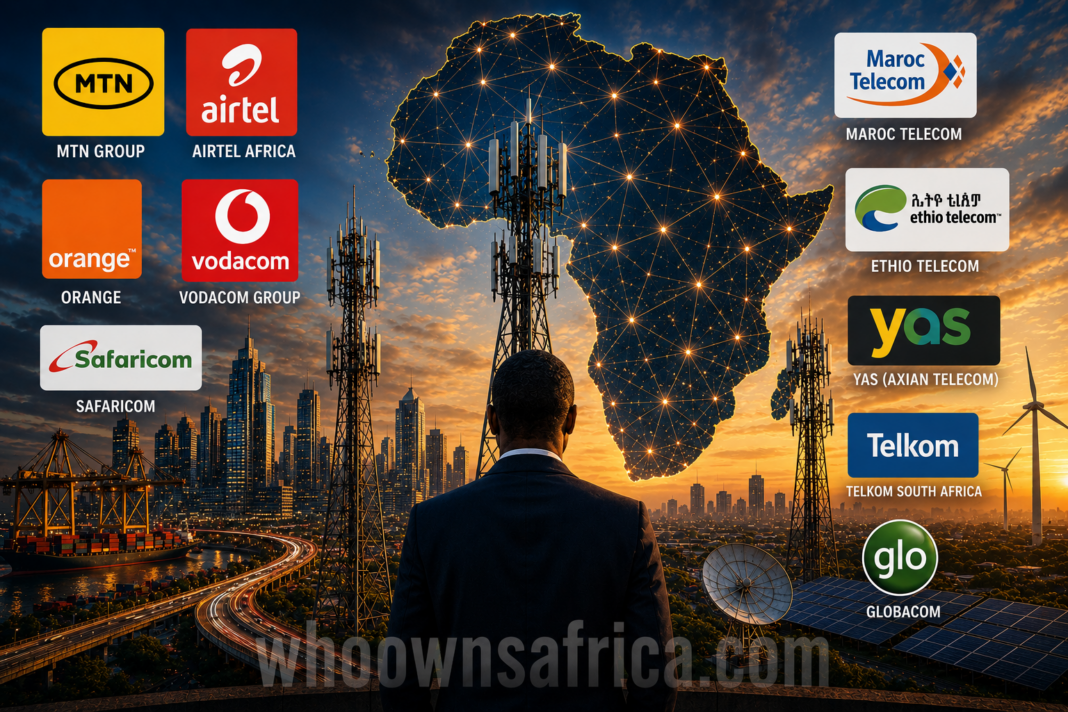

Africa’s biggest telecom companies connect more than a billion people, move vast sums through mobile-money platforms and control infrastructure that is becoming essential to the continent’s economy. But behind the familiar brands are ownership structures that stretch across Africa, Europe, Asia and the Middle East. So, who really owns Africa’s telecom giants?
For millions of Africans, telecom ownership appears simple. A customer buys an MTN, Airtel, Safaricom, Orange or Vodacom SIM card and sees a familiar brand. The company appears local because its shops, towers, employees and customers are local.
The ownership story is often very different.
Some of Africa’s largest telecom companies are controlled by foreign multinationals. Others have governments as major shareholders. Some are publicly traded and owned indirectly by pension funds and institutional investors. A smaller group is controlled by African billionaires and private investment groups.
This makes telecom ownership in Africa one of the continent’s most important and least understood business stories.
The stakes are also rising.
Mobile networks are no longer just about voice calls and text messages. Telecom companies now operate mobile-money platforms, fibre networks, data centres and digital-payment systems. They increasingly sit at the centre of Africa’s digital economy.
The company controlling a mobile network can therefore have influence over much more than telecommunications.
It can control a major financial platform, access to digital services and relationships with millions of consumers.
Africa’s biggest telecom companies
The scale of Africa’s telecom industry is enormous.
MTN Group remains the continent’s largest telecom operator by subscriber numbers. The South African-based group ended 2025 with more than 307 million customers across 16 markets.
Airtel Africa followed with 183.5 million customers at the end of March 2026. Orange had about 179 million customers across Africa and the Middle East.
Vodacom has also expanded its influence after increasing its effective stake in Safaricom, Kenya’s largest telecom operator and the company behind M-Pesa.
Other major players include Maroc Telecom, Ethio Telecom, AXIAN Telecom’s Yas, Telkom South Africa and Nigeria’s Globacom.
Yet subscriber numbers tell only part of the story.
To understand the real power of these companies, it is necessary to look behind the brands.
MTN Group: Who owns Africa’s largest telecom operator?
MTN Group is Africa’s largest telecom company by customer base.
Headquartered in South Africa, the company operates across 16 African markets.
Nigeria is one of its largest operations, while South Africa remains its corporate and financial centre.
MTN is listed on the Johannesburg Stock Exchange. That means it is not controlled by a single billionaire or directly owned by the South African government.
Instead, its shares are held by institutional investors, pension funds, strategic shareholders and members of the public.
One of the most important shareholders is the Public Investment Corporation, or PIC.
The PIC manages money on behalf of South African public-sector funds, including the Government Employees Pension Fund.
This gives South African public capital a significant financial interest in MTN.
However, that does not make MTN a traditional state-owned company.
The distinction matters.
A government-linked investment institution can own shares in a listed company without controlling its day-to-day management.
MTN is becoming more than a telecom company
MTN’s transformation also explains why its ownership matters.
The group has invested heavily in mobile money, data and digital services.
Its MoMo platform had around 70 million customers at the end of 2025.
MTN also reported more than $500 billion in MoMo transaction value during the year.
That makes the company a major player in African financial technology.
In other words, owning part of MTN increasingly means owning part of Africa’s digital-finance infrastructure.
Airtel Africa: The Indian telecom empire in Africa
Airtel Africa is Africa’s second-largest telecom operator by subscriber numbers.
The company had 183.5 million customers at the end of March 2026.
It operates in 14 African countries, including Nigeria, Kenya, Uganda, Tanzania, Zambia, Malawi and Rwanda.
It also has a large presence in Francophone Africa.
But Airtel Africa’s ownership is not primarily African.
The company is controlled by India’s Bharti Airtel, the telecom group associated with billionaire Sunil Bharti Mittal.
Airtel Africa is listed in London and Nigeria.
However, the existence of those listings does not mean that control is shared equally among African investors.
Bharti controls the company through a chain of holding companies.
This makes Airtel Africa one of the clearest examples of foreign ownership of African telecom companies.
Why Airtel Africa’s ownership matters
Airtel Africa demonstrates how the nationality of a brand can differ from the nationality of its controlling capital.
Its customers are African.
Its network infrastructure is largely African.
Most of its business activity takes place in Africa.
Yet ultimate corporate control sits with an Indian multinational group.
The structure is not unusual in the telecom industry.
Building large mobile networks requires enormous amounts of capital. International telecom groups have therefore played a major role in developing Africa’s digital infrastructure.
The question for African governments is how to attract that capital while retaining appropriate strategic oversight.
Orange: French ownership with a powerful African footprint
Orange is one of Europe’s largest telecom companies and one of Africa’s biggest foreign telecom investors.
The French company had nearly 180 million customers in Africa and the Middle East at the end of 2025.
Its African footprint includes markets such as Côte d’Ivoire, Senegal, Cameroon, Morocco, Egypt, Mali, Burkina Faso and Madagascar.
Orange has increasingly made Africa a central part of its growth strategy.
Its mobile-money business is also expanding rapidly.
Orange Money has become one of Africa’s major mobile financial platforms, serving tens of millions of customers.
Who owns Orange?
Orange is publicly listed, but the French state remains a major shareholder.
The French government holds a direct interest in Orange and has additional exposure through Bpifrance.
This makes Orange an interesting hybrid.
It is a publicly traded multinational company, but the French state retains a significant economic interest.
That ownership matters because telecom networks are increasingly treated as strategic infrastructure.
They carry government communications, financial transactions, business data and information used by millions of citizens.
For France, maintaining a significant interest in Orange therefore has both economic and strategic importance.
For Africa, Orange represents the continued influence of European capital in the continent’s telecommunications sector.
Vodacom: The Vodafone connection
Vodacom Group is headquartered in South Africa but is controlled by Britain’s Vodafone Group.
Vodafone owns 65.1% of Vodacom.
The company operates in several African markets, including South Africa, Tanzania, the Democratic Republic of Congo, Mozambique and Lesotho.
But Vodacom’s position in Africa became even more important after its increased investment in Safaricom.
The transaction changed the ownership structure of one of Africa’s most valuable telecom companies.
Safaricom: Kenya’s national champion changes hands
Safaricom is arguably the most strategically important telecom company in East Africa.
The company dominates Kenya’s mobile market and operates M-Pesa, one of the world’s most successful mobile-money platforms.
For years, Safaricom’s ownership was divided between Vodafone, the Kenyan government and public investors.
That structure changed in 2026.
Vodacom increased its effective ownership of Safaricom to approximately 55%.
The Kenyan government retained a 20% stake.
The remaining shares are publicly held.
This means Safaricom remains a Kenyan-listed company and a Kenyan national brand, but effective corporate control now sits with Vodacom.
Vodacom, in turn, is controlled by Vodafone.
Why Safaricom is different
Safaricom is not simply a telecom company.
M-Pesa has become deeply integrated into Kenya’s economy.
Consumers use the platform to send money, pay bills, purchase goods and services and access financial products.
Businesses also depend on the platform for payments.
This gives Safaricom an influence that goes far beyond traditional telecommunications.
Vodacom’s increased ownership therefore gives Vodafone greater exposure to one of Africa’s most developed mobile-money markets.
It also demonstrates how foreign ownership can increase even when a company retains its national identity.
Maroc Telecom: UAE capital controls a Moroccan giant
Maroc Telecom is another major example of cross-border ownership.
The Moroccan company had nearly 77 million customers at the end of 2025.
It operates across 11 African countries.
Outside Morocco, many of its operations use the Moov Africa brand.
The ownership structure is relatively clear.
UAE-based Etisalat owns 53% of Maroc Telecom.
The Moroccan government owns 22%.
The remaining 25% is publicly traded.
That gives a Gulf telecom company majority control while the Moroccan state retains a substantial minority stake.
Maroc Telecom’s African expansion
Maroc Telecom operates in markets including Benin, Burkina Faso, Côte d’Ivoire, Gabon, Mali, Mauritania, Niger and Togo.
Its footprint demonstrates the increasing movement of capital between North Africa, the Gulf and sub-Saharan Africa.
Morocco has also positioned itself as an important gateway between Europe and Africa.
Maroc Telecom is part of that wider economic relationship.
The company therefore represents more than a Moroccan telecom story.
It is also an example of how Gulf capital is becoming increasingly important in Africa’s digital infrastructure.
Ethio Telecom: Africa’s major state-controlled operator
Ethio Telecom represents a very different ownership model.
For decades, the company operated as a state monopoly.
Ethiopia later opened its telecom market to private competition.
Safaricom Ethiopia entered the market in 2022.
Despite that competition, Ethio Telecom remains the dominant operator.
The company reported more than 90 million customers during the 2025/26 financial year.
That gives it one of the largest customer bases of any telecom operator in Africa.
Ethiopia begins to open ownership
The Ethiopian government has also started introducing private ownership.
A share sale attracted Ethiopian citizens, with 10.7 million shares sold.
The move was significant because it marked a departure from complete state ownership.
However, the government remains firmly in control.
Ethio Telecom therefore demonstrates that market liberalisation does not automatically mean foreign ownership.
A government can allow competition while retaining control of its largest telecom company.
Yas and AXIAN: The rise of African private capital
The rise of AXIAN Telecom provides an important counterpoint to the dominance of foreign multinationals.
AXIAN operates its telecom businesses under the Yas brand.
The group has operations in markets including Tanzania, Madagascar, Senegal, Togo and Comoros.
Its telecom expansion has been driven largely by acquisitions and investment.
The company is associated with Malagasy businessman Hassanein Hiridjee.
This makes AXIAN one of Africa’s most important examples of private African capital building a regional telecom empire.
Yas is more than a mobile network
Yas is also expanding into digital financial services.
Its Mixx by Yas platform provides mobile financial services in several markets.
This reflects a wider trend across African telecoms.
The most valuable companies are increasingly those that can connect telecommunications with finance.
Mobile data brings customers onto the network.
Mobile money keeps them inside the ecosystem.
Financial services can then create additional revenue.
That model is reshaping the competition between Africa’s telecom giants.
Telkom South Africa: A state-linked telecom company
Telkom South Africa occupies a different position.
The South African government holds about 40.5% of the company.
The Public Investment Corporation is also a significant shareholder.
Telkom operates mobile, fixed-line, fibre and information-technology businesses.
Its ownership structure gives the government substantial influence while allowing the company to operate commercially as a listed business.
This hybrid model is common in strategic industries.
Governments want private capital and commercial efficiency.
At the same time, they want to retain influence over infrastructure considered important to national development and security.
Telkom illustrates that balance.
Globacom: The Nigerian billionaire behind Glo
Nigeria’s Globacom offers another ownership model.
The company was founded by Nigerian billionaire Mike Adenuga in 2003.
Unlike MTN Nigeria and Airtel Nigeria, Globacom is not controlled by a foreign publicly traded telecom group.
It remains privately controlled through Adenuga’s business interests.
Globacom has reduced its international footprint in recent years.
After leaving Ghana and Benin, the company is now focused on Nigeria.
However, Nigeria is Africa’s largest single telecom market.
That gives Globacom a significant domestic customer base and strategic importance.
Its ownership also demonstrates the role of African billionaires in building major infrastructure businesses.
The continent’s telecom sector is therefore not simply a story about foreign investors.
African private capital also controls major networks.
Who really owns Africa’s telecom companies?
The answer becomes clearer when the major operators are placed into broad ownership categories.
Publicly listed African companies
MTN and Telkom demonstrate how African telecom companies can remain locally listed while being owned by a mixture of institutional investors, pension funds and public shareholders.
Foreign-controlled telecom groups
Airtel Africa and Vodacom demonstrate how African telecom assets can be controlled by multinational companies headquartered outside the continent.
State-linked companies
Orange, Maroc Telecom and Safaricom all have significant government interests, although the governments involved do not necessarily hold majority control.
State-owned operators
Ethio Telecom remains overwhelmingly controlled by the Ethiopian government.
African private ownership
Globacom and AXIAN demonstrate the growing ability of African entrepreneurs and investment groups to build telecom businesses with regional reach.
These categories are not always mutually exclusive.
A company can have foreign majority ownership, a local government as a major shareholder and thousands of individual investors.
That is why the phrase African-owned telecom company can sometimes be misleading.
The hidden role of pension funds
One of the least visible forces behind Africa’s telecom companies is institutional investment.
Pension funds can own significant stakes in publicly listed businesses.
South Africa’s Public Investment Corporation is one of the continent’s most important examples.
It manages public-sector retirement assets and invests across the economy.
This means ordinary workers can have an indirect financial interest in telecom companies through their pension savings.
They may never buy an MTN or Telkom share directly.
But their retirement fund may own shares in those companies.
In this sense, some of Africa’s largest telecom businesses are partly owned by millions of pension contributors.
That is an important part of the ownership story.
Why telecom ownership matters
Ownership becomes more important as telecom companies expand into new industries.
Mobile networks now support financial transactions, e-commerce, entertainment, cloud services and digital communications.
Mobile-money platforms are particularly important.
MTN operates MoMo.
Airtel operates Airtel Money.
Orange operates Orange Money.
Safaricom operates M-Pesa.
Yas operates Mixx by Yas.
These platforms turn telecom operators into major financial-services companies.
That creates new questions about data, competition, regulation and ownership.
Who controls the data generated by millions of transactions?
Who controls the infrastructure?
Who receives the profits?
Who has influence over the company’s strategic decisions?
The answers can be found in the ownership structures behind the brands.
Foreign investment and African control
Foreign investment has been critical to Africa’s telecom development.
Companies from Europe, India and the Gulf have invested billions of dollars in networks, spectrum, fibre and digital services.
That capital has helped expand connectivity.
It has also introduced technology, management expertise and access to international financing.
But the growing importance of telecoms creates a difficult question for governments.
How much strategic control should remain in African hands?
There is no single answer.
Kenya retains 20% of Safaricom.
Morocco owns 22% of Maroc Telecom.
South Africa has a substantial stake in Telkom.
Ethiopia controls Ethio Telecom.
France remains a major shareholder in Orange.
These structures show that governments continue to view telecommunications as a strategic sector.
Africa’s telecom ownership is becoming more global
The old image of Africa’s telecom industry being dominated by European companies is changing.
European groups remain powerful.
Vodafone controls Vodacom.
Orange has a major African business.
But Indian capital has become equally important through Bharti Airtel.
Gulf capital has strengthened its position through Etisalat’s ownership of Maroc Telecom.
African governments remain significant shareholders.
African pension funds invest in listed telecom companies.
And private African entrepreneurs are building regional groups.
The result is a much more complicated ownership map.
Capital is moving in several directions at once.
African companies are buying African assets.
Gulf investors are entering digital infrastructure.
Asian telecom groups are expanding their African operations.
European companies are defending established positions.
Governments are selling stakes to raise money while retaining strategic interests.
The next telecom battle will be about infrastructure
Subscriber numbers will remain important.
But the next major battle in Africa’s telecom industry could be about infrastructure.
That includes:
- Fibre-optic networks
- 4G and 5G networks
- Data centres
- Submarine cables
- Cloud infrastructure
- Digital-payment systems
- Mobile-money platforms
- Artificial intelligence infrastructure
The companies that control these assets will have increasing influence over Africa’s digital economy.
This could trigger more mergers, acquisitions and strategic partnerships.
It could also attract new investors.
Gulf sovereign funds, international private-equity firms, pension funds, technology companies and African investment groups are all potential sources of capital.
As governments face financial pressure, some may also consider selling additional stakes in strategic telecom companies.
The real question is not who owns the logo
Africa’s telecom landscape tells a larger story about ownership and power.
MTN is a South African-listed giant with major institutional shareholders.
Airtel Africa is controlled by India’s Bharti group.
Orange has French state backing.
Vodacom is controlled by Vodafone.
Safaricom is majority-controlled by Vodacom, while Kenya retains a significant minority stake.
Maroc Telecom is controlled by UAE-based Etisalat, with the Moroccan government retaining 22%.
Ethio Telecom remains overwhelmingly state-controlled.
AXIAN represents privately controlled African capital expanding across several markets.
Globacom remains a Nigerian private telecom empire associated with Mike Adenuga.
The common thread is that Africa’s telecom ownership is global, complex and increasingly strategic.
The brands may feel local.
The customers are local.
The towers stand on African soil.
But the capital behind those towers can come from Johannesburg, London, Mumbai, Paris, Abu Dhabi or private African fortunes.
That is why understanding who owns Africa’s telecom companies matters.
As telecom networks become the foundation of banking, commerce, information and digital services, ownership will increasingly determine who has economic power in Africa’s digital future.
The next question may therefore not be who has the most subscribers.
It may be who controls the infrastructure connecting those subscribers, the money moving through their phones and the data generated by their digital lives.
For African governments, that raises a strategic choice: attract the capital needed to build world-class digital infrastructure while ensuring that national interests remain protected.
For investors, the opportunity is equally significant.
Africa’s telecom companies are evolving into digital platforms with enormous customer bases and growing financial ecosystems.
And for consumers, the question is perhaps the simplest of all:
When you make a call, send money or buy data, who ultimately owns the network making that transaction possible?
That answer lies not on the SIM card.
It lies several corporate layers behind it.

