
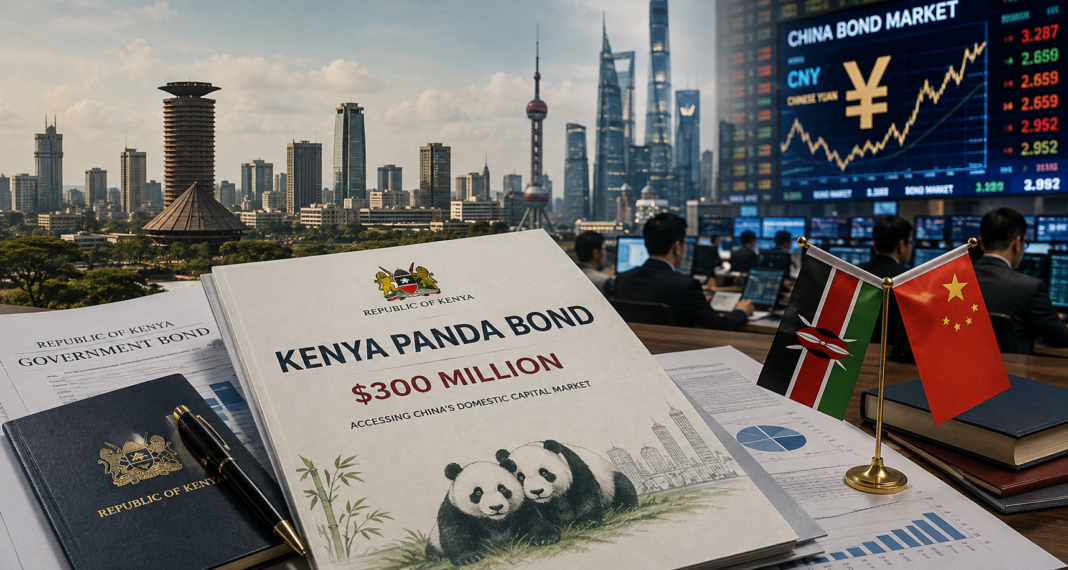

Kenya is looking beyond its traditional lenders and international bond markets, with plans to explore a $300 million Panda Bond in China as the government searches for new ways to finance its budget and manage the growing cost of public debt.
The proposed transaction would mark Kenya’s first entry into China’s domestic bond market and give Nairobi access to a new pool of investors at a time when the country’s borrowing needs remain substantial.
The proposal is more than a search for another $300 million.
It signals a broader change in Kenya’s approach to sovereign financing.
For years, Nairobi’s international borrowing strategy has been closely associated with Eurobonds, multilateral lenders and bilateral creditors. Now the government is looking increasingly toward Asian capital markets, including China and Japan, while also considering Islamic finance, diaspora bonds and other instruments.
The objective is straightforward: find more ways to raise money, spread borrowing risks across different markets and reduce dependence on any single source of financing.
But Kenya’s move toward China comes with a striking paradox.
China is already Kenya’s largest bilateral creditor. Yet Nairobi is now seeking to enter China’s capital market not simply as a borrower from a Chinese state institution, but as a sovereign issuer seeking investment from Chinese financial-market participants.
That distinction could become increasingly important in the next phase of Kenya’s debt strategy.
A new chapter in Kenya’s debt story
A Panda Bond is a renminbi-denominated bond issued in China’s domestic market by a foreign government, company or institution.
For Kenya, the proposed $300 million issue would be its first.
The Treasury’s 2026/27 borrowing plan says the government will consider an inaugural Panda Bond of about $300 million. The transaction would require the necessary legal and regulatory approvals before it could proceed.
The proposal comes alongside plans for an $815 million Eurobond and more than $500 million of borrowing from the Japanese market, including a possible Samurai Bond.
Kenya is also considering Sukuk bonds, diaspora bonds and other financing arrangements.
The pattern is revealing.
Nairobi is not abandoning the international capital markets. It is trying to build a larger financing map.
That matters because Kenya’s fiscal requirements are too large to be comfortably met through one channel.
Why China, and why now?
China has one of the world’s largest domestic bond markets and a deep institutional investor base.
For Kenya, accessing that market could provide something it increasingly values: diversification.
Traditional international bond markets expose emerging-market borrowers to shifts in global investor sentiment, interest rates and risk appetite. When investors become more cautious about emerging markets, borrowing costs can rise sharply.
A Panda Bond potentially gives Kenya another audience.
Instead of depending exclusively on investors in London, New York and other established international financial centres, Nairobi can test demand among investors in China’s domestic market.
The idea is not entirely untested in Africa.
In April 2025, the African Export-Import Bank, or Afreximbank, raised 2.2 billion yuan, equivalent to about $300 million at the time, through its first Panda Bond. The transaction demonstrated that an African financial institution could successfully access China’s domestic capital market.
Kenya’s proposed transaction would take that experiment into the sovereign space.
The $300 million is only part of the story
The headline figure can make the proposal look smaller than it really is.
Kenya’s overall financing requirement is much larger.
For the 2026/27 financial year, the government has projected a budget deficit equivalent to 5.5% of gross domestic product. The Treasury expects to cover part of that gap through external financing of 247.2 billion Kenyan shillings, roughly $1.9 billion, with the remainder coming from domestic borrowing.
The proposed Panda Bond would therefore cover only a fraction of the government’s external financing requirement.
But its significance lies in what it could establish.
If Kenya successfully enters China’s bond market, it could create a new financing relationship that may be used again in the future.
That is potentially more important than the first $300 million.
Kenya’s debt burden
The search for new financing comes as Kenya manages a substantial public debt burden.
Official data from the Public Debt Management Office shows Kenya’s external public debt stood at KSh5.46 trillion, or about $42.34 billion, at the end of December 2025.
China was the country’s largest bilateral creditor, with KSh628.7 billion outstanding. China accounted for roughly one-third of Kenya’s bilateral external debt at the time.
The numbers underline the complexity of Kenya’s relationship with Beijing.
China has been a major source of infrastructure financing for Kenya, particularly during the country’s large infrastructure expansion over the past decade.
But Chinese lending to Kenya has also changed.
Outstanding Chinese debt has fallen from previous peaks as repayments have outpaced new lending. By the end of 2025, China’s share of Kenya’s external debt was about 11.9%, according to the National Treasury’s annual debt report.
That makes the proposed Panda Bond particularly interesting.
Kenya’s relationship with Chinese finance is evolving from one dominated by bilateral infrastructure loans toward a potentially broader relationship involving capital markets.
From Chinese loans to Chinese investors
This is where the Panda Bond story becomes more significant.
A conventional bilateral loan from a Chinese institution and a Panda Bond are fundamentally different forms of financing.
With a bilateral loan, Kenya borrows from a specific lender under negotiated terms.
With a Panda Bond, Kenya would issue a security into China’s domestic capital market and seek investment from market participants.
The latter approach could give Nairobi greater access to institutional investors while allowing China-based investors to gain exposure to Kenyan sovereign debt.
It is a more market-oriented relationship.
For Kenya, the attraction is potentially greater diversification.
For Chinese investors, the appeal would depend on the bond’s yield, Kenya’s credit profile, currency arrangements and expectations about the country’s economic performance.
The currency question
There is, however, an important issue that cannot be ignored: currency risk.
Panda Bonds are generally denominated in Chinese yuan, while Kenya’s revenues are primarily collected in Kenyan shillings.
That creates an exchange-rate exposure.
If the Kenyan shilling weakens against the yuan, the cost of servicing a yuan-denominated obligation can increase when measured in local currency.
Kenya already has a diversified external debt portfolio across several currencies.
The National Treasury’s data shows that while the U.S. dollar remains the dominant currency in Kenya’s external debt, the country also has significant exposure to the euro, Japanese yen and Chinese yuan. At the end of June 2025, yuan-denominated debt represented about 5% of the external public debt portfolio.
A Panda Bond would therefore add another layer to an existing currency-management challenge.
The key question will be whether the financing cost and diversification benefits justify that exposure.
Kenya wants cheaper debt
The timing of the proposal is also important.
Kenya is under pressure to contain the cost of servicing its debt.
National Treasury data shows cumulative external debt service reached KSh376.42 billion by the end of December 2025 against a full-year target of KSh716.46 billion. Commercial creditors accounted for 59% of cumulative external debt service during that period.
That is one reason Nairobi is looking at ways to replace or retire expensive external debt.
The government’s current borrowing plan calls for at least $500 million of expensive external debt to be retired during the financial year, with the objective of reducing debt-servicing costs and improving fiscal sustainability.
A new source of financing only makes sense if it helps achieve that objective.
Borrowing more money simply because another market is available would not solve Kenya’s underlying fiscal problem.
The economics of the transaction will therefore matter.
The lessons from Brazil
Kenya is also entering the Chinese bond market at a time when other major emerging economies are exploring the same route.
Brazil announced in June that it planned to raise up to 5 billion yuan, about $735 million, through its first Panda Bond. Reuters described the planned transaction as the largest debut of yuan-denominated debt by a foreign sovereign in China’s market.
Brazil’s decision highlights an important trend.
China’s capital market is becoming relevant not only to companies and financial institutions but also to sovereign borrowers looking for alternative sources of international funding.
For African governments, the significance could be even greater.
Many African economies have traditionally depended heavily on Western capital markets and development institutions.
A deeper Chinese investor base could give governments another avenue for financing infrastructure, refinancing existing debt or supporting budget needs.
But diversification should not be confused with cheap money.
Investors will still price African sovereign debt according to perceived risk.
Kenya’s bigger financing experiment
The Panda Bond is part of a much broader experiment by Nairobi.
The government is considering several instruments at the same time.
The $815 million Eurobond would maintain Kenya’s presence in the conventional international capital market.
The proposed Samurai Bond would provide access to Japanese investors.
Sukuk financing could attract Islamic investors.
Diaspora bonds could tap Kenyans living abroad.
Debt swaps could potentially convert existing obligations into financing for specific development priorities.
The strategy is therefore not simply about China.
It is about building a more diversified sovereign financing system.
That could be valuable if Kenya can execute it without increasing its overall debt vulnerabilities.
What investors will be watching
For investors, the first question will be pricing.
How much will Kenya have to pay to borrow in China’s market?
The second will be demand.
Will Chinese institutional investors be willing to hold Kenyan sovereign debt at competitive yields?
The third will be currency risk.
How will Kenya manage its exposure to the yuan?
And the fourth will be fiscal credibility.
Investors will want evidence that Kenya can manage its deficit, raise sufficient revenue and meet its debt obligations.
A successful transaction could demonstrate that Kenya has developed a credible presence in another major international capital market.
A costly transaction could expose the limitations of diversification.
What it means for Africa
Kenya’s potential Panda Bond also deserves attention beyond Nairobi.
African governments are increasingly searching for alternatives as traditional international borrowing becomes more expensive and debt-service obligations consume a larger share of public resources.
The experience of Afreximbank shows that African institutions can access China’s domestic market.
Kenya could now test whether an African sovereign can do the same at a meaningful scale.
If the issue is successful and competitively priced, other African governments could follow.
That would deepen the links between African sovereign borrowers and Asian capital markets.
It could also gradually change the geography of African finance.
For decades, the major international financial centres in Europe and the United States have played an outsized role in African sovereign debt.
China, Japan and other Asian markets could become increasingly important parts of the picture.
The real test for Nairobi
Still, Kenya’s challenge is not simply finding new lenders.
It is borrowing intelligently.
A government facing a fiscal deficit can always search for another source of money. The harder task is ensuring that each new dollar or yuan borrowed contributes to a financing structure that remains manageable years later.
That is especially important for Kenya because domestic borrowing is already substantial and external debt service remains high.
The government will therefore need to judge the Panda Bond against alternatives rather than considering it in isolation.
If Chinese investors offer attractive pricing, the bond could become a useful addition to Kenya’s financing toolkit.
If the cost is high, Nairobi may find that a new market does not necessarily mean cheaper money.
A new financial relationship
Kenya’s proposed $300 million Panda Bond is therefore about more than China.
It is about how Nairobi sees the future of sovereign finance.
The country is trying to move from a relatively concentrated borrowing model toward a more diversified system in which European, American, Asian, African and domestic investors all form part of the financing equation.
China is an obvious part of that strategy because of the size of its capital market and its existing economic relationship with Kenya.
But the irony is impossible to miss.
Kenya is approaching Chinese investors at a time when its outstanding bilateral debt to China has been falling.
The relationship is changing from one centred heavily on infrastructure loans toward one that could increasingly involve capital markets.
For Who Owns Africa, that is the bigger story.
Kenya’s $300 million Panda Bond may be modest compared with the country’s overall debt stock and financing needs. But if Nairobi succeeds, the transaction could mark an important step in the evolution of African sovereign borrowing.
The question is no longer simply who will lend to Africa?
It is increasingly which global capital markets will Africa choose to access, on what terms, and at what cost?
Kenya’s answer may begin in Beijing.

