
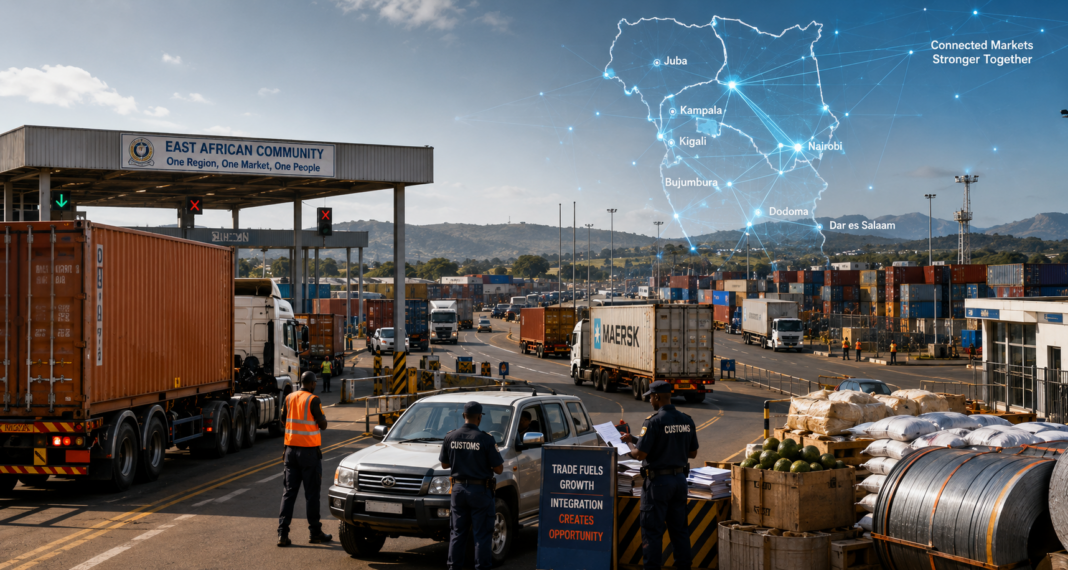

East Africa’s regional economy is becoming more connected, but businesses are still finding that crossing an international border can be harder than selling into the domestic market.
Intra-EAC trade increased by 28% to $19.3 billion in 2025 from $15.2 billion in 2024, showing that companies, farmers and traders are increasingly looking beyond their home markets. Yet the EAC says intra-regional trade has remained around 15% of total trade for more than a decade, well below its estimated potential of 30% to 50% or higher.
A market with enormous potential
The numbers tell only part of the story. East Africa is building a market large enough to support manufacturers, technology companies, agricultural businesses, logistics operators and financial institutions that want to expand beyond one country. The opportunity becomes particularly significant when companies can use regional demand to justify investment in larger factories, distribution networks and supply chains.
The EAC Customs Union was designed to make this possible. Since 2005, member states have committed to free trade in qualifying goods produced within the region while applying a Common External Tariff to goods entering from outside the bloc. Goods moving freely within the EAC must comply with regional Rules of Origin and other customs requirements.
In principle, that should make East Africa function more like one market.
In practice, the experience is more complicated.
The tariff question
Tariffs remain an important part of the debate because governments must balance regional integration with domestic economic priorities. National authorities want to protect local industries, collect revenue and manage sensitive imports, while businesses want predictable and competitive access to neighbouring markets.
That tension can create uncertainty for companies operating across borders. The EAC was still reviewing implementation of the revised Common External Tariff, specific duty rates and Rules of Origin in 2026, highlighting the continuing effort to harmonise trade policy across member states.
For a large corporation, changes in tariff policy can be incorporated into financial models and supply-chain planning. For a small manufacturer or trader, however, an unexpected duty or a disagreement over the origin of a product can quickly turn a profitable shipment into a loss.
The bigger issue, therefore, is not simply whether tariffs exist. It is whether businesses can predict the total cost of getting their products from one EAC market to another.
The barriers businesses cannot see
Some of the most damaging obstacles to regional trade do not appear in tariff schedules.
They can take the form of additional inspections, domestic taxes and charges, inconsistent application of Rules of Origin, different sanitary requirements or administrative procedures that force traders to provide similar information several times. The EAC identified these issues as major constraints during a high-level regional dialogue on trade barriers in February 2026.
These are known as non-tariff barriers, or NTBs.
Their economic effect can be significant. A truck that spends hours waiting at a border creates costs for the transporter, driver, importer and eventually the consumer. For perishable goods, delays can also translate directly into lost products and lost income.
This is why businesses often care less about the theoretical tariff rate than about the final cost and predictability of moving goods.
Borders are the real test
The success of regional integration is ultimately measured at the border.
One-Stop Border Posts were introduced to reduce duplication by bringing agencies from neighbouring countries together. The model has helped reduce crossing times in several locations, but the EAC says the region now needs to move beyond simply placing agencies under one roof and toward smarter, technology-driven border management.
That shift could be crucial.
A modern regional market requires customs systems that communicate with one another, digital documents that can be verified electronically and agencies that share information instead of repeatedly asking traders for the same paperwork.
The EAC has also called for action on domestic administrative bottlenecks at border crossings, saying they delay goods, increase business costs and undermine regional competitiveness. In July 2026, Secretary General Stephen P. Mbundi said removing these bottlenecks would be critical to the bloc’s ambition of increasing intra-EAC trade to 50% by 2030.
Small businesses carry the burden
The consequences are particularly serious for small and medium-sized businesses.
A multinational company can employ customs experts, lawyers and logistics specialists to navigate complex regulations. A small food processor, clothing manufacturer or agricultural trader may have only a handful of employees and limited working capital.
For such businesses, regional expansion can become intimidating if every new market introduces unfamiliar procedures.
The EAC has recognised the importance of smaller businesses in regional integration and has targeted stronger support for micro, small and medium-sized enterprises as part of its 2026/27 to 2030/31 development strategy. The strategy also sets a target of resolving all reported non-tariff barriers by 2030/31.
That matters because the success of the regional market will not be determined only by the largest companies. It will depend on whether thousands of smaller businesses can regularly sell, source and invest across borders.
Manufacturing needs a bigger market
For East Africa to industrialise more rapidly, manufacturers need scale.
A factory producing pharmaceuticals, construction materials, processed foods, textiles or household goods is more attractive when it can serve several national markets rather than depend entirely on domestic demand. A larger addressable market can justify investment in machinery, technology, skilled workers and distribution infrastructure.
That is one reason regional integration matters beyond trade statistics.
A Kenyan manufacturer selling into Uganda, Rwanda or Tanzania is not simply exporting a product. It is potentially creating demand for packaging companies, transport operators, financial institutions, warehouses and suppliers across several economies.
The same applies to a Tanzanian manufacturer selling into Kenya or Uganda, or a Ugandan food processor supplying consumers elsewhere in the region.
Regional trade can therefore create an economic multiplier that is much larger than the value recorded on a customs declaration.
The trade numbers are encouraging
There are reasons for optimism.
The EAC recorded strong growth in international merchandise trade in 2025. Regional exports rose 37.7% to $77 billion, while intra-EAC trade increased 28% to $19.3 billion. The bloc’s total trade with the rest of the world also expanded substantially.
Those figures show that businesses are already using the regional market.
The challenge is that intra-EAC trade still represents only a relatively small share of the bloc’s overall trade. The EAC reported that regional trade stood at about 12.3% of total trade in 2025, while its February 2026 dialogue noted that the share has remained far below the region’s potential.
The gap between current performance and potential is where the biggest economic opportunity lies.
The $400 billion opportunity
The often-cited $400 billion scale of the East African economy is important because it changes the way companies can think about growth.
Instead of viewing Kenya, Tanzania, Uganda, Rwanda, Burundi, South Sudan, the Democratic Republic of Congo and Somalia as separate markets, businesses can increasingly view them as interconnected destinations within a broader regional economy.
That does not mean national markets will disappear.
Governments will continue to set domestic tax policies, regulate industries and protect national interests. But if regional commitments are implemented consistently, companies should be able to plan their operations around a much wider customer base.
That could attract more investment into manufacturing and regional supply chains while encouraging companies that already operate in East Africa to expand rather than remain concentrated in one country.
The hidden cost of fragmentation
The cost of fragmentation is rarely visible in a government budget.
It appears instead in the price of goods, the size of inventories, the amount of working capital required and the number of days needed to move products from a factory to a customer.
A business may decide not to enter a neighbouring market because compliance costs are too high. Another may choose to import a product from outside Africa because the regional supply chain is too unpredictable.
When that happens repeatedly, East Africa loses more than a single transaction.
It loses investment, jobs, manufacturing opportunities and the chance to develop regional value chains.
This is why eliminating trade barriers is not simply a customs issue. It is an industrial policy issue.
Digital trade is becoming critical
The next phase of regional integration will also depend heavily on digital systems.
The EAC has identified limited interoperability and weak real-time data exchange as problems that can contribute to duplication and border delays. Digital customs platforms can reduce paperwork, improve transparency and make it easier for authorities to identify risks without subjecting every shipment to the same level of inspection.
For small traders, digital systems could also make regional markets easier to access.
Instead of travelling to government offices to obtain documents or clarify requirements, businesses could increasingly access information online and complete procedures electronically.
But technology alone will not solve the problem.
Digital systems must be connected, reliable and supported by common rules. Otherwise, businesses simply move from paper-based bureaucracy to digital bureaucracy.
What businesses really need
The demands from the private sector are relatively straightforward.
Businesses want tariffs that are transparent and predictable. They want the same regional rules to be applied consistently at different borders. They want product standards recognised across countries and customs procedures that do not require repeated inspections without a clear reason.
They also want governments to resolve disputes quickly.
The EAC has already established mechanisms for reporting and addressing non-tariff barriers. Its Common Market framework explicitly provides for the elimination of tariffs and NTBs, the implementation of the Common External Tariff and harmonisation of standards and sanitary and phytosanitary measures.
The challenge is enforcement.
From policy to practice
This is increasingly the central question for the EAC.
The region does not lack agreements, institutions or policy ambitions. What it needs is consistent implementation.
The EAC’s February 2026 trade dialogue explicitly recognised that many of the remaining constraints are increasingly operational and institutional rather than simply legal. Officials called for stronger enforcement, better coordination and clearer mechanisms for escalating persistent barriers.
That represents an important change in emphasis.
The next stage of integration cannot depend only on signing another agreement. It must focus on whether an existing agreement works for the trader standing at a border, the manufacturer planning a new factory or the farmer looking for a buyer in another country.
A market waiting to be unlocked
East Africa has already shown that regional trade can grow rapidly when businesses are given the opportunity.
The increase to $19.3 billion in intra-EAC trade in 2025 is evidence that demand exists. The question is how much larger that figure could become if the region removes the barriers that continue to make cross-border commerce more expensive and unpredictable.
The answer could determine the next chapter of East Africa’s economic development.
A truly integrated market would allow manufacturers to produce at greater scale, farmers to reach more consumers, traders to expand across borders and investors to build businesses around a regional rather than purely national customer base.
The EAC has set itself an ambitious target of raising intra-regional trade to 50% by 2030. Achieving that goal will require more than tariff reforms. It will require governments to make borders faster, regulations more predictable, digital systems more connected and regional commitments more enforceable.
For East African businesses, integration is not an abstract political ambition.
It is measured in the time a truck spends at the border, the cost of moving a shipment, the paperwork required to enter a new market and the confidence an entrepreneur has that the rules will remain the same tomorrow.
The region has built much of the framework for a common market.
Now it has to make that market work.

