

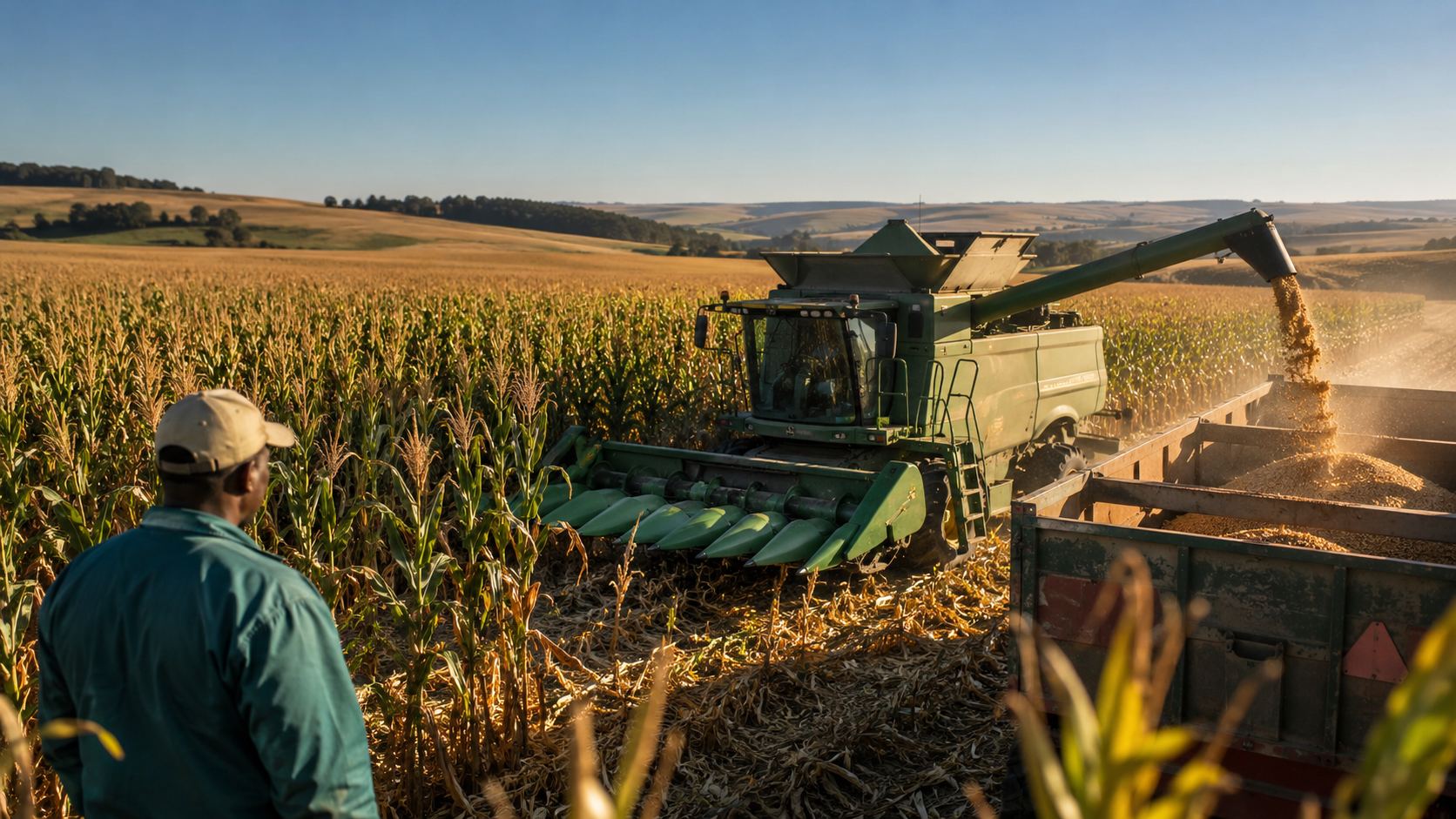
South Africa’s 2025/26 maize harvest is expected to rise 4.5% to 17.4 million tonnes, according to the government’s Crop Estimates Committee, reinforcing expectations of strong agricultural output and ample domestic supplies.
The latest forecast, released on Wednesday, puts production above the 16.65 million tonnes recorded in the previous season and slightly above the committee’s July estimate of 17.363 million tonnes.
The increase is significant for South Africa and the wider African food market because maize is a major staple crop and an important component of the country’s agricultural economy. A larger harvest can influence food prices, livestock feed costs, trade flows and the availability of grain for processors and consumers.
For a continent where food security remains closely linked to agricultural production, South Africa’s maize output also has implications beyond its borders. The country is one of Africa’s major grain producers and plays an important role in regional agricultural markets.
Bigger harvest expected
The Crop Estimates Committee’s seventh summer crop forecast estimates commercial maize production at 17.4 million tonnes for the 2025/26 season. The figure compares with 16.65 million tonnes in the previous season, representing an increase of roughly 750,000 tonnes.
The latest number also marks a modest upward revision from the committee’s previous forecast issued on July 28. At that time, expected commercial maize production stood at 17.363 million tonnes.
The forecast is therefore not simply a recovery from the previous season. It points to another year of strong maize production, following a substantial increase in output in 2024/25.
South Africa’s final calculated commercial maize crop for 2025 was 16.65 million tonnes, according to the Department of Agriculture. That figure was itself higher than the committee’s earlier final estimate because calculations were revised using actual deliveries and information on on-farm usage and retention.
The continued strength of production gives South Africa a larger supply base from which to meet domestic demand and participate in regional and international grain markets.
White maize leads output
White maize is forecast at approximately 9.49 million tonnes, while yellow maize production is expected to reach about 7.91 million tonnes.
The distinction matters because the two types serve different parts of the agricultural economy. White maize is widely used for human consumption and is closely associated with staple foods such as maize meal. Yellow maize is used primarily as animal feed and is therefore important to the poultry, livestock and broader feed industries.
The balance between the two crops can influence different parts of the food system. A strong white maize harvest can improve availability for millers and consumers, while abundant yellow maize can support feed manufacturers and livestock producers.
For consumers, however, a larger harvest does not automatically mean an immediate or proportionate decline in food prices. Retail prices are influenced by several factors, including transport costs, processing expenses, currency movements, energy prices, storage costs and broader global commodity markets.
Still, increased local supply can ease pressure on the underlying cost of grain, particularly when production is comfortably above domestic requirements.
Food security implications
The latest maize forecast comes at an important time for food security discussions across Africa. Population growth, urbanisation, climate variability and rising demand for food are placing greater pressure on agricultural systems across the continent.
South Africa’s strong maize production provides an important buffer because domestic availability reduces the need to depend heavily on imports during periods of tight supply.
The Food and Agriculture Organization said earlier this year that South Africa’s 2026 maize production prospects were favourable, with output expected to remain above average. It attributed the outlook partly to generally conducive weather conditions since the 2025 planting season, although rainfall distribution was uneven in some areas.
Weather remains one of the biggest variables for African agriculture. Good rainfall can support yields and improve planting conditions, while drought, flooding or prolonged dry periods can quickly reverse production expectations.
The 2025/26 season therefore highlights both the opportunities and risks facing South African agriculture. Higher production can strengthen food availability, but maintaining that performance will depend on farmers’ ability to manage increasingly unpredictable weather patterns, input costs and market conditions.
What it means for food prices
For South African households, the most immediate question is whether the larger maize harvest will translate into cheaper food.
An increase in production can create downward pressure on grain prices when supply expands faster than demand. This can benefit millers, feed manufacturers and other processors, potentially lowering some of their input costs.
The impact on retail food prices, however, is less direct. Maize moves through several stages before reaching consumers, from farms and storage facilities to transporters, processors, wholesalers and retailers.
This means cheaper grain at the farm or commodity level does not necessarily translate into an equivalent reduction in the price of maize meal or other finished products.
Even so, a strong harvest can reduce the risk of severe supply shortages. That is particularly important for a staple food market where sudden production declines can quickly affect household budgets.
Export potential
Higher maize production could also strengthen South Africa’s position in regional agricultural trade.
When domestic requirements are adequately supplied, surplus production can be directed toward export markets. South African maize has long been traded within the African region, making production levels important for neighbouring countries that rely on imports to supplement their own harvests.
A larger crop could therefore provide opportunities for grain traders, logistics companies, storage operators and agricultural processors.
However, export prospects depend on more than production alone. Prices, exchange rates, transport infrastructure, regional demand and harvest conditions in neighbouring countries all influence the competitiveness of South African maize.
The Food and Agriculture Organization has previously indicated that South Africa’s maize exports were expected to decline in the 2025/26 marketing year despite strong production, illustrating how domestic supply and international trade do not always move in the same direction.
For African markets, the key issue will be whether the additional production becomes available for export and at what price.
Agriculture remains strategic
The maize forecast also underlines the broader economic importance of agriculture in South Africa.
Agriculture contributes to economic activity through farming, food processing, transport, storage, manufacturing and retail. A successful harvest can therefore have effects across a much wider supply chain than the farm sector alone.
The three leading maize producing provinces, Free State, Mpumalanga and North West, were expected to account for about 82% of the 2026 commercial maize crop in the committee’s July forecast. The July estimate also described the expected harvest as the largest maize crop on record at that stage.
That concentration makes agricultural infrastructure particularly important. Roads, rail networks, storage facilities and grain handling capacity must be able to move large volumes efficiently from producing areas to domestic consumers, processors and export points.
If infrastructure constraints raise transport or storage costs, part of the economic benefit of a larger harvest can be lost.
Farmers face the next test
For farmers, the stronger production forecast is positive, but the outlook is not without challenges.
High yields can increase total market supply, potentially putting pressure on producer prices. Farmers must therefore balance production gains against input costs, financing, machinery expenses and market volatility.
Weather will remain another major factor. South Africa’s maize sector is highly exposed to rainfall patterns, and changes in the timing and distribution of precipitation can affect both planting decisions and yields.
The latest forecast demonstrates the value of favourable conditions, but it also highlights why agricultural planning increasingly depends on accurate climate information and improved risk management.
Investment in irrigation, drought-resistant seed varieties, precision agriculture, storage and agricultural technology could become increasingly important as producers seek to protect yields against climate uncertainty.
A wider African story
South Africa’s maize harvest is more than a national agricultural statistic. It is part of a wider African story about food production, trade and economic resilience.
Across the continent, governments are under pressure to increase agricultural productivity while keeping food affordable for rapidly growing populations. Countries that can produce consistent surpluses have an opportunity to strengthen domestic food security and participate more actively in regional trade.
For South Africa, the 17.4 million tonne forecast provides another sign that the country remains a major agricultural force on the continent.
The challenge will be converting strong production into broader economic benefits. That means ensuring farmers receive sustainable returns, consumers benefit from reliable supplies, processors have competitive input costs and export markets remain accessible.
What comes next
The 17.4 million tonne forecast is not yet the final word on the season. Crop estimates can change as harvesting progresses and more information becomes available.
The Department of Agriculture maintains a regular crop estimates process, with production forecasts updated during the season. The committee’s 2026 schedule includes successive assessments of summer crops as information on planting, weather and crop conditions develops.
For now, the direction is encouraging. South Africa is heading toward another large maize harvest, with white maize expected to account for about 9.49 million tonnes and yellow maize approximately 7.91 million tonnes.
The numbers offer a positive signal for food availability, agricultural trade and the wider economy. But the significance of the harvest will ultimately be measured not only by how much maize farmers produce, but also by how efficiently that grain reaches consumers, livestock producers and markets across Africa.
