

NAIROBI — Africa’s cities are being physically remade at a pace and scale without precedent in the continent’s history, driven by urbanization rates adding tens of millions of new city residents each year, middle-class income growth generating demand for formal housing and commercial real estate, and a long-term infrastructure deficit creating investment opportunities across roads, airports, ports, water systems and energy networks. The construction boom is visible in the cranes on Nairobi’s skyline, the rapidly expanding residential neighborhoods encircling Lagos, the high-rise office towers transforming Kigali and the port expansions reshaping Mombasa, Dar es Salaam and Abidjan.
Real estate development has become one of the largest sectors of private investment across African cities, attracting domestic capital, diaspora investment, international real estate funds and development finance in volumes that reflect both genuine market opportunity and in some markets speculative activity that creates property cycles not unlike those observed in less mature real estate markets globally. High-end residential development — luxury apartments and gated estate houses targeting the African upper-middle class and diaspora return buyers — has been particularly active in Nairobi, Lagos, Accra, Abidjan and Kigali, with developer marketing often targeting diaspora buyers abroad making investment decisions about their home country without the daily operational context that would inform local buyer assessments of location and developer reliability.
The affordable housing deficit is the most consequential dimension of African urban construction, even though it attracts a smaller share of private investment than upper-market development. Estimates of the affordable housing gap across sub-Saharan Africa run into tens of millions of units, reflecting decades of urbanization that informal settlements have accommodated by default because formal housing supply has consistently failed to match population growth at income levels that the large majority of urban migrants can afford. The economics of affordable formal housing development — producing a quality product at a price that low-income urban residents can pay while covering land, construction, financing and developer margin costs — have historically been challenging enough that the market provides inadequate supply without significant policy intervention.
The construction materials industry has grown substantially alongside the urban development boom, with cement production expansion being the most visible indicator. Dangote Cement’s pan-African expansion, building production capacity in multiple African countries beyond its Nigerian base, represents the most significant private sector investment in construction materials manufacturing and reflects a commercial assessment that the African construction boom will generate sustained demand growth over multiple decades. Building materials import substitution — producing locally what was previously imported — has been economically attractive in several African markets where the combination of currency depreciation and growing local demand has improved the competitiveness of domestic production.
Infrastructure construction — roads, highways, urban transit, airports, ports, water and sewerage systems — has been a major component of African construction activity, driven by government capital budgets, Chinese infrastructure financing and multilateral development bank lending. Chinese infrastructure lending and construction has delivered real physical infrastructure across many African countries while generating debt sustainability concerns and controversy about financing terms that have been negotiated without adequate transparency in some cases.
Urban planning capacity — the institutional ability to guide and regulate urban growth — is the dimension of the construction boom that has received least attention relative to its importance. Cities expanding rapidly without adequate planning controls develop in ways that are expensive to retrofit: roads too narrow for eventual traffic volumes, buildings without adequate setbacks, exclusion of public space from development plans. Several African cities have experienced rapid physical growth without the planning frameworks, enforcement capacity and institutional authority to shape that growth toward better long-term outcomes. The cities that invest most deliberately in climate-resilient planning and building standards during the current construction boom will carry a significant long-term advantage over those that treat urban governance as a future concern to be addressed after the immediate housing and infrastructure deficit is resolved.

More from Business

How Mr Eazi became a major shareholder in Ghana’s pharmaceutical industry
Nigerian musician Mr Eazi's investment firm Zagadat Capital has quietly built a major stake in a Ghanaian drug maker.

Who owns Africa’s new wealth? The companies and sectors creating the continent’s next billionaires
African governments are competing for global capital with tax incentives, but the bigger question is who will own the wealth created.
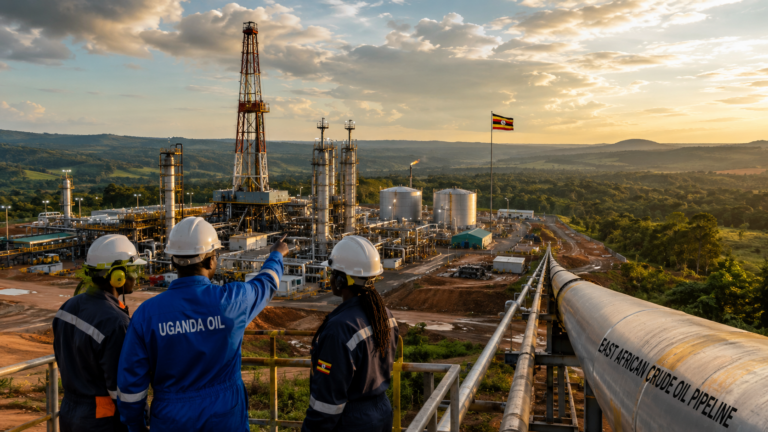
Uganda’s oil gets a name: “Pearl Sweet” as first oil draws near
Uganda’s long-awaited oil era is nearing reality, but questions remain over ownership, revenues, local benefits and who ultimately controls the wealth.