
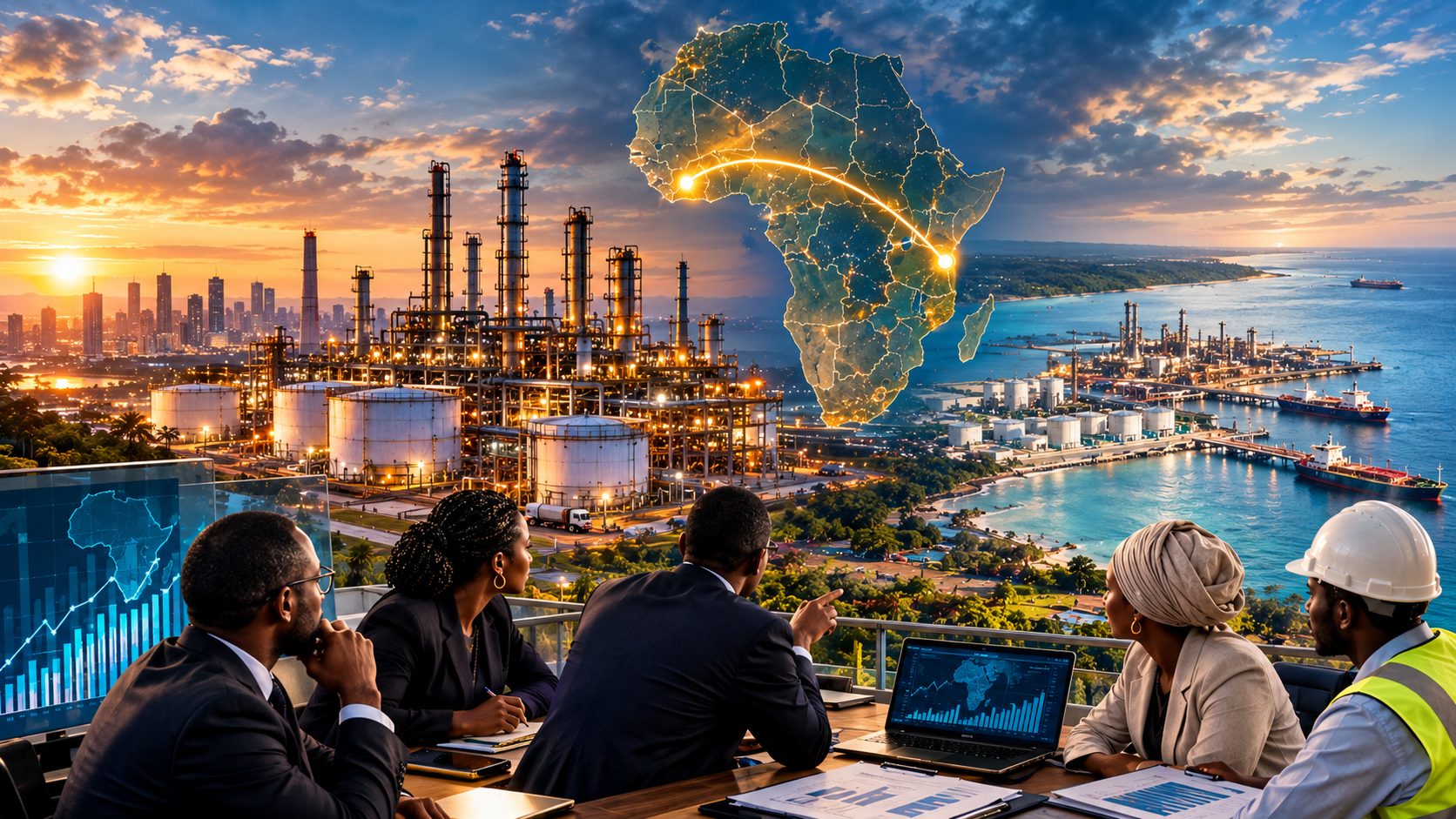
There is something bigger happening around Aliko Dangote’s refineries than the construction of another giant oil plant: Africa is beginning to debate not simply where its fuel comes from, but who owns the infrastructure, capital and industrial power behind it.
That distinction matters.
The immediate headlines are easy to understand. Kenya has approved a mechanism allowing eligible Kenyan investors to participate in the initial public offering of Dangote Petroleum Refinery and Petrochemicals in Nigeria through global depositary receipts. The Nigerian refinery IPO opened on Sept. 14 and is scheduled to close on Oct. 13. The Capital Markets Authority said the eventual GDRs are expected to be listed on the Nairobi Securities Exchange, subject to further approvals.
At almost exactly the same moment, Dangote has begun construction of a planned $16 billion, 700,000-barrel-per-day refinery in Lamu, Kenya, with completion targeted for around 2030. The project is designed not merely as a refinery but as a wider industrial complex incorporating petrochemicals, power, storage, pipelines and marine infrastructure.
Taken separately, these are two major corporate developments.
Taken together, they tell a more consequential story.
This is about the emergence of an African industrial network in which ownership, capital and physical infrastructure can cross borders without necessarily following the old pattern of Africa exporting raw materials and importing finished products.
That is why the Dangote story deserves to be read as an ownership story.
Not just an oil story.
The map is changing
For decades, Africa’s petroleum economy has been defined by a peculiar contradiction.
The continent has some of the world’s most significant oil and gas reserves, yet many African countries have remained heavily dependent on imported refined petroleum products.
Crude oil leaves African shores.
Refined fuel comes back.
The value chain, and much of the financing, technology and trading power attached to it, has historically sat elsewhere.
Dangote’s industrial strategy is an attempt to attack that contradiction at scale.
The Lagos refinery was built around the idea that Nigeria should not simply produce crude oil and then send it abroad for processing. Its stated industrial proposition is to refine crude domestically and create an integrated ecosystem around refining, petrochemicals, power, storage and logistics. Dangote’s refinery website describes the Lagos facility as having current crude distillation capacity of 700,000 barrels per day and an expansion plan to 1.4 million barrels per day.
Now the same industrial logic is being projected eastward.
Lamu is not Lagos.
Kenya is not Nigeria.
East Africa is not West Africa.
But the commercial logic is remarkably similar.
Build large-scale refining capacity.
Create supporting infrastructure.
Connect the plant to regional markets.
Attract capital.
Capture more value inside Africa.
And, increasingly, give African investors a pathway to participate in the ownership of the businesses being built.
That last part may ultimately be the most important.
The IPO changes the conversation
The Nigerian refinery IPO creates a fascinating shift in the Dangote story.
For years, Dangote has been the archetype of African private industrial power. The company builds enormous factories, finances ambitious infrastructure and operates across national borders, while Aliko Dangote has become one of the continent’s most prominent symbols of African entrepreneurship.
An IPO introduces another principle.
Ownership can become broader.
The refinery is no longer only a story about the wealth and risk carried by one industrial group. It becomes a capital markets story, in which investors can potentially participate in the economic future of one of Africa’s most important industrial assets.
Nigeria’s Securities and Exchange Commission confirmed the refinery IPO opened on Sept. 14 and warned investors to use only officially approved channels and receiving agents.
Kenya’s role is particularly interesting.
The Capital Markets Authority approved a Short Form Prospectus submitted by Renaissance Capital Kenya for a GDR structure that can enable eligible Kenyan investors to participate in the Nigerian offer. The GDRs would represent shares in the Nigerian company and could subsequently be listed on the Nairobi Securities Exchange, subject to Nigerian regulatory approval.
This is more than a technical securities-market development.
It suggests the possibility of an African capital market that is beginning to work across national boundaries.
A Kenyan investor does not necessarily need to think of a Nigerian industrial company as something financially distant.
A Nigerian industrial company can become an investable African asset.
That is a powerful idea.
But there is an important distinction
There is also a detail that should not be lost in the excitement.
The Kenyan GDR approval does not mean Kenyan investors are buying into the new Lamu refinery.
The Capital Markets Authority explicitly clarified that the current transaction concerns Dangote Petroleum Refinery and Petrochemicals in Nigeria. It is not an offer of shares in the planned Dangote East African Petroleum Refinery and Petrochemicals project in Lamu.
That distinction is crucial for understanding what is actually happening.
The Nigerian refinery is moving toward broader ownership through the capital markets.
The Lamu refinery is a separate project being developed in Kenya.
Yet the two projects are connected by something deeper than corporate branding.
They form part of the same industrial philosophy.
The first demonstrates the scale of Dangote’s refining model.
The second attempts to transplant that model into another African regional market.
The capital-market development in Kenya then adds another layer.
It creates a bridge between African investors and African industrial assets.
The result is not yet a continental oil company in the conventional sense.
But it is beginning to look like a continental industrial strategy.
Lamu is the more audacious bet
The Lamu refinery may eventually prove to be the more consequential part of the story.
The planned facility is expected to process 700,000 barrels of crude per day and represents an investment of about $16 billion. Kenya’s government says the project will include a 1,000-megawatt power plant and facilities associated with plastics, fertiliser and chemical production. Officials have also projected around 60,000 direct jobs.
Those numbers are enormous by Kenyan standards.
They are enormous by East African standards.
They are enormous by almost any African industrial standard.
And that is precisely why the project should not be viewed simply as a refinery.
A refinery is an energy asset.
A refinery connected to power generation, storage, pipelines, port infrastructure, petrochemicals and regional distribution becomes something much larger.
It becomes an industrial platform.
That is the real significance of Lamu.
The refinery could create demand for logistics companies, engineering firms, construction contractors, maintenance providers, financial institutions, insurers, technology companies and manufacturers.
It could also change the economic importance of Lamu Port and the wider LAPSSET corridor.
Kenya’s State Department for Transport has described the project as an anchor investment for the Lamu port and LAPSSET Special Economic Zone, while highlighting potential opportunities for local suppliers and skills development.
If that ecosystem develops, the refinery’s influence will extend far beyond the price of petrol.
The real prize is the value chain
This is where Africa’s industrial debate often becomes too narrow.
The question is usually framed as whether Africa produces enough oil.
That is not the most useful question.
The better question is: what does Africa do with the oil it produces?
Crude extraction is only one part of the energy economy.
There is refining.
There is petrochemicals.
There is transportation.
There is storage.
There is power generation.
There are lubricants and base oils.
There are plastics.
There is aviation fuel.
There are industrial chemicals.
There are trading businesses.
There is finance.
There is infrastructure.
There are thousands of businesses that exist around the core industrial asset.
The countries that control more of that chain capture more of its economic value.
Dangote’s strategy is therefore important because it attempts to move vertically through the chain.
The company is not simply building a place where crude is turned into petrol.
It is building an integrated industrial ecosystem.
That is why the Lamu project should be watched through the wider lens of African industrialisation.
From national champions to continental players
There was a time when the dominant model of African business was national.
A successful entrepreneur built a company in one country.
The company became large.
Then it expanded into neighbouring markets.
Dangote’s trajectory is different in scale.
The group has increasingly pursued businesses and infrastructure that operate across African economic boundaries.
Cement is one example.
Fertiliser is another.
Refining now takes the strategy into a more politically sensitive and economically strategic field.
Fuel is not just another commodity.
It touches transportation, agriculture, manufacturing, aviation and household costs.
Whoever has significant influence over refining capacity therefore has influence over a critical component of economic activity.
That is why governments care about refineries.
It is also why Dangote’s expansion creates both excitement and questions.
The excitement is obvious.
African countries could reduce dependence on imported refined products.
Regional supply chains could become more resilient.
Industrial jobs could increase.
Local manufacturing could grow.
African capital could participate in African assets.
But the questions are equally important.
Who ultimately controls the assets?
How much value remains in host economies?
How are communities compensated?
What environmental standards apply?
How much financing comes from African institutions?
And what happens when a private industrial empire becomes large enough to influence the economic fortunes of multiple countries?
These are not anti-Dangote questions.
They are the questions that naturally follow when private African capital reaches continental scale.
Ownership is more complicated than nationality
There is another reason the Dangote story deserves scrutiny.
It is tempting to call an industrial project African simply because its principal entrepreneur is African.
That definition is too easy.
Ownership is more complicated.
An asset can be African-owned but heavily financed by foreign institutions.
It can be located in Kenya but controlled through a Nigerian corporate structure.
It can employ thousands of Kenyans while its technology, equipment and debt financing originate elsewhere.
It can be listed in Nairobi while the underlying shares remain connected to another jurisdiction.
That does not make the project less African.
It simply means African ownership needs to be measured more carefully.
The emerging question should be: how much of the economic value chain can Africans own?
Not merely where the factory is located.
This is where the Kenyan GDR development becomes symbolically significant.
If Kenyan investors can participate in the ownership of a Nigerian industrial asset through their own capital-market infrastructure, the boundaries of African ownership begin to look different.
The investor is Kenyan.
The company is Nigerian.
The security can be represented through a GDR.
The capital moves across borders.
The economic relationship becomes continental.
That is exactly the kind of financial integration Africa has talked about for years.
Lamu raises the harder question
There is, however, a danger in celebrating scale without examining consequences.
Lamu is an environmentally and culturally sensitive location.
The refinery project has already faced legal and community opposition related to land claims and environmental concerns. Reuters reported that a Kenyan court dispute involving residents and land claims had created a challenge around the project, while other reporting has highlighted concerns about the proximity to Lamu’s internationally recognised heritage and sensitive coastal ecosystem.
This matters because industrialisation is not simply a question of investment size.
A $16 billion project can transform an economy.
It can also transform a landscape.
The challenge for Kenya is therefore not to choose between development and environmental protection as if one must eliminate the other.
The challenge is to demonstrate that large-scale African industrialisation can meet a higher standard.
If Lamu becomes a successful refinery while respecting communities, environmental rules and cultural heritage, it will offer a powerful model.
If it becomes associated with displacement, weak consultation or environmental damage, it could become a warning about the costs of development without sufficient accountability.
Africa needs the former.
The East African market is the real test
The economics of Lamu will ultimately depend on more than the refinery itself.
The plant needs crude.
It needs infrastructure.
It needs financing.
It needs reliable electricity.
It needs skilled workers.
It needs storage and distribution networks.
And most importantly, it needs customers.
The proposed refinery is designed for a regional market rather than Kenya alone.
That makes strategic sense.
Kenya’s own petroleum market is not large enough to justify thinking of a 700,000-barrel-per-day refinery purely as a domestic project.
The business case must therefore extend across East Africa and potentially beyond.
Uganda matters.
Ethiopia matters.
Rwanda matters.
South Sudan matters.
Tanzania matters.
The Democratic Republic of Congo matters.
And the wider Indian Ocean market matters.
That is where the Lamu project becomes a regional integration project.
A refinery cannot exist as an island.
It needs roads, pipelines, ports, storage depots, railways and cross-border trade arrangements.
In other words, Dangote’s refinery could end up forcing governments to think more seriously about the infrastructure required for an integrated East African energy market.
That may be one of its most important effects.
Competition will not disappear
Nor should the arrival of Dangote be interpreted as the end of competition.
East Africa has other refinery ambitions.
Uganda has continued to pursue its own refinery plans, while Tanzania has ambitions tied to its energy and logistics infrastructure.
At the Lamu groundbreaking, Ugandan President Yoweri Museveni said Uganda would continue with its own refinery plans, arguing that the region needs multiple refineries.
That is a sensible position.
One giant refinery should not become a substitute for a competitive regional energy system.
Africa’s energy security should not mean replacing dependence on foreign fuel suppliers with dependence on one African supplier.
The objective should be diversification.
Multiple refineries.
Multiple ports.
Multiple supply routes.
Multiple investors.
Multiple capital markets.
And, ultimately, more choices for consumers.
Dangote’s continental expansion will be healthier for Africa if it stimulates competition rather than suppressing it.
The financing question may be bigger than the oil question
There is another story underneath all of this.
Africa needs enormous amounts of capital to industrialise.
The continent cannot rely indefinitely on governments to finance every major road, refinery, power plant, factory and logistics network.
Private capital will have to play a much larger role.
But foreign private capital alone cannot solve the problem.
Africa also needs deeper domestic capital markets.
That means pension funds.
Insurance companies.
Banks.
Sovereign funds.
Stock exchanges.
Private equity.
Retail investors.
And institutional investors willing to hold African infrastructure over long periods.
The Dangote IPO and Kenya’s GDR mechanism point toward that possibility.
It is still a small step.
But it is an important one.
Kenya’s CMA described the transaction as the first of its kind since the country’s policy guidance on GDRs and global depositary notes and said it could strengthen Kenya’s position as a financial hub for capital raising in Africa.
That is where the story becomes bigger than Dangote.
If African exchanges can eventually allow investors in Nairobi to own assets in Lagos, investors in Lagos to participate in projects in Johannesburg, and investors in Johannesburg to access companies in Nairobi, African capital markets could begin functioning more like a connected financial system.
That would be transformative.
Africa needs an ownership revolution
The continent has spent decades talking about economic sovereignty.
But sovereignty without ownership is incomplete.
A country can control its political institutions while importing most of its refined fuel.
It can export crude oil while importing petrol.
It can have millions of consumers while foreign companies capture much of the value created by those consumers.
It can possess natural resources without controlling the technology, financing and infrastructure required to turn those resources into wealth.
Industrial ownership changes that equation.
This is why Dangote’s refinery strategy deserves attention even from people who are not interested in oil.
The refinery is an example of an African entrepreneur attempting to own more of the value chain.
The IPO introduces a pathway for wider investment ownership.
The Lamu project extends the industrial model across another major African region.
Together, these developments create a question that Africa will have to confront repeatedly over the next generation.
Who owns the infrastructure of African growth?
Dangote cannot answer that question alone
There is a temptation to turn Aliko Dangote into the entire story.
He is certainly central to it.
But the future of African ownership cannot depend on one billionaire.
That would simply create another concentration of economic power.
The deeper success would be if Dangote’s strategy inspires a larger ecosystem of African industrialists, pension funds, banks, entrepreneurs, engineers and investors.
Africa needs hundreds of major industrial companies.
It needs thousands of suppliers.
It needs millions of shareholders.
It needs financial markets capable of recycling African savings into African infrastructure.
It needs governments capable of regulating powerful businesses without suffocating investment.
And it needs communities capable of demanding a fair share of the value generated around them.
That is a much bigger ambition than building refineries.
The Lagos to Lamu connection
The most interesting way to understand Dangote’s expansion is therefore not as a journey from one refinery to another.
It is a journey from one economic model to another.
Lagos demonstrated that an African industrial group could build refining capacity at a scale that challenged assumptions about what African private capital could accomplish.
Lamu is the attempt to make that industrial logic regional.
The Nigerian IPO adds a third dimension.
It asks whether African capital can participate in owning the infrastructure being built by African entrepreneurs.
The geographical line from Lagos to Lamu is therefore more than a corporate expansion route.
It is a potential line across Africa’s future industrial map.
West African capital.
East African capital.
African infrastructure.
African consumers.
African energy.
African investors.
The pieces are beginning to connect.
The risk of getting carried away
But commentary should resist the easy conclusion that Africa has solved its energy problem.
It has not.
A refinery does not automatically produce cheap fuel.
A giant industrial project does not automatically create broad prosperity.
An IPO does not automatically create democratic ownership.
And a foreign investment approval does not automatically translate into local economic power.
Execution matters.
Governance matters.
Pricing matters.
Infrastructure matters.
Environmental protection matters.
Community consent matters.
And competition matters.
The Lamu project will take years to build. Its final economics will depend on crude supply, construction costs, financing, regional demand, fuel prices and the ability to complete supporting infrastructure.
The same discipline should apply to the Nigerian IPO.
Investors are buying an asset, not a slogan.
The Nigerian SEC has already warned prospective investors to study the approved prospectus and understand the risks before subscribing.
That is an important reminder.
African ownership should be ambitious.
It should also be informed.
The real revolution is psychological
Perhaps the most important part of the Dangote story is psychological.
For too long, large-scale industrial ambition in Africa has been discussed as something that requires foreign governments, multinational corporations or development institutions to make possible.
Dangote’s projects challenge that assumption.
They do not prove that Africa can finance everything itself.
They do not eliminate the need for international capital, technology or partnerships.
But they demonstrate that African entrepreneurs can conceive projects at a scale previously associated with global industrial giants.
That matters.
So does the idea that African investors might eventually become shareholders in those businesses.
The difference between an African economy that merely consumes industrial products and one that owns the companies producing them is enormous.
Ownership produces dividends.
Ownership produces voting rights.
Ownership produces capital gains.
Ownership creates institutional knowledge.
Ownership creates financial power.
And ownership can eventually create the next generation of entrepreneurs.
That is why the most important word in this story may not be refinery.
It may be owner.
Who owns Africa’s fuel future?
This is the question that should follow Dangote from Lagos to Lamu.
Not whether one businessman can build the largest refinery.
Not whether Kenya can host another giant industrial project.
Not even whether Africa can refine enough crude.
The harder question is who captures the wealth generated when Africa begins processing more of its own resources.
Will the value remain concentrated in a handful of industrial groups?
Will governments acquire meaningful stakes?
Will pension funds invest?
Will ordinary African investors participate?
Will local companies become serious suppliers?
Will communities around industrial projects receive lasting economic benefits?
Will African stock exchanges become places where Africans can own African infrastructure?
The answer will determine whether the current industrial push becomes another chapter in Africa’s long history of resource extraction, or the beginning of something structurally different.
Dangote has supplied the first part of the argument.
Build.
Refine.
Process.
Integrate.
Expand.
Now the rest of Africa has to decide what it does with that opportunity.
From refinery to ownership
The most profound consequence of the Dangote strategy may ultimately have little to do with the number of barrels processed each day.
It may be that Africa is beginning to move from asking who will build its industrial future to asking who will own it.
That is a much harder question.
It is also a much more important one.
The approval allowing eligible Kenyan investors to participate in Dangote’s Nigerian refinery IPO through GDRs is a modest financial mechanism on paper. But symbolically, it represents something much larger: African capital beginning to reach across African borders to participate in African industry.
Meanwhile, in Lamu, the physical infrastructure of that industrial ambition is taking shape.
The planned refinery is enormous.
The capital required is enormous.
The expectations are enormous.
So are the risks.
But perhaps that is precisely why the project matters.
Africa cannot industrialise by thinking small.
It also cannot industrialise by ignoring the difficult questions about ownership, accountability, environmental protection and distribution of wealth.
Dangote’s next refinery will therefore be judged not only by how much fuel it produces.
It should be judged by how much African economic capacity it creates around it.
And the IPO should be judged not simply by how much money it raises.
It should be judged by whether it helps build a culture in which Africans increasingly become investors in the continent’s most important companies.
That is the real story stretching from Lagos to Lamu.
The refinery is the visible part.
The ownership question is the profound part.
Africa’s next economic era will not be defined simply by what the continent produces.
It will be defined by who owns what it produces, who finances it, who controls the infrastructure around it and who receives the wealth created by it.
That is the debate Dangote has now carried from Nigeria to Kenya.
And it is a debate that Africa can no longer afford to avoid.

More from Business

Who owns Quickmart? Inside Kenya’s KSh15 billion supermarket IPO
Quickmart’s public listing exposes how Kenyan retail, private equity and everyday consumer power are quietly reshaping who owns the country’s economy.

How Mr Eazi became a major shareholder in Ghana’s pharmaceutical industry
Nigerian musician Mr Eazi's investment firm Zagadat Capital has quietly built a major stake in a Ghanaian drug maker.
Who owns Africa’s new wealth? The companies and sectors creating the continent’s next billionaires
African governments are competing for global capital with tax incentives, but the bigger question is who will own the wealth created.