

Kenya’s electric vehicle ambition is no longer simply about replacing petrol cars with batteries. The more consequential question is whether the country can use the electric-car transition to build an industrial economy that captures more value, creates skilled jobs and gives Africa a stronger stake in the technologies defining its transport future.
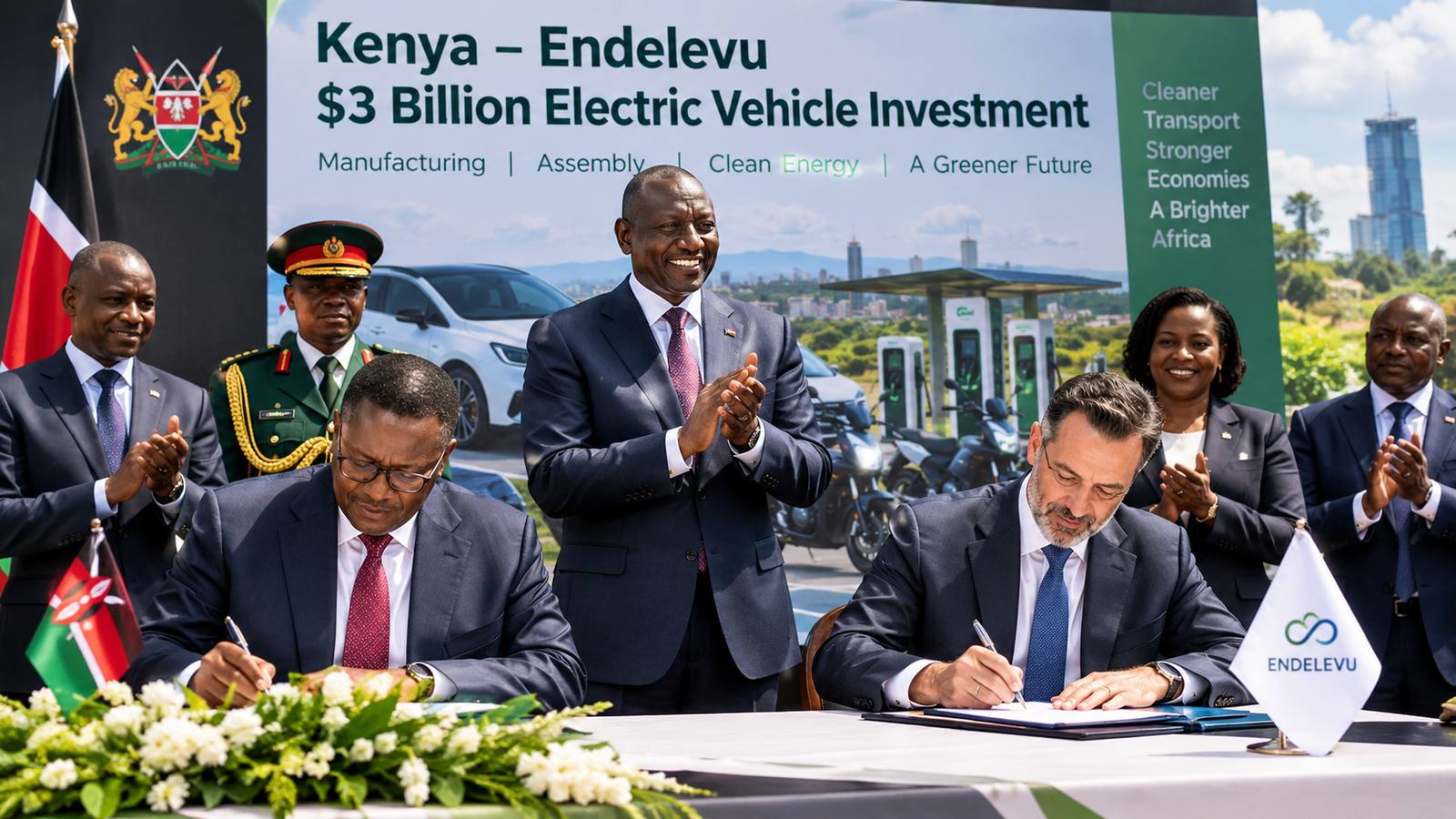
That is what makes President William Ruto’s newly announced $3 billion electric-mobility investment worth watching. On Tuesday, Ruto presided over the signing of a KSh389 billion memorandum of understanding between the Kenyan government and Endelevu Enterprise Corporation covering electric-vehicle manufacturing and assembly.
The headline number is enormous. But the real story is not the size of the cheque, at least not yet. It is the industrial proposition behind it.
The proposed project includes capacity to assemble 50,000 four-wheel vehicles annually and up to 100,000 two-wheelers and light-mobility vehicles. It also envisages 1,000 solar-powered charging hubs and a digital platform capable of supporting up to 100,000 green vehicles. The government says the project could create about 2,000 direct jobs, more than 20,000 indirect opportunities and potentially tens of thousands more in fleet management, operations and related services.
For Kenya, this is an attempt to turn a transport transition into a manufacturing strategy.
The bigger bet is industrial
For decades, African countries have been important consumers of automobiles without becoming equally important producers.
Cars arrive at African ports. Fuel arrives in tankers. Spare parts arrive in containers. The financing, intellectual property and sophisticated components are frequently controlled elsewhere.
That model creates commerce, but it does not necessarily create deep industrial power.
Electric vehicles offer a rare opportunity to change the equation because the industry is still evolving. Battery technology is advancing. Charging networks are being built. Software is becoming part of the vehicle itself. New companies can emerge around batteries, fleet management, energy storage, charging, financing and mobility services.
Kenya therefore has a window.
The question is whether Nairobi intends to remain a market for foreign electric vehicles or become a production and technology centre serving East Africa and eventually the wider continent.
Ruto has made the second ambition clear. The objective extends beyond Kenya, with locally manufactured vehicles expected to serve East Africa and Africa, particularly where they qualify under regional rules of origin.
That distinction matters.
Kenya is betting on the ecosystem
An electric vehicle factory by itself would not transform Kenya’s economy.
A factory assembles vehicles. An ecosystem produces industrial depth.
That ecosystem requires suppliers, battery technicians, software developers, engineers, charging companies, financiers, mechanics, logistics operators, recyclers and manufacturers of components. It requires universities and technical colleges capable of producing workers who understand high-voltage systems and modern vehicle electronics.
Kenya’s proposed investment recognises some of that architecture.
The charging hubs are particularly important because electric mobility cannot expand at scale if vehicles remain trapped within a handful of urban corridors.
The country has been working to develop regulations, incentives and institutional frameworks for electric mobility, while policymakers have increasingly presented the sector as part of a broader industrial and energy strategy.
This is where the $3 billion proposition becomes more interesting.
It is not really a bet on cars.
It is a bet on the infrastructure around cars.
Africa’s mobility problem is different
There is another reason Kenya’s strategy deserves attention.
Africa does not have to reproduce Europe’s or America’s transition to electric mobility.
The continent has a different transport structure, different income levels and different urbanisation patterns.
In Kenya, the motorcycle is often more economically important than the family sedan. The boda boda is not simply transport. It is employment, logistics, commerce and last-mile connectivity.
That makes electric motorcycles potentially more transformative than expensive electric passenger cars.
Kenya’s electric-vehicle market has grown rapidly in recent years, with electric motorcycles accounting for a significant share of the country’s emerging electric-mobility ecosystem.
That growth points towards a distinctly African electric-mobility model.
Instead of starting with wealthy consumers buying premium electric cars, the transition can begin with commercial motorcycles, buses, delivery fleets and public transport.
The economics can be compelling.
A commercial motorcycle travels frequently and consumes fuel continuously. Reducing that fuel cost can materially change the economics of the operator.
The energy advantage
Kenya also has something many countries would like to possess: a relatively strong renewable-energy base.
That gives the electric-vehicle story a second dimension.
An electric vehicle charged primarily from clean electricity is not simply a different type of car. It becomes part of an energy system.
Kenya generates the overwhelming majority of its electricity from renewable sources, giving the country an unusual advantage as it attempts to electrify transport.
That matters because Kenya spends heavily on imported petroleum.
The country’s petroleum import bill represents a significant drain on foreign exchange, making transport electrification relevant not only to climate policy but also to energy security and economic resilience.
In that sense, electric mobility could become an industrial response to an old African vulnerability: spending scarce foreign currency to import the energy required to move people and goods.
But $3 billion is not yet $3 billion of factories
This is where the excitement needs to be tempered.
A memorandum of understanding is not the same thing as completed investment.
A signature does not employ a worker. It does not manufacture a battery. It does not produce a vehicle.
Even Ruto acknowledged that reality, saying after the signing that a signature does not build a factory and urging government agencies to facilitate approvals, infrastructure and land.
That is perhaps the most important point surrounding the announcement.
Kenya has made ambitious industrial promises before. The test this time will be execution.
Investors will want predictable taxation. Manufacturers will want reliable electricity. Consumers will want affordable financing. Operators will want dependable charging networks. Component producers will want a sufficiently large market.
And everyone will want policy stability.
The government has introduced incentives aimed at encouraging electric vehicles, charging infrastructure and related manufacturing, while its broader electric-mobility strategy seeks to develop skills and local industrial capacity.
The next challenge is turning those policies into a stable business environment.
China will shape the competition
There is also an uncomfortable reality behind Africa’s electric-vehicle opportunity.
Much of the world’s EV manufacturing power sits in China.
Chinese companies possess enormous advantages in batteries, components, manufacturing scale and cost.
That creates both an opportunity and a risk for Kenya.
Chinese technology and investment can accelerate Africa’s electric transition. But if African countries merely import finished Chinese vehicles, the continent could exchange one form of dependence for another.
The more ambitious objective is technology partnership without surrendering the industrial value chain.
That means insisting on local skills, local suppliers, local assembly and eventually local component production.
The debate should therefore not be framed simply around whether Chinese companies are welcome.
The more important question is what Africa receives in return.
Kenya’s regional opportunity
Kenya’s strongest argument may ultimately be geographical.
It sits at the centre of an East African market with major cities, expanding logistics networks and millions of potential mobility users.
If Kenya can build competitive EV assembly and component manufacturing, the domestic market could become only the starting point.
Uganda, Tanzania, Rwanda, Ethiopia and other African markets could become destinations for Kenyan-assembled vehicles and related services.
That would turn electric mobility into an export industry.
The East African Community could become more important in this calculation because regional rules of origin can help determine whether manufacturing activity in Kenya translates into preferential access elsewhere.
This is where the phrase “Made in Kenya” could acquire a new meaning.
Not simply a vehicle assembled in Nairobi or Mombasa, but a product embedded in a regional supply chain.
Who owns Africa’s electric future?
That question sits at the heart of the story.
Africa has often owned the raw materials while others owned the technology.
The continent has supplied minerals but imported finished products. It has provided consumers but struggled to capture manufacturing margins.
Electric mobility offers a chance to challenge that pattern.
Kenya cannot manufacture every component of an electric car. Nor should it try to do everything alone.
But it can decide what parts of the value chain it wants to own.
It can build expertise in vehicle assembly, software, charging, fleet management, batteries, maintenance and financing. It can cultivate regional suppliers. It can negotiate technology-transfer arrangements that create lasting domestic capabilities rather than temporary construction jobs.
That is the deeper meaning of this $3 billion bet.
The real measure of success
The success of Kenya’s EV strategy should not ultimately be measured by how many vehicles leave an assembly line.
The better questions will be harder.
How many Kenyan companies become suppliers?
How many engineers learn advanced automotive technology?
How much of each vehicle’s value is created locally?
How many African markets buy Kenyan-made electric vehicles?
How much petroleum does the country stop importing?
How affordable does electric transport become for ordinary Africans?
And, perhaps most importantly, who owns the technology?
Kenya has placed itself at an interesting crossroads. Its electric-mobility strategy, growing EV market, renewable-energy advantage and new investment ambitions give it the ingredients to become more than an early adopter.
But ambition is only the beginning.
The $3 billion agreement is best understood as an invitation to build an industrial future, not proof that the future has already arrived.
For Who Owns Africa, that is the story worth following.
Because Africa’s electric-car revolution will not ultimately be defined by who sells the most vehicles on the continent.
It will be defined by who captures the knowledge, factories, intellectual property, supply chains and economic power behind them.
And Kenya is now betting that it can be one of those owners.

More from Business

From Lagos to Lamu: How Dangote is building Africa’s first truly continental oil empire
From Lagos to Lamu, Dangote is turning refining, capital markets and regional trade into a new argument about African ownership.

Who owns Quickmart? Inside Kenya’s KSh15 billion supermarket IPO
Quickmart’s public listing exposes how Kenyan retail, private equity and everyday consumer power are quietly reshaping who owns the country’s economy.

How Mr Eazi became a major shareholder in Ghana’s pharmaceutical industry
Nigerian musician Mr Eazi's investment firm Zagadat Capital has quietly built a major stake in a Ghanaian drug maker.