

JOHANNESBURG — Mining has shaped African economies for more than a century, funding state budgets, building infrastructure, attracting foreign capital and generating export revenues that have underpinned development across resource-dependent countries from South Africa to Zambia to the Democratic Republic of Congo. The sector’s role is now being reshaped by several simultaneous forces: the global energy transition that is reducing demand for coal while dramatically increasing demand for the minerals needed to build electric vehicles and renewable energy infrastructure; the intensifying push by African governments to capture more value from mineral resources through beneficiation and local processing rather than raw export; and the governance and environmental challenges that have made mining investment in Africa more complex and more scrutinized than at any previous point.
South Africa’s mining sector, once the undisputed anchor of the country’s industrial economy, has declined in absolute terms over several decades as the depth and ore-grade challenges of aging Witwatersrand gold mines have made extraction progressively less economically viable. Platinum group metals have partially substituted for gold’s shrinking contribution, as South African PGM resources represent the world’s largest known reserves and global demand for palladium, rhodium and platinum in catalytic converters and hydrogen fuel cell technology has sustained prices at commercially viable levels. The ongoing structural restructuring of South African gold mining — involving significant workforce reduction, mine consolidation and in some cases closure — represents one of the continent’s most consequential industrial transitions in terms of employment and community welfare impact.
The Democratic Republic of Congo’s extraordinary mineral endowment — the world’s largest cobalt reserves alongside significant copper, gold, coltan and lithium deposits — positions the country at the center of the global energy transition mineral supply chain. Cobalt, essential for lithium-ion batteries, comes predominantly from the DRC, giving the country a structural importance in the clean energy supply chain that has attracted investment from Chinese mining companies, Western battery manufacturers and impact-oriented investors concerned about governance and human rights standards in artisanal and small-scale mining in the Katanga province. The challenge of translating mineral wealth into development outcomes for Congolese citizens — moving beyond the resource curse pattern that has characterized much of the country’s extraction history — remains the central governance question facing the DRC’s political leadership and its international partners.
Zambia’s copper sector, the primary source of foreign exchange and fiscal revenue for a country whose fiscal distress led to Africa’s first pandemic-era sovereign bond default, has experienced a revival following years of underperformance. New ownership in the Zambia Consolidated Copper Mines and renewed investment commitments from international mining groups have generated optimism about production volume recovery, supported by energy transition demand dynamics that make copper — essential for electrical wiring in all forms of clean energy infrastructure — one of the most structurally supported of all mineral commodities over the medium term.
The beneficiation imperative — the push by African governments to process mineral resources domestically before export rather than shipping raw ore for value addition overseas — has been a consistent theme of African mineral policy across multiple commodity cycles. The economic logic is straightforward: minerals processed closer to their final commercial form capture the value added through processing, creating jobs and economic activity in the producing country rather than in the refining country. The commercial barriers are equally real: processing facilities are capital-intensive, require reliable power and technical skills, and face competition from established processing industries in Asia and Europe that benefit from scale, infrastructure and proximity to end-user markets that new African processing entrants cannot quickly match.
Zimbabwe’s policy push toward local beneficiation — including export restrictions on lithium ore from its significant deposits — illustrates the tension between mineral nationalism and the investment climate conditions needed to attract the capital required for large-scale mining development. The policy has attracted criticism from investors who argue that export restrictions reduce Zimbabwe’s mining competitiveness relative to alternatives, generating legal disputes with companies that challenge the policy’s consistency with existing investment agreements. No African mining-dependent government has fully resolved this balance between capturing more domestic value and maintaining the investor confidence needed to develop resources in the first place.
Environmental, social and governance standards applied to African mining have tightened significantly as both institutional investors and African civil society have raised the bar for acceptable practice. Community benefit agreements — negotiated settlements between mining companies and affected communities that define revenue sharing, infrastructure commitments and complaint procedures — have become standard requirements in some African jurisdictions and progressively expected commercial practice in others. The energy transition’s bifurcation between declining coal demand and surging critical mineral demand creates a structural challenge for African mining policy: managing the phase-down of fossil fuel extraction while scaling up transition mineral development in ways that actually deliver development benefits for affected communities and national economies rather than simply replicating the extractive enclave model in a new mineral category.
Looking at the long-term trajectory, the concentration of transition minerals — copper, cobalt, lithium, nickel, manganese — in African geology gives the continent a structural role in the global energy transition supply chain that represents both enormous opportunity and familiar governance challenges. Whether Africa captures genuine development value from this endowment, or whether the transition mineral boom follows the pattern of previous commodity cycles in delivering revenue to governments and royalties to communities without building the industrial, human and institutional capital that transforms resource wealth into lasting development, will be determined by policy choices, governance quality and international partnerships made over the next decade.

More from Business

How Mr Eazi became a major shareholder in Ghana’s pharmaceutical industry
Nigerian musician Mr Eazi's investment firm Zagadat Capital has quietly built a major stake in a Ghanaian drug maker.

Who owns Africa’s new wealth? The companies and sectors creating the continent’s next billionaires
African governments are competing for global capital with tax incentives, but the bigger question is who will own the wealth created.
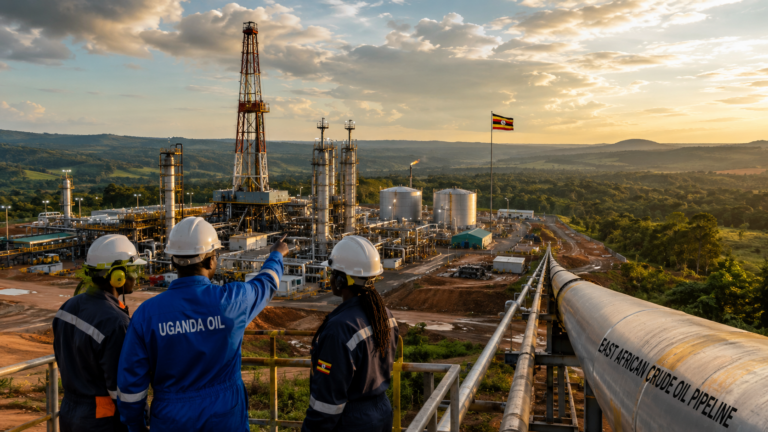
Uganda’s oil gets a name: “Pearl Sweet” as first oil draws near
Uganda’s long-awaited oil era is nearing reality, but questions remain over ownership, revenues, local benefits and who ultimately controls the wealth.