

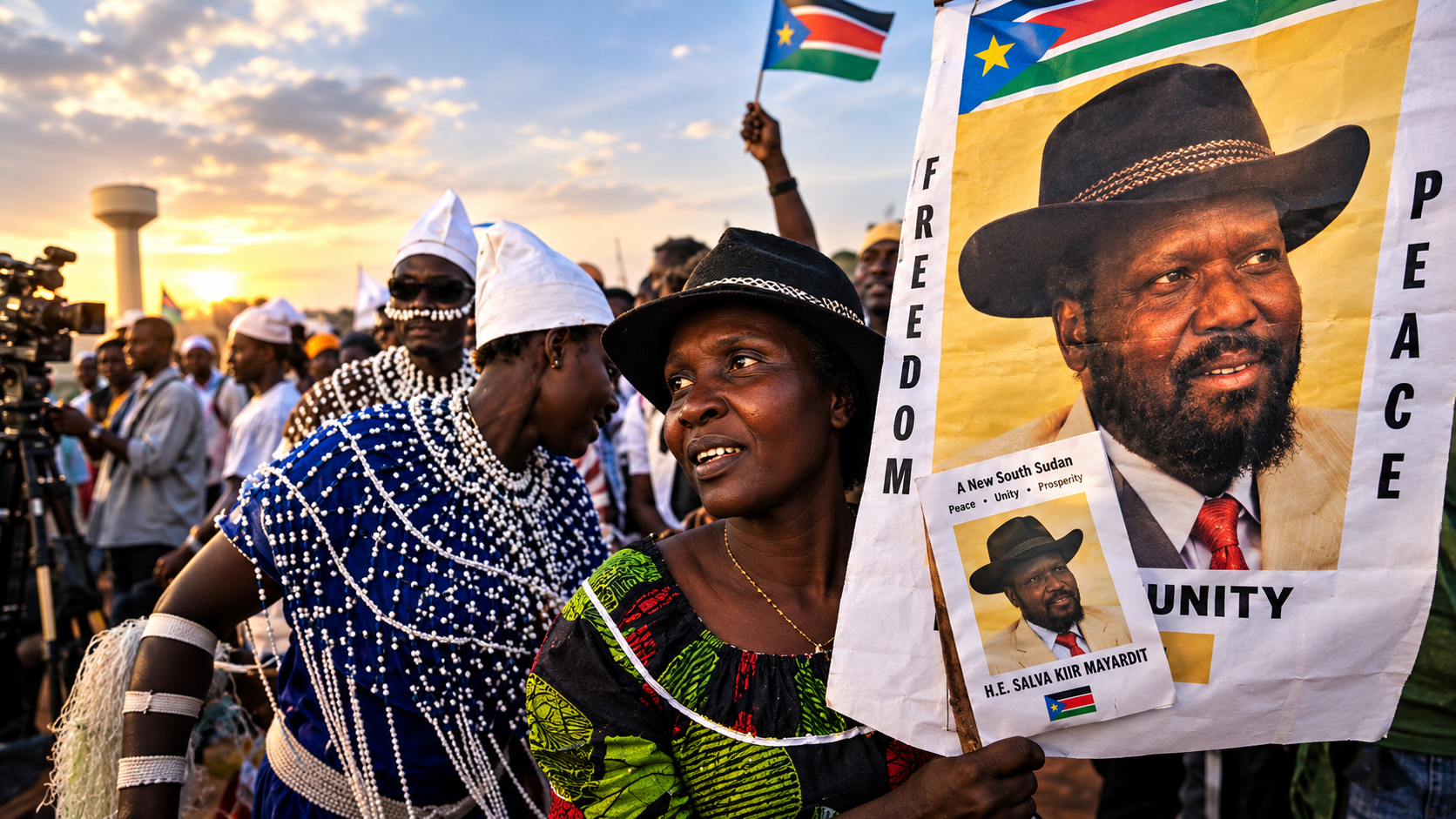
South Sudan’s December election is no longer simply a question of whether President Salva Kiir can get his country to the ballot box. It is increasingly a test of whether East and Southern Africa can shape a political transition whose foundations remain unsettled.
Kiir’s movement from Nairobi to Pretoria this week tells a larger story than the official language of bilateral cooperation suggests.
On October 6, the South Sudanese president left Kenya for South Africa after meeting President William Ruto in Nairobi. He was due to continue discussions with President Cyril Ramaphosa, who chairs the African Union’s High-Level Ad Hoc Committee on South Sudan, known as the C5. Juba says the talks are intended to translate regional commitments into practical support for the December election, including technical, financial and logistical assistance.
On paper, this is diplomacy.
In reality, it is a measure of how much South Sudan’s political future has become a regional concern.
The country is approaching a December 22 election after years of postponed polls, a fragile peace process and repeated disputes over the conditions under which political competition can take place. The African Union has welcomed preparations while simultaneously warning that the political and institutional groundwork remains incomplete.
That contradiction matters.
A government can prepare polling stations, electoral materials and legal instruments. It cannot manufacture political legitimacy through logistics alone.
The election is only half the story
Kiir’s government has moved decisively in recent weeks.
On September 22, he dissolved the transitional government after amendments to electoral law removed some of the conditions that had previously stood in the way of an election, including requirements linked to a permanent constitution and a national census. The move cleared a legal path toward the December vote.
But clearing a legal path is not the same as resolving a political crisis.
That is where the AU’s position becomes important.
The C5, led by Ramaphosa, has called for a feasible, consensual and time-bound electoral roadmap setting out the legal basis, scope and sequencing of the elections. It has also urged the government to comply fully with the Revitalized Peace Agreement, refrain from unilateral actions that could undermine it and create a political environment broad enough to accommodate meaningful participation.
The message is carefully constructed.
The African Union is not telling South Sudan not to hold elections. It is telling Juba that an election without sufficient political consensus may fail the very test the vote is supposed to pass.
That distinction could define the next two months.
Nairobi is not just a neighbour
Kenya has a special interest in what happens next.
For years, Nairobi has been deeply involved in South Sudanese diplomacy. Geography makes that unavoidable, but economics and security make it strategic.
Ruto has already argued that South Sudan’s political transition needs inclusive dialogue, including with groups outside the existing transitional arrangements. In February, he told the C5 process that holdout groups and excluded actors should be brought into efforts to resolve outstanding issues under the peace agreement.
His October meeting with Kiir therefore carries more weight than the standard language of bilateral relations.
Kenya wants stability on its northern frontier. It also wants economic connectivity.
That second interest has become more visible as Kenya develops its Lamu infrastructure and seeks to position the port as a regional energy and trade hub. South Sudan’s oil industry is part of the wider economic equation, even if the country remains dependent on infrastructure and export routes beyond its borders.
Reuters has reported that the proposed Lamu refinery faces major questions over crude supply, with South Sudan, Uganda and Kenya among potential sources. The project is designed to become a major regional energy facility, but infrastructure and geopolitical constraints remain significant.
This creates an important overlap.
For Nairobi, South Sudan is simultaneously a neighbour, a security concern, an economic partner and a potential participant in a wider East African energy network.
Political stability in Juba therefore has consequences well beyond the ballot.
Pretoria brings a different weight
South Africa approaches South Sudan from a different strategic position.
Ramaphosa is not merely another African president receiving Kiir. He chairs the C5, the mechanism through which the African Union has concentrated high-level political attention on South Sudan.
That gives Pretoria an unusual role.
South Africa is being asked to help bridge the distance between Juba’s determination to proceed with elections and the AU’s demand for a credible political process.
The C5’s September declaration was revealing. It reaffirmed the December 22 election timetable but also called for the implementation of the peace agreement, an end to hostilities, protection of political rights and the release of people arbitrarily detained on political grounds. It also called for stronger domestic funding of electoral institutions and coordinated international assistance.
That is not the language of an election that the region regards as a routine administrative event.
It is the language of a transition still under supervision.
And that may be the most important development of all.
Who owns the transition?
The question facing South Sudan is no longer simply who wins the election.
It is who defines the rules under which the winner claims legitimacy.
Juba wants the election to demonstrate that the transitional period can finally end. Regional governments want an election that does not reopen the conflict. The AU wants a process anchored in the peace agreement. International humanitarian agencies are confronting a crisis so severe that political instability could have immediate human consequences.
Those objectives overlap, but they are not identical.
That is why Kiir’s diplomatic route through Nairobi and Pretoria is significant.
He is not operating in a vacuum.
He is seeking regional political backing at precisely the moment when the regional institutions supporting the election are asking for more political consensus.
There is a delicate balance here.
Too much external pressure could allow Juba to portray the election as a sovereignty dispute. Too little pressure could produce a vote that is formally legal but politically contested.
Neither outcome would serve the region.
The opposition question remains unresolved
The most difficult issue is political participation.
South Sudan’s transition was built around a power-sharing arrangement intended to turn an armed conflict into a political settlement. But the transition has repeatedly struggled to convert that settlement into functioning institutions.
The question of opposition participation is therefore fundamental.
The C5 has urged the government to create an inclusive political environment and has called for political detainees to be treated according to due process. Its declaration also insists that the Revitalized Peace Agreement remains the principal framework for the country’s political transition.
That position places pressure on Juba.
A government can legitimately argue that elections cannot be postponed forever. South Sudan has already spent years in transition.
But opponents can equally argue that speed cannot substitute for political inclusion.
The danger is obvious.
If the election is seen as an administrative conclusion to a transitional government rather than a genuine opening of political competition, the vote could deepen the country’s divisions instead of resolving them.
The humanitarian clock is even faster
There is another reason regional leaders should be careful about treating the election as an isolated political event.
South Sudan’s humanitarian crisis is immense.
The United Nations estimates that more than 10 million people, roughly two-thirds of the population, will require humanitarian assistance in 2026. More than 2.5 million people are internally displaced, while the food crisis remains severe.
The Food and Agriculture Organization estimates that 7.8 million people are facing high levels of acute food insecurity, including people in several areas experiencing catastrophic conditions.
These numbers change the meaning of political instability.
In a wealthy democracy, a disputed election may produce protests, legal battles and institutional paralysis.
In South Sudan, political paralysis can quickly become a humanitarian emergency.
Displacement rises. Food access deteriorates. Local armed groups become harder to control. Humanitarian operations become more expensive and dangerous.
The political calendar therefore sits on top of a humanitarian clock.
Regional diplomacy must become more than election support
This is where Kenya, South Africa and the wider African Union face their real test.
Providing election materials is necessary.
Providing technical assistance is necessary.
Helping electoral institutions function is necessary.
But none of those things can resolve the political question.
The region needs to decide what it means by a credible transition.
If credibility simply means that ballots are printed, polling stations open and results are announced, South Sudan may achieve an election without achieving political settlement.
If credibility means that political rivals can campaign, citizens can participate, institutions can operate independently and the peace agreement remains meaningful, then the regional task is much harder.
It also requires African governments to maintain pressure after election day.
That is where many international interventions lose momentum.
The election becomes the finish line when it should be the beginning of institutional accountability.
South Sudan is becoming a regional mirror
There is a wider lesson here.
South Sudan has often been described as a problem to be managed by neighbouring states and international organisations.
That description is becoming outdated.
The country’s political trajectory increasingly reflects the competition, priorities and ambitions of the region itself.
Kenya wants stability and economic connectivity.
South Africa wants to demonstrate that African diplomatic mechanisms can still manage difficult political transitions.
The African Union wants its peace architecture to remain relevant.
IGAD wants to preserve its role in a region increasingly affected by overlapping crises.
Juba, meanwhile, wants to demonstrate that it can control its own political timetable.
Those interests are converging around December 22.
That makes the election bigger than South Sudan.
The real test begins before the vote
The most consequential question between now and December is not whether South Sudan can organise an election.
It is whether the government and its regional partners can build enough political confidence for the result to be accepted.
That requires more than speeches in Nairobi or Pretoria.
It requires clarity on the electoral roadmap.
It requires meaningful political dialogue.
It requires credible electoral institutions.
It requires space for opposition participation.
It requires adherence to the peace agreement.
And it requires regional governments to make clear that stability is not the same thing as political silence.
The AU has already identified many of these requirements. Its August peace and security communique called for predictable domestic funding for electoral institutions, a realistic and consensual electoral roadmap and stronger coordination among the AU, IGAD, the C5, R-JMEC and the United Nations.
The machinery is therefore in place.
The question is whether the political will is.
A regional power test
Kiir’s journey from Nairobi to Pretoria should be read in that context.
It is a diplomatic tour, but it is also a search for regional reassurance.
Kenya can offer proximity, economic links and long experience with South Sudan’s politics.
South Africa can offer continental legitimacy through the C5.
The African Union can offer institutional backing.
But none can manufacture the political consensus that South Sudan itself must ultimately create.
That is the uncomfortable truth at the centre of the December election.
South Sudan may finally be moving toward a vote. But an election is not automatically a transition.
A transition happens when political power becomes contestable, institutions become credible and the losing side believes it has a future outside government.
If the region can help South Sudan reach that point, December could mark a genuine break with the country’s prolonged transitional era.
If it cannot, the ballot may simply give an old political struggle a new date.
For Kenya, South Africa and the African Union, that is the real choice now.
The question is no longer whether South Sudan will vote.
It is whether the region can help ensure that, when South Sudan does vote, the country has something more valuable than a result.
It has legitimacy.

More from Elections
Libya’s 24-month election deal: Who really stands to own the country?
Libya’s election roadmap promises political unity, but control of guns, oil, money and foreign alliances may decide who holds power.
Zambia’s Hichilema wins a second term: What it means for Africa’s copper economy
Zambia’s copper boom is entering a critical phase as President Hakainde Hichilema begins a second term focused on investment, production and local value.