
Libya Libya has taken a potentially important step toward national elections, but an attempted attack on a fuel depot in Tripoli is a reminder that political agreements and control on the ground remain two very different things.
Representatives of Libya’s rival political and military camps signed a UN-backed agreement on Aug. 30 setting a framework for presidential and parliamentary elections within 24 months. The agreement addresses disputes over electoral laws, calls for a reconstituted election commission and envisages elections under a single executive authority and unified state institutions.
That makes the so-called 4+4 agreement one of the more significant political developments in Libya since the 2020 ceasefire. But it does not answer the question that has frustrated previous political settlements: who controls Libya while the transition is being negotiated, and who will control its institutions, oil revenues and security forces if the election process succeeds?
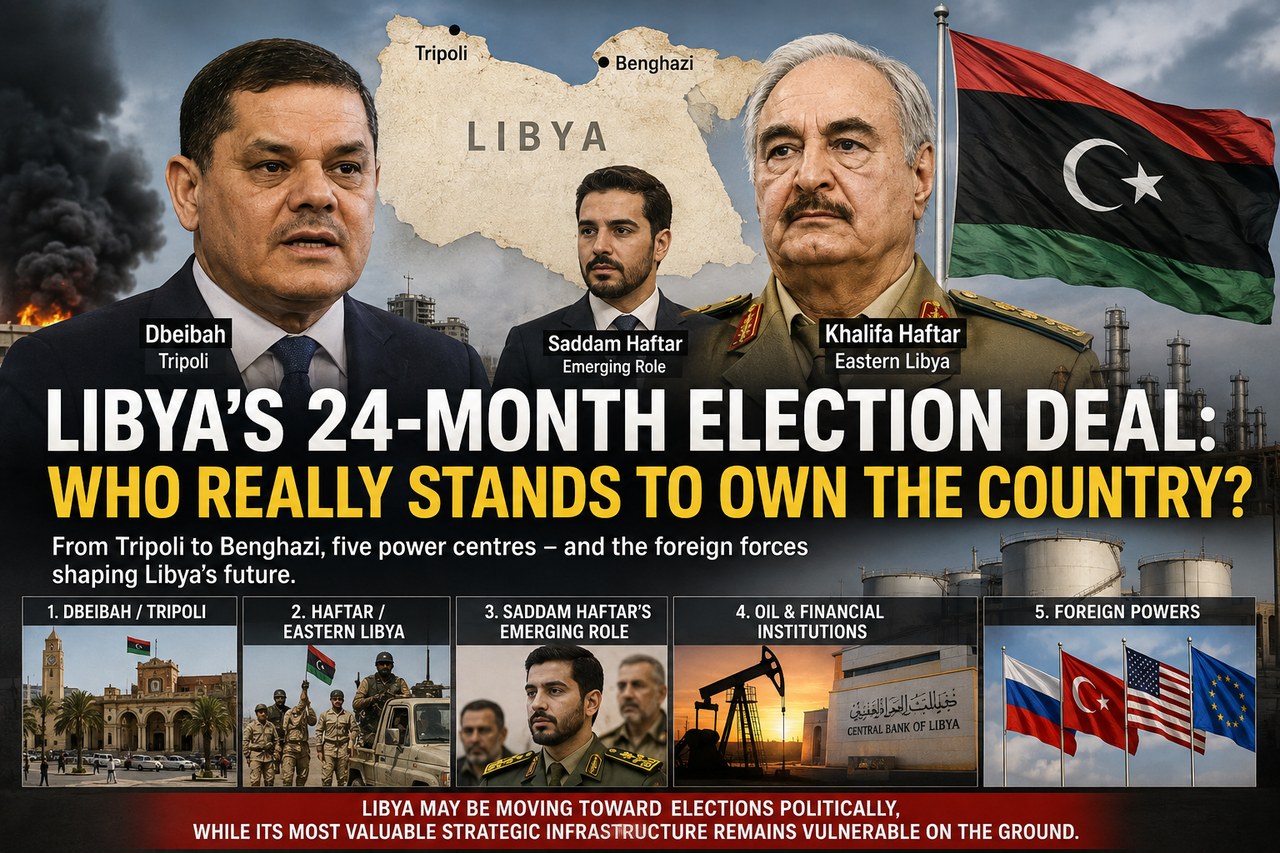
The answer is likely to depend on five competing centres of power.
1. Dbeibah and Tripoli
Prime Minister Abdul Hamid Dbeibah remains one of the most important figures in western Libya. His Government of National Unity controls the capital and much of the country’s western political machinery, giving him access to state institutions, diplomatic relationships and substantial public spending.
The 4+4 arrangement is significant for Dbeibah because it creates a route toward elections without immediately requiring him to disappear from the political scene. The agreement seeks a unified executive authority before elections, but critics have pointed out that it does not provide a clear mechanism for achieving that unity.
That ambiguity matters. Libya’s previous transition plans repeatedly created interim institutions that were supposed to prepare the country for elections but instead became entrenched. Dbeibah himself was selected in 2021 to lead an interim government ahead of elections scheduled for later that year. Those elections collapsed before voting took place, leaving his administration in office long after the mandate of the transitional arrangement was supposed to end.
For Dbeibah, therefore, the next 24 months are not simply about organising a vote. They are about maintaining influence during the transition while avoiding a political settlement that strips Tripoli of control over the institutions and financial resources on which its authority depends.
2. Haftar and eastern Libya
In the east, the central power remains military commander Khalifa Haftar and the Libyan National Army, which controls much of eastern and southern Libya.
Haftar does not command the internationally recognised government in Tripoli, but his military position gives him considerable bargaining power. His forces control territory containing some of Libya’s most important oilfields and infrastructure, while the eastern political establishment has developed its own institutions and relationships with foreign governments.
The 4+4 agreement brings representatives of Haftar’s side directly into the political process. That is important because earlier negotiations often struggled to translate political decisions into realities on the ground. The new format includes two representatives from the eastern military command alongside representatives from the House of Representatives, Dbeibah’s government and the High Council of State.
But Haftar’s leverage goes beyond the negotiating table. Reuters reported earlier this year that his forces had acquired what appeared to be Chinese and Turkish combat drones despite the longstanding UN arms embargo, reinforcing questions about the military capabilities and foreign support available to eastern Libya.
That military weight is likely to remain central to negotiations over the shape of any future unified state.
3. Saddam Haftar’s emerging role
If Khalifa Haftar represents the established military power of eastern Libya, his son Saddam increasingly represents the next generation of that power.
Saddam Haftar, deputy commander of the Libyan National Army, has moved into a much more visible diplomatic and political role. He has travelled abroad, met senior officials and become an increasingly important figure in discussions over Libya’s future.
His emergence is particularly significant because the new electoral framework allows military personnel to run for office after leaving their official positions and addresses the question of dual nationals seeking the presidency. Those changes could potentially widen the field for candidates from the eastern military establishment.
Saddam’s rise also reflects a broader shift in how foreign governments engage with Libya. He is no longer simply viewed through the lens of his father’s military organisation. He is increasingly treated as a political actor in his own right.
Reuters reported in July that a proposed Pakistani-backed reunification plan under discussion envisaged Dbeibah remaining prime minister while Saddam Haftar could head a presidential council, with Khalifa Haftar retaining significant fiscal influence. The proposal was not the final 4+4 agreement, but it showed how seriously foreign mediators were considering a future role for Saddam.
The central question is whether Saddam’s rise will help Libya transition away from personalised military rule or simply transfer that influence to a younger generation.
4. Oil and the institutions controlling money
For all the attention on elections and military commanders, Libya’s deepest struggle may still be over money.
Libya possesses Africa’s largest proven crude oil reserves, and oil revenues finance much of the state. The National Oil Corporation manages the country’s oil production, while the Central Bank of Libya plays a crucial role in receiving oil revenues and funding salaries and government spending.
That makes the NOC and central bank more than economic institutions. They are pillars of political power.
Previous disputes have demonstrated how quickly political disagreements can become economic warfare. In 2024, an oil blockade linked to a struggle over the Central Bank governor caused production to plunge, illustrating how control over state finances can be used as leverage between rival factions.
This is why the election timetable cannot be separated from the question of institutional control. Whoever controls the flow of oil revenue has influence over salaries, public contracts, subsidies and the wider economy.
The vulnerability of that system was starkly demonstrated again this week.
On Thursday, a suspected drone struck near fuel storage tanks at a Tripoli depot operated by Brega Petroleum Marketing Company. No casualties were reported and authorities said fuel distribution continued, but the incident caused minor damage to pipelines and tanks, according to Libyan authorities.
The attack followed drone strikes on fuel storage facilities at the Zawiya oil complex in August, which damaged a major gasoline storage tank and temporarily disrupted fuel supplies in western Libya.
Libya may be moving toward elections politically, while its most valuable strategic infrastructure remains vulnerable on the ground.
That is the contradiction at the heart of the 24-month roadmap.
5. Russia, Turkey, the United States and Europe
Libya’s political settlement will also be shaped by powers outside the country.
Turkey has historically been one of the strongest foreign supporters of the Tripoli government, providing military assistance that helped repel Haftar’s 2019-20 offensive against the capital. Russia, meanwhile, has maintained a significant relationship with eastern Libya and Haftar’s forces.
But those alliances are becoming less rigid.
Reuters reported that Turkey has recently increased engagement with Haftar and Saddam, reflecting Ankara’s economic and energy interests and its desire to protect its broader strategic position in Libya.
Russia’s position is equally important because its military presence in eastern Libya has given Moscow a platform from which to project influence into the Sahel and wider Africa. That makes Libya valuable not only for its oil but also for its geography.
The United States is now pushing harder for political unification. Washington has supported the new electoral process while pursuing parallel diplomacy aimed at bringing the eastern and western camps closer together. U.S. officials have also engaged directly with Libyan leaders, including Saddam Haftar.
Europe has its own reasons to want stability. Libya sits on one of the main migration routes into the Mediterranean and remains an important energy supplier to European markets.
For these outside powers, a unified Libya is desirable, but the definition of “unified” may differ. Security access, energy contracts, migration cooperation and regional influence all form part of the calculation.
The real test begins now
The 4+4 agreement is genuinely significant. It brings together actors who possess political, military and institutional power and sets a formal 24-month target for presidential and parliamentary elections. The UN has described the agreement as an important step in advancing its political roadmap.
But Libya’s history shows that an agreement is not the same thing as transferring power.
The country has seen repeated roadmaps, ceasefires and political bargains collapse because the institutions created by those agreements could not overcome the armed and economic networks operating around them.
This time, the crucial test will be whether the rival camps accept rules that could eventually remove them from office.
If Dbeibah loses an election, will Tripoli’s political and armed networks accept the result? If a Haftar-backed candidate loses, will eastern Libya surrender its military and economic leverage? And if one side wins, will the other accept a single national security structure and a unified system for managing oil revenues?
Those questions may prove more important than the date printed on an election calendar.
The attempted attack on the Tripoli fuel depot offers a timely warning. A drone falling beside a fuel tank may have caused little immediate disruption, but it illustrates the wider problem facing Libya: strategic infrastructure remains exposed to forces that politics alone has yet to neutralise.
The country is closer to an election roadmap than it has been in years. Whether that roadmap leads to a functioning state, however, will depend on who controls Libya’s guns, oil, money and foreign relationships during the journey.
For now, the answer is still contested.
And that is why the real story of Libya’s 24-month election deal is not simply who will vote.
It is who will still control the country when the voting is over.

More from Elections
South Sudan’s December election is becoming a regional power test
As Kiir courts Kenya and South Africa, South Sudan’s election exposes a deeper struggle over peace, power and regional influence.
Zambia’s Hichilema wins a second term: What it means for Africa’s copper economy
Zambia’s copper boom is entering a critical phase as President Hakainde Hichilema begins a second term focused on investment, production and local value.