

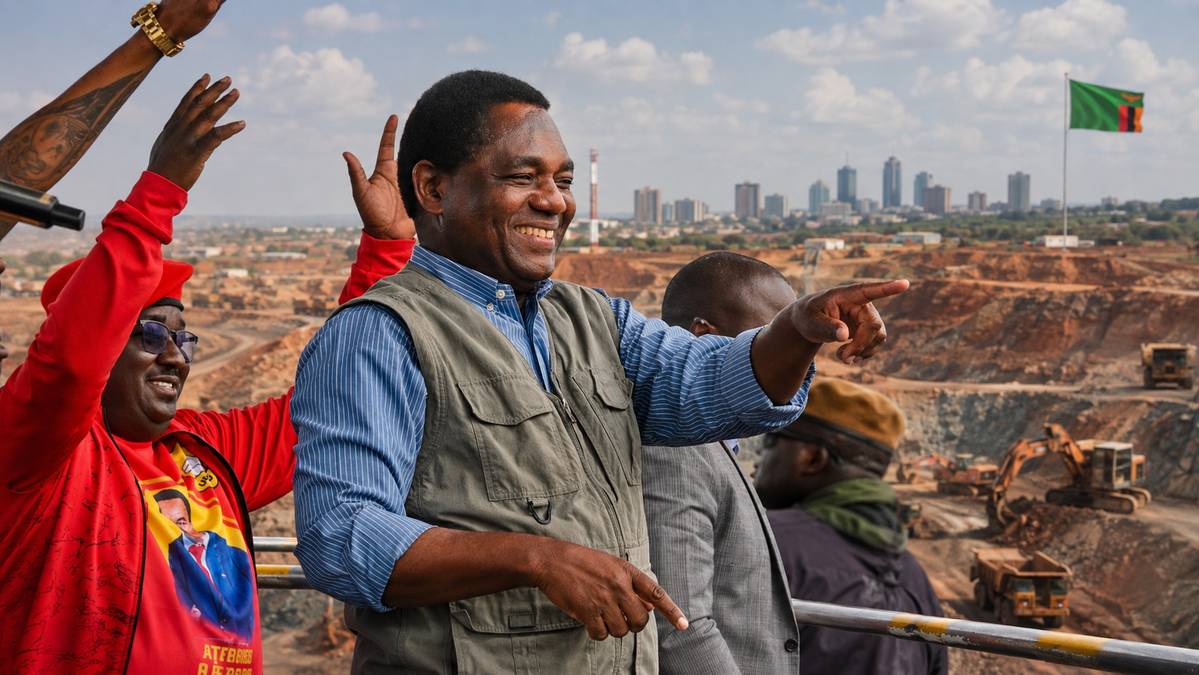
President Hakainde Hichilema has won a second five-year term in Zambia, putting the country’s copper industry at the centre of his next economic chapter.
With Zambia seeking to dramatically increase copper production while attracting billions of dollars in new mining investment, the bigger question is no longer simply how much copper the country can produce, but who will own the mines, capture the profits and benefit from the wealth beneath Zambian soil.
A second term built around copper
Hichilema’s victory gives his administration another five years to pursue an economic strategy built around investment, debt management and mineral production.
The 2026 election was closely watched by investors because Zambia has emerged from a severe debt crisis while simultaneously becoming one of Africa’s most important destinations for critical-mineral investment.
The country is Africa’s second-largest copper producer and copper remains central to its exports, government revenues and economic prospects. Reuters reported before the election that copper accounted for about 70% of Zambia’s export earnings and more than 10% of gross domestic product.
Official results showed Hichilema securing roughly 61% of the vote, comfortably ahead of his main challenger Brian Mundubile. The result gives the president a renewed mandate, but also leaves him facing the same economic question that dominated the campaign: how can Zambia turn mineral wealth into broader prosperity?
The copper prize
Zambia’s copper story is becoming larger.
The country produced 890,346 tonnes of copper in 2025, according to mining-sector data reported in 2026, marking a significant recovery in output. The government has been targeting production of more than 1 million tonnes and has set an even more ambitious long-term goal of around 3 million tonnes a year by 2031.
That ambition comes at a potentially favourable moment.
Copper is increasingly important to the global energy transition. Electric vehicles, power grids, renewable-energy infrastructure, data centres and other technologies require large quantities of the metal.
For Zambia, this creates an opportunity that goes beyond simply exporting another commodity.
The country could become an important supplier of a mineral increasingly viewed as strategically important by the United States, China, Europe and other major economies.
But the opportunity also raises a fundamental question for Hichilema’s second administration: will Zambia remain primarily a producer and exporter of copper, or can it capture more of the value created after the ore leaves the mine?
Who owns Zambia’s copper?
This is where the Who Owns Africa question becomes important.
Zambia’s copper industry is not controlled by one company. Instead, major operations are spread among international mining companies and Zambian state interests.
First Quantum Minerals is one of the biggest players. Its Kansanshi copper-gold mine is 80% owned by First Quantum, with the remaining interest held by ZCCM Investments Holdings, a Zambian state-controlled company. First Quantum also owns 100% of the Sentinel copper mine.
Kansanshi has become particularly important because its S3 expansion was commissioned in 2025. The project represents an investment of about $1.25 billion and is designed to significantly expand processing capacity.
Sentinel is another major operation. First Quantum says the mine represents a $2.1 billion investment and is one of the largest infrastructure investments in Zambia’s modern history.
The result is a complicated ownership structure. International companies provide capital, technology, management and access to global markets, while the Zambian state retains interests in some strategically important assets.
The challenge is ensuring that the economic benefits extend beyond dividends, taxes and royalties.
Foreign capital, Zambian wealth
Hichilema has made attracting foreign investment a central part of his economic strategy.
That approach reflects a practical reality. Expanding Zambia’s copper industry requires enormous amounts of capital, modern equipment, technical expertise and infrastructure.
The government cannot easily finance a transformation to 3 million tonnes of annual production on its own.
Foreign mining companies therefore have an important role to play.
But foreign ownership also creates a familiar African dilemma.
Countries rich in natural resources can generate billions of dollars in exports while communities surrounding mines continue to complain about unemployment, environmental damage, inadequate infrastructure and limited economic opportunities.
That tension was visible during the election campaign, when economic growth and mining investment competed with concerns over the cost of living and whether ordinary Zambians were benefiting sufficiently from the recovery. Reuters reported that although the economy had improved, cost-of-living pressures remained a major concern for voters.
For Hichilema, the next five years will therefore be judged not only by how much investment enters Zambia, but by what that investment produces for citizens.
The value-addition question
The biggest opportunity may lie beyond mining.
For decades, African mineral economies have largely exported raw or semi-processed resources and imported higher-value manufactured products.
Copper provides Zambia with an opportunity to change that model.
Instead of focusing exclusively on increasing tonnes mined, Zambia could seek greater investment in refining, processing, manufacturing and copper-based industries.
The country already has important processing capabilities. First Quantum’s Kansanshi operation includes a copper smelter, allowing more processing to take place inside Zambia. The company says the smelter has helped optimise the value of copper produced at the operation and created specialist employment.
The bigger ambition would be to develop an ecosystem around copper.
That could include equipment manufacturing, engineering services, electrical components, cables, construction materials and other industries linked to mining and energy.
Such a strategy could create more jobs and businesses than mining alone.
Power is a critical risk
Copper expansion will require reliable electricity.
Zambia’s dependence on hydropower has exposed the economy to severe risks during droughts. Power shortages have previously disrupted mining operations and forced companies and households to rely on alternative sources of electricity.
This makes energy infrastructure one of the most important issues for Hichilema’s second term.
If Zambia wants to produce millions of tonnes of copper annually, it will need dependable and increasingly diversified electricity supplies.
That means investment in hydropower rehabilitation, solar generation, transmission infrastructure and potentially other forms of power generation.
Without sufficient electricity, new mines can be built faster than the infrastructure required to operate them.
Zambia in the global minerals race
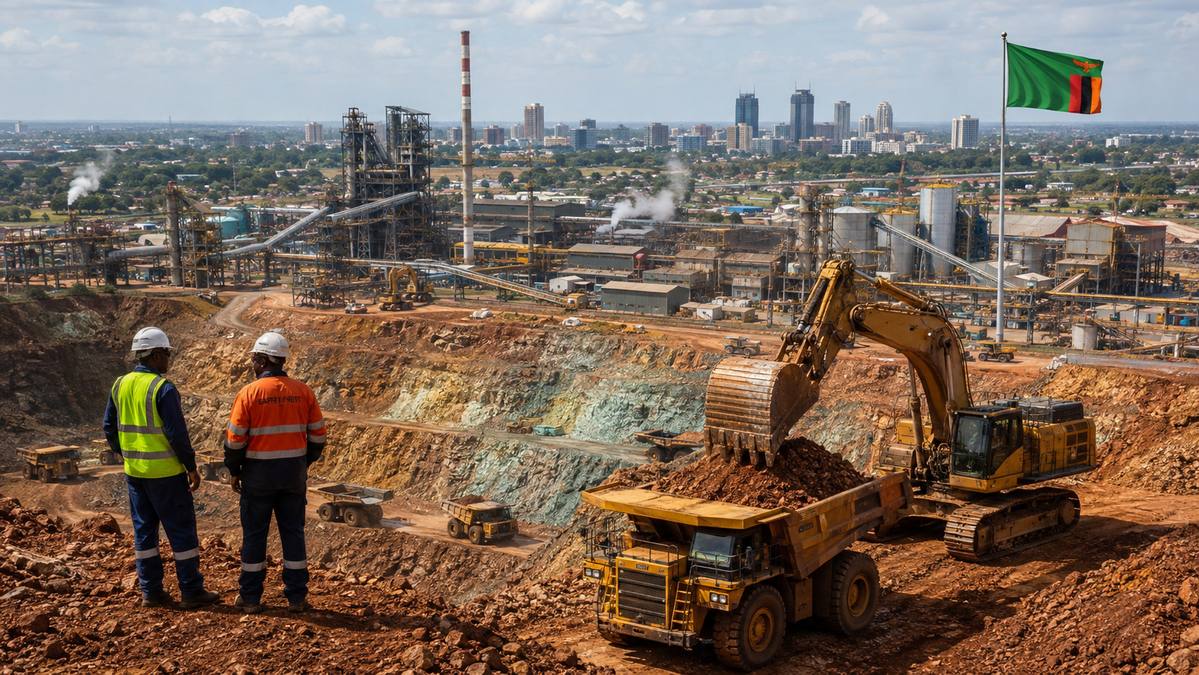
The stakes extend beyond Zambia.
The United States and China are competing for influence over Africa’s critical-mineral supply chains, while European and other international investors are looking for alternative sources of minerals needed for energy and industrial technologies.
Zambia’s geographical position also gives it potential importance in regional mineral corridors connecting the Copperbelt to ports and international markets.
That competition could strengthen Zambia’s bargaining position.
Hichilema’s government can use the growing international demand for copper to negotiate investment that delivers more than extraction.
The objective should be long-term partnerships that build infrastructure, skills, supply chains and domestic businesses alongside mining capacity.
The debt lesson
Zambia’s recent debt crisis provides another reason for caution.
The country defaulted on its sovereign debt in 2020 before entering a lengthy restructuring process. Hichilema’s first term focused heavily on restoring relations with international lenders and stabilising the economy.
A copper boom could provide valuable fiscal breathing room.
But commodity prices are volatile.
A government that becomes too dependent on high copper prices could find itself vulnerable when global demand weakens or prices fall.
The more sustainable strategy is therefore to use mining revenues to diversify the economy rather than deepen dependence on copper.
The real test begins now
Hichilema’s re-election gives Zambia political continuity at a crucial moment for the mining industry.
Investors are likely to welcome the continuation of policies that helped attract mining capital and improve relations with international lenders. But citizens will expect tangible results.
The government’s challenge is to turn record or rising copper production into better roads, electricity, schools, jobs, businesses and public services.
That requires stronger local participation in mining supply chains, transparent taxation, effective regulation and careful management of mineral revenues.
Zambia does not need to choose between foreign investment and national ownership.
It needs a model in which international capital can earn competitive returns while Zambia captures a greater share of the economic value generated by its resources.
That is the real significance of Hichilema’s second term.
The copper beneath Zambia’s soil belongs to the country. The question is how much of the wealth created from it will remain in Zambia.
For Africa, the answer could become a model for the next generation of resource economies.

More from Elections

Libya’s 24-month election deal: Who really stands to own the country?
Libya’s election roadmap promises political unity, but control of guns, oil, money and foreign alliances may decide who holds power.
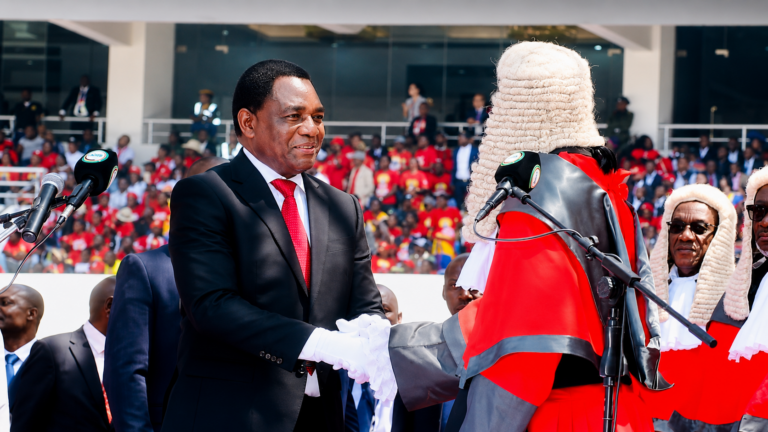
Zambia’s second Hichilema term begins under shadow of election dispute
Zambia’s president begins another five-year term as opposition arrests and election concerns raise fresh questions about the country’s democratic trajectory.